You know the moment. You write alliteration on the board, offer a cheerful example, and half the class looks politely unconvinced while the other half starts shouting tongue twisters. Someone asks whether “city” and “cat” count. Someone else insists it's just “words with the same first letter.” And suddenly a quick mini-lesson has turned into a sound-vs-spelling debate before first period has fully settled.
That's usually when I stop treating alliteration like a definition to memorize and start treating it like a sound pattern students can hear, test, and use. Once they hear it, they get it. Once they use it in their own writing, they remember it.
Bringing Literary Devices to Life
A few years ago, I watched a class perk up over alliteration only after we left the textbook behind. We were reading a poem, and the room felt flat. Then I asked students to underline words that seemed to “tap” against each other when read aloud. Suddenly they were leaning in, repeating lines, and arguing over which sound pattern was strongest. The device hadn't changed. The entry point had.
That's one reason I like teaching alliteration early and revisiting it often. It feels playful, but it opens the door to bigger conversations about sound, rhythm, emphasis, and author choice. Students can spot it in a silly sentence one day and discuss its effect in a speech or poem the next.
Alliteration isn't a made-up school exercise. It's an ancient poetic device, and scholars have treated it as an important structural feature in literature across time, as discussed in historical scholarship on alliteration in classical verse.
That historical piece matters more than it might seem. It helps us frame alliteration as part of a long tradition of writers shaping language for the ear, not just the eye. When students realize the same device appears in classical poetry, modern speeches, and the catchy phrases they already know, the lesson starts to feel relevant.
What helps students care
In my classroom, engagement rises when students can answer three simple questions:
- What is it: A repeatable sound pattern.
- Why use it: To create rhythm, emphasis, and memorability.
- Where do I see it: In poems, stories, speeches, titles, slogans, and student writing.
If you're looking for an example of alliteration to build a lesson around, don't start with the trickiest one. Start with a phrase students can hear immediately. Then move to the gray areas. That sequence saves a lot of confusion later.
Decoding Alliteration Beyond the Dictionary
The biggest misconception is also the most common one. Students think alliteration is about matching letters. It isn't.
Core rule: Alliteration is the repetition of the same initial consonant sound in nearby words.
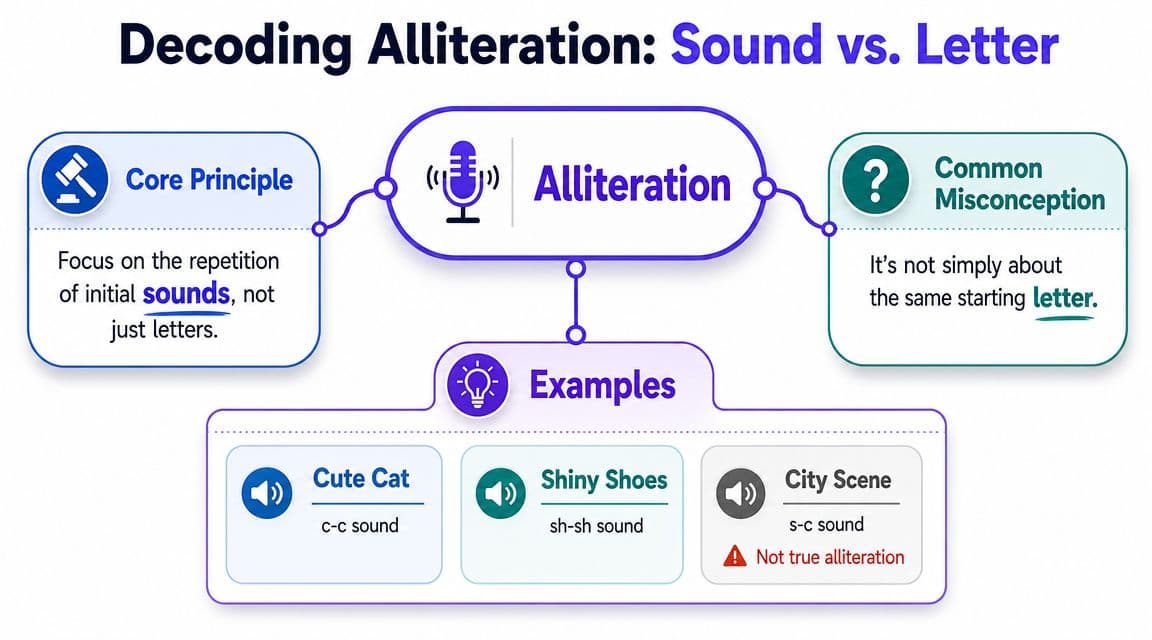
That distinction matters because it changes how we teach it. If students only scan for matching first letters, they'll miss real examples and accept false ones. Educational writing guides stress that teachers need to focus on repeated sounds, not letters, especially when students hit confusing edge cases, as explained in Grammarly's guide to alliteration.
Sound first, spelling second
Try these with students out loud:
- Tasty tacos counts because both words begin with the same initial sound.
- Kitchen cookie can count because the opening sound matches even though the letters differ, a point highlighted in Ereading Worksheets' explanation of alliteration.
- Thirty typists is a useful non-example because the starting letters may look related, but the initial sounds are not the same.
- City scene looks tempting on paper, but the beginning sounds don't match in the way students often assume.
Why writers use it
Alliteration isn't only decorative. It shapes how a line lands in the ear. When repeated sounds sit close together, especially in stressed positions, they create a noticeable pulse that strengthens cadence and emphasis, as described in LitCharts' discussion of alliteration and sound patterning.
That's why students often remember alliterative phrases so quickly. The line has a beat.
A classroom test that works
When students ask, “Does this count?” I use a short routine:
- Say the phrase aloud
- Listen for the starting sound
- Check that the words are close together
- Ignore spelling if the sound matches
- Decide whether the repetition is clearly audible
That routine turns alliteration from a guessing game into something students can verify.
Alliteration in Action Examples for Every Grade
The fastest way to build confidence is to put strong examples next to near-misses. Younger students need obvious patterns they can hear right away. Older students can handle subtler examples and discuss effect, not just identification.
One reason this device stays useful across grade bands is that it doesn't live only in poetry. Teaching resources note that alliteration also appears in marketing slogans, speeches, and branding because repeated sounds help make language more memorable and rhythmic, which gives us plenty of real-world material for students to analyze in class, as noted in ClickView's classroom ideas for alliteration examples.
Alliteration examples by grade level
| Grade Level | Example Type | Example |
|---|---|---|
| K to 2 | Simple phrase | Silly snakes slither silently. |
| K to 2 | Animal image phrase | Busy bees buzz. |
| 3 to 5 | Descriptive sentence | Wild winds whisked the leaves. |
| 3 to 5 | Food phrase | Crispy cookies crumbled. |
| 6 to 8 | Character line | Brave Benny battled big bears. |
| 6 to 8 | Narrative sentence | The summer sun sizzled softly. |
| 9 to 12 | Literary line | From forth the fatal loins of these two foes. |
| 9 to 12 | Analytical model | The repeated sound sharpens the line's intensity. |
| Any grade | Branding example | PayPal |
| Any grade | Title or slogan style | Movie night madness |
What to choose for different learners
For primary students, I stick with concrete nouns and strong sound repetition. Animals, weather, food, and classroom objects work well because students can picture them.
For upper elementary and middle school, I like examples that add action:
- Raging rivers rushed
- Students studied
- Bouncing balls boomed
By high school, the question changes from “Can you find it?” to “Why did the writer use it here?” That's where literary lines and speech excerpts become more useful than tongue twisters.
The best example is the one students can hear first and analyze second.
If you want a quick practice page for identification before students write their own, I'd use an alliteration recognition worksheet as a short warm-up, especially when the class still confuses sound with spelling.
Proven Strategies for Teaching Alliteration
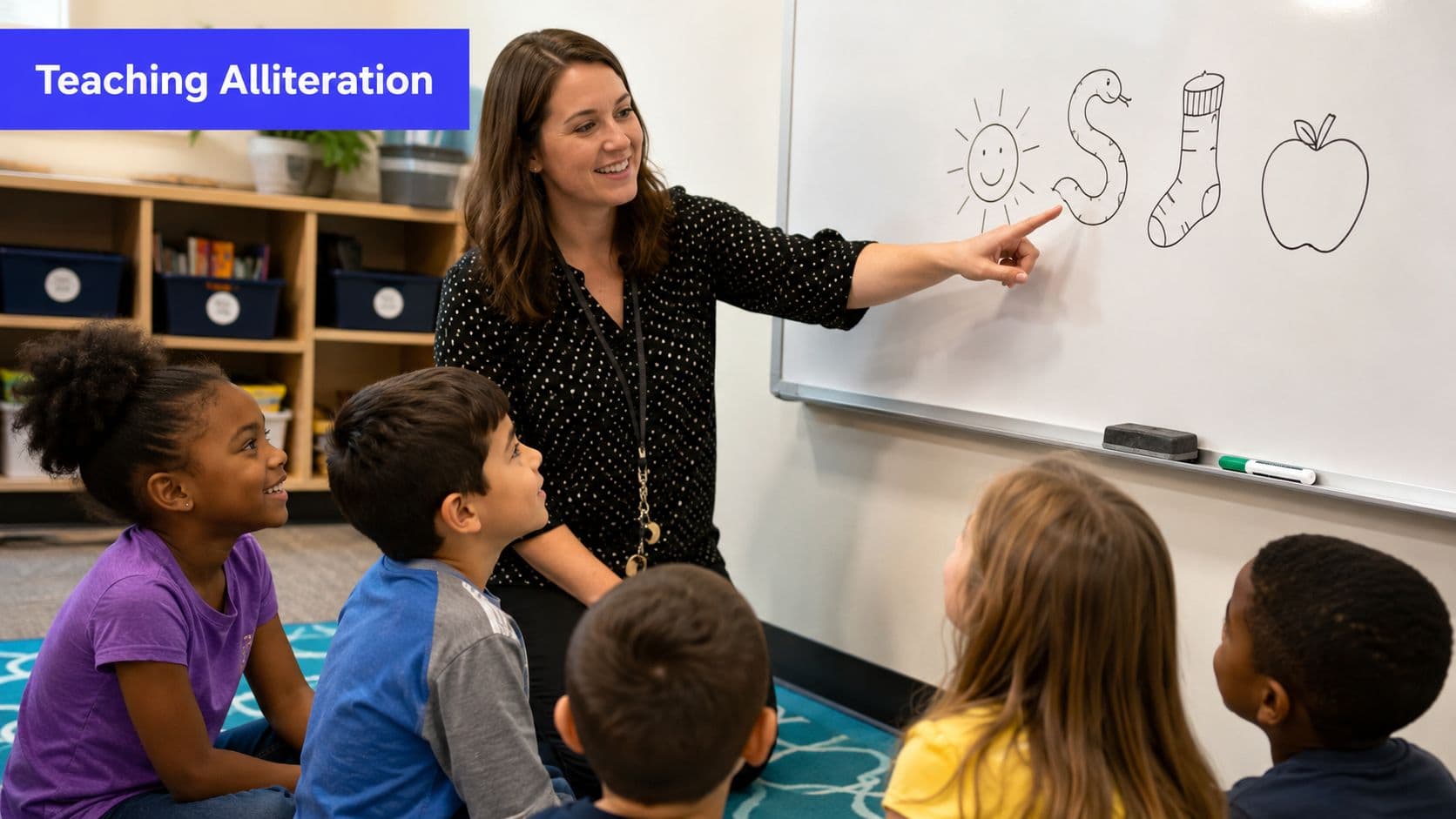
A good alliteration lesson often starts the same way. One student spots matching letters, another hears the repeated sound, and a third insists that “phone” and “photo” count because they both start with p h. That small moment tells you what to teach next.
Students need a sequence they can hear, test, explain, and then use in their own writing. I treat alliteration like basketball shooting form. If the setup is shaky, the final product is shaky too. Strong instruction begins with sound, then moves to meaning, then turns into purposeful writing.
Start with oral language and sound sorting
I begin with quick listening rounds before students ever pick up a pencil. Say two options aloud and ask, “Which one repeats the beginning sound more clearly?” That keeps attention on what students hear, not what they see on the page.
Good opening pairs might be:
- Funny frogs vs. green frogs
- Big blue balloon vs. bright kite
- Silent snow vs. snowy hill
That oral work supports the phonological awareness skills that sit underneath later reading and writing, a point the International Literacy Association addresses in its discussion of phonological awareness and literacy.
One caution helps here. Students often confuse repeated letters with repeated sounds. “City cat” does not give the same effect as “cool cat,” even though both words begin with c. I say the pair aloud, stretch the opening sound, and let students judge with their ears.
Move from finding it to explaining its job
Once students can identify alliteration, the lesson gets more interesting. Ask what the repetition adds.
That question changes the task from a scavenger hunt into interpretation.
Students usually notice the effect faster when you give them choices. Does the repeated sound make the line feel playful, harsh, calm, quick, or memorable? A simple menu like that helps reluctant writers explain sound without getting stuck on abstract vocabulary.
A classroom progression that works well looks like this:
- Hear it in a short phrase.
- Mark it in a sentence or passage.
- Say the repeated sound aloud.
- Describe the effect on rhythm, mood, or emphasis.
- Use it in a sentence with a clear purpose.
When I want students to review directions before class and save discussion time for practice, I sometimes borrow tips for flipped classrooms and send a short video model or audio example ahead of time.
A brief visual explanation can help at that point:
Teach alliteration as a writing choice, not a trick
Students grow faster when they see that alliteration is not just “three words with the same letter.” Writers use it to make a phrase stick, sharpen a tone, or give a sentence more rhythm. That is the shift from worksheet thinking to craft thinking.
For younger students, I limit the task. One strong phrase is enough. For upper grades, I ask students to revise a plain sentence into one that uses alliteration on purpose. “The rain hit the roof” becomes “Rapid rain rattled the roof.” Then we compare versions and ask which sounds stronger and why.
This is also where classroom tools can save time. If you are building review stations or homework, a mixed figurative language practice worksheet helps students sort alliteration from other devices instead of memorizing it by itself. If you use AI to generate extra practice, keep the prompt tight: grade level, target sound, sentence length, and whether students are identifying, revising, or creating examples.
Pair alliteration with nearby sound devices
Older students benefit from comparison. Once they can hear alliteration reliably, place it next to assonance and consonance and ask them to defend their choices with evidence from the line.
That comparison clears up a lot of confusion.
It also prepares students for real reading. Authors rarely isolate one device at a time, and our instruction should reflect that. A short sort, a quick annotation task, or a revision exercise usually teaches more than another round of definition matching.
Fun Alliteration Activities for Your Classroom
Practice is where alliteration stops being a definition and becomes a writing tool. The activities below are low-prep, flexible, and easy to scale up or down.
Quick wins for any grade
Alliterative headlines
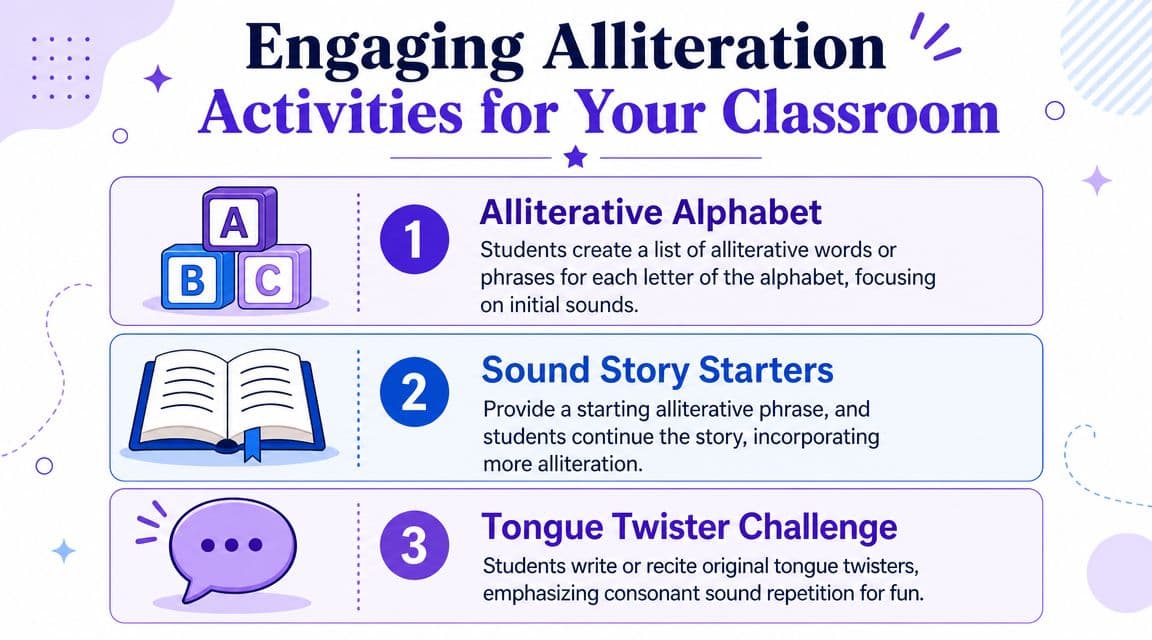
Give students a plain news event or story summary, then ask them to turn it into a catchy headline. “Storm hits school” becomes “Sudden storm surprises school.” This pushes them to hear repeated sounds while thinking about audience.Tongue twister challenge
Pick one consonant sound and have students write a short original tongue twister. Keep the goal small. One line is enough. The learning payoff is strong because students hear very quickly whether the sound pattern holds.Picture caption race
Show an image and ask for one alliterative caption. This works well for early finishers and for classes that need a fast, active warm-up.
Activities that build writing stamina
For longer practice, I like tasks that mix choice with structure.
Sound story starters work well in upper elementary and middle school. Give students a phrase like “Misty morning market” or “Brave brother boarded” and let them continue with a short paragraph.
Character naming is another favorite. Students invent a character whose name and defining trait share an opening sound, then write a description. That helps them see how alliteration can shape tone and memorability.
If students can create one strong phrase, they can usually build a sentence. If they can build a sentence, they can start using the device intentionally in larger pieces.
A practical way to prep less
When you want students writing rather than waiting for handouts, a tool that generates prompts can save time. Kuraplan's writing prompt generator is one option for creating themed prompts and worksheet-ready tasks for activities like alliterative poems, character creation, or caption writing.
I still keep a simple rule on the board during these activities: same starting sound, nearby words, say it aloud. That reminder cuts down on most errors before they spread.
How to Assess Alliteration Mastery
Assessment doesn't need to be a quiz full of isolated terms. I get better evidence when students have to identify, explain, and create.
Fast formative checks
These are easy to use at the end of a lesson:
- Exit ticket
Ask students to write one original example of alliteration about a topic you studied that day. - Non-example sort
Give three phrases. Students circle the one that is not true alliteration and explain why. - Read-aloud check
Students say their phrase to a partner, who confirms whether the opening sound really repeats.
Rubric-friendly summative options
In a poem, paragraph, or speech assignment, I include one short criterion for sound devices. Not “used alliteration perfectly,” but something more useful:
- Uses repeated initial sounds intentionally
- Creates an audible pattern the reader can hear
- Chooses sound to support tone or emphasis
That wording encourages application. It also keeps students from stuffing alliteration into every sentence just to prove they know the term.
If you're trying to move quickly from lesson to check-for-understanding, Kuraplan can help generate standards-aligned quizzes, worksheets, and rubrics from lesson content. I'd use it for a short mastery check, then adjust the next lesson based on the errors students made.
Common Questions Teachers Ask About Alliteration
A student writes “giant giraffe” and proudly calls it alliteration. Another writes “phone fish” and hesitates. That moment tells you what many students are sorting out. They are not just learning a definition. They are learning to hear language.
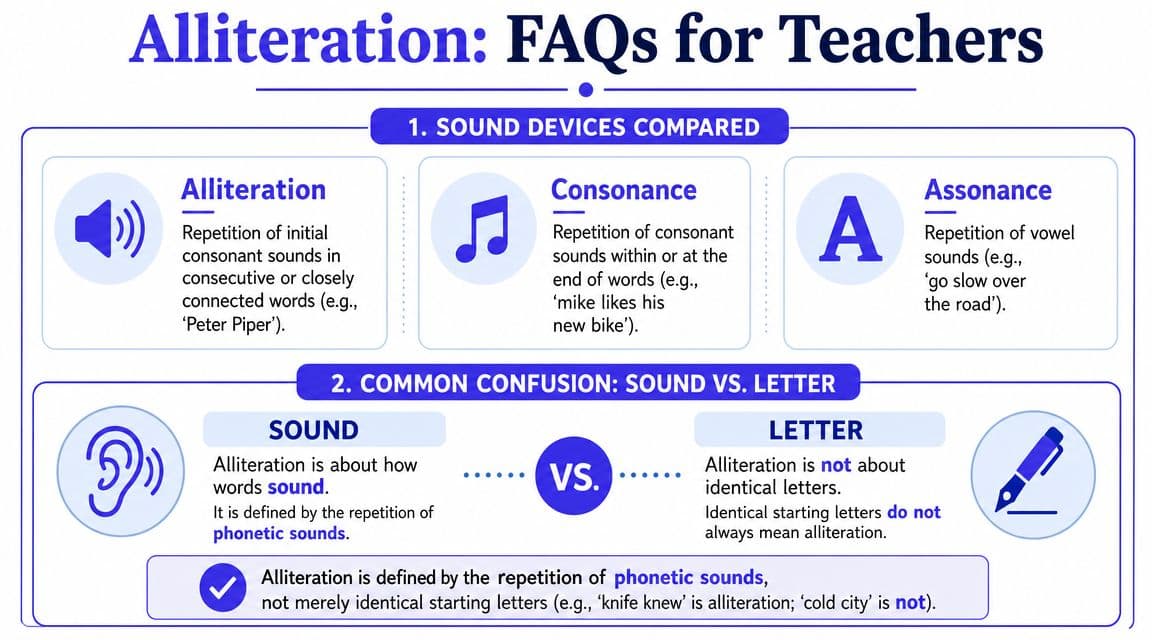
Is alliteration about letters or sounds
It is about sounds.
That distinction clears up a lot of confusion. Students often assume matching first letters automatically creates alliteration, but the ear is the true test. Cat and kite can work because they begin with the same /k/ sound. Giant and giraffe usually do not, because their opening sounds differ.
A good classroom shortcut is this: have students cover the word and say it aloud first. Alliteration works more like music than spelling. If the beginning sounds echo each other, the phrase is doing the job.
If you want a teacher-friendly reference for that sound-based definition, the Poetry Foundation's glossary gives a clear explanation of alliteration as repeated consonant sounds at the beginning of words: Poetry Foundation glossary entry on alliteration.
How is it different from consonance and assonance
Students mix these up because all three depend on repeated sound. I teach them by location.
| Device | What repeats | Where students hear it most clearly | Simple example |
|---|---|---|---|
| Alliteration | Initial consonant sounds | At the beginning of nearby words | wild winds |
| Consonance | Consonant sounds | Inside words or at the end | blank think |
| Assonance | Vowel sounds | In the stressed vowel sound | slow road |
Location helps. If the repeated sound shows up right at the start, students should check for alliteration first. If the echo happens later in the word, they are usually hearing consonance or assonance instead.
What should I tell students when they're unsure
I keep the coaching language short enough to use during conferences or share on an anchor chart:
- Say the words aloud.
- Listen for the opening sound.
- Ignore spelling for a moment.
- Check whether the words are close together.
- Ask whether the repetition sounds noticeable to a listener.
That last question matters because students often over-label. They hear one repeated consonant somewhere in a sentence and want to count it. I tell them alliteration should be easy to hear, the way a clap pattern is easy to follow. If the pattern feels faint or accidental, it probably is.
For planning, this is also where AI can save time. Kuraplan can turn a short lesson on sound devices into practice items, sorting tasks, and quick reteach sheets, which helps when you need different versions for different grade levels without building every page from scratch.
If you want a faster way to turn literary devices lessons into worksheets, prompts, visuals, and assessments, Kuraplan is built for that kind of classroom prep. It's especially useful when you want students practicing a concept like alliteration in different formats without spending your planning period formatting everything by hand.