You're probably teaching atoms again this week, and at least a few students are about to ask some version of the same question: “How do we know what an atom looks like if nobody can see one?”
That's the core teaching problem. Not the vocabulary. Not the worksheet. The problem is that atomic structure definition sounds simple on paper and feels slippery in the room. Students hear “protons, neutrons, electrons” and nod along, but many still picture a tiny solid ball or a neat little solar system that never changes.
When I help new teachers plan this topic, I don't start with the diagram. I start with the fact that students need a mental model they can hold onto, then revise as they get older. If you treat atomic structure as a memorization unit, they forget it fast. If you teach it as a model that gets sharper over time, it sticks.
How to Teach a Concept Students Cannot See
The atom is hard to teach because students can't touch it, can't watch it happen, and can't compare it to everyday experience without some support. That's why your delivery matters more here than with many other science topics. You're not just giving a definition. You're building a ladder students can climb.
Start with what students can handle
In elementary grades, “all matter is made of tiny building blocks” is enough. In middle school, students are ready for parts of the atom and basic charge. In high school, they can handle the idea that our classroom diagrams are useful models, not literal photographs.
That gradual build is one reason how scaffolding enhances learning matters so much with this topic. Students need the first model to be simple enough to use, but not so oversimplified that it causes confusion later.
Teach the version students can successfully use today, then name what will need updating later.
Use routine and repetition
I've learned this works well:
- Begin with a one-sentence anchor: “An atom is a tiny unit of matter with a center called a nucleus and electrons around it.”
- Repeat the same visual language: center, outer region, charge, mass.
- Return to the same sketch often: even a rough board drawing helps students connect each new idea to one stable image.
- Give students something to manipulate: paper cutouts, counters, or printable tasks from science worksheets for classroom practice make the abstract feel less distant.
A lot of confusion comes from switching explanations too fast. If one day the atom is a marble, the next day a solar system, and the next day a cloud, some students think science keeps changing its mind. They need to hear that models are tools. Each one helps with a different part of the idea.
The Core Atomic Structure Definition
If a colleague asked me for the cleanest classroom-ready wording, I'd give them this:
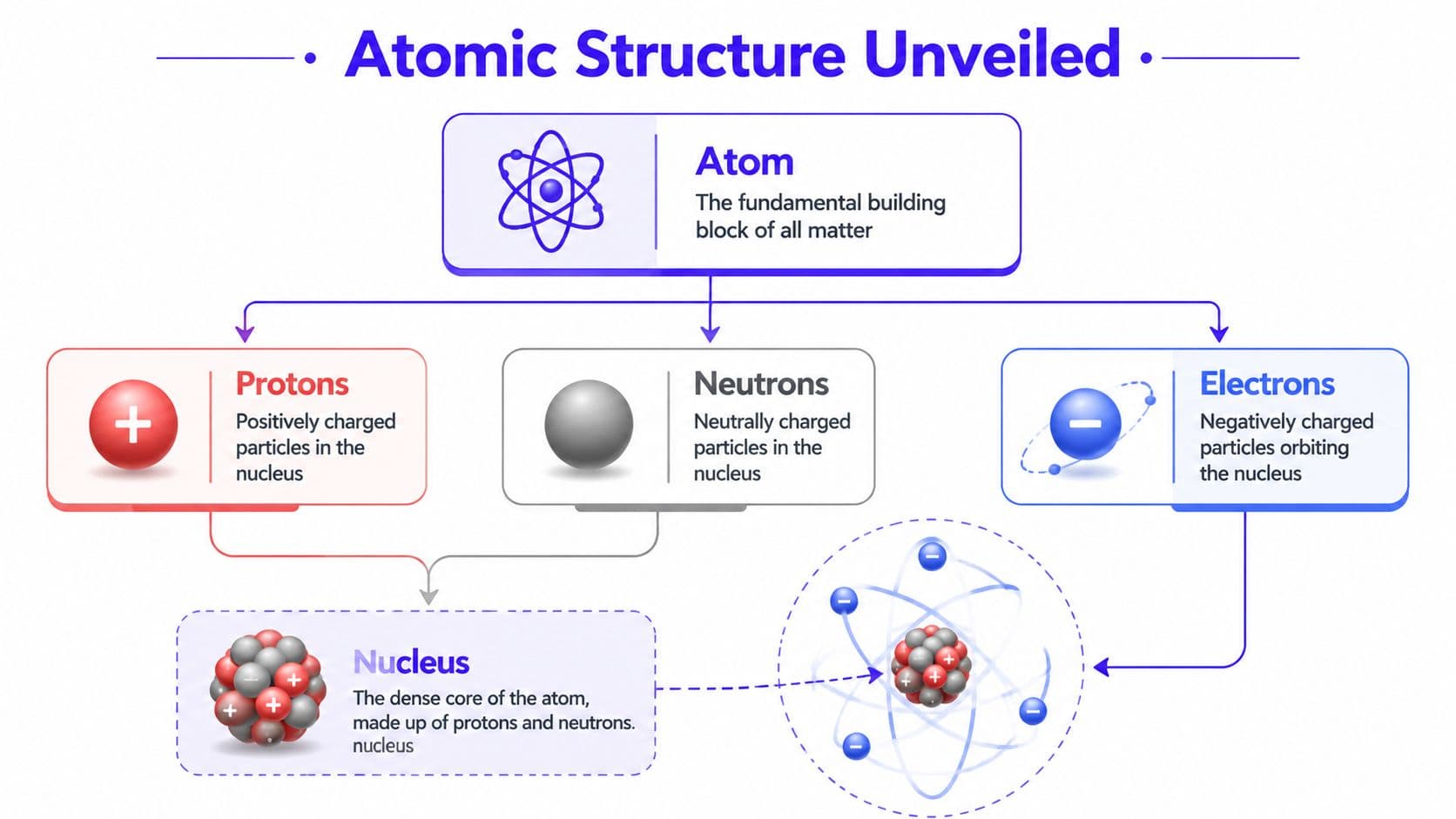
Atomic structure is the arrangement of the particles inside an atom. An atom has a central nucleus containing protons and neutrons, with electrons in the space around the nucleus.
That's the anchor definition. Then I unpack it slowly.
A fruit analogy that younger students actually remember
I often use a peach or plum. The pit stands in for the nucleus. The area around it stands in for where electrons are found. It isn't a perfect analogy, but it gives students a center and an outside region, which is what they need first.
Here's the part worth saying out loud: analogies help students get started, but none of them is the atom itself.
The three main particles
A short table helps students separate the jobs of each part:
| Particle | Where it is | Charge | What students should remember |
|---|---|---|---|
| Proton | In the nucleus | Positive | Helps define the atom's identity |
| Neutron | In the nucleus | Neutral | Adds mass and can vary in atoms of the same element |
| Electron | Around the nucleus | Negative | Affects charge and chemical behavior |
For most K to 8 lessons, that's enough detail. In upper grades, I add that electrons are often shown in shells or energy levels because that picture is useful for teaching, even if it's simplified.
A script you can actually say
Try something like this:
Practical rule: “The nucleus is the crowded center. Protons and neutrons live there. Electrons are outside that center, and they're the part we usually talk about when atoms react.”
Students usually mix up location before they mix up charge. So I teach location first, then charge, then function.
A few classroom moves help:
- Color-code consistently. Keep proton, neutron, and electron colors the same every time.
- Point to the center every time you say nucleus. The physical gesture helps.
- Ask quick checks instead of long explanations. “Which particle is negative?” “Which two are in the nucleus?”
If they can answer those quickly, you've built the base. Everything else in the unit rests on that.
From Plum Puddings to Electron Clouds
Students often think science arrives fully finished in a textbook. Atomic theory is a good place to show that it doesn't. Our definition of the atom changed as scientists gathered better evidence.
Tell it like a sequence of better guesses
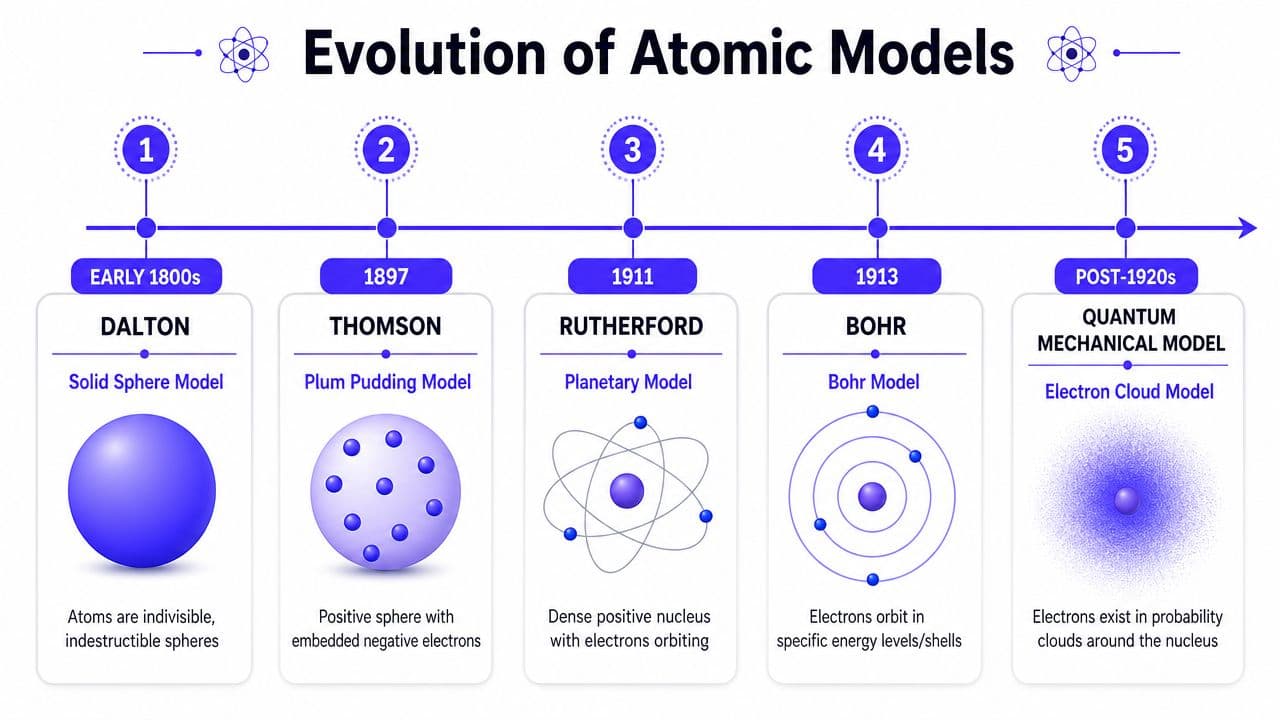
Start with John Dalton, who formalized atomic theory in 1808. At that stage, atoms were treated as solid, indivisible units. Later, in 1897, J. J. Thomson showed atoms were not indivisible after all, which pushed science toward a structural definition of atoms as made of smaller parts, as outlined in the history of atomic theory.
That historical turn matters for teaching. It gives students permission to revise their own thinking. They see that changing your model because of evidence isn't failure. It's science.
The models students usually meet
I frame the models as classroom tools with different strengths:
- Dalton's model works for the big idea that matter is made of tiny units.
- Thomson's plum pudding model helps students see that people once tried to fit electrons into the picture in a new way.
- Rutherford's model introduces a dense center.
- Bohr's model gives beginners a manageable way to think about shells or energy levels.
- The electron cloud model gets closer to modern scientific understanding.
Students like the detective-story feeling of this. One model solves one problem, then creates another question.
What to say about Bohr without causing a mess
The Bohr model is still useful. It helps students organize electrons in early chemistry and it gives them something visible to draw. But students need one sentence of caution:
The Bohr picture is a teaching model, not a literal tiny solar system.
That simple line prevents a lot of later confusion.
A quick comparison you can use on the board
| Model | What it helped explain | What it leaves out |
|---|---|---|
| Solid sphere | Matter is made of atoms | Internal structure |
| Plum pudding | Atoms include smaller particles | Dense nucleus |
| Bohr model | Shells or energy levels | Real electron behavior |
| Electron cloud | Electrons aren't fixed on neat tracks | Harder for beginners to visualize |
When students understand that models are revised, the modern atomic structure definition makes more sense. It becomes a current best explanation, not a cartoon they're supposed to memorize forever.
Making It Concrete with Analogies and Examples
Lessons either click or drift. Students need something concrete enough to picture, but you have to choose the analogy that fits their age.
For elementary students
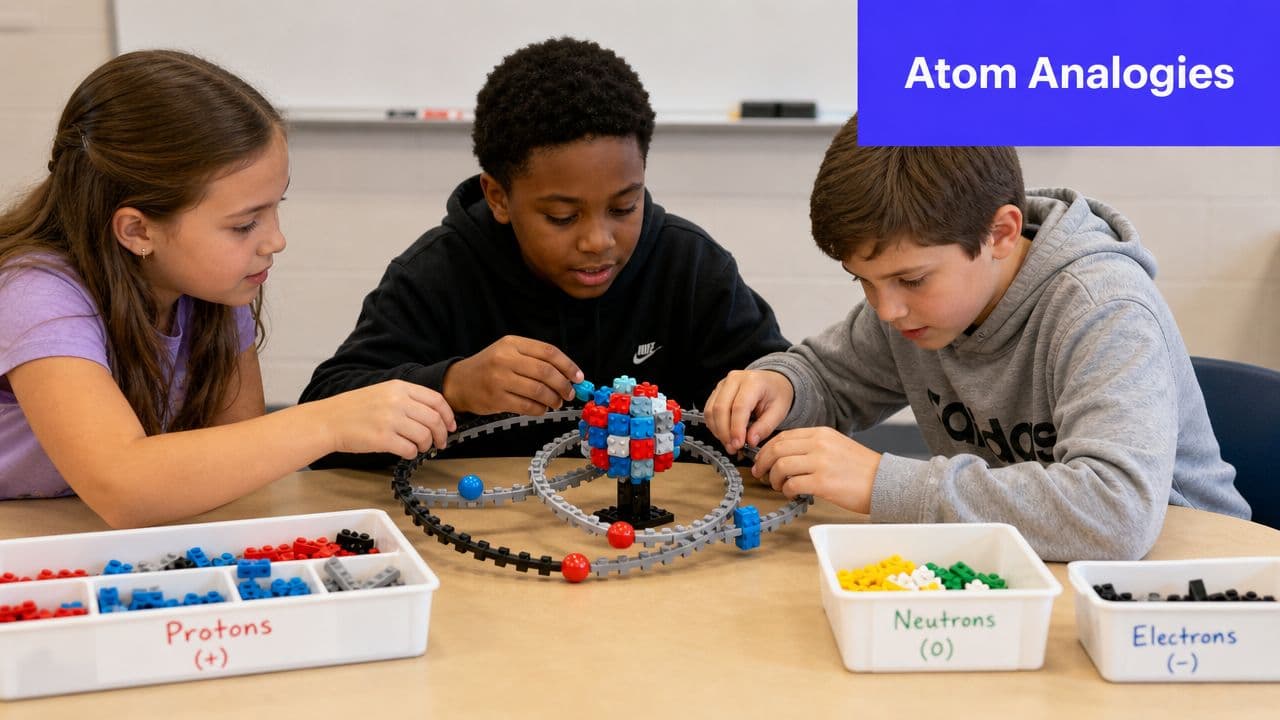
Use LEGO bricks or building blocks. Not to model exact atomic structure, but to show the idea that tiny parts build bigger things. Kids understand construction. They know lots of different objects can come from small repeated pieces.
To put it plainly: matter is built from tiny units, and atoms are among those basic units.
For middle school students
The solar system analogy can help, as long as you label it as partial. Students can understand a center and outer parts. That's useful when they're first meeting the nucleus and electrons.
This is also a good time to create a memorable scale moment. Rutherford's work in the 1910s supported the nuclear model, showing that atoms have a tiny, dense nucleus. A classroom chemistry source notes the nucleus is typically less than one ten-thousandth the size of the atom while containing more than 99.9% of its mass in the atomic structure history summary at LibreTexts.
That's the “wow” fact many students remember.
Most of the atom is space, but most of its mass is packed into the nucleus.
For high school students
High schoolers can handle more careful language. I stop saying electrons “orbit like planets” and shift to shells, energy levels, and models. They're also ready to compare what a simplified diagram shows versus what scientists mean.
A worksheet like this periodic table properties practice page can help students connect atomic structure to the periodic table once they've built the basic model.
After students have a mental picture, a short visual explanation can help settle the vocabulary:
Which analogy fits which grade
- Early grades: building blocks
- Middle school: nucleus plus outer electrons using a carefully limited solar system picture
- High school: diagrams as models, not literal snapshots
The mistake isn't using analogies. The mistake is forgetting to retire or revise them when students are ready for more.
Clearing Up Common Student Misconceptions
This part saves time later. If you don't tackle misconceptions early, they show up in every worksheet, every quiz, and every class discussion.
Misconception one. Atoms are tiny solid balls
Students often hear “matter is made of atoms” and picture atoms as hard little beads. That image is simple, but it causes trouble. It makes it harder for them to understand why electrons matter, why charge can change, and why simplified drawings are only models.
A better line is: atoms have structure. They are not just featureless specks.
Misconception two. Electrons move on perfect racetracks
The classroom Bohr diagram is useful, but many students think those rings are literal tracks. I usually say, “Those circles are a map for learning, not a photograph of motion.” That keeps the diagram useful without making it seem exact.
Misconception three. Element, ion, and isotope all mean the same kind of change
This is one of the biggest sticking points, and it needs very plain wording. The atomic number, which means the number of protons, defines the element. If protons and electrons are equal, the atom is neutral. Changing electrons creates ions, while changing neutrons creates isotopes, as summarized in Britannica's explanation of the atom.
A board-ready correction chart
| Student confusion | Short correction |
|---|---|
| “If it gains an electron, it becomes a new element.” | No. Changing electrons makes an ion. |
| “If neutrons change, it's a different element.” | No. Changing neutrons makes an isotope. |
| “Neutral means no particles.” | No. Neutral means protons and electrons are equal. |
“Same protons, same element” is one of the most useful lines in the whole unit.
A teaching move that works fast
Give students three quick card sorts:
- one card changes proton number
- one changes neutron number
- one changes electron number
Then ask: which card changes the element, which changes the isotope, and which changes the ion? Students usually remember the categories better after sorting than after copying definitions.
Another common confusion is thinking atoms are frozen pictures. They're not. Classroom diagrams are static because paper is static. Your language should keep reminding students that the drawing is a model, not the thing itself.
Quick Activities for Your Classroom
When students build something, atomic structure stops feeling like pure vocabulary. You don't need fancy materials.
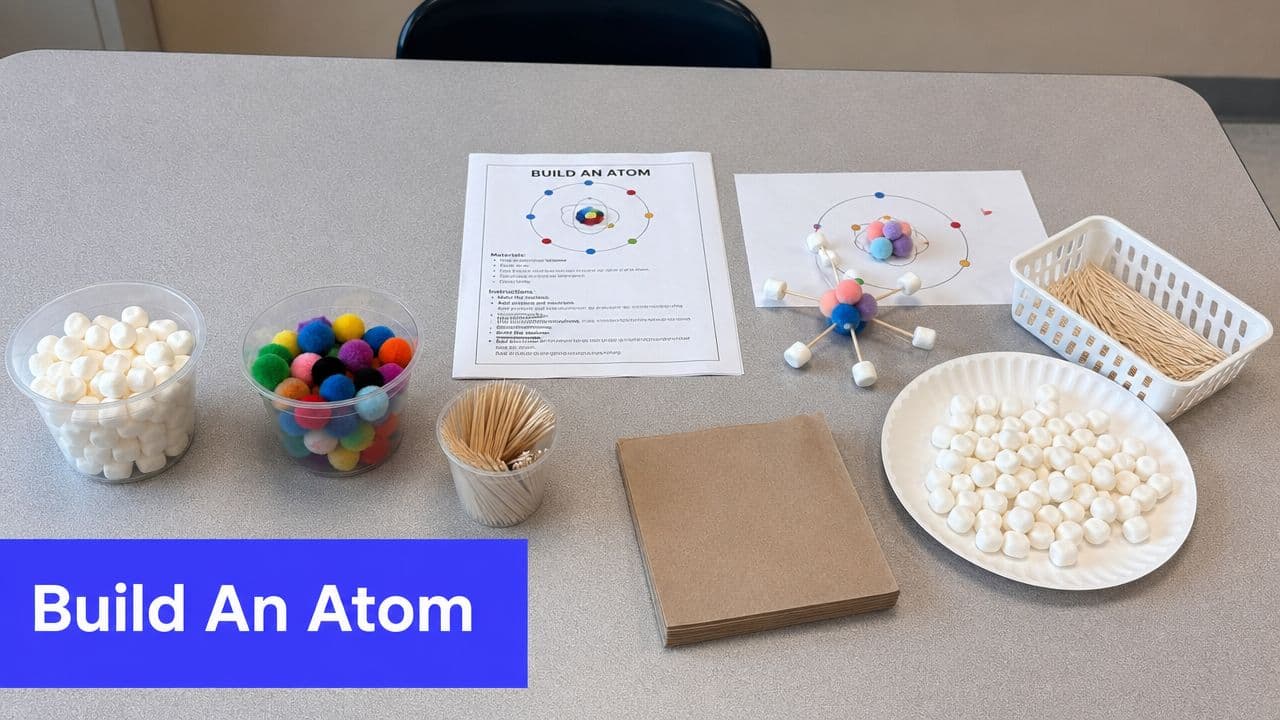
Low-prep ideas that pull their weight
- Build an atom station: Use pom-poms, marshmallows, stickers, or counters for subatomic particles. Students build one neutral atom, one ion, and one isotope.
- Periodic table scavenger hunt: Have students find atomic numbers, then use them to identify how many protons an atom has.
- Human atom model: Put a few students in the center as nucleus particles and others around them as electrons. It's simple, noisy, and memorable.
Add a written check right after the hands-on part
A tool can save time. If you want a follow-up sheet without building it from scratch, Kuraplan can generate age-appropriate worksheets, visuals, and lesson materials from a prompt such as “worksheet for carbon atom structure,” and a related resource like this valence electrons and groups worksheet fits well once students are ready to extend beyond the basic atom.
Keep the exit ticket short
Try these:
- Which particles are in the nucleus?
- What makes an atom neutral?
- What change creates an ion?
- What change creates an isotope?
If students can answer those without notes, your atomic structure definition has started to stick.
Bringing the Atomic World into Focus
Students don't need a perfect mental image of the atom on day one. They need a useful one. That's why good teaching here depends on sequence. Start simple, add structure, correct the biggest misconceptions, and use models as stepping stones rather than final answers.
The strongest atomic structure lessons usually combine three things. A clear definition students can repeat. A story of how scientific models changed. Hands-on practice that turns invisible ideas into something discussable.
If a student leaves your classroom knowing that an atom has a nucleus, that electrons matter, and that changing protons, neutrons, or electrons does different things, you've done important work. The finer detail can come later. The durable understanding starts with language, models, and repetition that make sense to kids.
If you want to turn this topic into a ready-to-teach lesson set, Kuraplan can help you build lesson plans, worksheets, and classroom visuals for atomic structure in less planning time. It's a practical option when you need differentiated materials, quick checks, or printable science resources without starting from a blank page.