Some weeks, spelling prep sneaks up on you faster than the laundry pile and the unread parent emails. You've got your word list, you know what your students need, and yet you're still staring at a blank page trying to turn one simple list into something useful for Monday, Wednesday, and Friday.
That's why a good free spelling worksheet maker has become one of the handiest little classroom shortcuts around. Not because kids need more paper. They don't. It helps because the right tool takes the repetitive formatting off your plate so you can spend your energy on the part that actually matters: choosing better words, building better practice, and spotting who's still shaky on a pattern before the test.
The Sunday Night Scramble for Spelling Worksheets Is Over
I still think of the old way whenever I open a worksheet generator. You type the list by hand. You copy it into a second version. Then a third. Then you realize one student needs a word bank, another needs sentence support, and somebody's packet still has a typo in the directions.
That used to be normal.
The biggest change in this space is simple. Teachers no longer have to build every spelling page from scratch. The move from manual drill sheets to digital generators is a real milestone. Tools such as Common Core Sheets' spelling worksheet creator describe making a week's worth of printable activities “in seconds,” which tells you exactly how much the workflow has shifted.
What changed for teachers
The win isn't just speed. It's repeatability.
Once worksheet making moved online, it stopped being a one-off task and became a routine you can reuse every week. Put in the list. Pick the format. Print. Adjust for a small group if needed. Done.
That changes the emotional side of prep too. Sunday night feels different when you know you can make a scramble, a sentence sheet, and a test page without rebuilding the same content three times.
Practical rule: If a task repeats every week, it should live in a system, not in your head.
Why this matters in a real classroom
A worksheet generator won't fix weak spelling instruction. It will fix wasted time.
That means you can spend your planning minutes on questions like these instead:
- Which pattern needs direct teaching: short vowels, long vowels, suffixes, blends?
- Who needs lighter support: a word bank, picture clues, or fewer words on the page?
- Who needs more stretch: sentence application, editing, or sorting by pattern?
That's the improvement. The basic labor of formatting has gotten lighter, so the instructional choices can get better.
Finding the Right Free Worksheet Maker for Your Classroom
Not every tool that makes a worksheet is useful in the same way. Some are quick and plain. Some are flexible but slower. Some try to fit into your planning process instead of sitting off to the side.
If you're choosing a free spelling worksheet maker, it helps to think in categories instead of hunting for one magical website.
Three tool types you'll actually run into
| Tool type | What it's good at | Trade-off |
|---|---|---|
| Simple web generators | Fast weekly sheets from one word list | Usually plain-looking and limited in customization |
| Template platforms | Better visuals and more control over layout | More clicking, more design decisions |
| AI planning tools | Faster creation inside a broader lesson workflow | Best fit if you want planning and worksheets connected |
The simplest generators are often the ones teachers use most consistently. If you already know your list and just need a printable page, these are hard to beat. They're built for speed, not beauty.
Template platforms sit in a different lane. Canva is a good example of how spelling worksheet creation has moved into mainstream classroom software, not just niche worksheet sites. That's useful when you want something polished for centers, homework folders, or family-facing materials.
What to look for before you commit
One of the clearest signs that this category has matured is the range of formats now available. Worksheet Creator says it offers 29 templates for spelling, phonics, and ELA worksheets, and Education.com recommends using 50 words or less for its spelling test generator. That tells you two practical things. First, modern tools can turn one list into several activity styles. Second, there's still a sensible ceiling for keeping a worksheet manageable.
A quick checkpoint list helps:
- Format variety: Can it generate more than one practice type from the same list?
- Editing control: Can you fix awkward wording or adjust instructions easily?
- Answer key support: Does it save you from making a second teacher copy?
- Print readiness: Does it come out cleanly on paper without extra formatting?
A tool that saves five minutes but creates confusing student directions isn't saving time at all.
When a more connected tool makes sense
If you're already using AI tools to plan instruction, it helps when worksheet creation is built into that workflow. Kuraplan's worksheet generation tools are an example of that approach. Instead of treating spelling practice as a separate task, the worksheet can sit closer to the lesson itself.
That setup is especially helpful when you're trying to keep your word work aligned with a broader literacy plan. If you also like having extra classroom-ready materials on hand, these printable lesson plans and worksheets can be useful for backup practice, sub folders, or quick reinforcement.
Designing Spelling Activities That Actually Teach
A worksheet only helps if students have to think while they're doing it. Copying a word five times might keep hands busy, but it doesn't always reveal whether a child understands the pattern, hears the sound, or can use the word correctly.
That's where variety matters.
Use one list in more than one way
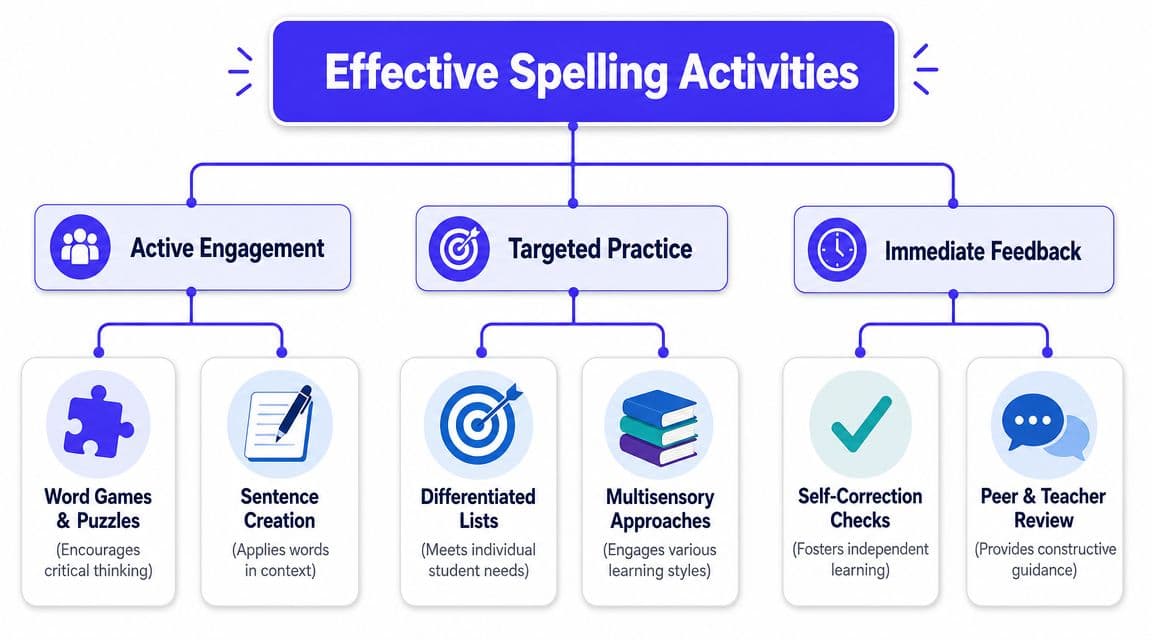
A strong worksheet week doesn't start with three unrelated pages. It starts with one grade-appropriate list, then asks students to work with those same words in different formats.
That matters because different tasks ask for different kinds of recall. A scramble asks students to notice letter order. A fill-in-the-blank sentence asks them to connect spelling to meaning. A matching task asks them to discriminate between words that may look or sound similar.
Modern tools make that easier because they aren't boxed into one format. Worksheet Creator is a reminder of the kind of variety teachers now expect from these tools. The broader category includes over 29 templates and activity types such as fill-in-the-blanks, scrambled words, and word searches, and one list can stay within a practical limit of 50 words or less when you're building distinct practice sheets.
What works better than a copy-the-list page
Here's the sequence I've found most useful in elementary classrooms:
- Start with recognition early in the week: word search, matching, or simple sort.
- Move to retrieval: scramble, cloze, or cover-and-write tasks.
- Finish with application: sentence writing, editing, or choosing the correct word in context.
That rhythm keeps the worksheet from becoming busywork because each page does a different job.
Activity types that pull their weight
Some worksheet formats are better at teaching than others.
- Word scrambles help when students know the word orally but don't yet hold the letter order securely.
- Sentence blanks are strong for homophones, vocabulary-heavy lists, and words that students can spell but misuse.
- Word searches are fine for exposure and confidence-building, especially at the start of the week, but they shouldn't be the only format.
- Definition or picture matching helps younger students and multilingual learners connect the printed word to meaning.
If every worksheet asks for the same kind of thinking, students get more practice at completing worksheets than at learning spelling.
A simple quality check
Before you print, ask four questions:
- Does this task match the skill I'm teaching?
- Will students need to recall, not just copy?
- Can I tell from the page what they misunderstood?
- Is the workload appropriate for this age group?
If the answer to the third question is no, it's probably practice only. That's not useless, but it shouldn't be mistaken for evidence of mastery.
Your Five-Minute Spelling Worksheet Workflow
When teachers say they want a faster way to make spelling materials, they usually don't mean “give me more options.” They mean “help me finish this before the copier line starts.”
A reliable workflow is better than a fancy tool you only use once.
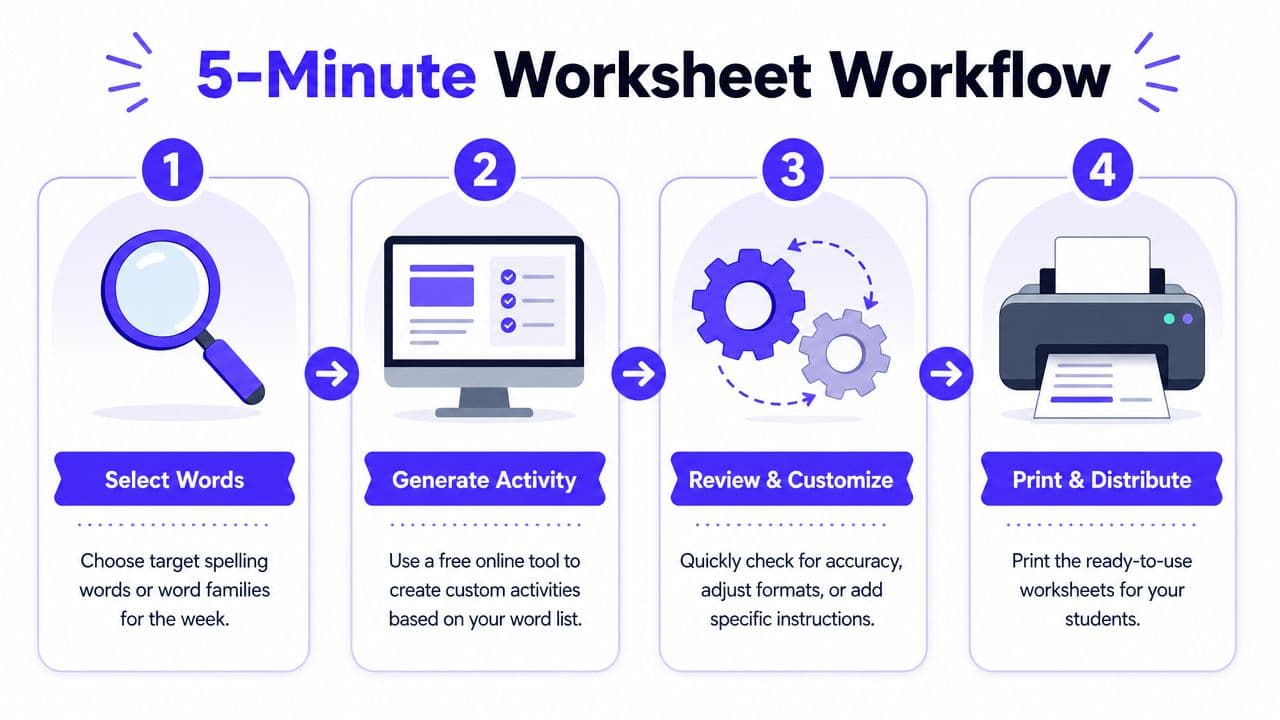
The sequence that saves the most time
The strongest routine is straightforward and supported by many worksheet makers. Storyboard That's spelling worksheet workflow reflects the same pattern many teachers use successfully: begin with a grade-appropriate list, generate more than one exercise type from that list, add visual cues if needed, and proofread before printing.
That sequence works because it keeps your content stable while changing the task.
A weekly version you can repeat
Try this:
Choose the week's target words
Keep the list age-appropriate and focused on the pattern you're teaching. If the list is messy, every worksheet built from it will be messy too.Make one low-stakes practice page
Early in the week, use a word search, sort, or scramble. This gets students looking closely at the words without asking for too much too soon.Make one reinforcement page
Midweek, switch to cloze items or sentence tasks. Students now need to retrieve the word and connect it to meaning.Make one check-for-understanding page
End the week with a quiz format, dictation page, or short application task. Keep directions clean and the layout uncluttered.
Where teachers lose time
The biggest time drain usually isn't the generator. It's the extra fixing after the page is made.
Watch for these problems:
- Auto-generated awkwardness: a sentence stem might technically work but sound unnatural to kids.
- Direction overload: students don't need a paragraph of instructions for a simple task.
- Font and spacing issues: younger students need room to write.
- Typos in the source list: once the list is wrong, every version is wrong.
Proofread the worksheet the way a second grader will read it, not the way an adult skims it.
Small upgrades that make the workflow stronger
Add a word bank for students who need support. Add picture cues if a few students still need vocabulary help. For older elementary students, add one short sentence-writing item at the bottom so the page does more than rehearse letters.
If you're working from a lesson plan instead of a standalone word list, a connected system can cut another step. That's where tools that turn existing plans into worksheets can help, because you're not re-entering the same content into a different platform.
Differentiating Worksheets for Every Learner
A spelling worksheet becomes more useful the moment it stops pretending every child needs the same task in the same form.
That matters for instruction, but it matters even more for assessment. Many free worksheet makers are good at convenience and variety. They're much less clear about whether the worksheet helps you measure mastery or diagnose errors. Brainator's spelling worksheet generator reflects that broader gap in the category. The tools focus on creating practice quickly, not necessarily on showing which rule or pattern a student still hasn't locked in.
The easiest adjustments with the biggest payoff
Differentiation doesn't need to mean making four separate packets.
A few small changes usually do the job:
- Add a word bank: This shifts the task from pure recall to recognition plus application. It's especially useful for students who know the pattern but freeze during independent work.
- Use picture or meaning cues: Younger students and multilingual learners often need support with vocabulary, not just spelling.
- Reduce the written load: Some students can demonstrate understanding with fewer items.
- Raise the ceiling, not just the floor: Strong spellers can sort by pattern, explain a rule, or write original sentences.
Turn practice into information
A plain worksheet tells you who finished. A differentiated worksheet tells you more.
If a student succeeds only with a word bank, you've learned something. If another spells the target word correctly in isolation but uses it incorrectly in a sentence, that tells you the issue may be language or meaning, not spelling alone. If a child keeps missing the same vowel pattern across formats, that's a teachable pattern, not just “careless work.”
That's why I'd rather have a simpler worksheet that reveals thinking than a prettier one that hides it.
What to watch for when you're planning support
A good rule is to match the support to the barrier.
| Student need | Useful worksheet tweak |
|---|---|
| Trouble recalling the whole word | Word bank or first-letter prompt |
| Trouble with meaning | Picture cue or short definition |
| Trouble applying in context | Sentence frame |
| Ready for challenge | Pattern sort or original sentence task |
If you teach phonics and spelling closely together, it also helps to keep practice tied to the pattern, not just the weekly list. Resources built around phonics worksheets for classroom practice can support that kind of targeted alignment.
The worksheet should answer a teaching question. If it doesn't, it's probably just paper.
Reclaim Your Time Without Sacrificing Quality
The best thing about a free spelling worksheet maker isn't that it produces paper quickly. It's that it clears space in your week for better decisions.
When the formatting is handled, you can focus on the parts students experience. Better word choice. Better directions. Better follow-up when a child keeps confusing a pattern. That's the trade most teachers want.
A solid routine gives you three things at once: speed, variety, and enough flexibility to differentiate without rebuilding everything from scratch. That's more than convenience. It's a way to keep spelling practice useful instead of repetitive.
And if a simple generator starts to feel too disconnected from the rest of your planning, that's usually the point where a more integrated option becomes worth exploring.
If you want your worksheets to connect more directly to lessons, standards, and day-to-day planning, Kuraplan is worth a look. It's built for teachers who want to generate classroom materials faster without losing sight of instruction.