The email pops up five minutes before recess. Indoor day. Students hear it, energy spikes, and a class that was holding together just fine suddenly needs a plan.
That is usually the moment indoor recess gets blamed, when the problem is lack of structure.
Schools still need to protect recess time even when weather, staffing, or space changes the setting. The shift is significant: recess is now treated as part of the school day, not a reward to pull when it rains. In practice, that means indoor recess needs the same level of planning as any other transition you want to run smoothly.
The version that works is simple. Give students clear choices, keep materials ready in labeled bins, and build routines they can follow without needing you to referee every five minutes. The best indoor recess ideas balance movement, creativity, and quiet options so the room does not tip too far in one direction. Too many high-energy choices raise the noise level fast. Too many sit-down choices leave half the class restless and picking at each other.
I've found that a station model saves the most time. Students know where to go, how many can join each activity, and what a finished reset looks like before the next group rotates. If you want one fast-prep printable that works across multiple stations, a custom bingo card generator for seasonal, vocabulary, or math-review games can fill a gap without feeling like extra seatwork.
You can also widen the menu with social and self-regulation options. These SEL-focused classroom games fit well into a station setup, especially for classes that need more support with turn-taking, frustration, or re-entry after recess.
Below are the indoor recess ideas I'd keep in rotation. Each one includes the teacher toolkit piece that often gets skipped: management moves that cut down on conflict, inclusion adjustments for different learners, and ready-to-use ways to prep materials before the next rainy-day announcement hits.
1. Structured Board Game and Card Game Stations
Board games are one of the easiest wins for indoor recess, but only if you stop treating them like a free-for-all. A game shelf with random boxes sounds great until half the class forgets the rules, one group argues about whose turn it is, and you spend recess settling Uno disputes.
What works is a station setup with a small menu. Pick a few games students can learn quickly and replay without much adult help. Chess, Checkers, Uno, Spot It, and simple curriculum-linked card games all hold up well because they reward turn-taking and attention without getting too loud.
Set up the station so it runs itself
Laminated rule cards save your voice. Put one in every box, and keep the directions short enough that a student can re-teach the game.
A few management moves matter more than the games themselves:
- Limit choices: Start with only a few options until students prove they can handle the routine.
- Assign game monitors: Pick students who can reset pieces, explain rules, and spot problems early.
- Use fixed seating: Keep each game in one place so pieces don't drift across the room.
- Rotate monthly: Kids enjoy familiar games, but a slow refresh keeps interest up.
If you want a quick-print option for whole-class play, Kuraplan's bingo card generator is handy for making seasonal, vocabulary, or math-review boards that feel like recess instead of extra seatwork.
Practical rule: If a game needs more than a minute of explanation during indoor recess, it probably belongs in a lesson block, not your recess bin.
For special education and inclusion, keep at least one cooperative or low-language-demand option available. Matching games, visual card games, and partner-based play reduce stress for students who struggle with complex verbal directions. I also like having one “quiet competition” table for students who want social time without the volume.
2. Creative Arts and Crafts Corner
Some classes need to move first. Others settle beautifully when their hands are busy. A craft corner can be your calmest station, but only if you plan for cleanup before anyone opens the glue.
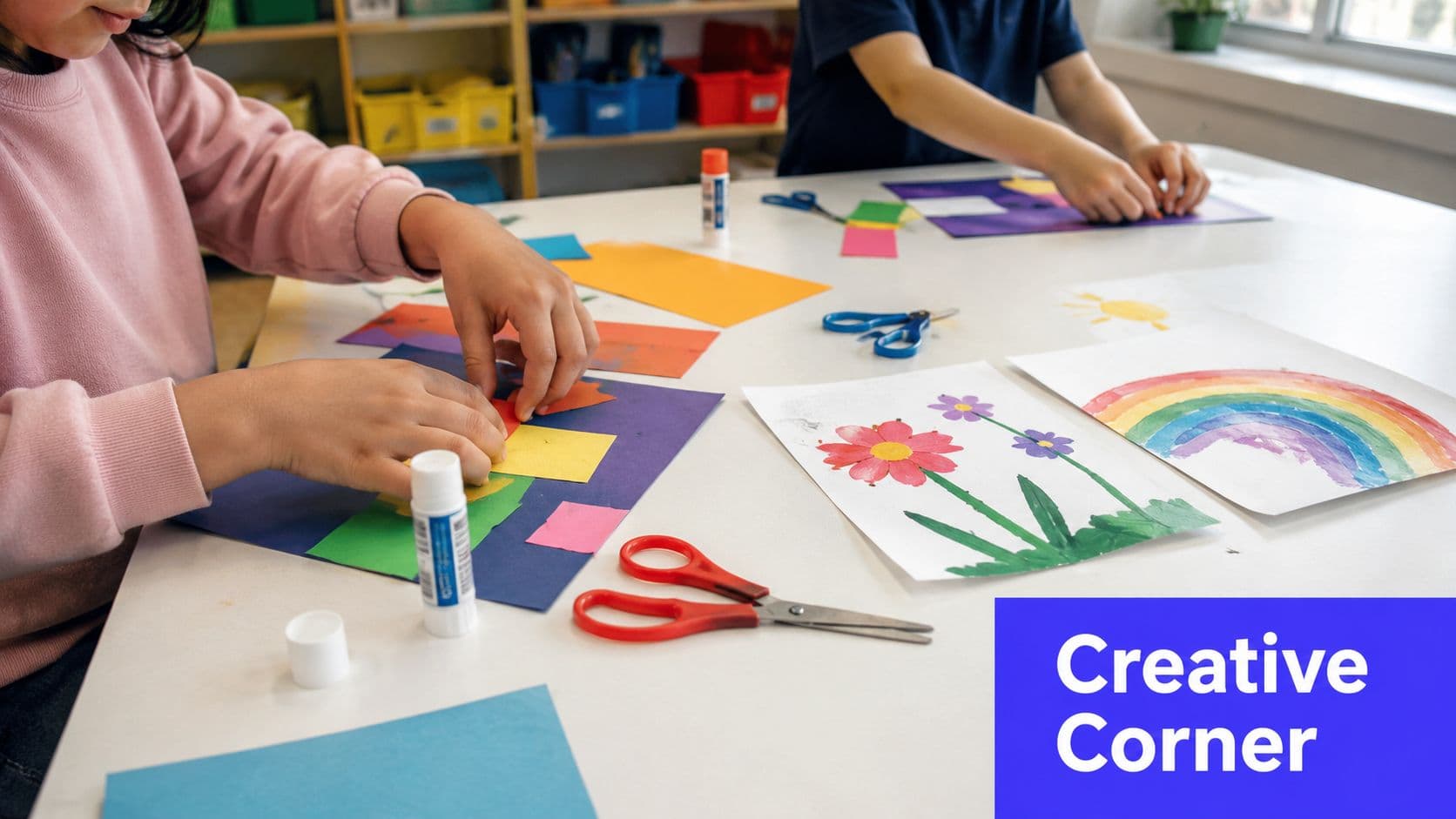
I keep this area focused on low-mess, high-success activities. Directed drawing, collage, bookmark making, origami, and simple themed crafts all work better than anything with too many steps or wet materials. If you're teaching younger students, these simple crafts for kindergarteners are a good reminder that easy usually beats impressive.
Keep the supplies boring and the output interesting
Pre-portioned materials are the secret. Put what students need in trays or small bins before recess starts. If kids have access to the whole cabinet, you'll spend the next block sorting scraps and hunting for missing scissors.
A reliable craft station usually includes:
- Visual directions: Picture cards beat spoken directions when the room is busy.
- Two choices only: Too many options slows everyone down.
- Cleanup jobs: Table wiper, scrap collector, and supply checker prevent the “I didn't make the mess” problem.
- Display space: Hallway boards or a classroom wall instantly raise buy-in.
Kuraplan fits nicely here because you can generate simple visual instruction pages and printable templates without building them from scratch. It's also useful for tying crafts to learning when you want the option there. Origami for geometry vocabulary, collage for story retell, or directed drawing tied to science topics all make the station feel purposeful without becoming another formal assignment.
For students with fine-motor challenges, offer adaptive scissors, thicker markers, larger paper, and fold lines already marked. Don't make perfection the standard. Indoor recess art should feel open, not like a graded product.
3. Reading Nook with Structured Literature Activities
It's the middle of a rain day, the room is loud, and two students are already done with every high-energy station. A reading nook earns its place in that moment. It gives students a calm option that still feels like recess, and it gives you one station in the room that usually lowers the volume instead of raising it.
The setup matters more than the decor. Bean bags and soft lighting are nice if you have them, but the primary driver is choice. Stock the area with graphic novels, short nonfiction, joke books, magazines, picture books, and audiobooks alongside traditional titles. Students are much more likely to pick this station if they can finish something, share something, or react to something in ten to fifteen minutes.
Build in structure without turning it into reading block
The best version of this station gives students just enough to do. Too little structure leads to wandering, fake reading, or book shopping for the full recess. Too much structure makes the nook feel like makeup work.
A practical middle ground looks like this:
- One basket of high-interest, quick-win texts: Short books prevent the “I just got started” cleanup battle.
- Simple response choices: Draw a scene, rate the book, match a character to a trait, or retell to a partner.
- Clear occupancy limit: Post the number of seats so the nook stays calm.
- Visible rotation system: Clothespins, name sticks, or a small signup card stop arguments fast.
- Audio option: Audiobooks help students who want story access without the decoding load.
I'd also keep the tasks reusable. Laminated prompt cards and half-sheet response slips save prep and make the station easy to reset. If you want ready-made materials, Kuraplan's reading comprehension worksheets for short, recess-friendly follow-up can help you generate quick printables without building a new activity every time indoor recess pops up.
Classroom management is what makes this nook successful. I'd teach three routines before you need them: how to choose a spot, how to respond to a book, and what to do if your first choice is full. Those tiny procedures save more time than any themed display.
For students who need more support, add visual choice boards, partner retell cards, and books with predictable text or strong picture support. Some students will engage better by listening first and responding orally. Others need a fidget, a defined seat, or a timer so the station feels contained. A few noise-reducing headphones can turn this into a real refuge for students who get overwhelmed by active stations, which is a key part of helping children with comprehension during busy times.
4. STEM Building and Engineering Challenges
This is the station that can become brilliant or disastrous in about two minutes. Building challenges are fantastic for students who need a hands-on outlet, but they need tighter structures than people expect.
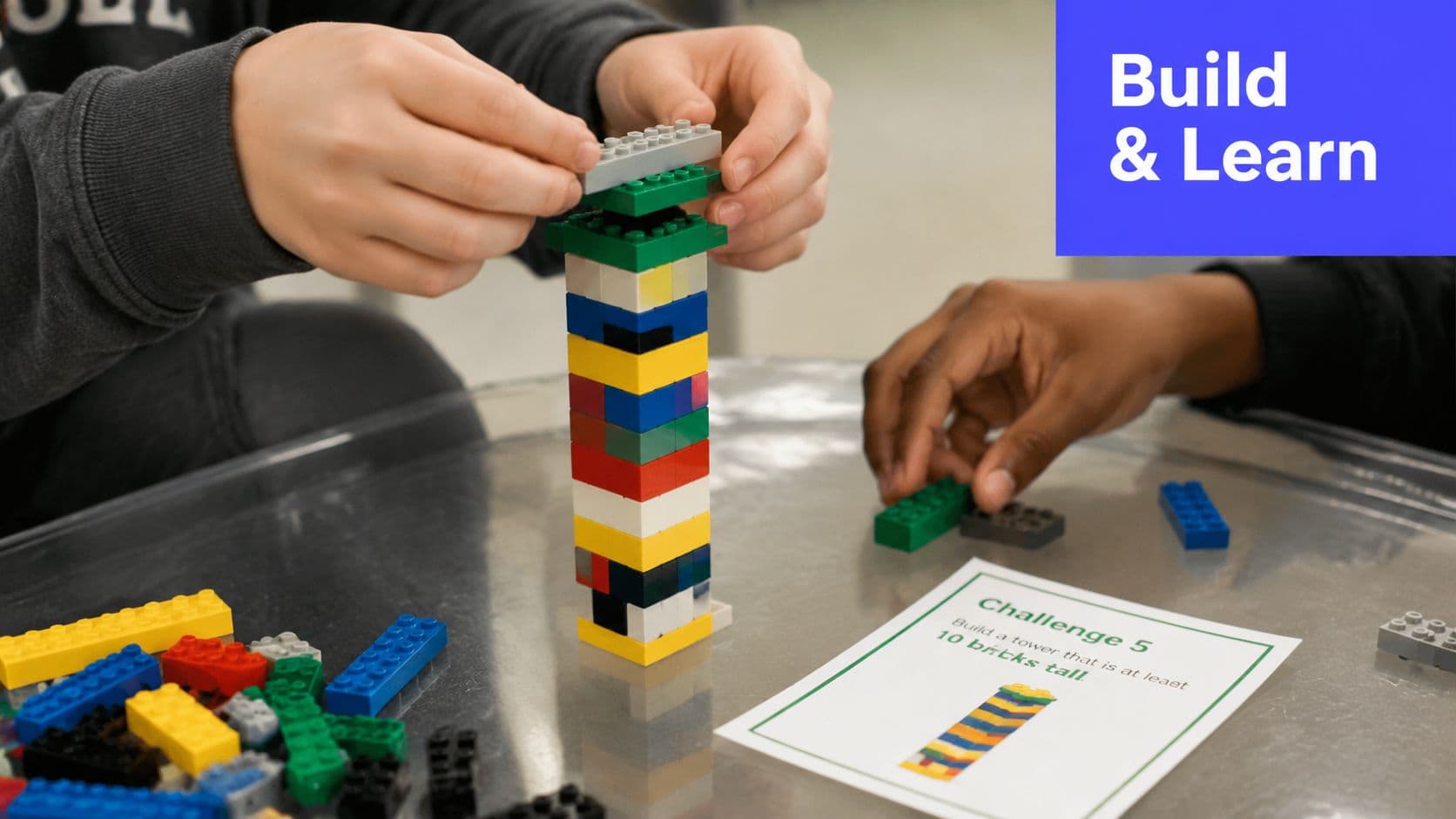
Loose tubs of blocks invite dumping. Challenge cards invite thinking. That's why I'd always pair materials with a specific prompt. Build the tallest tower. Make a bridge across two books. Create a structure that can stand on its own. Design a shape with only certain pieces. Students still get creativity, but the task gives the room direction.
Good constraints make better builds
Indoor recess is not the time for huge makerspace projects with endless supplies. Short-cycle tasks are better. Teacher resources consistently favor printable, scalable formats like challenge cards and modular prompts because they reduce transition time and make supervision easier, as reflected in The OT Toolbox's indoor recess ideas.
What helps most:
- Color-coded bins: Separate materials by type so cleanup is faster.
- One challenge card per table: Shared focus reduces wandering.
- Failure-friendly language: Students should know redesigning is part of the activity.
- Photo finish: Snap a picture before cleanup if students want their work remembered.
Kuraplan is useful here for generating challenge cards tied to standards or themes you're already teaching. If your class is in a weather unit, you can prompt wind-resistant towers. If you're in measurement, challenge them to build to a target height using nonstandard units.
For students who struggle with open-ended work, offer a model card, a parts limit, or a partner role like builder, tester, or materials manager. Some kids thrive when the decision load is lower.
A building station should end with a reset routine, not a pile of mixed pieces and a promise to “sort it later.”
5. Movement and Yoga Stations
Indoor recess gets loud fast when a class loses outdoor time and has nowhere to put that energy. A movement station gives students a controlled way to reset before the whole room starts chasing stimulation in less helpful ways.
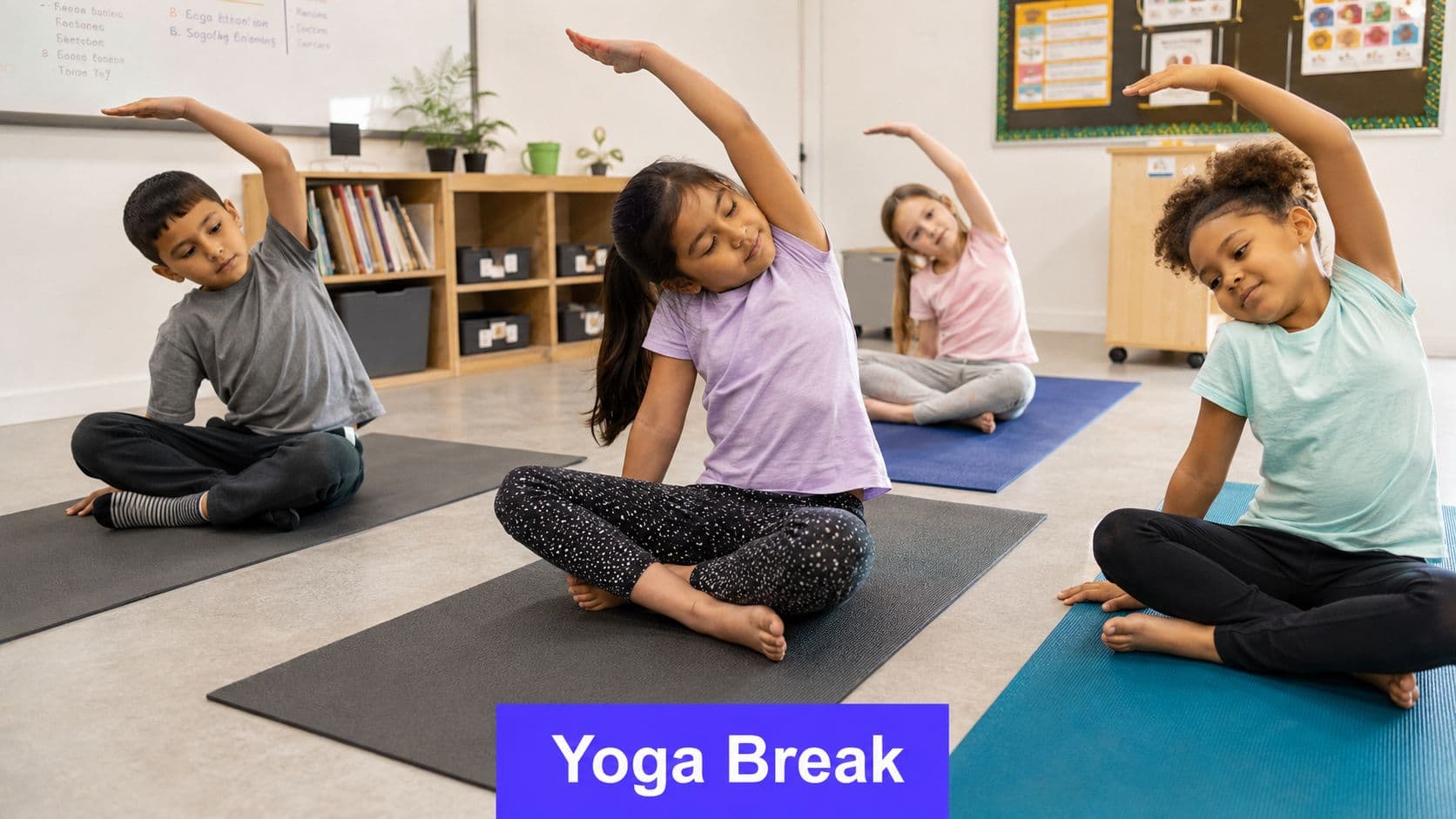
The mistake is treating movement as one big group event. That works for some classes, but in many rooms it creates waiting, showing off, and arguments about who has space. Stations work better because they split the need. Some students need to get their heart rate up. Others need pressure, stretching, and a quieter reset.
Build the station in two lanes
Set up one lane for active movement and one for regulation. The active side can include movement dice, mirror games, freeze dance, balloon taps, or a taped path for jumps and balances. The regulation side can include chair yoga, breathing cards, wall pushes, seated stretches, or a short pose sequence students can follow without much teacher help.
That split saves management time. It also keeps indoor recess from turning into a room full of kids doing high-energy movement five minutes before math.
A setup that holds up well usually includes:
- Floor boundaries with tape: Clear space limits prevent collisions and side wandering.
- A posted rotation card: Students know what to do first, next, and last.
- Very short rounds: Two to four minutes keeps the pace up and cleanup simple.
- A visible stop cue: Timer, chime, or call-and-response. Pick one and use it every time.
- Low-prep equipment: Painter's tape, beanbags, balloons, pose cards, and a speaker are usually enough.
For inclusive indoor recess planning, UConn's indoor recess framework is useful because it emphasizes movement, belonging, and participation choices. That matters here. Some students will happily join a dance prompt. Others will participate more consistently if the option is private, quiet, and predictable.
This kind of guided movement can help if you want a visual to anchor the routine:
Kuraplan is especially helpful for the teacher-toolkit side of this station. Use it to generate printable pose cards, movement challenge strips, “roll and move” boards, or SEL-based reset prompts tied to feelings language. If indoor recess gets called during a weather unit, it can also create themed cards fast, such as move like wind, freeze like ice, or stretch like a growing tree. That kind of prep turns a vague idea into a station you can run tomorrow.
A few adaptations make this station work for more students. Give visual-first directions. Offer seated and standing versions of the same task. Let students choose a partner role such as timer, card holder, or routine leader if full participation feels like too much. For students who get overstimulated, a quiet sensory path or wall-pressure routine is often more successful than asking them to join a dance video with peers watching.
The best movement station burns energy without creating new chaos. If students can start fast, move safely, and stop on cue, the station is doing its job.
6. Structured Drama and Improv Games
Drama games are one of the most underrated indoor recess ideas because they burn energy, build language, and can be done with almost no materials. They also go off the rails fast if you start with the wrong activity.
The mistake is opening with something too exposed. If a shy class walks into full improv, you'll get refusals, silliness, or one loud student taking over. Start with low-risk formats like silent charades, emotion statues, mirroring, or reader's theater with short scripts.
Start safe, then get bolder
Drama stations work best when students know they can participate without being “on stage” alone. Offer backstage jobs, prop setup, script holding, or audience roles alongside performance options.
A few dependable choices:
- Silent charades: Great for mixed language levels and shared laughter without chaos.
- Freeze scenes: Fast, visual, and easy to stop.
- Reader's theater: Strong for fluency and collaborative reading.
- Story building circles: One line per student keeps everyone involved.
Kuraplan is a natural fit here because it can generate simple scripts, character cards, or curriculum-themed scene prompts. If your class just finished a folktale, a science cycle, or a history topic, you can turn it into a light recess performance without writing everything yourself.
What doesn't work as well? Long skits with costume tubs. They eat your time, create arguments over props, and are hard to shut down cleanly. Short dramatic play wins because it resets quickly when recess ends.
“No wrong way to join” should be the rule students hear before any improv game starts.
For students with anxiety, selective mutism, or language-processing needs, use visual prompts and allow nonverbal roles. Participation doesn't have to look identical to be meaningful.
7. Puzzle and Brain Teaser Station
Every class needs one station that lowers the volume without feeling like a consequence. Puzzles do that well, especially for students who enjoy solving instead of performing.
The strongest setup mixes quick wins with longer challenges. Jigsaw puzzles, tangrams, visual brain teasers, pattern blocks, and simple logic problems all belong here. What I wouldn't do is fill the area with only one kind of puzzle. If every option feels hard, kids avoid the station. If every option is too easy, they dump pieces and move on.
Make the challenge visible
Students choose better when they can tell what they're getting into. I like color coding or simple labels so they know whether a puzzle is quick, medium, or likely to last multiple recesses.
A workable puzzle station often includes:
- Clear bins with picture labels: Students can find and return materials independently.
- A “save for later” tray: Half-finished work doesn't need to be destroyed at cleanup.
- Partner-friendly options: Some students solve better with a peer.
- One featured challenge: A fresh puzzle on display attracts attention.
Kuraplan can help generate printable logic tasks, sequencing challenges, or math-based brain teasers that match the age of your group. I'd keep those mixed with tactile options so the station doesn't become just another worksheet corner.
For inclusion, offer puzzles with different entry points. Knobbed or larger-piece puzzles for younger learners, visual pattern tasks for students who struggle with text, and collaborative logic games for students who like talk-based problem solving. This station often becomes a favorite for students who need a quieter social space but don't want to read.
8. Technology-Based Learning Stations
Tech can absolutely work during indoor recess, but it needs sharper boundaries than most teachers expect. Left open, it turns into device hogging, off-task clicking, and ten different login issues you didn't ask for.
The key is to keep it purpose-built. One coding choice, one digital creation choice, and maybe one review-style option are plenty. Scratch, Code.org, simple drawing tools, or age-appropriate educational apps can all fit, especially in classrooms that already have devices ready to go.
Use tech as a station, not a default
This station should feel like one option in the room, not the whole room's plan. Kids still need social, hands-on, and movement alternatives, especially during a break.
A few rules make tech recess manageable:
- Post login cards: Don't trust memory under indoor recess energy.
- Use task cards: Students need a clear “do this” entry point.
- Create student tech helpers: They can handle small troubleshooting before you get pulled in.
- Set turn lengths: Devices attract monopolizers fast.
Kuraplan is helpful for creating digital task cards, mini-project prompts, and assignment directions students can follow independently. If your class is already working on a topic, you can build quick digital creation tasks around it, like design a weather icon set, animate a habitat scene, or make a simple vocabulary comic.
What doesn't work? Unstructured “educational game time.” Even good apps get loud, competitive, and uneven without a defined task. Keep the station focused and time-bound, and it stays useful.
9. Peer Tutoring and Academic Practice Stations
This one sounds suspiciously like “more school,” so it has to be handled carefully. If it feels remedial, students will resist it. If it feels game-based, collaborative, and brief, it can be one of the most productive indoor recess options in the room.
The sweet spot is practice with a social twist. Math fact games, vocabulary sorting, fluency pairs, quiz cards, and partner challenge boards all work because they feel interactive rather than teacher-directed. Older students can also take real pride in coaching younger peers or helping classmates through games.
Pair for chemistry, not just skill
A technically perfect academic pair can still flop if the personalities clash. Indoor recess is social time, so relationship fit matters.
A few pairing rules I'd use:
- Train the helper role: Students need sentence stems and expectations, not just a title.
- Keep rounds short: Quick games keep the mood light.
- Use role cards: Tutor, player, checker, and encourager can rotate.
- Celebrate effort: Improvement matters more than who “won.”
Kuraplan can make this station realistic by generating differentiated practice cards and leveled review materials without making you build separate sets by hand. That's especially helpful if your class has wide skill variation and you still want the station to feel fair.
This is also a good place to build in student leadership. Some students who struggle in whole-group instruction absolutely shine when they get to explain a pattern, run a game, or encourage a classmate one-on-one. Keep the tone playful, and this station won't feel like punishment disguised as recess.
10. Writing and Journaling Stations
Writing can be a surprisingly popular recess choice when it's framed correctly. Kids who won't touch a response journal during literacy block will happily write comics, secret-agent logs, silly stories, or “would you rather” debates when the pressure is gone.
The biggest mistake here is making every prompt open-ended and text-heavy. Some students freeze when the page is too blank. Others need visual starters, sentence stems, or alternate formats like lists, speech bubbles, and story maps.
Give students formats, not just prompts
Choice matters more than genre here. Let students decide whether they want to write a short poem, a comic strip, a journal entry, a fake news report, or a character conversation.
Useful supports include:
- Picture-based prompt cards: Great for students who need a fast entry point.
- Sentence starters: Especially helpful for hesitant writers.
- Graphic organizers: Story maps and character webs reduce overwhelm.
- Sharing option, not requirement: Some students write more when they know they won't have to read aloud.
If you want fresh material without hunting for it, Kuraplan's writing prompt generator makes this station much easier to keep stocked. You can create themed prompts, adapt for grade level, and print enough variety that students don't burn out on the same cards.
I also like mixing in nontraditional writing. Comics, mini-zines, dialogue strips, and collaborative one-word stories can be a better fit than paragraph writing during a break. Students who dislike formal writing often engage more when the format feels creative and low-stakes.
10 Indoor Recess Ideas Comparison
A quick comparison table helps when you need to choose fast, especially on a day when the class energy is off and you do not have time to set up everything. I use this kind of chart to match the activity to the room, the noise level, and the amount of supervision I can realistically give.
| Activity | 🔄 Implementation Complexity | ⚡ Resource Requirements | ⭐ Expected Outcomes | 💡 Ideal Use Cases | 📊 Key Advantages |
|---|---|---|---|---|---|
| Structured Board Game and Card Game Stations | Moderate. Requires station setup, rule teaching, and clear rotations | Low to Medium. Games, storage, small tables | Builds strategic thinking, math practice, turn-taking, and social problem-solving | Small-group recess, rainy-day rotations, quick partner play | Easy to reuse, simple to differentiate, works well with visual rule cards |
| Creative Arts and Crafts Corner | Low to Medium. Best with firm cleanup routines and supply limits | Medium. Art supplies, table covers, drying or display space | Supports fine motor practice, creativity, and self-expression | Calm centers, themed classroom days, choice-based recess | Good emotional outlet, flexible for mixed ages, easy to adapt with templates |
| Reading Nook with Structured Literature Activities | Low to Medium. Needs organized bins and clear task choices | Medium to High. Leveled books, seating, optional audio support | Improves fluency, comprehension, and independent reading stamina | Quiet recess, regulation breaks, literacy-friendly classrooms | Low-noise option, strong for mixed energy levels, easy to pair with response sheets |
| STEM Building and Engineering Challenges | Medium to High. Materials and challenge cards need planning | High. Building kits, bins, work space, photo examples | Strengthens spatial reasoning, teamwork, and engineering habits | Makerspace-style recess, problem-solving groups, standards tie-ins | Highly engaging, hands-on, easy to extend with simple challenge prompts |
| Movement and Yoga Stations | Low. Clear boundaries and posted routines matter most | Low. Mats or floor spots, visual cards, optional music | Improves regulation, focus, body awareness, and transition readiness | High-energy classes, post-lunch reset, indoor weather days | Fast to run, low prep, inclusive for many learners with visual modeling |
| Structured Drama and Improv Games | Low to Medium. Works best with tight behavior expectations | Low. Open space, cue cards, simple props | Builds speaking skills, confidence, listening, and creativity | Reader's theater, social skills practice, expressive groups | High engagement, minimal materials, strong option for students who need active participation |
| Puzzle and Brain Teaser Station | Low. Mostly requires rotation and organized storage | Low to Medium. Puzzles, task cards, printables, bins | Develops logic, persistence, visual-spatial thinking, and patience | Quiet tables, independent centers, low-movement recess | Easy to supervise, low mess, good fit for students who want solo or partner work |
| Technology-Based Learning Stations | High. Requires device routines, login support, and network setup | High. Devices, reliable Wi-Fi, software or app access, charging | Builds digital literacy, coding practice, and creation skills | Tech rotation days, differentiated practice, digital choice boards | Strong for individual pacing, easy to track progress, useful for mixed readiness levels |
| Peer Tutoring and Academic Practice Stations | Medium. Pairing students well takes planning and supervision | Low. Leveled materials, checklists, answer keys | Improves skill fluency, peer relationships, and informal assessment | Intervention blocks, mixed-ability groups, short review sessions | Low-cost, targeted, and productive when you need recess to stay structured |
| Writing and Journaling Stations | Low. Needs prompt sets and a simple way to store work | Low. Paper or devices, prompts, organizers, pencils | Strengthens writing fluency, expression, and idea generation | Quiet choice time, reflection days, low-prep indoor recess | Easy to maintain, calm atmosphere, creates work students can revisit later |
The trade-off is simple. The highest-engagement stations usually take more setup and tighter routines. The easiest stations to run tend to be quieter, lower-mess, and easier to repeat all year.
If you want this to work as a real teacher toolkit instead of a wishlist, prep each station with three things: a directions card, a materials bin, and one built-in support for students who need a different entry point. That might mean picture directions for board games, a choice board for writing, sensory-friendly seating in the reading area, or partner roles in STEM. Kuraplan can save time here too. Use it to generate printable challenge cards, visual instructions, writing prompts, and differentiated task sets so the station is ready before the next rainy-day recess hits.
Make Your Next Indoor Recess the Best One Yet
The rain starts five minutes before recess. Half the class needs to move, three students are already dysregulated, and you still have to keep the room safe without turning the block into free-for-all chaos. Indoor recess goes better when the plan is already built.
The strongest setups are predictable for students and realistic for teachers. That usually means a small set of repeatable stations, limited choices, clear routines, and materials stored so you can put them out fast. Students do better when they know exactly where to go, what to do, and how to clean up before the timer ends.
You do not need all ten ideas running at once. In most classrooms, two or three well-run options work better than a full menu that is hard to supervise. I usually want one movement station, one quiet station, and one partner or small-group option. That mix covers a lot of needs without spreading materials and attention too thin.
What makes this work long term is treating indoor recess like a toolkit, not a last-minute rescue plan. Each station needs a directions card, a materials bin, and one built-in support for students who need a different entry point. Picture cues help at game stations. Sentence starters help in writing. Flexible seating or headphones can make the reading area usable for more students. In STEM and partner tasks, assigned roles cut down on conflict and help students who freeze when directions feel too open.
Whole-class indoor recess also has to hold up in real conditions. Shared spaces, mixed energy levels, and short time windows reward activities that are easy to reset and easy to supervise. The ideas that last all year are usually the ones with short rounds, simple cleanup, and clear stopping points.
A few routines do most of the heavy lifting:
- Prep the containers: Use labeled bins with only the materials needed for that station.
- Post the directions: A short rule card saves you from repeating instructions across the room.
- Build in support: Add visuals, partner roles, or simplified choices before students need them.
- Keep timing tight: Activities with natural reset points make cleanup much easier.
- Reuse your winners: Familiar stations usually run better than brand-new ones.
Kuraplan helps on the prep side. You can use it to create printable challenge cards, visual instructions, differentiated task sets, writing prompts, and quick practice pages without spending your planning time formatting everything by hand. That matters on the days when indoor recess is announced with no warning and you need something ready, not another idea to develop later.
Set up a few stations well, teach the routine once, and let repetition do the work. Indoor recess becomes much easier to manage when students recognize the system and can use it with less adult help.
If you want indoor recess materials ready before the weather turns, Kuraplan is worth having in your teacher toolkit. It helps you create printable station cards, differentiated practice pages, writing prompts, visual instructions, and standards-aligned activities in minutes, which means less scrambling and more time for teaching.