We’ve all been in those "collaboration" meetings that feel more like a time drain than a lifeline. You know the ones: where the conversation circles but never lands on anything actionable, leaving you with less time and more to do. But what if collaboration wasn't just another item on the to-do list? What if it was the one thing that could lighten your load, spark new ideas, and directly boost student learning?
True collaboration moves beyond sharing frustrations and becomes a powerful engine for professional growth. To foster truly impactful and sustainable professional growth, teacher teams can implement proven team collaboration best practices that lead to high-performing learning environments. It’s about building a system of shared expertise that makes everyone’s job more manageable and effective.
In this list, we're cutting through the noise to bring you 10 field-tested teacher collaboration strategies that aren't just theory. These are practical, adaptable frameworks that real teachers use to build stronger lessons, support struggling students, and make their teaching lives more sustainable. Let's dive into strategies that will actually save you time and transform your practice, instead of just filling your calendar.
1. Professional Learning Communities (PLCs)
Professional Learning Communities (PLCs) are one of the most powerful teacher collaboration strategies for systematically improving student outcomes. This isn't just another meeting; it's a structured team of educators working together to achieve common goals. The core of the PLC process revolves around a continuous cycle of inquiry centered on four critical questions: What do we want students to learn? How will we know if they have learned it? How will we respond when they don't? And how will we extend the learning for students who have?
This model, popularized by experts like Rick and Rebecca DuFour, isn't just fluffy theory. For instance, Adlai E. Stevenson High School District 125 in Illinois attributed a 25% increase in student achievement directly to its robust PLC implementation.
How to Implement PLCs
To make your PLC meetings actually work, focus on structure and data. The goal isn't just to talk about teaching; it's to analyze evidence and make informed instructional adjustments.
- Establish Norms and Agendas: Start by agreeing on meeting norms, roles (like facilitator and note-taker), and a consistent schedule. A predictable structure means you actually get things done.
- Focus on Common Assessments: The most effective PLCs analyze student work from common formative assessments. This shifts the conversation from "what I taught" to "what students learned."
- Leverage AI Tools: Instead of reinventing the wheel for every lesson, use tools that get you to the starting line faster. Your PLC can use an AI assistant like Kuraplan to co-create standards-aligned lesson plans and assessments, ensuring everyone is working from the same playbook. It makes generating rubrics and tracking mastery much quicker, giving you instant data for your team to analyze.
2. Instructional Coaching and Peer Mentoring
Instructional coaching and peer mentoring are teacher collaboration strategies that provide personalized, on-the-job support to improve classroom practice. This approach pairs an instructional coach or an experienced mentor with a teacher to focus on specific instructional goals. The coach acts as a supportive partner—observing lessons, co-planning, modeling techniques, and providing non-evaluative feedback to help you grow.
This model is a cornerstone of professional development in many high-achieving districts. Prominent frameworks from experts like Jim Knight and Elena Aguilar emphasize a partnership approach, where the teacher is in the driver's seat of their own learning. The New Teacher Center, for example, has shown that its intensive mentoring programs significantly increase teacher retention and effectiveness, impacting student achievement across hundreds of schools.
How to Implement Coaching and Mentoring
Effective coaching is built on trust, clear goals, and a structured process. The focus should always be on collaborative problem-solving, not a top-down evaluation.
- Establish a Coaching Cycle: Implement a clear cycle: pre-observation conference, observation, and post-observation debrief. This creates a predictable and safe structure for reflection and goal-setting.
- Focus on Specific Goals: Work with the teacher to identify one or two high-leverage instructional goals. Trying to fix everything at once leads to overwhelm; a narrow focus leads to mastery.
- Use Tools for Shared Planning: Coaches and mentees can use a tool like Kuraplan to co-create and refine lesson plans. This lets the coach provide concrete resources, link activities directly to standards, and model how to build differentiation into a lesson, making the feedback instantly actionable.
3. Collaborative Lesson Study
Collaborative Lesson Study is a professional development model from Japan that treats lesson planning as a form of practical research. Unlike simply sharing lesson plans, this teacher collaboration strategy involves a small team of educators working together to meticulously design, teach, observe, and refine a single "research lesson." The process focuses intensely on student thinking, providing deep, shared insights into what's actually working in the classroom.

This powerful methodology has been adopted globally for its effectiveness. Catherine Lewis and the Lesson Study Research Group have been instrumental in its spread, while institutions like Stanford University have implemented successful mathematics lesson study projects. The goal is to create a culture of continuous, evidence-based instructional improvement driven by teachers themselves.
How to Implement Collaborative Lesson Study
To get started with Lesson Study, the key is to be disciplined and focused on collecting evidence of student learning, not just judging teacher performance.
- Form a Small Team and Choose a Focus: Assemble a team of 3-4 teachers. Pick a challenging concept or standard where students consistently struggle. The team's work will revolve around designing a lesson to address this specific learning gap.
- Plan, Teach, and Observe: Collaboratively design the research lesson in great detail, anticipating student responses. One team member teaches the lesson while the others observe, taking specific notes on student engagement, understanding, and misconceptions.
- Refine and Share with Technology: After the lesson, the team debriefs, analyzing student work and observation data to revise the lesson. Use a tool like Kuraplan to build the initial research lesson, ensuring it’s aligned to standards with clear rubrics. After refining it, the polished lesson plan can be easily shared on the platform, allowing your team's hard work to benefit the entire school.
4. Departmental and Grade-Level Team Meetings
Departmental and grade-level team meetings are a foundational teacher collaboration strategy, giving educators who share the same content or students dedicated time to align their efforts. These structured sessions move beyond simple announcements to focus on cohesive curriculum planning, developing common assessments, and analyzing student data to ensure instructional consistency. The primary goal is to create a unified experience for students, so expectations, pacing, and core instruction don't vary wildly from one classroom to the next.
This approach is highly effective in various settings. Many elementary schools schedule daily or weekly grade-level collaboration time to plan interdisciplinary units, while high schools often use common planning periods for departments to map out course sequences and refine vertical alignment.
How to Implement Departmental and Grade-Level Meetings
To prevent these meetings from becoming a waste of time, they must be purposeful, structured, and action-oriented. The focus should always be on collective problem-solving that directly impacts student learning.
- Establish a Predictable Rhythm: Create a clear agenda and circulate it at least 48 hours in advance. Stick to a strict timeline, typically 45-60 minutes, and rotate roles like facilitator and timekeeper to build shared ownership.
- Make Data the Centerpiece: Ground your discussions in evidence, not just anecdotes. Analyze results from common exit tickets, quizzes, or benchmark assessments to identify specific areas where students are struggling and brainstorm targeted instructional responses as a team.
- Streamline Your Planning Workflow: Use technology to make curriculum alignment and assessment creation more efficient. With an AI assistant like Kuraplan, your team can instantly generate standards-aligned lesson plans and assessments. This allows you to spend less time on tedious formatting and more time collaboratively refining instructional strategies.
5. Cross-Curricular Integrated Planning
Cross-Curricular Integrated Planning is a teacher collaboration strategy that breaks down the traditional silos between subjects. Teachers from different disciplines—like English, history, and science—work together to design learning units centered around a common theme, essential question, or real-world problem. This helps students make meaningful connections between content areas, fostering a deeper and more holistic understanding of complex topics.
This model is a cornerstone of innovative educational frameworks like the project-based learning initiatives at High Tech High and the International Baccalaureate (IB) Middle Years Programme. At these schools, students tackle projects that require them to apply scientific principles, historical context, and persuasive writing skills simultaneously, showing that knowledge is interconnected, not isolated.
How to Implement Cross-Curricular Planning
Effective integrated planning requires a shared vision and a clear framework to ensure all subject-specific standards are met while exploring a central theme. The goal is to create authentic learning experiences, not just loosely related activities.
- Start Small with a Big Idea: Instead of overhauling the entire curriculum, begin with one integrated unit per semester. Choose a compelling theme or an essential question that naturally lends itself to multiple perspectives, such as "How do we build a sustainable community?"
- Use Backward Design: Begin with the end in mind. Collaboratively define what students should know and be able to do by the end of the unit. Design a culminating project or performance task and create a shared rubric that assesses standards from each discipline.
- Map Standards and Lessons: It's crucial that subject-specific rigor isn't lost. Use a tool like Kuraplan to streamline this. Each teacher can generate standards-aligned lesson plans for their part of the unit. The platform's AI assistant can help you align activities across disciplines and ensure all required learning objectives are covered, creating a cohesive and comprehensive unit plan.
6. Peer Observation and Feedback Cycles
Peer observation and feedback cycles transform the isolated act of teaching into a shared, reflective practice. This strategy involves teachers systematically observing one another's classrooms to provide non-evaluative, growth-oriented feedback. The goal is not to judge, but to create a transparent culture of mutual learning where we can refine our craft by seeing different strategies in action and having a real professional dialogue.
This model, championed by educators like Elena Aguilar and embedded in frameworks like Charlotte Danielson's, fosters trust and innovation. Many schools using peer coaching frameworks report significant improvements in both teacher morale and the implementation of new instructional initiatives, as the feedback comes from a supportive colleague rather than an administrator.
How to Implement Peer Observation and Feedback Cycles
Successful peer observation is built on trust and structure. The focus should always be on collecting objective evidence related to a pre-agreed-upon instructional goal, not personal opinions.
- Establish Clear Protocols: Before any observations, agree on a process. This includes setting a focus for the observation (e.g., student engagement, questioning techniques), scheduling a brief pre-conference to discuss the lesson's goals, and deciding on a data collection tool or "look-fors."
- Focus on Evidence, Not Judgment: The observer's role is to be a second set of eyes. Instead of saying, "The class was well-behaved," an observer might note, "22 of 25 students were on-task during the independent work period." Hold a post-observation conference within 48 hours to discuss the evidence while the lesson is still fresh.
- Connect Observations to Lesson Design: Technology can create a powerful link between planning and practice. Before an observation, teachers can share their lesson plans in Kuraplan. This allows the observer to understand the intended instructional moves and learning targets, making their feedback more targeted and relevant to the lesson's design.
7. Knowledge Sharing, Resource Libraries, and Online Professional Communities
This teacher collaboration strategy extends beyond your school walls, using digital platforms to create shared repositories of instructional materials and foster professional dialogue. By building collective resource libraries and participating in online communities, we can reduce duplicated work, preserve institutional knowledge, and tap into a global network of expertise. This democratizes access to high-quality materials and innovative ideas.
The rise of Open Educational Resources (OER) and platforms like Teachers Pay Teachers demonstrates the immense power of peer-to-peer sharing. Similarly, vibrant online communities on platforms like Twitter (using hashtags like #edutwitter) and specialized Facebook groups allow teachers to find subject-specific support and solutions instantly, crowdsourcing answers to complex instructional challenges.
How to Implement Knowledge Sharing and Online Communities
Effective knowledge sharing requires intentional organization and active participation. The goal is to create systems that are easy to contribute to and even easier to navigate, whether they are internal to a school or part of a global community.
- Establish Clear Organization: For an internal resource library, create a logical folder structure (e.g., by grade level, subject, then standard). Use a consistent file naming convention so resources are easily searchable.
- Set Norms for Participation: In online communities, establish clear guidelines for respectful and constructive dialogue. Create discussion prompts or weekly themes to focus conversations and encourage active engagement.
- Leverage Technology: Instead of relying on a cluttered shared drive, use platforms designed for curriculum development. With a tool like Kuraplan, teachers can build standards-aligned lessons and then easily share them with colleagues, complete with attached rubrics and materials.
8. Collaborative Curriculum Mapping
Collaborative Curriculum Mapping is a strategic process where educators work together to visually chart the entire learning journey for students. This teacher collaboration strategy involves documenting what is taught, when it is taught, and how it is assessed across grade levels and subjects. The primary goal is to ensure a cohesive, logical, and non-repetitive curriculum, eliminating learning gaps and building a strong foundation for future knowledge.
This method, championed by experts like Heidi Hayes Jacobs, creates transparency and promotes vertical and horizontal alignment. Schools implementing curriculum mapping often discover critical gaps, such as a foundational math concept being skipped in third grade, or redundancies, like the same historical event being taught in three different courses.
How to Implement Collaborative Curriculum Mapping
Effective curriculum mapping is an ongoing, cyclical process, not a one-time event. It requires a commitment to seeing the bigger picture of student learning beyond individual classrooms.
- Start Small and Use Backward Design: Avoid the overwhelm of mapping an entire K-12 curriculum. Begin with a single subject area or grade-level team. Apply backward design by first identifying the essential standards for the end of the year, then mapping backward.
- Make it Visual and Dynamic: Use digital tools or large chart paper to create visual maps that are easy to understand and modify. The map should be a living document that is reviewed and updated annually.
- Automate Unit and Lesson Planning: A curriculum map provides the "what" and "when," but teachers still need to build out the "how." Use Kuraplan to translate your high-level map into detailed, standards-aligned units and lessons. The platform's AI curriculum generator can rapidly create the foundational content, allowing your team to focus its energy on customizing and refining instructional strategies.
9. Action Research and Inquiry Teams
Action Research and Inquiry Teams formalize teacher curiosity into a structured, collaborative investigation. This strategy empowers small teams of educators to systematically examine a shared instructional challenge, moving from anecdotal evidence to data-driven solutions. Using a cyclical process like Plan-Do-Study-Act (PDSA), teachers formulate a specific question, implement a change, collect data on its impact, and refine their approach based on the findings.
This model transforms teachers into researchers of their own practice. Initiatives like the National Council of Teachers of Mathematics (NCTM) have long promoted action research to improve math instruction, demonstrating its power to generate localized, relevant solutions to persistent classroom problems. It’s one of the most effective teacher collaboration strategies for building deep, reflective practice.
How to Implement Action Research
Effective action research is focused and systematic. The goal is to test a specific instructional hypothesis and measure its direct impact on student learning with concrete evidence.
- Frame a Narrow Research Question: Start with a specific, answerable question. Instead of asking "How can I improve reading comprehension?" ask "Does using a reciprocal teaching strategy for 20 minutes, twice a week, improve 4th-grade students' ability to identify the main idea in non-fiction texts?"
- Use Mixed Data Sources: Combine quantitative data (like pre/post-assessment scores) with qualitative data (like student work samples or observation notes) to get a complete picture of the intervention's impact.
- Leverage Technology for A/B Testing: To rigorously test an instructional change, you need comparable materials. An AI tool like Kuraplan can create two versions of a lesson or unit—one as a control, and one with your new strategy. By generating parallel assessments for both groups, you can efficiently collect and compare student outcome data to see what truly works.
10. Structured Data Meetings and Student Work Analysis
Structured Data Meetings are a powerful form of teacher collaboration that shifts the focus from "what was taught" to "what was learned." This strategy involves teams of teachers collaboratively examining student data—formative assessments, work samples, and performance metrics—to identify learning patterns and make collective instructional adjustments. The goal is to move beyond raw numbers to understand the story behind the data and take shared responsibility for student outcomes.
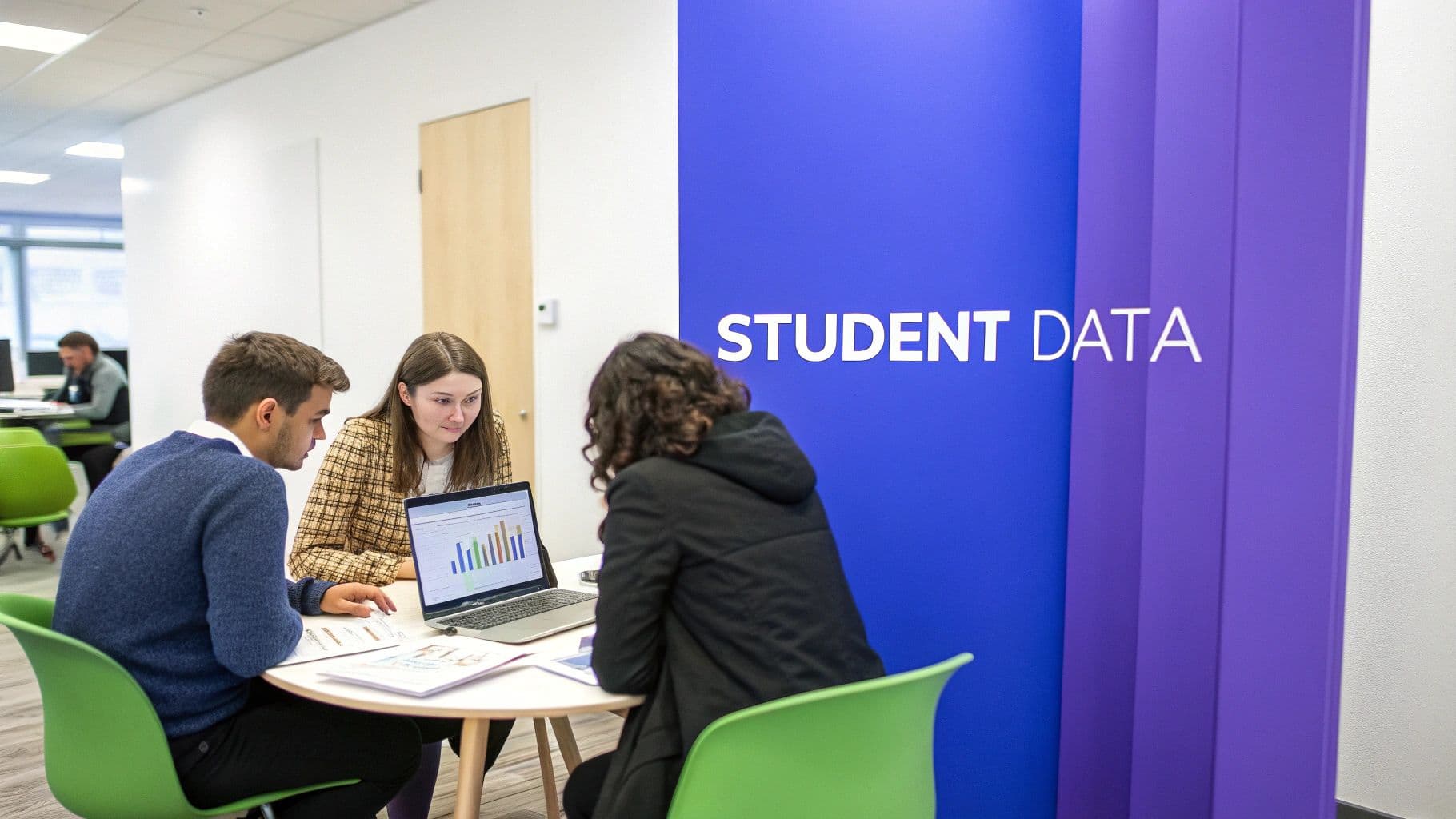
Models like the Data Wise process from Harvard Graduate School of Education have shown how this collaborative inquiry can lead to significant gains. When teams use structured protocols, they ensure that conversations are evidence-based, equitable, and focused on actionable solutions rather than judgment.
How to Implement Structured Data Meetings
Effective data analysis requires structure and a non-judgmental culture. The key is to use protocols that guide the conversation toward improving instruction for all students.
- Establish Clear Protocols: Use established protocols (like the ATLAS protocol for looking at student work) to guide discussions. This keeps the focus on evidence and prevents conversations from becoming personal or defensive.
- Focus on Actionable Insights: The purpose of analyzing data isn't just to identify problems; it's to find solutions. End every meeting by asking, "What are our specific next steps based on this evidence?"
- Generate and Analyze Common Assessments: The most meaningful data comes from common assessments that measure the same standards. You can leverage an AI tool like Kuraplan to create standards-aligned assessments, ensuring the data your team analyzes is consistent and directly tied to learning goals. For more ideas on using data effectively, explore these data-driven instruction examples.
Teacher Collaboration Strategies — 10-Point Comparison
| Approach | 🔄 Implementation complexity | ⚡ Resource requirements | ⭐📊 Expected outcomes | 💡 Ideal use cases | ⭐ Key advantages |
|---|---|---|---|---|---|
| Professional Learning Communities (PLCs) | Medium–High; ongoing cycles and skilled facilitation required | Medium; regular protected meeting time, data tools, admin support | ⭐⭐⭐⭐ Improved student achievement; coherent curriculum; measurable gains | Whole-school alignment, sustained instructional improvement | Collective expertise; data-driven decisions; shared accountability |
| Instructional Coaching & Peer Mentoring | Medium; individualized cycles and coaching skills needed | High; qualified coaches, release time, coach training | ⭐⭐⭐⭐ Increased teacher efficacy; targeted classroom change | New/struggling teachers; targeted instructional initiatives | Personalized PD; real-time modeling; improves retention |
| Collaborative Lesson Study | High; detailed research lesson design and multiple teach/observe cycles | Medium–High; extended planning, observation time, training | ⭐⭐⭐⭐ Deep pedagogical insight; evidence-based lesson refinements | Improving complex content instruction and inquiry-driven practice | Produces durable, research-based lessons; deep content understanding |
| Departmental & Grade-Level Team Meetings | Low–Medium; agenda-driven routine collaboration | Low–Medium; protected planning time, shared digital docs | ⭐⭐⭐ Greater consistency in curriculum and assessments; efficiency | Routine alignment, pacing, and common-assessment development | Curricular coherence; efficient resource sharing; quick coordination |
| Cross-Curricular Integrated Planning | High; cross-department coordination and standards mapping | High; substantial coordination time, interdisciplinary assessment design | ⭐⭐⭐⭐ Higher student engagement; better transfer of learning | Thematic units, project-based learning, STEAM or magnet programs | Authentic, relevant learning; breaks subject silos; complex thinking |
| Peer Observation & Feedback Cycles | Medium; requires protocols and feedback training | Medium; scheduling observations, observer training | ⭐⭐⭐ Practical instructional improvements; shared strategies | Building reflective practice and collaborative culture | Classroom-focused feedback; fosters mutual learning; low external cost |
| Knowledge Sharing, Resource Libraries & Online Communities | Low–Medium; platform setup and governance needed | Low–Medium; tech infrastructure, curation/moderation time | ⭐⭐⭐ Time saved in planning; wider access to vetted materials | Scaling resources, onboarding new teachers, OER distribution | Preserves institutional knowledge; efficient planning; broad access |
| Collaborative Curriculum Mapping | High; comprehensive, cross-grade mapping and upkeep | High; sustained time, multi-grade participation, ongoing maintenance | ⭐⭐⭐⭐ Coherent K–12 scope & sequence; gaps and redundancies identified | District-wide alignment, curriculum redesign, accreditation work | Clear visibility of pacing/standards; supports vertical alignment |
| Action Research & Inquiry Teams | High; research design, data collection, iterative cycles | Medium–High; time for data work, research support/training | ⭐⭐⭐ Context-specific improvements; builds teacher leadership | Addressing local instructional problems; professional inquiry | Evidence-based solutions; builds analytic skills and autonomy |
| Structured Data Meetings & Student Work Analysis | Medium; protocol-driven analysis and facilitation | Medium; reliable data systems, assessment tools, data literacy PD | ⭐⭐⭐⭐ Data-informed instruction; early intervention and equity insights | RTI, intervention planning, performance monitoring cycles | Actionable instructional adjustments; targets student needs |
Making Collaboration Your Superpower, Not Your Burden
We've explored a wide range of powerful teacher collaboration strategies, from the structured cycles of PLCs and Lesson Study to the dynamic energy of cross-curricular planning and peer observation. The common thread is simple but profound: we are so much more effective together than we are alone. Moving from isolated practice to a culture of shared expertise doesn't happen by accident; it requires intention, structure, and a commitment to professional growth.
The goal isn't to add more meetings to your calendar. It's to transform the time you already spend planning and reflecting into high-leverage activities that directly impact student learning. Whether you're dissecting student work in a structured data meeting or co-planning a unit with a colleague, these strategies provide the frameworks to make those interactions meaningful. They turn hallway conversations into focused, actionable dialogue.
From Strategy to Sustainable Practice
The most important takeaway is that sustainable collaboration is built on a foundation of clear protocols and shared goals. Without them, even the best intentions can dissolve into unproductive discussions. To ensure collaboration is a superpower rather than a burden, it's vital to implement effective team collaboration best practices that establish clear norms, roles, and outcomes for every interaction.
This is also where modern tools can become a game-changer. Technology should serve your pedagogy, not complicate it. For instance, using a platform like Kuraplan to generate standards-aligned lesson frameworks or differentiated materials can eliminate hours of tedious prep work. This frees up your team's collective brainpower to focus on the truly important questions: What do our students need most, and how can we, together, design an experience that meets that need?
Your Next Collaborative Step
The journey to a more collaborative school culture can feel daunting, but it starts with a single step. Don't try to implement all ten strategies at once. Instead, consider this a menu of options.
- Start Small: Choose one strategy that feels most achievable for your team right now. Is it a peer observation cycle with a trusted colleague? Or perhaps a structured protocol for your next grade-level data meeting?
- Define a Focus: Select a specific, measurable goal for your first collaborative effort. It could be improving student performance on a particular standard or increasing engagement in a specific unit.
- Commit and Iterate: View your first attempt as a pilot. Commit to the process, gather feedback, and be willing to adapt your approach. Authentic collaboration is a skill that improves with practice.
Ultimately, mastering these teacher collaboration strategies is about more than just improving lesson plans or raising test scores. It’s about building a professional community that fosters resilience, innovation, and collective efficacy. It’s about creating a school where every teacher feels supported and every student benefits from the collective wisdom of the entire staff. You have the power to build this culture, one thoughtful conversation at a time.
Ready to spend less time on administrative tasks and more time on high-impact collaboration? Discover how Kuraplan can instantly generate standards-aligned lesson plans, activities, and differentiated resources, giving your team the foundation you need for rich professional dialogue. Try Kuraplan today and reclaim your collaborative time.