Index Law 1: Multiplication Mastery
Year 8 Mathematics Australian Curriculum ACARA When multiplying powers with the same base, add the indices
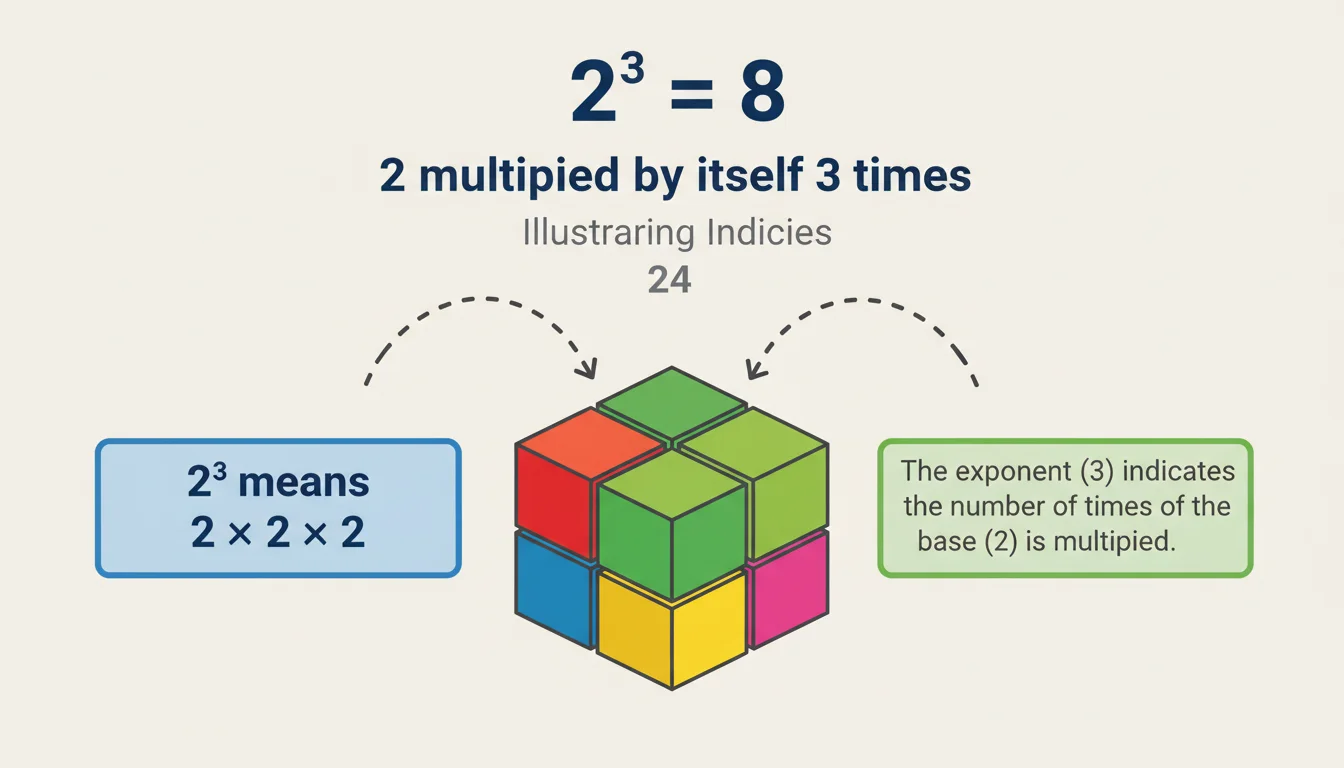
What Are Indices?
An index (or exponent) tells us how many times to multiply a number by itself In 2³, the base is 2 and the index is 3 2³ = 2 × 2 × 2 = 8 Indices help us write large numbers in a shorter way
Check Your Understanding
What does 3⁴ equal? A) 12 B) 7 C) 81 D) 64 Deeper Thinking: If 2ˣ = 32, what is the value of x?
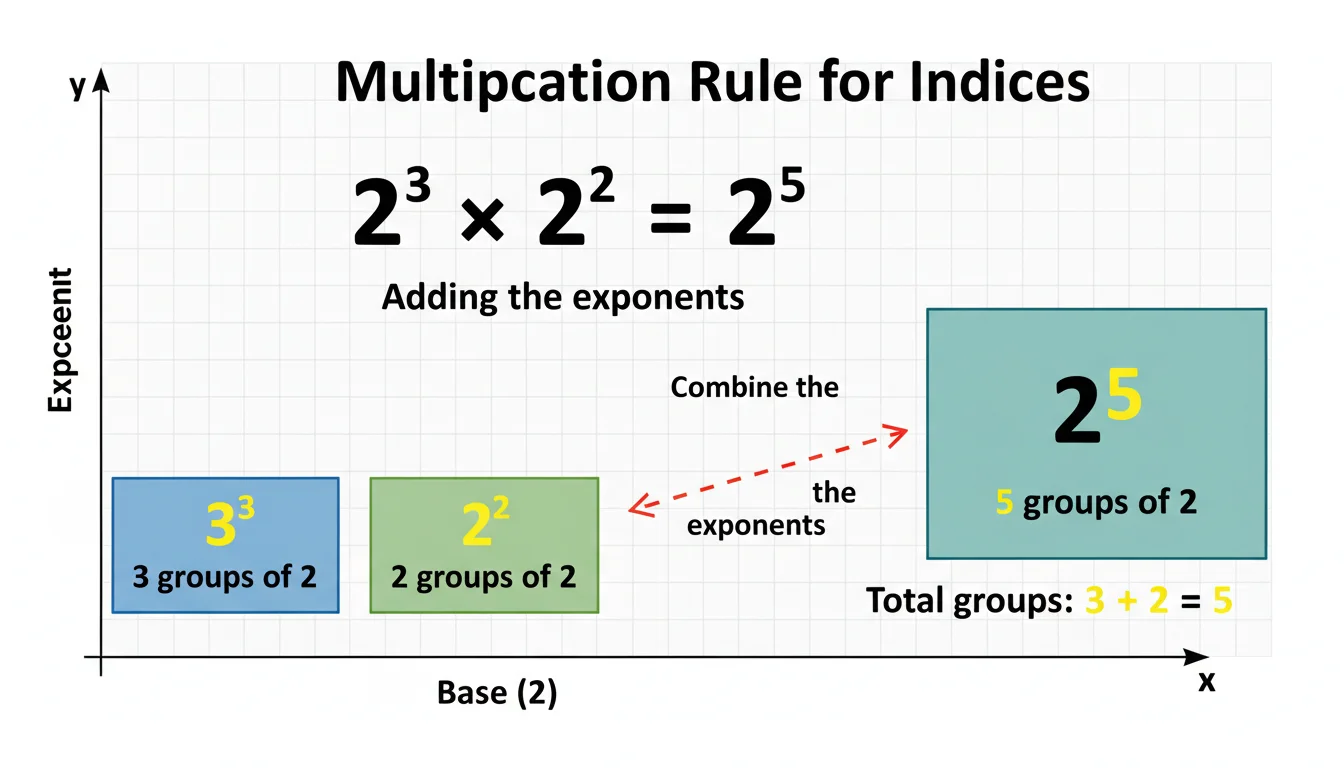
Index Law 1: The Multiplication Rule
When multiplying powers with the same base, ADD the indices aᵐ × aⁿ = aᵐ⁺ⁿ Example: 2³ × 2² = 2³⁺² = 2⁵ = 32 The base stays the same, only the indices change
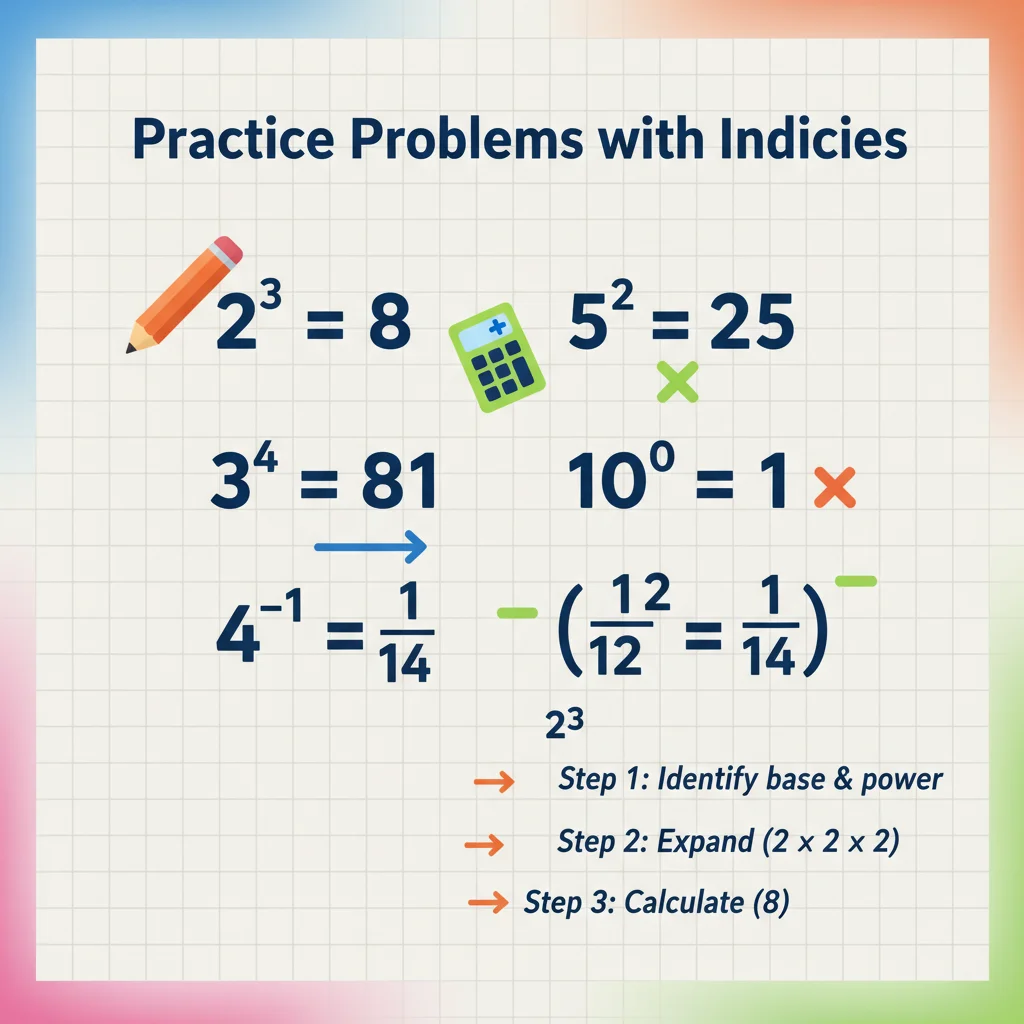
Let's Practice Together
Work through these examples: 3² × 3⁴ = ? 5¹ × 5³ = ? x³ × x² = ? Remember: same base, add the indices!
Quick Check
Which of these is correct? A) 4² × 4³ = 4⁶ B) 4² × 4³ = 4⁵ C) 4² × 4³ = 16³ D) 4² × 4³ = 8⁵ Deeper Thinking: Simplify (2³)² × 2⁴
Common Mistakes vs Correct Method
{"left":"INCORRECT:\n• 2³ × 2² = 2⁶ (multiplying indices)\n• 3² × 3⁴ = 9⁶ (changing the base)\n• 5¹ × 5³ = 25⁴ (adding bases)\n","right":"CORRECT:\n• 2³ × 2² = 2⁵ (add indices)\n• 3² × 3⁴ = 3⁶ (keep same base)\n• 5¹ × 5³ = 5⁴ (add indices only)"}
Challenge Question
What is the value of x² × x³ × x? A) x⁵ B) x⁶ C) 3x⁶ D) x²³ Deeper Thinking: If 3ᵃ × 3ᵇ = 3⁷, and a = 3, what is b?

Real-World Application
Bacteria doubles every hour Start with 2³ bacteria After 1 hour: 2³ × 2¹ = 2⁴ bacteria After 2 hours: 2⁴ × 2¹ = 2⁵ bacteria Index laws help us track exponential growth!
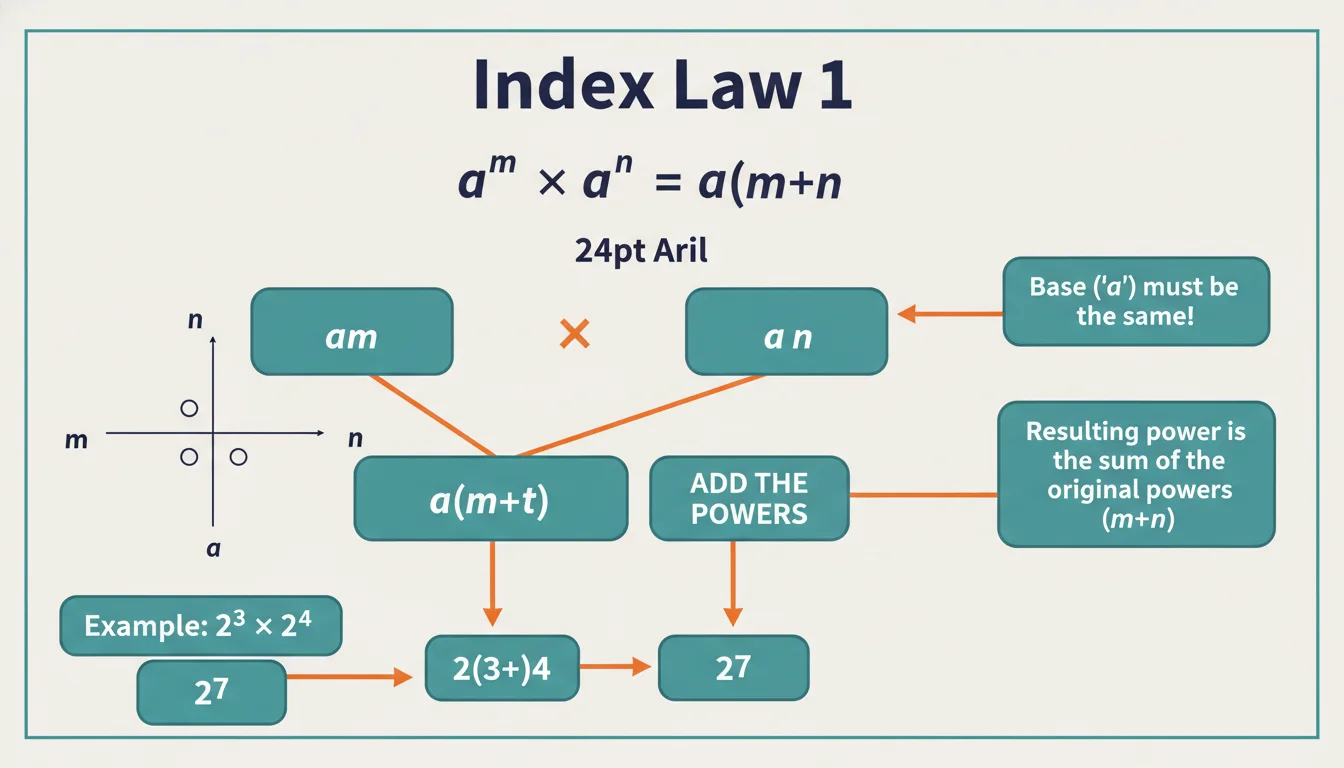
Summary: Index Law 1
When multiplying powers with the SAME base: ADD the indices: aᵐ × aⁿ = aᵐ⁺ⁿ The base stays the same Only works when bases are identical Essential for simplifying algebraic expressions