Predicting Gas Exchange Through Data
Year 11 Biology Lesson 7: Exploring Cellular Energy and Exchange Interpreting data to understand gas movement
Think About It
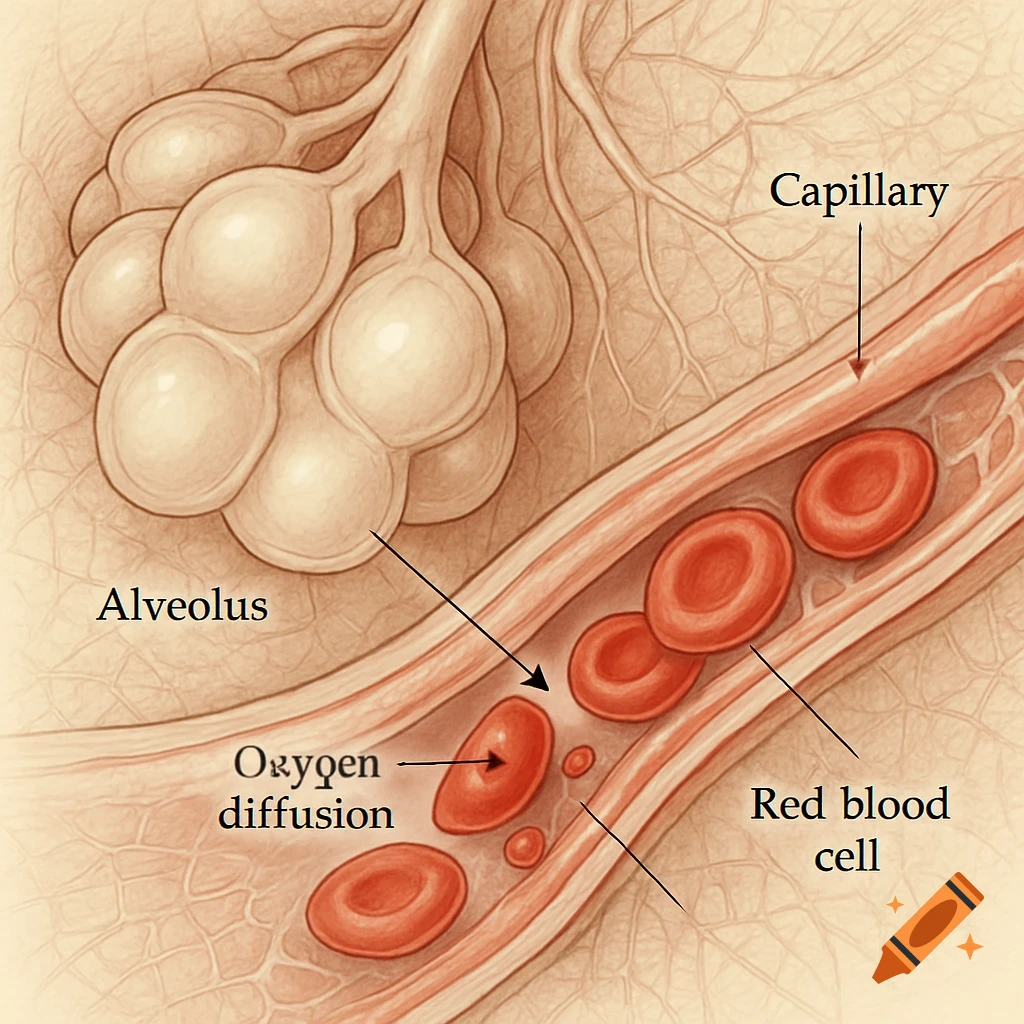
Based on what you know about diffusion, how does oxygen move from your lungs to your muscle cells? What drives this movement?

Key Principles of Gas Exchange
Diffusion occurs from high to low concentration Partial pressure drives gas movement Oxygen moves: alveoli → blood → tissues Carbon dioxide moves: tissues → blood → alveoli

Understanding Partial Pressure
Partial pressure = pressure exerted by one gas in a mixture Measured in mmHg or kPa Higher partial pressure = more gas molecules Drives diffusion across membranes

Data Analysis Challenge
Work in pairs to analyze gas concentration data Compare partial pressures in different locations Predict direction of gas movement Justify your predictions using scientific reasoning

Sample Data Interpretation
{"left":"Alveoli: O₂ = 100 mmHg, CO₂ = 40 mmHg\nPulmonary capillaries: O₂ = 40 mmHg, CO₂ = 46 mmHg\nPrediction: O₂ moves alveoli → blood\nPrediction: CO₂ moves blood → alveoli","right":"Muscle tissue: O₂ = 20 mmHg, CO₂ = 60 mmHg\nSystemic capillaries: O₂ = 95 mmHg, CO₂ = 40 mmHg\nPrediction: O₂ moves blood → muscle\nPrediction: CO₂ moves muscle → blood"}

Extension Thinking
What would happen to gas exchange during intense exercise? How might altitude affect these measurements? What if someone had lung disease?

Success Check & Next Steps
Can you interpret partial pressure data correctly? Can you predict gas movement direction? Can you explain your reasoning scientifically? Next lesson: Factors affecting gas exchange efficiency