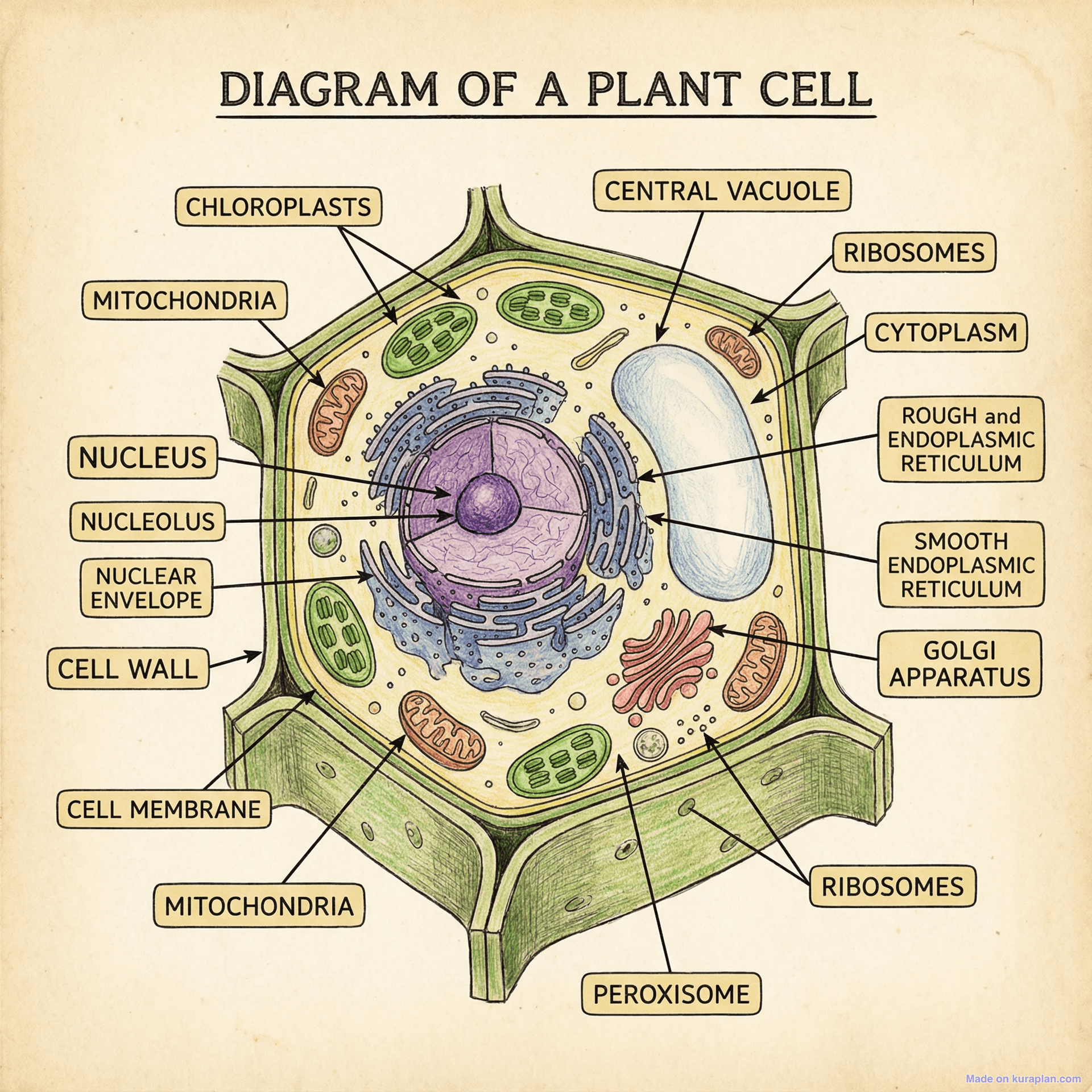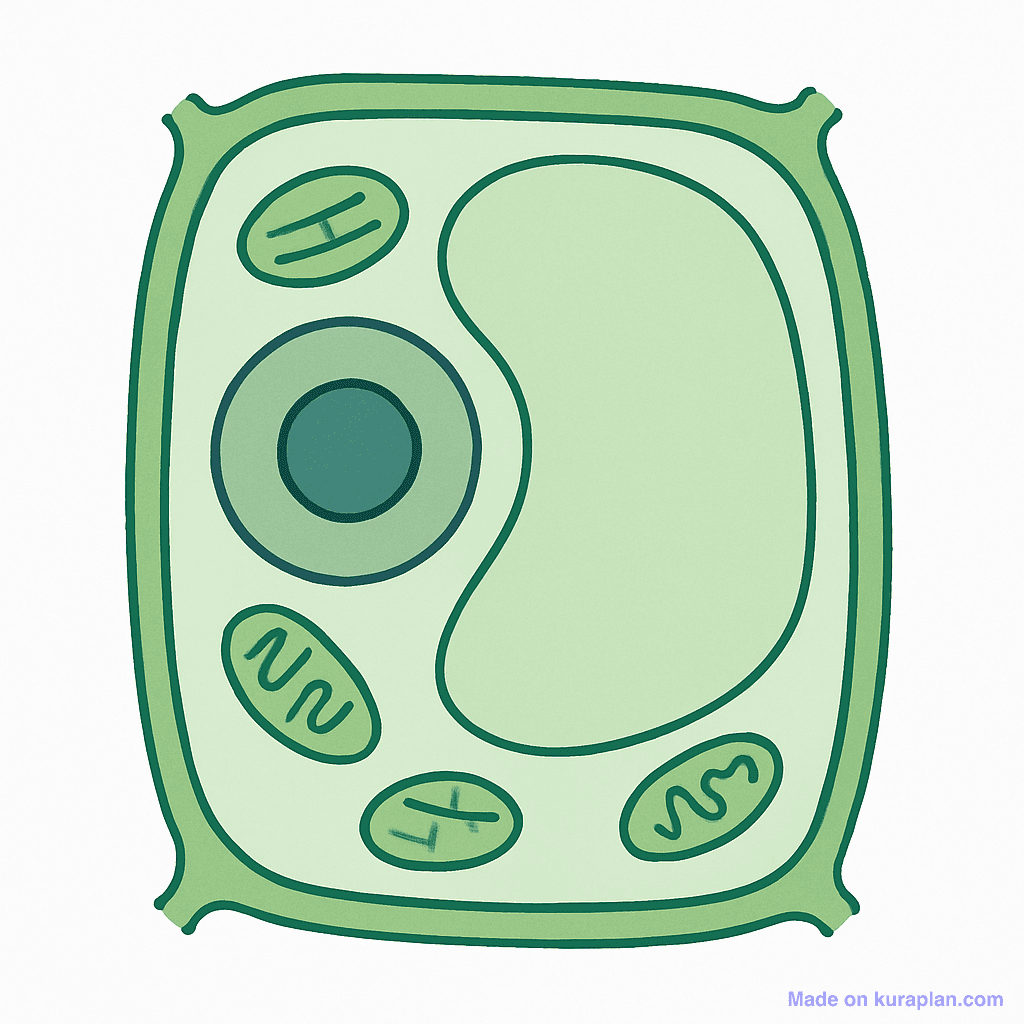
Hey fellow teachers! Let's be honest, making microscopic concepts feel real and exciting is one of our biggest challenges. That standard diagram of a plant cell isn't just a drawing; it's a blueprint for life, a tiny factory powering our entire planet.
But how do we make it click for our students?
Bringing the Microscopic World into Your Classroom
This guide is your answer. We're going to move beyond rote memorization and start exploring the plant cell as a bustling, microscopic city. You'll get clear explanations for each part, grade-specific teaching strategies, and creative classroom activities that actually spark curiosity.
We’ll connect this tiny building block to huge ideas like photosynthesis and ecology, making it relevant for everyone from elementary kids to high school biology students. Think of this as your practical, teacher-to-teacher playbook for turning a standard lesson into an unforgettable exploration.
Making a Complex Topic Accessible
The goal here is to demystify cell biology and make it feel more like an adventure than a chore. Using relatable analogies and hands-on activities, we can help students see the vibrant, active world inside every leaf and stem. It's all about building a strong foundation they can rely on later.
To really bring this world to life, some educators are even using modern web tech to create incredible interactive 3D models. These tools can turn a flat, static drawing into a dynamic experience students can explore.
For so many students, the leap from a 2D diagram to a 3D concept is where true understanding begins. Visualizing the cell as a living system, not just a flat image, is the key.
Building a Foundation for Deeper Learning
Understanding the parts of a plant is the perfect first step. For a lesson that pairs perfectly with this one, check out our guide on exploring plant parts and their functions.
Of course, when you're short on time, creating all these engaging materials from scratch can feel like a mountain to climb. That’s where a tool like Kuraplan comes in. You can instantly generate age-appropriate diagrams, worksheets, and full lesson plans, freeing you up to focus on what you do best—inspiring your students.
Alright, let's dive in.
Anatomy of a Plant Cell: A Tour of the Organelles
Ready to journey inside that tiny green powerhouse? Let’s move past dry lists of terms and explore the plant cell as a bustling miniature city. This analogy is a fantastic way to help students grasp each part's function in a way that truly sticks.
First up is the Cell Wall, which is like the city's sturdy, fortified outer wall. Made of tough cellulose, it gives plants the rigid structure they need to stand tall and provides a solid first line of defense.
Just inside that wall, you'll find the Cell Membrane. Think of it as the city's high-tech security gate. This flexible layer carefully controls what comes in and what goes out, making sure only essential nutrients and water pass through while keeping unwanted substances at bay.
The Command Center and Power Plants
At the very heart of our city is the Nucleus—this is City Hall. It's a crucial organelle that houses the cell's DNA, which acts as the official blueprints for everything the cell does. From growth to reproduction, the nucleus directs all activities to keep the city running smoothly.
The real magic, though, happens in the Chloroplasts. These are the city's solar power plants. Packed with green chlorophyll, they capture sunlight and convert it into chemical energy through photosynthesis, producing the food that fuels the entire plant. You can dive deeper into this process with our full lesson plan for understanding photosynthesis, which really brings these power plants to life.
To help you connect these ideas in the classroom, this concept map shows how to link the core concepts of a plant cell diagram to hands-on activities and real-world relevance.
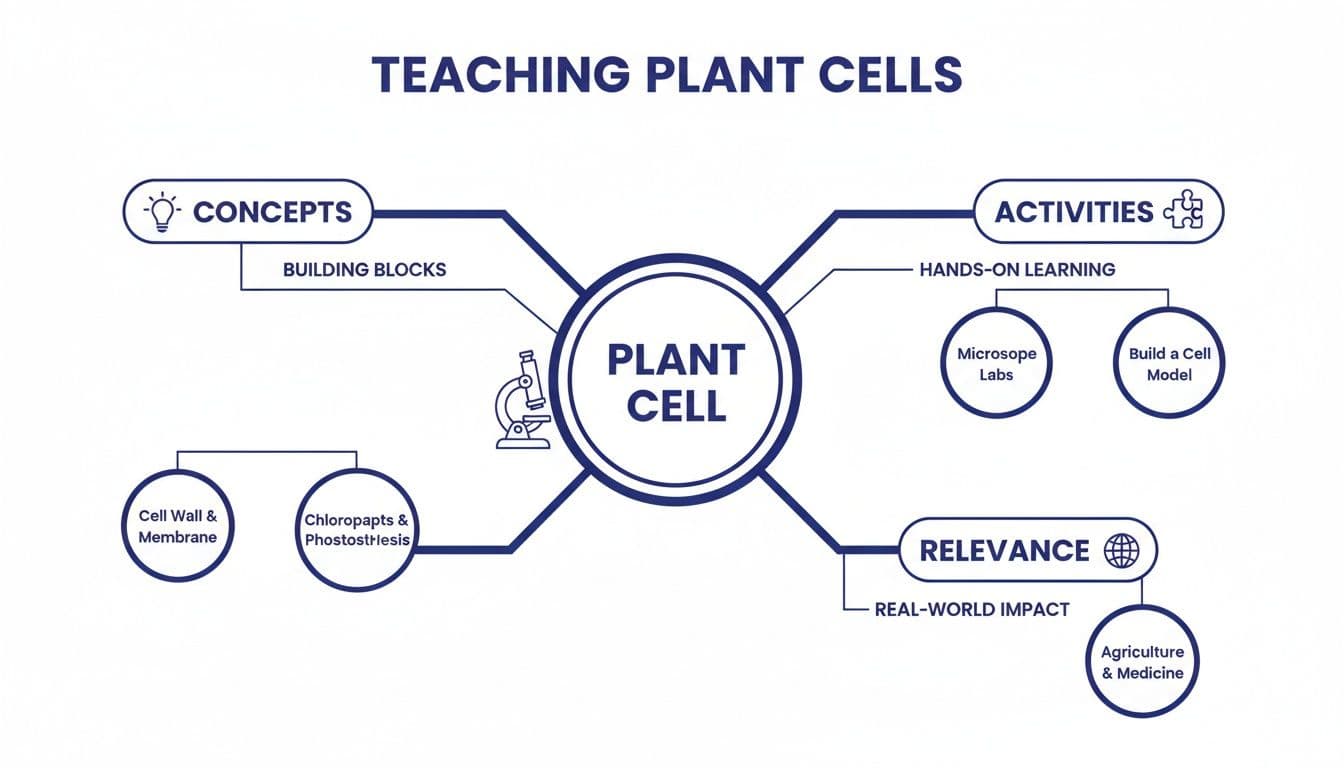
As the map illustrates, the best teaching combines a solid conceptual foundation with engaging activities, helping students see the vital role these tiny structures play on our planet.
Storage, Energy, and Support Systems
Every city needs a large reservoir and a central warehouse. In the plant cell, that’s the job of the massive Central Vacuole. This huge, water-filled sac is so big it can take up 90% of the cell's volume.
It’s not just for storage, though. The central vacuole has a few critical jobs:
- It stores water, nutrients, and even waste products.
- It maintains turgor pressure against the cell wall, which is what keeps the cell firm and the plant standing upright. When a plant wilts, it's because its vacuoles have lost water.
Finally, we have the Mitochondria, which are like the local power stations scattered throughout the city. These organelles take the sugars made by the chloroplasts and convert them into usable energy packets called ATP. This energy is what powers all of the cell's activities, from making repairs to building new parts.
To make these functions even clearer for your students, here’s a quick reference table using our city analogy.
Key Plant Cell Organelles and Their Functions
| Organelle | City Analogy | Primary Function |
|---|---|---|
| Cell Wall | City Fortification | Provides structural support and protection. |
| Cell Membrane | Security Gate | Controls what enters and exits the cell. |
| Nucleus | City Hall | Contains DNA and directs all cell activities. |
| Chloroplast | Solar Power Plant | Converts sunlight into food via photosynthesis. |
| Central Vacuole | Reservoir & Warehouse | Stores water, maintains pressure, and holds nutrients. |
| Mitochondria | Power Station | Converts food into usable energy (ATP). |
By framing each organelle within a familiar analogy, students can move from just memorizing a diagram to truly understanding how a plant cell works as a dynamic, interconnected system.
The Story Behind the Diagram
That plant cell diagram we show our students isn't just a static drawing; it's the final page of a thrilling scientific adventure. It’s a story packed with curiosity, groundbreaking tech, and brilliant minds solving a puzzle they couldn't even see with the naked eye. Sharing this history turns the diagram from a list of facts into a masterpiece centuries in the making.
When we tell this story, the cell transforms from a simple vocabulary list into a profound discovery. It helps students see that science isn't about memorizing answers but about asking questions, observing, and building on what others have found. The worksheet on their desk is the baton passed down through an incredible scientific relay race.
The First Glimpse into a New World
Our story kicks off in 1665 with a scientist named Robert Hooke. Picture him hunched over his rudimentary microscope, looking at a thin slice of cork. What he saw were tiny, boxy structures that reminded him of the small rooms—or 'cells'—where monks lived. He was the first person to ever see one.
That single observation laid the groundwork for everything we know about cells today. But the real "aha!" moment came in the 1830s. In 1838, Matthias Schleiden proposed that all plants were made of cells. Just one year later, Theodor Schwann confirmed the same for animals, cementing the idea that cells are the fundamental building blocks of all life. You can actually walk your students through a detailed timeline of these pivotal discoveries to show how the puzzle came together.
This was the point where science established a core truth: if you want to understand a living thing, you have to start with the cell.
Adding Pieces to the Puzzle
Once Hooke opened the door, the race was on to figure out what was inside those tiny boxes. As microscopes got better and better, scientists started spotting the organelles we teach about today. Every new discovery added another piece to our diagram of a plant cell.
One of the biggest breakthroughs came from Rudolf Virchow in 1855, who famously declared that all cells come from pre-existing cells. His idea, "omnis cellula e cellula," finally put the old theory of spontaneous generation to rest. It proved that the cell was at the very heart of reproduction and life itself.
Understanding this history is so powerful in the classroom. It shows students that the diagram isn't just something to memorize; it’s a map drawn by generations of explorers who ventured into a microscopic world.
This narrative of discovery is a fantastic teaching tool. Instead of just handing over the finished diagram, you can reveal the story piece by piece. You could even use a tool like Kuraplan to generate a series of diagrams that build on each other—starting with Hooke’s simple sketch and adding organelles as they were discovered. This approach shows students how scientific knowledge evolves, making the whole topic far more engaging and memorable.
Adapting Your Plant Tissues Lessons for Every Grade Level
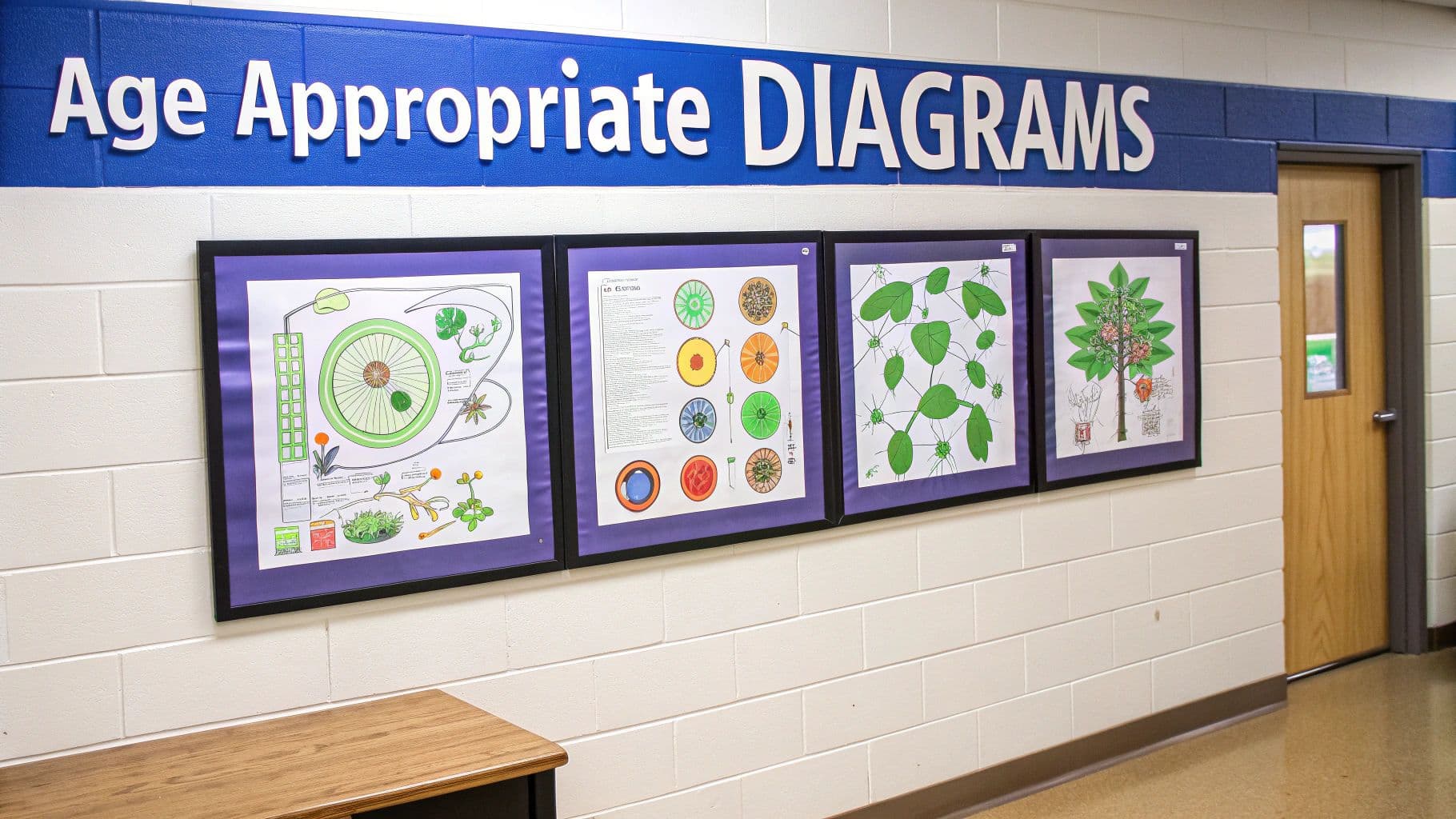
A plant cell diagram that works for a third grader will likely overwhelm them, while a high schooler needs much more detail. The key to a successful lesson is differentiation—meeting students exactly where they are. Let’s break down how to adapt your lessons for every grade level.
This isn’t just about simplifying a drawing. It’s about strategically focusing their attention on the most relevant concepts for their developmental stage. By doing this, we build a strong, layered understanding that deepens over time.
Elementary School: Focus on The Big Three
For your youngest learners, keep it simple and relatable. Focus on what makes a plant cell special: the cell wall, chloroplasts, and the central vacuole. These three parts offer the perfect introduction without causing cognitive overload.
Use a simple analogy, like a house. The cell wall is the sturdy brick exterior, the chloroplasts are the kitchen making food from sunlight, and the big vacuole is the water tank in the basement. Activities like building edible cell models with candies representing these key parts work beautifully here.
Middle School: Expanding the City
Middle schoolers are ready for more complexity. Now, we can expand our diagram of a plant cell to include the "command center" and "power stations" we discussed earlier. This is the ideal time to introduce the nucleus and mitochondria.
You can build on the city analogy, explaining how the nucleus acts as the mayor’s office, directing everything, while mitochondria are the power plants that keep the lights on. This helps them understand the flow of information and energy within the cell.
A key goal here is to shift students from merely identifying parts to understanding the dynamic relationships between them. It’s not just a collection of organelles; it's a living, working system.
It's also crucial to connect these lessons to the bigger picture. After all, plant cells power 80% of global food production, with chloroplasts producing 100-150 billion tons of glucose annually. Globally, 1.2 billion students study these tiny factories, and research shows that diagrams boost retention by 65% in visual learners. Highlighting these facts makes the content feel important and relevant. You can explore more about the evolution and impact of plants to see just how critical these cells are.
High School: Diving into Detail
High school students can handle the ultrastructure. Here, you introduce the finer details: the endoplasmic reticulum, Golgi apparatus, and ribosomes. Discuss the fluid mosaic model of the cell membrane and the biochemistry of photosynthesis and cellular respiration.
At this level, students can move beyond static diagrams. Encourage them to create digital presentations, animations, or detailed 3D models. This challenges them to synthesize their knowledge and demonstrate a deeper understanding of cellular processes.
For any teacher feeling short on time, creating three different versions of every lesson is a tall order. This is where a tool like Kuraplan can be a lifesaver. You can instantly generate age-appropriate diagrams, worksheets, and activities tailored to elementary, middle, or high school standards, ensuring every student gets the right level of challenge without you spending hours on prep.
Hands-On Activities and Printable Resources
Looking at a diagram of a plant cell is a great start, but the real magic happens when learning becomes hands-on. Let's get students doing instead of just listening. These activities help turn abstract organelles into something tangible and memorable.
One of the all-time classroom favourites is the "edible cell model." It's simple: use a pan of green Jell-O for the cytoplasm and have students place different candies to represent the organelles. Think a jawbreaker for the nucleus, green M&Ms for chloroplasts, and a fruit roll-up for the cell membrane. It's a delicious way to make the lesson stick.
Another fantastic project is creating a "Cell City" poster. Students give each organelle a job within a city—the mitochondria become power plants, the nucleus is city hall—and draw their own bustling metropolis. This analogy-based activity is brilliant for reinforcing how each part functions within a larger, interconnected system.
Modern Twists and Digital Tools
For a more modern spin, why not try stop-motion animation? Students can use clay or paper cutouts to show processes like photosynthesis in action, moving chloroplasts and energy packets frame by frame. Augmented reality (AR) apps are another incredible option, letting students explore a 3D plant cell right on their desks with a tablet.
Creating custom visuals for these projects can be time-consuming. To speed things up, teachers can use AI image generators to design unique diagrams or illustrations. For lesson planning and worksheet creation, AI assistants like Kuraplan can generate custom activities, diagrams, and quizzes tailored to your exact needs, which is a huge time-saver.
Printable Resources and Custom Worksheets
Of course, no lesson is truly complete without solid printable resources. We all need high-quality diagrams—both labeled versions for teaching and unlabeled ones for quizzes. They're essential for reinforcement and assessment.
But what if you could create perfectly tailored resources in seconds?
The ability to instantly generate a worksheet that matches your exact learning objective is a game-changer. It frees you from the endless search for the 'perfect' resource and lets you focus on your students.
This is where an AI tool like Kuraplan really shines. Instead of hunting for a generic worksheet, you can ask it to generate a custom coloring page, a matching game for organelles, or a fill-in-the-blanks quiz based on your specific plant cell diagram. It automatically aligns everything to your grade level and standards.
If you're looking for more ways to structure these lessons, our guide on investigating cell structures offers a great framework. This approach saves you valuable prep time and ensures you have beautiful, effective materials ready to go for every class.
Common Questions About the Plant Cell Diagram

Even with the clearest lesson, the diagram of a plant cell always seems to spark a few more questions. That’s a good thing! It means students are digging deeper into these complex little worlds. To help you stay one step ahead, I've put together answers to the questions that pop up most often in my own classroom.
Think of this as your back-pocket guide for those "what about..." and "how come..." moments. Having a simple, confident answer ready keeps the lesson moving and helps every student connect the dots.
What Are the Main Differences Between Plant and Animal Cells?
This is always the first question, and it’s a great one because it cuts right to the heart of what makes plants so unique. While they’re both eukaryotic cells, there are three major differences you’ll want to point out on any diagram.
- The Cell Wall: Plant cells have a rigid outer wall made of cellulose that gives them structure and protection. Animal cells just have a flexible membrane. I like to say a plant cell is like a building with brick walls, while an animal cell is more like a tent.
- Chloroplasts: These are the little green powerhouses responsible for photosynthesis—the magic of turning sunlight into food. Since plants make their own food, they need chloroplasts. Animals, on the other hand, are consumers, so our cells don't have them.
- A Large Central Vacuole: A mature plant cell has one giant, water-filled sac that acts like an internal water balloon. It stores water and nutrients and maintains pressure to keep the plant from wilting. Animal cells might have tiny vacuoles, but nothing like this.
How Can I Make Learning the Organelles More Engaging?
Getting students past rote memorization is the real goal here. We want them to understand the why behind each organelle, not just cram vocabulary for a test.
Analogies are your absolute best friend. Comparing the cell to a bustling city or a factory works wonders. The nucleus is city hall, making all the decisions, while the mitochondria are the power plants keeping the lights on.
Hands-on activities are a total game-changer. When students build a 3D model with Jell-O or clay, they’re creating a physical map of the cell in their minds. It creates a much stronger memory of the diagram of a plant cell than just looking at a flat picture.
You can also lean on digital tools to liven things up. Interactive online diagrams are great, but for something more specific to your lesson, a tool like Kuraplan can generate custom matching games or "Who Am I?" organelle riddles in just a few clicks. I’ve also had huge success with having students act out the roles of organelles in short skits—it's memorable and a lot of fun.
Where Can I Find High-Quality Printable Plant Cell Diagrams?
Excellent question! You can often find great, scientifically accurate diagrams on university biology websites or from science education organizations. The only problem is that sifting through them all to find one that’s just right for your grade level can take up a huge chunk of planning time.
This is where an AI lesson planner really shines. Instead of spending an hour searching, you can just ask it to create the exact diagram you need. A prompt like, "Generate a simple, labeled diagram of a plant cell for 5th graders" or "Create a detailed diagram for an AP Biology class" will give you a custom, standards-aligned visual you can print and use immediately. It saves you the hunt and guarantees the content is perfectly matched to your students.
Ready to stop spending your evenings searching for the perfect diagrams and worksheets? Let Kuraplan do the heavy lifting. You can instantly generate beautiful, standards-aligned lesson plans, visuals, and activities, giving you more time to focus on what you do best—inspiring your students. Start planning smarter today.