Let’s be real. The first few days of school set the entire tone for the year. We all want to build a connected, respectful classroom community, but the pressure is on. Juggling seating charts, syllabi, and a room full of new faces, who has time to reinvent the wheel? That's why having a go-to list of effective icebreakers is a teacher's secret weapon.
But not just any icebreaker. We need activities that are more than just filler; they need to be purposeful, inclusive, and genuinely fun. Forget the awkward silences and forced sharing that come with tired, overused games. This list is packed with 10 teacher-approved options that actually work, from getting kinesthetic learners moving to providing safe entry points for shy students. Each activity is designed to build connections and establish a positive learning environment from the very first bell.
We will break down each classroom icebreaker activity with everything you need to use it tomorrow:
- Step-by-step directions
- Differentiation tips for diverse learners
- Specific learning objectives
- Adaptations for remote or hybrid classrooms
Think of this as your practical playbook for building a classroom where every student feels seen and ready to learn from day one. These activities are foundational first steps. For more ideas on fostering a supportive environment throughout the year, explore other essential classroom community building activities. This curated collection goes beyond simple introductions, providing a blueprint for creating a space where authentic learning and collaboration can flourish.
1. Two Truths and a Lie
A classic for a reason, "Two Truths and a Lie" is a fantastic classroom icebreaker activity that encourages creative thinking while building community. Each student prepares three statements about themselves: two that are true and one that is a believable lie. They share these statements, and the rest of the class votes on which one they believe is the lie. It’s perfect for the first days of school, helping everyone learn names and interesting facts in a low-pressure, engaging way.
This game’s strength lies in its simplicity and adaptability. It reveals student personalities, hobbies, and hidden talents, giving you valuable insights for building relationships throughout the year.
How to Implement It
- Grade Band: K–12
- Time Required: 15–30 minutes
- Learning Objective: Social-Emotional Learning (SEL), Community Building
- Materials: Whiteboard or chart paper (optional)
Step-by-Step Instructions:
- Model First: Start by sharing your own three statements. For example: "I have bungee jumped over a canyon," "I speak three languages fluently," and "My favorite food is Brussels sprouts." This demonstrates the format and sets a fun, open tone.
- Give Preparation Time: Allow students 3–5 minutes to quietly brainstorm and write down their two truths and a lie. Encourage them to make the lie plausible.
- Share and Guess: Have students share their statements one by one. After each student shares, have the class vote on the lie using a show of hands, thumbs-up/down, or by writing their guess on a small whiteboard.
- The Big Reveal: The student reveals the lie, and a short, fun discussion can follow.
Teacher Tip: For shy or hesitant students, allow them to write their statements on a card and submit them to you. You can then read the statements aloud on their behalf, reducing the pressure of public speaking while still ensuring their participation.
Differentiation and Adaptation
This activity can be easily modified for any classroom. For younger students, provide sentence starters like "I have a pet..." or "My favorite animal is...". For ESL students, simplify the language and offer visual aids.
For a tech-infused approach, students can post their statements in a class discussion board or use a polling feature. AI tools can also be a huge help here. For example, if you're stuck for ideas, you can ask a tool like Kuraplan to generate age-appropriate and curriculum-aligned prompts. You could ask it to create "Two Truths and a Lie" prompts related to a historical figure for a social studies class, turning the icebreaker into a content review session.
2. Human Bingo
"Human Bingo" is a dynamic and interactive classroom icebreaker activity that gets students moving, talking, and discovering connections with their peers. Each student receives a bingo card with squares containing different experiences or characteristics, such as "Has a younger sibling" or "Loves to draw." They then mingle to find classmates who match each description and get their signature in the corresponding square.
This activity excels at breaking down social barriers and encouraging communication among students who might not otherwise interact. It promotes a positive classroom culture by highlighting shared experiences and celebrating the unique diversity within the group.

How to Implement It
- Grade Band: K–12
- Time Required: 15–25 minutes
- Learning Objective: Community Building, Communication, Social Awareness
- Materials: Pre-made bingo cards, pens or pencils
Step-by-Step Instructions:
- Distribute Cards: Give each student a Human Bingo card and a writing utensil.
- Explain the Rules: Clearly state the objective: to find a different classmate for as many squares as possible and get their signature. Set rules, such as only one signature per person on each card and expectations for movement around the room.
- Start Mingling: Let students walk around the classroom, asking questions to find peers who match the squares on their card. Play upbeat background music to build energy.
- Declare a Winner: The first student to get five signatures in a row (horizontally, vertically, or diagonally) shouts "Bingo!" You can also play for a full card (blackout).
- Share Discoveries: After the game, bring the class together and ask students to share one interesting thing they learned about a classmate.
Teacher Tip: Before starting, include a few squares that almost everyone can sign, like "Is a student in this class" or "Is wearing shoes today." This gives everyone an easy start and builds momentum.
Differentiation and Adaptation
This activity is incredibly versatile. For younger, pre-reading students, use picture-based bingo cards with symbols instead of words. In middle school, include squares about hobbies like "Plays a sport" or "Enjoys video games." For high schoolers, focus on future aspirations or cultural backgrounds.
To make this activity even more targeted, you can use an AI assistant to generate differentiated bingo cards tailored to your grade level and class demographics. For instance, using a teacher-focused tool like Kuraplan, you can simply ask it to "Create a Human Bingo card for a 7th-grade ELA class with prompts about favorite books and authors" to create a content-relevant version of this engaging classroom icebreaker activity.
3. Speed Networking (Structured Partner Interviews)
"Speed Networking" is a dynamic and highly structured classroom icebreaker activity that ensures every student interacts with multiple peers in a short amount of time. Students pair up for brief, timed conversations to answer prepared questions before rotating to a new partner. This rapid-fire format is excellent for building energy and quickly establishing numerous connections across the classroom.
The activity’s strength is its efficiency and structured nature, which minimizes off-task behavior and supports students who may be anxious about unstructured social time. It’s a powerful tool for breaking down cliques and fostering a sense of whole-class community from day one.
How to Implement It
- Grade Band: 3–12
- Time Required: 15–20 minutes
- Learning Objective: Community Building, Oral Communication, Active Listening
- Materials: Timer, bell or chime, projector or whiteboard to display questions
Step-by-Step Instructions:
- Set Up the Space: Arrange students in two lines facing each other, or in an inner and outer circle. This makes rotating partners clear and simple.
- Display Questions: Project or write 2–3 conversation-starting questions on the board for all to see. Examples could be: "What is a skill you'd like to learn this year?" or "If you could have any superpower, what would it be and why?"
- Model and Time: Explain that each "interview" will last for 2 minutes. Model a quick round with a student to demonstrate expectations for listening and sharing. Set the timer and begin the first round.
- Rotate Partners: When the timer goes off, use a clear signal (like a chime) to stop conversations. Have one line or circle of students shift one position to the right to face a new partner. Repeat the process for several rounds.
Teacher Tip: A well-managed rotation is key. Practice the movement once without the interview component to ensure everyone understands how to move. This simple step prevents confusion and makes transitions seamless, an important part of any successful classroom management plan.
Differentiation and Adaptation
This activity is incredibly flexible. For younger students, use simple, visual questions. For ESL or special education students, provide sentence frames and visual supports to guide their conversations and build confidence.
In a virtual classroom, use breakout rooms with pairs of students, automatically shuffling them into new rooms after a set time. For a subject-specific twist, you can use this activity as a content review. AI tools like Kuraplan can generate questions about key concepts from a previous unit, turning the icebreaker into an engaging academic warm-up. You could ask it to create "10 thought-provoking questions about the American Revolution for a 5th-grade history class" to get started.
4. Would You Rather
A highly engaging and kinesthetic classroom icebreaker activity, "Would You Rather" gets students moving and sharing their opinions in a fun, low-stakes format. The premise is simple: students are presented with two choices and must physically move to a designated side of the room to indicate their preference. This activity is excellent for revealing personalities, sparking lighthearted debates, and energizing the classroom atmosphere.
The game's power lies in its ability to quickly build common ground among students who might not otherwise interact. It promotes critical thinking as students justify their choices and creates a dynamic environment where every voice is validated.
How to Implement It
- Grade Band: K–12
- Time Required: 10–20 minutes
- Learning Objective: Community Building, Critical Thinking, Communication
- Materials: None (optional: signs for each side of the room)
Step-by-Step Instructions:
- Establish Zones: Designate two sides of the classroom for the two choices (e.g., the side by the window is Option A, the side by the door is Option B).
- Present a Question: Pose a "Would You Rather" question. Start with fun, simple prompts like, "Would you rather have the ability to fly or be invisible?"
- Get Moving: Instruct students to move to the side of the room that represents their choice. This physical movement is key to keeping the energy high.
- Share the 'Why': Ask for 2-3 volunteers from each group to briefly explain the reasoning behind their choice. This encourages justification and respectful listening.
Teacher Tip: Emphasize that there are no "wrong" answers. This reassures students that it's about personal preference, not correctness, which builds psychological safety and encourages participation from everyone.
Differentiation and Adaptation
This activity is incredibly versatile. For younger students, use picture-based choices or simple questions like, "Would you rather be a dinosaur or a dragon?" For older students, introduce more complex or curriculum-related dilemmas, such as, "Would you rather live in ancient Rome or ancient Egypt?"
For a virtual classroom, use the polling feature in your video conferencing tool or have students type "A" or "B" in the chat. You can also use a teacher-focused AI tool like Kuraplan to generate grade-level appropriate and curriculum-connected questions. For a science class, you could ask it to create prompts like, "Would you rather be a marine biologist or an astronomer?" to seamlessly blend community building with content introduction.
5. Four Corners (Preference or Opinion-Based Sorting)
An excellent kinesthetic classroom icebreaker activity, "Four Corners" gets students moving and helps them visualize the diversity of opinions and preferences within their community. The teacher assigns a different option to each of the four corners of the classroom. Students then move to the corner that best represents their choice, forming instant groups based on shared interests or viewpoints.
This activity is powerful because it’s a low-stakes way for students to express themselves non-verbally. It reveals commonalities and differences in a visually engaging format, making it a perfect tool for building a sense of classroom identity and belonging from day one.
How to Implement It
- Grade Band: K–12
- Time Required: 10–20 minutes
- Learning Objective: Community Building, Kinesthetic Learning, Data Visualization
- Materials: Signs or labels for each corner (optional but helpful)
Step-by-Step Instructions:
- Label the Corners: Clearly designate each of the four corners with a sign or label. Announce the options for the first round. For example: "Which season is your favorite? Spring, Summer, Fall, or Winter?"
- Give Thinking Time: Pose the question and give students 15–30 seconds to think about their choice.
- Move to Corners: Instruct students to quietly walk to the corner that represents their answer.
- Facilitate Discussion: Once students are in their corners, prompt a brief discussion. Ask a volunteer from each group to share why they chose that corner. This allows students to articulate their reasoning and learn from their peers' perspectives.
Teacher Tip: Start with simple, fun topics like favorite foods or animals before moving to more thought-provoking prompts. This builds comfort and ensures all students feel safe participating. You can also use the resulting groups for a quick follow-up partner or small-group discussion.
Differentiation and Adaptation
This activity is easily adapted for all learners. For younger students, use pictures on the corner signs and simple, concrete choices. For older students, you can introduce more complex or abstract topics relevant to your subject, such as learning style preferences (Visual, Auditory, Kinesthetic, Reading/Writing) or opinions on a character’s decision in a novel.
In a virtual setting, you can replicate this using breakout rooms, labeling each room with one of the four options. For topic ideas, an AI tool built for teachers like Kuraplan can generate age-appropriate and curriculum-aligned prompts, like asking it to create "Four Corners prompts about different ecosystems" for a science class to check for prior knowledge.
6. Concentric Circles (Rotating Partner Conversations)
Popularized by cooperative learning models, "Concentric Circles" is a dynamic and highly structured classroom icebreaker activity that gets every student talking. Students form two circles, one inside facing out and one outside facing in, creating pairs. After discussing a prompt for a short period, one circle rotates, giving everyone a new partner for the next question. This method ensures all students participate, practice active listening, and meet multiple classmates in a quick, controlled fashion.
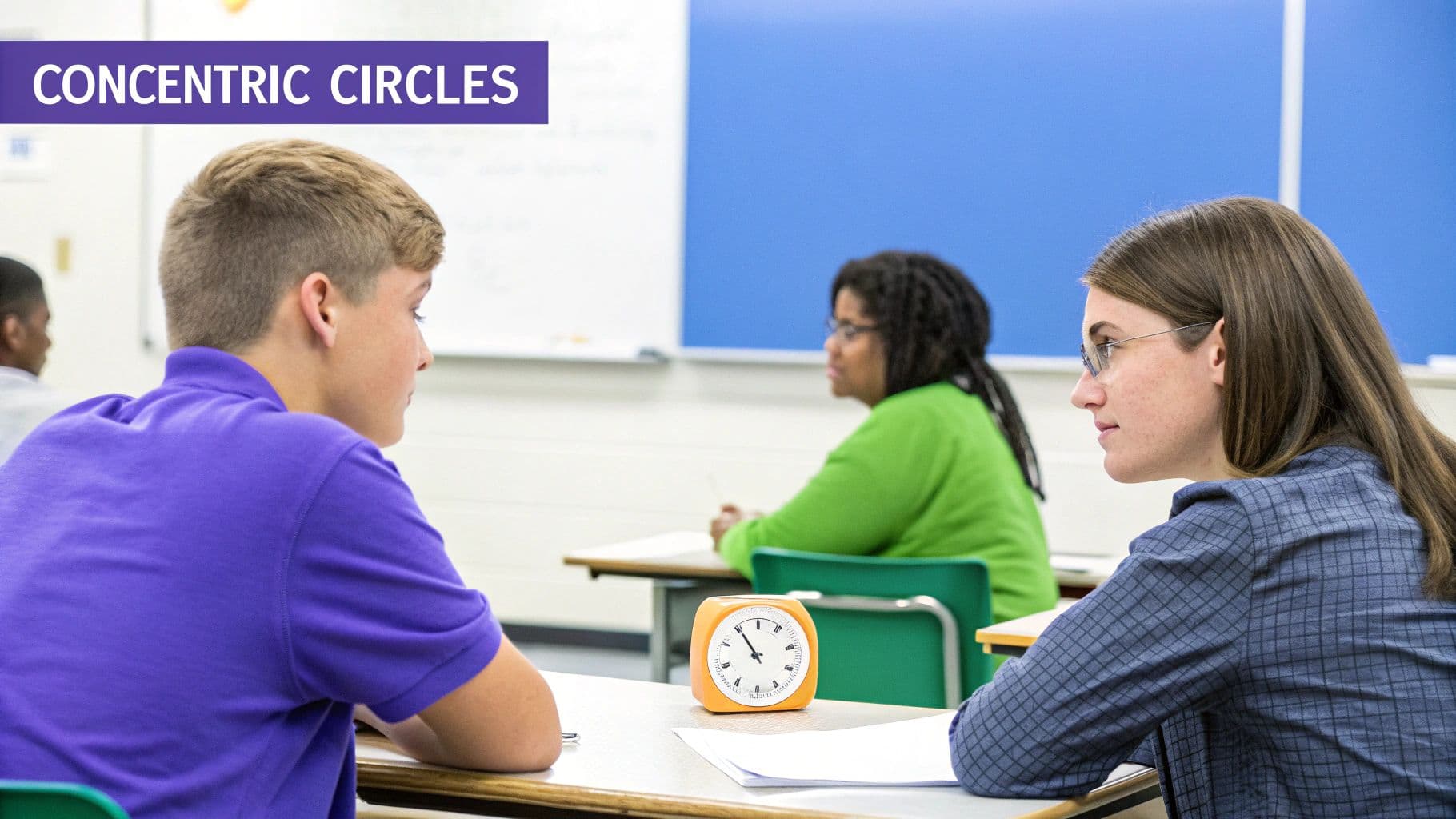
The strength of this activity is its systematic approach to interaction. It equalizes participation, preventing students from sticking to familiar peers and gently pushing them to engage with everyone. The progressive nature of the questions allows you to seamlessly shift from community-building to academic content review.
How to Implement It
- Grade Band: 3–12
- Time Required: 15–20 minutes
- Learning Objective: Collaboration, Communication, Community Building, Content Activation
- Materials: Timer, prepared list of questions
Step-by-Step Instructions:
- Form the Circles: Ask half the class to form a circle in the middle of the room, facing outward. Have the other half form a circle around them, facing inward, so each student has a partner. If you have an odd number, you can participate to complete a pair.
- Explain the Process: Clearly explain that you will ask a question, and pairs will have 90 seconds to discuss it. When the timer goes off, the outer circle will rotate one person to the right.
- Ask and Discuss: Pose the first question. For example: "What is one thing you are proud of accomplishing?" Start the timer and let students talk.
- Rotate and Repeat: Use a clear signal (like a bell or stopping music) to signal the rotation. The outer circle moves, and you pose the next question to the new pairs. Continue for 5–7 rounds.
Teacher Tip: Practice the rotation once or twice without a question to ensure the movement is smooth and efficient. This small step prevents confusion and keeps the activity's momentum going strong.
Differentiation and Adaptation
For students who need more support, pre-teach conversation starters and active listening skills. Provide sentence frames on a whiteboard for reference. You can also allow students to write down their thoughts before sharing.
In a hybrid setting, this can be replicated using breakout rooms. Manually reassign students to new, small breakout rooms after each question round to simulate the rotation. For planning, you can use an AI lesson planner like Kuraplan to generate a progressive sequence of questions that start with social-emotional topics and build toward curriculum-specific content, like asking, "Generate five icebreaker questions about the scientific method for a 7th-grade science class."
7. Classroom Scavenger Hunt (Get to Know You Version)
A dynamic and interactive classroom icebreaker activity, the Get to Know You Scavenger Hunt gets students moving, talking, and discovering connections. Students receive a worksheet with various descriptions and must find classmates who match each one, creating a living map of the diverse skills, interests, and experiences within the room. This activity is excellent for promoting peer interaction beyond immediate friend groups and encouraging natural conversations.
Its key advantage is turning the "getting to know you" process into an active, gamified quest. It breaks down social barriers by giving students a clear, low-stakes reason to approach and talk to one another, building a foundation for collaborative learning.
How to Implement It
- Grade Band: K–12
- Time Required: 15–25 minutes
- Learning Objective: Collaboration, Community Building, Social Awareness
- Materials: Pre-made scavenger hunt worksheets, pens or pencils
Step-by-Step Instructions:
- Distribute the Hunt: Give each student a copy of the scavenger hunt worksheet. The sheet should contain prompts like "Find someone who plays a musical instrument" or "Find someone who has lived in another state."
- Explain the Rules: Instruct students to walk around the room and find a different person to sign their name next to each description that applies to them. Emphasize that they can only use each classmate's name once to encourage broad interaction.
- Start Mingling: Allow students 10–15 minutes to circulate and complete their sheets. The classroom will be buzzing with energy and conversation.
- Share and Debrief: Once time is up, bring the class back together. Ask students to share one surprising or interesting connection they made. This reinforces the value of the activity and highlights shared interests.
Teacher Tip: Include a few items on the list that nearly everyone can answer, such as "Find someone who likes pizza" or "Find someone who watched a movie last weekend." This gives students an easy win to start with and builds their confidence.
Differentiation and Adaptation
This activity is incredibly versatile. For younger students (K-2), use picture-based prompts or symbols. For high schoolers, you can create career-focused items like "Find someone interested in engineering" or "Find someone who has a part-time job."
For a subject-specific twist, you can tailor the prompts to your content. A science teacher might include "Find someone who has visited a national park." To integrate this into your curriculum, you can use an AI planning tool like Kuraplan to generate differentiated scavenger hunt lists based on your specific class demographics, grade level, and subject matter. You can also explore more ways to get students moving and interacting by learning about other active learning strategies for students.
8. Common Ground (Finding Connections in Small Groups)
A fantastic classroom icebreaker activity for fostering collaboration, "Common Ground" helps students discover shared interests and experiences in small groups. Students work together to find a list of things they all have in common, ranging from simple facts like birth months to more abstract ideas like future goals. This activity beautifully illustrates that even in a diverse classroom, there are surprising and meaningful connections waiting to be found.
The strength of this icebreaker lies in its ability to build empathy and break down social barriers. It moves beyond surface-level introductions to create genuine bonds and a sense of belonging among peers.
How to Implement It
- Grade Band: K–12
- Time Required: 15–25 minutes
- Learning Objective: Collaboration, Social-Emotional Learning (SEL), Community Building
- Materials: Whiteboard, chart paper, or a shared digital document
Step-by-Step Instructions:
- Form Groups: Divide students into small groups of 3–5. Use random or strategic grouping to encourage students to interact with new classmates.
- Set the Goal: Challenge each group to find and list 5–10 things all members have in common. Encourage them to find both "easy" things (e.g., "We all have siblings") and "tricky" things (e.g., "We all want to travel to the same country").
- Facilitate Discussion: Give groups 10–15 minutes to talk. Circulate around the room to listen, ask probing questions, and ensure all students are participating and included in the conversation.
- Share Discoveries: Have each group share 1–2 of their most surprising or interesting commonalities with the whole class. Record these on the board to create a visual map of the classroom's shared connections.
Teacher Tip: After the activity, lead a brief discussion with questions like, "What did you learn about your group members that you didn't know before?" or "Was it easy or hard to find things in common?" This reflection deepens the impact of the exercise.
Differentiation and Adaptation
This activity is highly adaptable. For younger students or English learners, provide sentence starters like "We all like..." or "We all have...". For older students, challenge them to find commonalities related to academic interests, career aspirations, or even learning styles.
In a virtual setting, use breakout rooms for small group discussions and a shared Google Doc or Jamboard for each group to list its findings. To enhance the activity, use an AI tool like Kuraplan to generate grade-specific sentence stems or creative discussion prompts that align with your unit of study, turning a simple icebreaker into a relevant learning experience. For more ideas on fostering these connections, explore these social-emotional learning activities.
9. Emoji or Symbol Response (Visual Icebreaker for Diverse Learners)
This inclusive classroom icebreaker activity provides a powerful, non-verbal way for students to share their feelings and perspectives. The teacher presents a question, and students respond by selecting from a set of emojis, symbols, or colored cards that represent different emotions or ideas. This creates an immediate visual snapshot of the classroom's mood, making it especially effective for diverse learners, including those with communication challenges or language barriers.

The strength of this activity is its accessibility. It lowers the barrier to participation and honors the fact that not all students are ready or able to express themselves with words, fostering a more empathetic and supportive classroom environment from day one.
How to Implement It
- Grade Band: Pre-K–12
- Time Required: 5–10 minutes
- Learning Objective: Social-Emotional Learning (SEL), Community Building, Self-Awareness
- Materials: Printed emoji cards, colored cards, or a digital tool (like a Jamboard or slide)
Step-by-Step Instructions:
- Prepare Visuals: Create or print a set of clear, universally understood emojis or symbols. Ensure they are large enough for everyone to see.
- Pose a Question: Ask a simple check-in question. Examples include: "How are you feeling about starting this class today?" or "Show me how you feel about our upcoming project."
- Provide Response Time: Give students a moment to look at the options and select the one that best represents their feelings.
- Share Visually: On your cue, have all students hold up their chosen card or point to their selection on a shared screen. Acknowledge the range of responses to validate everyone's feelings.
Teacher Tip: Create a permanent "Emoji Check-In" poster in your classroom. Students can point to an emoji as they enter the room each day, giving you a quick, private way to gauge their emotional state and identify anyone who might need extra support.
Differentiation and Adaptation
This activity is inherently differentiated. For younger students, use a smaller set of basic emotions (happy, sad, excited). For older students, introduce more complex emotions or use symbols to represent opinions on academic topics. This method is ideal for ESL and special education classrooms as it removes language dependencies.
In a virtual setting, use a polling feature, a chat waterfall with emojis, or an interactive whiteboard where students can place a digital marker on their chosen symbol. If you need a quick set of visuals, an AI tool like Kuraplan can generate a set of culturally appropriate, age-specific emoji cards or digital visuals for your lesson, ensuring the options are relevant and easily understood by your specific group of students.
10. Timeline or Continuum Line (Shared Experience Mapping)
"Timeline or Continuum Line" is a powerful, movement-based classroom icebreaker activity that creates a living visualization of the diversity and shared experiences within your class. Students place themselves along an imaginary or physical line that represents a spectrum of opinion or experience. This simple action allows students to see where they stand in relation to their peers, fostering empathy and revealing both unique perspectives and surprising commonalities.
This activity’s strength is its ability to make abstract concepts tangible. It immediately illustrates the classroom's composition regarding various topics, from personal comfort levels with a subject to diverse life experiences, all without putting individual students on the spot.
How to Implement It
- Grade Band: 3–12
- Time Required: 10–20 minutes
- Learning Objective: Community Building, SEL, Data Visualization
- Materials: Masking tape or a long rope (optional), signs for each end of the spectrum
Step-by-Step Instructions:
- Establish the Line: Create a physical line on the floor with tape or simply designate an imaginary line across an open space in the classroom. Clearly label the two endpoints of the spectrum (e.g., "Strongly Agree" and "Strongly Disagree").
- Pose the Prompt: Present a clear, low-stakes prompt. For example: "Position yourself on this line based on how much you enjoy reading, from 'I don't enjoy it at all' on this end to 'I absolutely love it' on the other."
- Students Find Their Spot: Give students a minute to think and then move to the spot on the line that best represents their position. Encourage them to look around and see where their classmates have placed themselves.
- Facilitate Discussion: Invite students to briefly share why they chose their spot. You can ask students at the ends or in clusters to explain their thinking. Emphasize that all positions are valid.
Teacher Tip: Use this as a pre-assessment tool. A prompt like, "How confident do you feel about our upcoming unit on fractions?" provides instant, visual data on student comfort levels, helping you tailor your instruction.
Differentiation and Adaptation
This activity is highly adaptable. For students who are unable to move or prefer not to, allow them to place a sticky note with their name on a line drawn on the whiteboard or use a digital tool. For younger students, use more concrete and visual prompts, like a spectrum from a frowny face to a smiley face.
In a virtual setting, you can recreate this using the annotation feature on a shared whiteboard in Zoom or a Jamboard/Google Slides template where students drag their name or an icon to a position on a digital line. Need ideas for prompts? A tool like Kuraplan can generate age-appropriate and curriculum-relevant continuum prompts. For a history class, you might ask for prompts about historical figures' decisions, turning the icebreaker into a critical thinking exercise.
Comparison of 10 Classroom Icebreakers
| Activity | 🔄 Implementation complexity | ⚡ Resources & time | 📊 Expected outcomes | Best use cases | ⭐ Key advantages / 💡 Tips |
|---|---|---|---|---|---|
| Two Truths and a Lie | Low — simple rules, needs respectful culture | Minimal materials; 10–15 min | Builds rapport, reveals interests for differentiation | First day, welcoming new students (K-12) | ⭐⭐⭐⭐ Encourages creativity and trust. 💡 Model first; offer written option for shy students. |
| Human Bingo | Medium — requires card design and movement management | Moderate prep (cards); 15–20 min | High interaction, uncovers commonalities, useful demographic data | Community-building, diverse classrooms (K-12) | ⭐⭐⭐⭐ Energizing, customizable. 💡 Include a few common squares; set movement guidelines. |
| Speed Networking (Structured Partner Interviews) | Medium — needs timing, clear transitions | Minimal props; 10–15 min | Rapid connections, equitable participation, quick observational data | Quick community-building, content activation (Grades 2–12) | ⭐⭐⭐⭐ Efficient equal participation. 💡 Display questions and use a timer. |
| Would You Rather | Low — simple prompts and movement choices | Minimal materials; 10–15 min | Visible preference distribution, sparks debate and reasoning | Energizers, perspective-taking, quick checks (K-12) | ⭐⭐⭐ Inclusive and fun. 💡 Start neutral, avoid sensitive prompts. |
| Four Corners | Low–Medium — corner setup and clear labels needed | Minimal materials; 10–15 min | Visual grouping, easy transition to small-group work | Preference surveys, grouping, instructional launch (K-12) | ⭐⭐⭐ Shows class diversity visually. 💡 Label corners clearly; allow opt-outs. |
| Concentric Circles | Medium — requires circle formation and rotation management | Minimal props; 15–20 min | Equitable one-on-one interactions, speaking/listening practice | ESL, speaking practice, content activation (Grades 2–12) | ⭐⭐⭐⭐ Systematic rotations foster voice. 💡 Practice rotation and use a clear signal. |
| Classroom Scavenger Hunt (Get to Know You) | Medium — list design, movement logistics | Moderate prep; 20–30 min | Surfaces talents/experiences, identifies peer mentors | Orientation, talent discovery, multicultural contexts (K-12) | ⭐⭐⭐ Celebrates diversity and assets. 💡 Balance items; provide movement accommodations. |
| Common Ground | Low — small-group facilitation required | Minimal prep; 15–20 min | Builds trust, consensus skills, uncovers hidden similarities | Small-group bonding, SEL, cooperative learning (K-12) | ⭐⭐⭐⭐ Fosters collaboration and belonging. 💡 Use sentence starters; mix group composition. |
| Emoji or Symbol Response | Low — prepare visual cards/icons | Minimal materials; 5–10 min | Fast, accessible mood/data checks, supports diverse communicators | Quick check-ins, ELL, neurodiverse-friendly (K-12) | ⭐⭐⭐⭐ Highly accessible and fast. 💡 Use clear, culturally appropriate symbols; track trends. |
| Timeline / Continuum Line | Medium — needs visible spectrum and space | Minimal props; 10–15 min | Visualizes experience/comfort ranges, fosters empathy | Prior-knowledge activation, perspective-taking (Grades 2–12) | ⭐⭐⭐ Reveals spectrum, reduces binary thinking. 💡 Make line visible and offer non-movement options. |
Making Connections That Last Beyond the First Week
The first few days of school set the trajectory for the entire year, and as we've explored, the right classroom icebreaker activity is far more than a simple time-filler. It's a strategic instructional move designed to build the foundation of your classroom culture. Moving beyond generic "get-to-know-you" questions, the activities detailed in this guide, from Human Bingo to Concentric Circles, are powerful tools for fostering psychological safety, establishing norms of collaboration, and gathering invaluable observational data about your learners.
The true magic of a well-chosen icebreaker isn't in the one-time completion of the activity itself. It’s in the echoes that reverberate throughout the semester. The inside joke sparked during a round of Two Truths and a Lie becomes a point of connection for two otherwise dissimilar students. The shared experience discovered during a Common Ground huddle informs how you structure a collaborative project weeks later. These moments are the initial deposits into a bank of community trust that you will draw from all year long.
From First Impressions to Lasting Instructional Tools
One of the most critical takeaways is the adaptability of these activities. A simple classroom icebreaker activity can, and should, evolve with your curriculum and your students' needs.
- Revisit for Review: The Four Corners format isn't just for opinions about pizza toppings. It can be transformed into a dynamic review session for a history lesson, with each corner representing a different historical figure or event.
- Deepen Social-Emotional Learning: The Emoji or Symbol Response activity, initially used for a simple check-in, can be adapted to help students identify and articulate complex emotions related to a story's characters or a real-world event.
- Activate Prior Knowledge: Before starting a new unit, use a quick round of Speed Networking where students interview each other about what they already know (or think they know) about the upcoming topic. This primes their brains for new information and gives you a real-time pre-assessment.
By viewing each classroom icebreaker activity as a flexible framework rather than a rigid script, you unlock its potential as a recurring instructional strategy.
Cultivating a Welcoming Environment from Day One
The effort you put into orchestrating these initial interactions sends a powerful, unspoken message to your students: "You belong here. Your voice matters. We are a team." This sense of belonging is a prerequisite for academic risk-taking and genuine engagement. It's the difference between a student passively receiving information and actively constructing knowledge alongside their peers.
This welcoming atmosphere is built through both interactive and environmental cues. Beyond interactive activities, visual cues are essential for setting a welcoming tone. You can foster an immediate sense of belonging and excitement for students by considering how to utilize creating effective welcome back banners at the start of the school year. Pairing a vibrant, inclusive physical space with intentional community-building activities creates a multi-sensory experience of welcome.
Ultimately, the goal is to weave the spirit of connection into the very fabric of your classroom. The thoughtfully chosen classroom icebreaker activity is your first and most important thread. It’s the starting point for building a classroom where students feel seen, heard, and ready to learn together.
Ready to spend less time planning and more time connecting? Kuraplan can instantly generate differentiated materials, prompts, and visual aids for any classroom icebreaker activity you choose, aligned to your specific grade level and subject. Transform your community-building ideas into ready-to-use resources in seconds at Kuraplan.