We've all been there: you pour your heart into a lesson, only to be met with blank stares. The truth is, the old "sit and get" model where students just absorb information doesn't really stick. Today's students need to participate, connect, and build their own understanding. This isn't about tossing your curriculum out the window; it's about transforming it with proven active learning strategies for students.
This guide is your practical playbook for creating a dynamic, participatory classroom where every student is a thinker and a collaborator. We’ll skip the dense theory and jump right into 10 high-impact strategies you can use tomorrow. To help students truly embrace these methods and move beyond cramming, it's also a great idea to teach them science-backed methods for effective exam study, which perfectly complements these classroom techniques.
Inside this roundup, you'll find:
- Actionable Steps: Clear, step-by-step instructions for each strategy.
- Real K–12 Examples: Concrete scenarios across grade levels and subjects.
- Differentiation Tips: Guidance for supporting all your learners.
- Assessment Ideas: Practical ways to see what students have learned.
Let’s turn those crickets into a buzz of excited, focused learning.
1. Think-Pair-Share
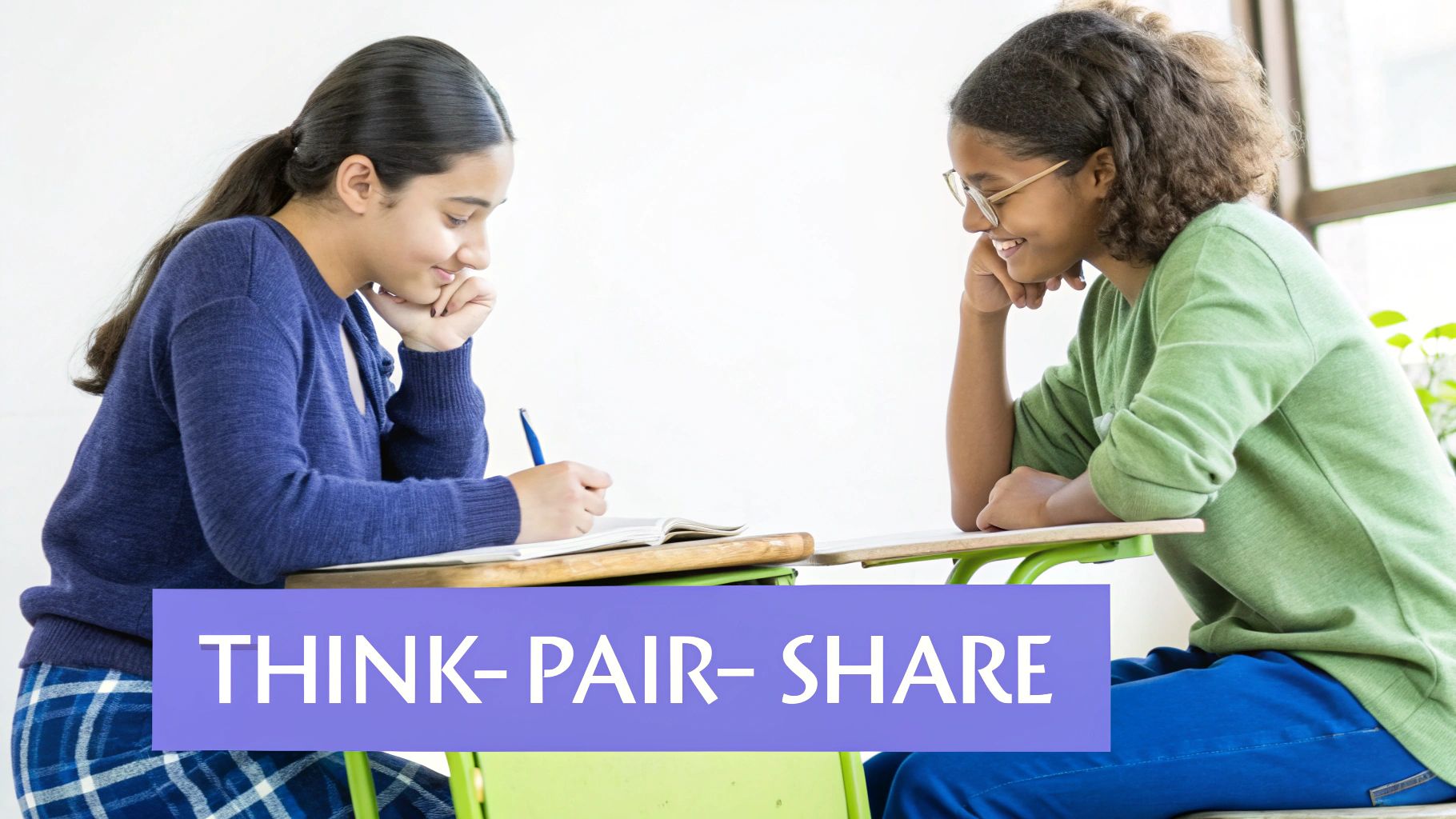
This is a classic for a reason. Think-Pair-Share moves students from being passive listeners to active participants in three simple steps. First, you pose a question, and students take a quiet moment to think on their own. Next, they pair up with a classmate to talk about their ideas. Finally, partners share their combined thoughts with the whole class.
This simple routine changes the whole dynamic. It guarantees that every single student has a chance to process the information and put their thoughts into words before the big group discussion. It’s a great confidence builder and makes your class discussions richer and more inclusive.
Why It Works
Think-Pair-Share is one of the most effective active learning strategies for students because it makes participation fair and accessible. The quiet "think" time is a gift to introverted students and those who need a beat to process. The "pair" phase is a low-stakes way to test out an idea. By the time they "share," students are more confident and their ideas are more polished.
Implementation and Classroom Examples
- Elementary (ELA): After reading a story, ask: "How did the main character change from the beginning to the end?" Students think, chat with a partner, and then share their evidence from the text.
- Middle School (Math): Give them a tricky word problem. Students first try it alone, then compare their method with a partner, and finally, different pairs show the class how they solved it.
- High School (Science): Before a lab, ask a hypothesis question like, "What do you predict will happen when we mix these two chemicals?" This gets their brains warmed up and gives the lab a clear purpose.
Tips for Success
- Use a Timer: Be explicit with time limits for each stage (e.g., 1 minute to think, 2 minutes to pair, 3-5 minutes for sharing).
- Offer Sentence Starters: Provide prompts like, "My idea is..." or "I agree with my partner, and I'd add..." to support all learners, especially English Language Learners.
- Write Great Prompts: The better the question, the better the discussion. If you're stuck, AI tools like Kuraplan can generate thought-provoking, standards-aligned questions in seconds, saving you prep time. You can discover more student-centered activities like Think-Pair-Share on the Kuraplan blog.
2. Peer Teaching and Reciprocal Learning
When students become the teachers, they deepen their own understanding in a powerful way. Peer teaching puts students in the role of being a learning resource for each other. They might explain a concept, lead a small group discussion, or show a skill they've already mastered. The whole idea is that you don't truly know something until you can teach it to someone else.
This strategy turns your classroom into a real learning community. When a student has to explain an idea to a friend, they're forced to organize their thoughts and find any gaps in their own knowledge. It’s a win-win, fostering both mastery and a sense of teamwork.
Why It Works
Peer teaching is so effective because it demands true mastery. To explain something well, you have to understand it far more deeply than just enough to pass a test. It builds metacognition—thinking about thinking—as students have to consider the best way to present information. It also sharpens communication skills, empathy, and the overall classroom vibe.
Implementation and Classroom Examples
- Elementary (Reading): Set up "Reading Buddies." Partners take turns reading a passage aloud while the other listens, offers gentle help with tricky words, and asks a "who, what, where, when, or why" question at the end.
- Middle School (Social Studies): Use a "jigsaw" activity. After students research different parts of an ancient civilization (like government or daily life), they form new groups to teach their specific topic to their peers.
- High School (Chemistry): Assign students to become "procedure experts" for a lab. Each expert is in charge of explaining and demonstrating one step to their group, making sure everyone does it correctly and safely.
Tips for Success
- Provide Clear Structures: Don't just say, "Teach each other." Give them specific steps, guiding questions, or a checklist to follow. This keeps the teaching focused.
- Equip the Student-Teachers: Give your peer teachers a little cheat sheet with key vocabulary, simple definitions, or talking points. This boosts their confidence and keeps the information accurate.
- Rotate Roles: Make sure every student gets to be both the teacher and the learner. This is key to making it reciprocal and fair.
- Set the Bar for Quality: Want to make sure the peer instruction is solid? An AI lesson planner like Kuraplan can instantly generate a simple rubric for what makes a "good explanation." Students can use this as their guide.
3. Problem-Based Learning (PBL)
Problem-Based Learning flips the usual "learn then apply" script. With PBL, you start by giving students a complex, real-world problem before any direct instruction. That authentic challenge becomes the reason they need to learn, driving their own research and skill-building.
Instead of just receiving information, students have to figure out what they need to know to solve the problem. This process builds independence, critical thinking, and teamwork, making it one of the most engaging active learning strategies out there. It turns your classroom into a busy workshop where learning has a real purpose.
Why It Works
PBL works because it’s how we solve problems in real life. By grounding the learning in a meaningful situation, it boosts motivation and helps students remember what they’ve learned long-term. They aren't just memorizing facts; they're building a usable understanding by applying concepts to a real challenge. It also naturally pulls in different subjects and develops those all-important 21st-century skills.
Implementation and Classroom Examples
- Elementary (Science/Social Studies): Challenge students to design a plan to reduce plastic waste in the school cafeteria. They have to research the problem, brainstorm solutions, and present their best idea to the principal.
- Middle School (Math/Civics): Students act as city planners designing a new local park. They must research what the community wants, create a budget, calculate area and perimeter, and present their proposal to a mock city council.
- High School (Biology): Present a medical case study of a patient with mysterious symptoms. Student teams research diseases, analyze the data, and propose a diagnosis, defending their reasoning with evidence.
Tips for Success
- Start with Structure: Begin with well-defined problems before moving to more open-ended challenges.
- Be a Facilitator, Not a Director: Provide resources and guidance, but don't give away the solution. Your job is to guide their inquiry, not lead them to the answer.
- Plan with Precision: Mapping a complex PBL unit to your standards can be a headache. A tool like Kuraplan can help you streamline the planning process, ensuring your project stays focused and hits all the right curriculum goals.
- Build in Reflection: Have teams regularly stop and reflect on their process. What’s working? What have they learned? What do they need to do next? This is crucial for deep learning.
4. Cooperative Learning Structures
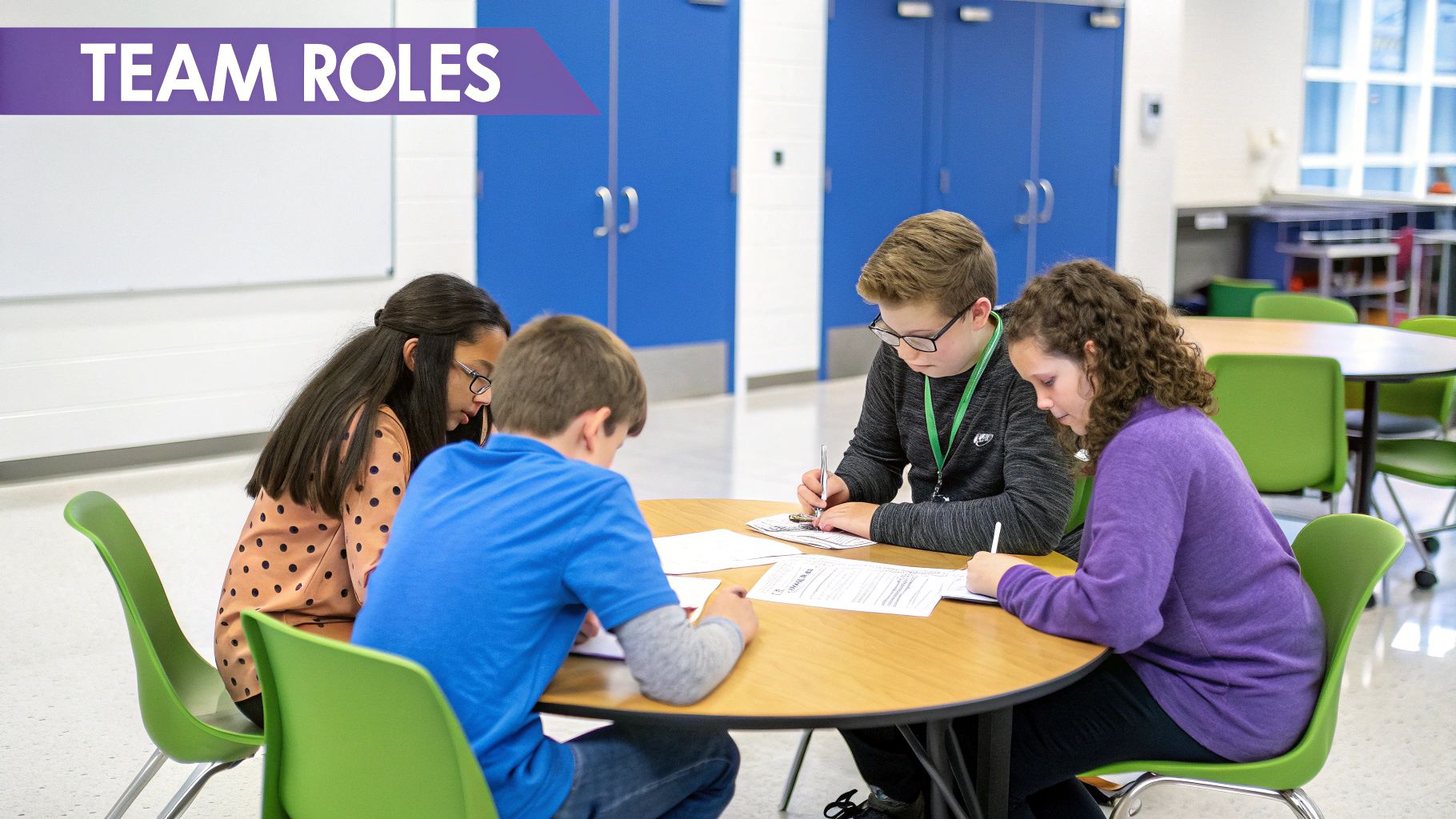
This is more than just "group work." Cooperative Learning Structures are highly organized methods where students work together in small groups with specific roles and a shared goal. The key here is that individual success is tied directly to the group's success. These structures have built-in ways to ensure everyone pulls their weight.
This strategy transforms the classroom into a community where students don't just share a table; they have jobs, they teach each other, and they work toward a common goal. This builds academic skills right alongside communication and social-emotional skills, making it one of the most powerful active learning strategies for students.
Why It Works
Cooperative Learning works because it combines individual accountability with shared responsibility. With everyone having a specific role, one or two students can't take over. This setup leads to deeper learning because students have to explain concepts to their teammates, which solidifies their own understanding. It also creates a supportive space where kids feel safe taking academic risks.
Implementation and Classroom Examples
- Elementary (Reading): Use a Jigsaw for literature circles. Each student in a group becomes an "expert" on something specific (like character or setting) by meeting with other experts. They then return to their original group to teach what they learned.
- Middle School (Social Studies): Try Student Teams-Achievement Divisions (STAD). After a lesson, teams study together. Then, students take individual quizzes, and team scores are based on how much each member has improved, encouraging everyone to help each other.
- High School (Biology): Use a Reciprocal Teaching activity for a dense science text. In groups of four, students take on the roles of Summarizer, Questioner, Clarifier, and Predictor, rotating jobs as they work through the reading together.
Tips for Success
- Establish Clear Roles: Define and model jobs like Facilitator, Recorder, Timekeeper, and Reporter. Role cards can be a huge help.
- Teach Teamwork: Don't just assume students know how to work together. Spend time teaching skills like active listening and how to disagree respectfully.
- Ensure Individual Accountability: Make sure every student is on the hook for the material. You can do this with individual quizzes or by requiring each student to contribute a specific part of the final product.
- Make Time for Reflection: At the end of an activity, have groups talk about their process. "What did our group do well?" and "What could we do better next time?" Building this into your classroom management plan makes a big difference.
5. Inquiry-Based Learning
Inquiry-based learning transforms students from passive listeners into active detectives. The idea is simple: instead of giving students the facts, you empower them to ask questions, do the research, and figure things out for themselves.
This strategy makes learning feel real and relevant. It builds critical thinking, problem-solving skills, and a genuine curiosity that goes way beyond the classroom. It can be as simple as a teacher-led question or as complex as a student-designed investigation from start to finish.
Why It Works
Inquiry-based learning is a fantastic active learning strategy because it gives students ownership. When they're in charge of the investigation, they're more invested in the outcome and more likely to remember what they discover. This process builds essential skills like asking good questions, analyzing data, and using evidence to back up their claims—skills they'll need for life.
Implementation and Classroom Examples
- Elementary (Science): Challenge students to find a way to stop soil from washing away on the school playground. They observe the problem, research solutions, build models, and present their findings.
- Middle School (Social Studies): Students investigate local history by coming up with questions about a town landmark. They interview community members, visit the historical society, and analyze old documents to create a mini-documentary.
- High School (Literature): Instead of a standard book report, students investigate an author's style. They might ask, "How does Margaret Atwood use symbolism to comment on power?" and analyze several of her books to support their argument.
Tips for Success
- Scaffold the Process: Start with more guided inquiry before letting students run their own open-ended investigations. This helps them build the skills and confidence they need.
- Teach How to Ask Good Questions: Explicitly teach students how to formulate strong, researchable questions. Model the difference between a simple question and a deep, investigable one.
- Provide the Right Resources: Make sure students have access to the background knowledge and materials they need to be successful.
- Structure the Investigation: For big projects, using a planning tool can be a lifesaver. An AI assistant like Kuraplan can help you generate a clear inquiry guide that outlines the steps and includes check-ins to keep students on track.
6. Gamification and Game-Based Learning
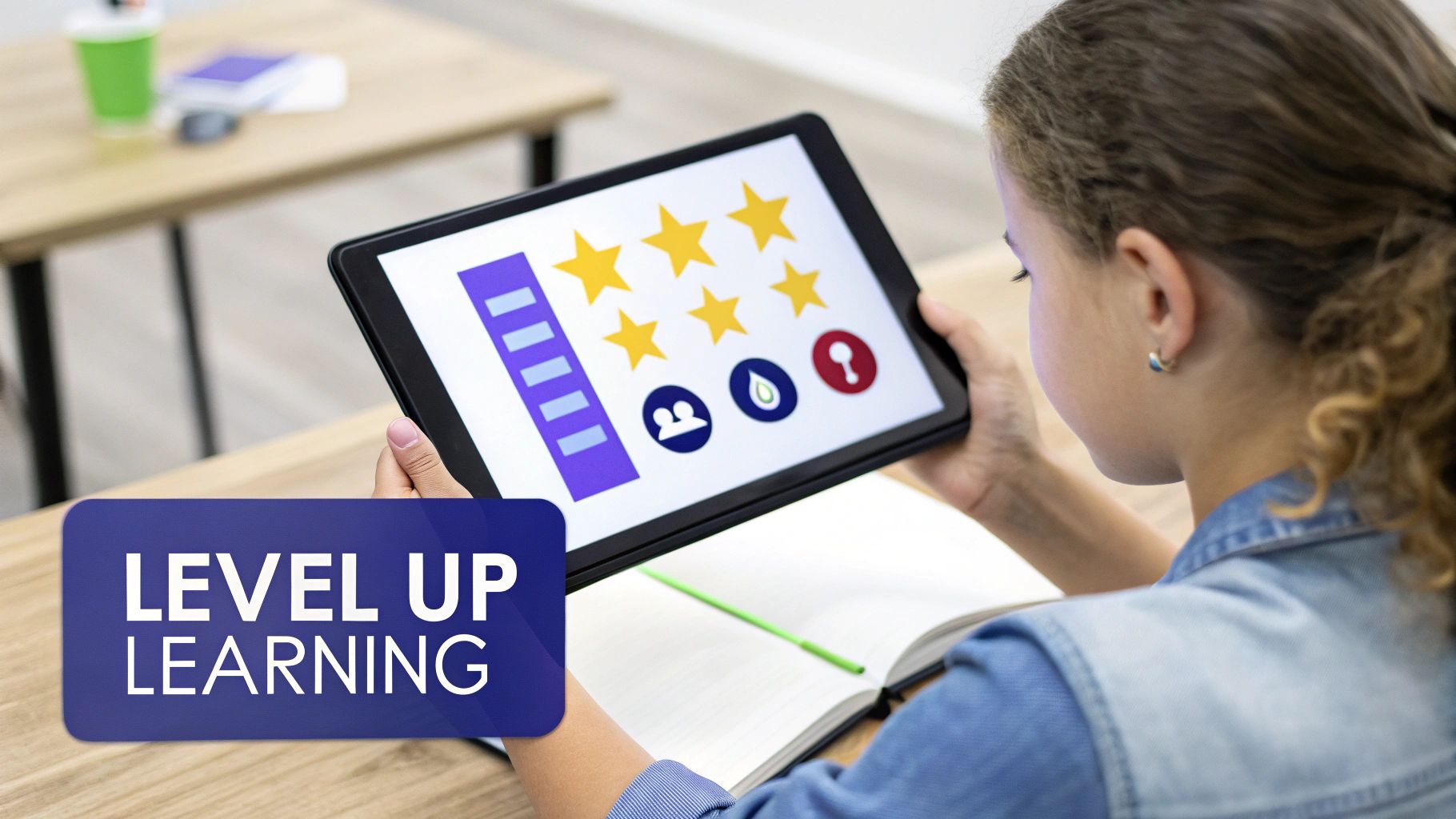
Gamification makes learning feel like a fun challenge by adding game-like elements like points, levels, and badges to your lessons. Game-based learning takes it a step further by using actual games to teach skills. Both strategies tap into the power of challenge and immediate feedback to boost student engagement.
These approaches connect with students' natural love for play and competition, turning classwork into a motivating quest. Whether it's on a screen or in a hands-on classroom challenge, gamification provides a clear path for progress, making learning feel less like a chore and more like an achievement.
Why It Works
Gamification and game-based learning are great active learning strategies because they create a safe place to fail and encourage students to keep trying. If you get an answer wrong in a game, you just try again. This builds resilience and a growth mindset. The clear rules, achievable goals, and instant feedback give students a sense of control and progress, which are huge motivators.
Implementation and Classroom Examples
- Elementary (Reading): Use a program where students earn points for each book they read and pass a quiz on. Create a classroom "reading quest" where students move their game piece along a map for every 20 minutes they read.
- Middle School (Social Studies): Have students use a game like Minecraft: Education Edition to build historically accurate settlements, which requires research and teamwork.
- High School (Language Arts): Create a "badge system" for writing skills. Students earn badges for mastering concepts like "Thesis Titan," "Evidence Expert," or "Citation Champion" in their essays.
Tips for Success
- Align with Learning Goals: Make sure the game directly supports your learning objectives and isn't just a fun distraction. The game should be a tool for learning.
- Balance Competition: Leaderboards can be tricky. Offer a mix of individual and team-based challenges so you don't discourage students who might be struggling.
- Talk About It Afterward: Always have a discussion after playing a game. Ask students what they learned, what strategies they used, and how the game connects to what you're studying.
- Plan with AI: To make sure your game-based lessons are still rigorous, you can use a tool like Kuraplan to generate learning objectives and quiz questions that you can build right into your game or use for your after-game discussion.
7. Socratic Seminar
A Socratic Seminar turns your classroom into a mature, collaborative discussion about a complex text or big idea. Students sit in a circle, and the teacher acts as a facilitator, guiding the conversation with thoughtful questions instead of giving answers.
This powerful strategy shifts learning from just remembering facts to actually building new understanding. Students have to listen closely, explain their reasoning with evidence from the text, and respectfully challenge each other's ideas. It's one of the best active learning strategies for building critical thinking and communication skills, especially in the upper grades.
Why It Works
The Socratic Seminar puts the responsibility for learning right where it belongs: on the students. By stepping back as the main source of knowledge, the teacher empowers students to create meaning together. The circle setup creates a feeling of equality, and the structured format keeps the conversation focused and respectful. It helps students develop sharp analytical skills and confidence in their own ideas.
Implementation and Classroom Examples
- Elementary (ELA): After reading a fable, students discuss the moral of the story. Use questions like, "Why do you think the character made that choice?" and "What would have happened if they chose differently?"
- Middle School (Social studies): Students analyze a primary source, like a letter from a historical figure. The seminar can explore the author's point of view, biases, and the document's importance.
- High School (Ethics/Science): Students debate a bioethical issue like gene editing. They use scientific articles and other texts to support their arguments about the moral implications.
Tips for Success
- Set Ground Rules: Create norms together before the first seminar. Rules should include things like listening actively, using evidence from the text, and disagreeing respectfully.
- Use Open-Ended Questions: The facilitator's questions shouldn't have one right answer. They should spark debate. Ask "What does the author mean by this phrase?" instead of "What is the definition of this word?"
- Prepare Great Prompts: A good seminar starts with a great opening question. AI curriculum tools like Kuraplan can help you generate layered, text-dependent questions that will ensure a rich discussion for all students.
- Use an Inner/Outer Circle: For big classes, have an "inner circle" discuss while an "outer circle" observes and takes notes on the conversation. Then, have them switch roles.
8. Project-Based Learning (PBL)
A cornerstone of authentic, student-driven instruction, Project-Based Learning (PBL) shifts the educational focus from rote memorization to in-depth investigation of complex, real-world problems. Pioneered by organizations like the Buck Institute for Education, PBL engages students in sustained inquiry, culminating in a tangible product or public presentation for an authentic audience. It's a dynamic process that transforms classrooms into hubs of collaboration and innovation.
This approach situates learning within a meaningful context, compelling students to develop critical thinking, creativity, and communication skills. Instead of just learning about a topic, students are actively doing something with their knowledge, which fosters deeper understanding and long-term retention.
Why It Works
Project-Based Learning is one of the most powerful active learning strategies for students because it mirrors how problems are solved in the real world. It builds intrinsic motivation by giving students voice and choice in their work. The sustained nature of the projects allows for deep exploration of content while simultaneously developing essential 21st-century skills like collaboration, project management, and public speaking.
Implementation and Classroom Examples
- Elementary (Science/Social Studies): Students design and build a model of a sustainable community, researching renewable energy, waste management, and green spaces. They present their final model and a "city plan" to a panel of local community leaders or parents.
- Middle School (ELA/History): Students act as historians, creating a documentary video about a significant local historical event. This involves conducting interviews, researching primary sources, writing scripts, and using video editing software.
- High School (STEM): Tasked with a local environmental problem like water pollution, students work in teams to design, build, and test a prototype of an engineering solution, presenting their findings and device to environmental scientists or city officials.
Tips for Success
- Anchor with an Essential Question: Start with a compelling, open-ended question that sparks curiosity and drives inquiry throughout the project.
- Establish Clear Objectives: A successful project is built on well-defined learning goals. For guidance on crafting these foundational elements, you can find helpful resources for writing objectives for your lesson plans on the Kuraplan blog.
- Build-in Checkpoints: Structure the project with milestones for feedback and formative assessment. This prevents students from getting overwhelmed and ensures they stay on track.
- Use Detailed Rubrics: Provide clear, comprehensive rubrics from the start so students understand the expectations for success. AI-powered tools like Kuraplan can help generate detailed, standards-aligned rubrics tailored to your project.
- Connect to an Authentic Audience: Arrange for students to present their work to someone beyond the teacher, such as experts, community members, or other classes, to increase motivation and purpose.
9. Differentiated Instruction
Differentiated Instruction isn't a single activity but a foundational philosophy that makes all other active learning strategies more effective. Pioneered by Carol Ann Tomlinson, this approach requires teachers to proactively plan and vary instruction based on student readiness, interests, and learning profiles. It’s about meeting students where they are and moving them forward, ensuring every learner is appropriately challenged and supported.
Instead of a one-size-fits-all lesson, differentiation transforms the classroom into a dynamic environment. Teachers strategically adjust the content (what students learn), the process (how they learn it), and the product (how they show what they know). This tailored approach ensures that advanced learners are stretched while students who need more support receive it, all while aiming for the same core learning objectives.
Why It Works
Differentiated Instruction is one of the most powerful active learning strategies for students because it honors the reality that every classroom is a mixed-ability environment. By providing multiple pathways to learning, it increases student engagement, boosts confidence, and reduces frustration. It shifts the focus from task completion to genuine understanding, empowering students to take ownership of their learning journey.
Implementation and Classroom Examples
- Elementary (Math): During a unit on addition, set up tiered math stations. One station might use manipulatives for single-digit addition, another could have two-digit word problems, and a third could challenge students with multi-step problems involving carrying over.
- Middle School (Literacy): Use a choice board for a novel study. Students must complete three tasks in a row, but they can choose from options like writing a diary entry from a character's perspective, creating a plot diagram, or designing a new book cover with a written rationale.
- High School (Social Studies): When studying a historical event, provide varied text levels. All students learn about the same event, but some read a scaffolded summary, others read the textbook chapter, and advanced groups analyze primary source documents.
Tips for Success
- Start with Data: Use frequent, low-stakes formative assessments like exit tickets or quick polls to understand what students know and where they need help.
- Leverage Flexible Grouping: Group and regroup students based on the specific skill or concept being taught. Groups should be fluid, not static ability tracks.
- Offer Meaningful Choices: Ensure all options on a choice board are rigorous and aligned with the learning target. The choice should be in the process or product, not the core standard.
- Use Tech to Your Advantage: For creating tiered assignments or assessments with varying complexity, you can use AI tools like Kuraplan to generate differentiated materials that meet the diverse needs of your students quickly and effectively.
10. Peer Feedback and Formative Assessment
This strategy transforms students from passive recipients of grades into active agents in their own learning journey. Peer feedback involves students thoughtfully reviewing and providing constructive comments on each other's work, guided by clear criteria. When combined with formative assessment, which focuses on gathering real-time data to adjust instruction, it creates a powerful classroom culture of collaboration and continuous improvement.
Pioneered by educators like Dylan Wiliam and Grant Wiggins, this approach helps students internalize quality standards by actively applying them to their peers' work. They learn to give and receive feedback respectfully, articulate their reasoning, and see their work from multiple perspectives, leading to deeper understanding and higher-quality final products.
Why It Works
Peer Feedback and Formative Assessment is one of the most impactful active learning strategies for students because it amplifies the feedback loop. Instead of waiting for a single source of feedback from the teacher, students receive timely input from multiple classmates. This process not only improves the work being reviewed but also strengthens the reviewer's own understanding of the success criteria, making learning a more collaborative and metacognitive act.
Implementation and Classroom Examples
- Elementary (Writing): After drafting a personal narrative, students use a "Two Stars and a Wish" protocol. They share two things they liked (stars) and one suggestion for improvement (a wish) with a partner, focusing on a specific skill like using descriptive words.
- Middle School (Social Studies): Students create a digital presentation on a historical event. They then participate in a "gallery walk," leaving sticky-note feedback on their peers' presentations based on a rubric covering accuracy, clarity, and engagement.
- High School (Art): During a critique, students use the "I Like, I Wonder, I Suggest" framework to provide feedback on classmates' in-progress artworks. This structured conversation keeps feedback constructive and focused on artistic elements and principles.
Tips for Success
- Model, Model, Model: Explicitly teach students how to give kind, specific, and helpful feedback. Model the process with an anonymous work sample before asking students to do it themselves.
- Provide Sentence Stems: Support students with scaffolds like, "I was impressed by how you..." or "I was a little confused by this part because..." to guide their comments.
- Use Clear Rubrics: A clear, criterion-based rubric is essential for high-quality feedback. Involve students in creating the rubric to build ownership, or use a tool like Kuraplan to generate clear, standards-aligned rubrics that students can easily use for peer evaluation.
- Assign Specific Roles: In groups, assign roles like "Reader" (reads the work aloud), "Praiser" (identifies strengths), and "Questioner" (asks clarifying questions) to structure the interaction.
10 Active Learning Strategies Compared
| Strategy | 🔄 Implementation Complexity | ⚡ Resources & Time | ⭐ Expected Outcomes / 📊 Impact | 💡 Ideal Use Cases | Key Advantages |
|---|---|---|---|---|---|
| Think-Pair-Share | Low 🔄 | Low ⚡ | ⭐⭐⭐ — raises participation, confidence | Quick checks, whole-class discussion | Low prep; broad applicability |
| Peer Teaching & Reciprocal Learning | Moderate–High 🔄🔄🔄 | Moderate ⚡⚡ | ⭐⭐⭐⭐ — deepens understanding, retention | Small groups, mastery-focused lessons | Builds leadership; peer explanation |
| Problem-Based Learning (PBL) | High 🔄🔄🔄🔄 | High ⚡⚡⚡⚡ | ⭐⭐⭐⭐ — strong transfer and critical thinking | Authentic STEM/social problems | Promotes self-directed inquiry |
| Cooperative Learning Structures | Moderate 🔄🔄 | Moderate ⚡⚡ | ⭐⭐⭐⭐ — improved achievement and social skills | Heterogeneous groups, skill practice | Defined roles; group accountability |
| Inquiry-Based Learning | High 🔄🔄🔄 | High ⚡⚡⚡ | ⭐⭐⭐⭐ — builds scientific thinking, curiosity | Science/STEM investigations, research | Student-driven exploration; inquiry skills |
| Gamification & Game-Based Learning | Moderate–High 🔄🔄🔄 | Moderate–High ⚡⚡⚡ | ⭐⭐⭐⭐ — markedly increases engagement | Practice drills, motivation, behavior systems | Immediate feedback; increased time-on-task |
| Socratic Seminar | High 🔄🔄🔄 | Moderate ⚡⚡ | ⭐⭐⭐⭐ — deep analysis & argumentation skills | Literature, ethics, social studies discussions | Evidence-based dialogue; critical listening |
| Project-Based Learning (PBL) | High 🔄🔄🔄🔄 | Very High ⚡⚡⚡⚡ | ⭐⭐⭐⭐ — sustained mastery; 21st-century skills | Extended interdisciplinary projects | Tangible products; authentic audiences |
| Differentiated Instruction | High 🔄🔄🔄 | High ⚡⚡⚡ | ⭐⭐⭐⭐ — improves access and achievement | Mixed-ability classrooms, inclusive settings | Personalized pathways; equity-focused |
| Peer Feedback & Formative Assessment | Moderate 🔄🔄 | Moderate ⚡⚡ | ⭐⭐⭐⭐ — boosts revision quality & metacognition | Writing, projects, presentations | More feedback sources; builds evaluation skills |
Making It Happen: Your Next Steps to an Active, Engaged Classroom
We've explored a powerful toolkit of ten active learning strategies, from the quick-fire engagement of Think-Pair-Share to the deep, sustained inquiry of Project-Based Learning. Each strategy offers a unique pathway to shift students from passive listeners to active participants, thinkers, and creators in their own education. The common thread weaving through all these approaches is a fundamental belief in student capability. When we structure learning experiences that require students to grapple, question, collaborate, and produce, we aren't just teaching content; we are building lifelong learners.
The journey from a traditional, teacher-centered model to a dynamic, student-centered classroom is not a single leap but a series of intentional steps. It’s about recognizing that engagement isn't just about fun activities; it's about cognitive heavy lifting. The true power of these active learning strategies for students lies in their ability to foster critical thinking, enhance long-term retention, and develop essential collaborative skills that are non-negotiable in the 21st century.
Your Action Plan: Moving from Theory to Practice
Reading about these strategies is the easy part. The real, rewarding work begins when you translate these ideas into your daily classroom practice. Don't feel pressured to implement everything at once. The most sustainable change is incremental.
Here’s a practical, three-step approach to get started:
- Select a Single Strategy: Look at your upcoming curriculum map. Identify one lesson or unit that feels a bit stale or where student engagement typically wanes. Which strategy from this list resonates most with you and seems like a natural fit for that content? Perhaps it's introducing a Socratic Seminar to debate a historical event or using a Cooperative Learning structure to review for a science test.
- Start Small and Plan Smart: Commit to trying just that one strategy. Your first attempt doesn't need to be perfect. The goal is to get a feel for the process, observe your students' reactions, and learn from the experience. Effective implementation, especially for complex methods like PBL or differentiated instruction, requires thoughtful planning. This is where modern tools can be an incredible asset. AI-powered lesson planners like Kuraplan can generate standards-aligned activities, create differentiated materials for diverse learners, and even draft rubrics for peer feedback, significantly reducing your prep time.
- Reflect and Iterate: After the lesson, take a few minutes to reflect. What went well? What would you do differently next time? What surprised you about your students' responses? This reflective practice is crucial. It turns a single attempt into a cycle of professional growth, allowing you to refine your approach and build confidence for your next implementation.
Funding Your Active Learning Vision
Bringing some of these dynamic strategies to life may require new resources, whether it's technology for gamification, materials for complex projects, or flexible seating to support collaboration. Don't let a tight budget be a barrier to innovation. Proactively seeking out funding can unlock incredible opportunities for your classroom. To help fund resources and initiatives that enhance active learning, consider exploring opportunities like the Walmart Teacher Grants to enhance student learning. Securing even a small grant can provide the spark needed to purchase the tools that will transform your students' learning experiences.
Ultimately, embracing active learning is an investment in your students' future and your own professional fulfillment. It is a commitment to creating a classroom buzzing with curiosity, collaboration, and genuine intellectual discovery. You are not just delivering a curriculum; you are cultivating an environment where every student has the opportunity to find their voice, take ownership of their learning, and build the skills they need to thrive. The path forward is clear: start small, be intentional, and watch your students soar.
Ready to spend less time planning and more time facilitating amazing active learning experiences? Let Kuraplan build your standards-aligned, differentiated lesson plans in minutes, so you can focus on what you do best: inspiring students. Discover your new favorite teaching assistant at Kuraplan and reclaim your planning period.