The Think Pair Share teaching strategy is a simple but powerful collaborative learning routine. It works like this: students first think quietly about a prompt, then talk through their ideas with a partner, and finally share their refined thoughts with the whole class.
It’s a structured way to make sure every single student gets a chance to process, participate, and learn from their peers.
What Is Think Pair Share in the Classroom?
So, what does Think Pair Share really look like on a Tuesday morning? Forget the jargon. At its heart, it's a simple, three-step routine that turns your classroom from a lecture hall into a buzzing hub of conversation. It's designed to give every student a voice, especially the ones who might not be quick to raise their hand.
The process is broken down into small, manageable chunks that feel low-stakes and build confidence.
First up is the ‘Think’ phase. This is all about quiet, individual reflection. You pose a question, and instead of calling for immediate answers, you give everyone a moment to just think. No pressure, no hands in the air.
Next comes the ‘Pair’ phase. Students turn to a partner and start talking. This is where the real learning often happens. Ideas get tested, questions get asked, and kids start to see things from a different perspective.
Finally, you bring it all together in the ‘Share’ phase. Pairs share their key takeaways with the whole class. By now, their ideas are clearer, and they’ve already had a chance to practice talking about them.
The Core Components of This Strategy
The real genius of the Think Pair Share strategy is in its intentional structure. Each part is designed to build on the last, taking students from quiet reflection to confident classroom contributors.
- Think: This is all about providing that crucial wait time. It gives every student, especially those who need a bit more time to process, a fair chance to gather their thoughts without feeling rushed.
- Pair: The partner chat is like a rehearsal. It's a safe space to try out an idea, hear what a classmate thinks, and build confidence before speaking in front of everyone.
- Share: By the time you get to the whole-group share-out, students are far more prepared. They've already vetted their ideas with a peer, so they feel more comfortable and ready to contribute.
This simple flow is what makes the strategy so effective.
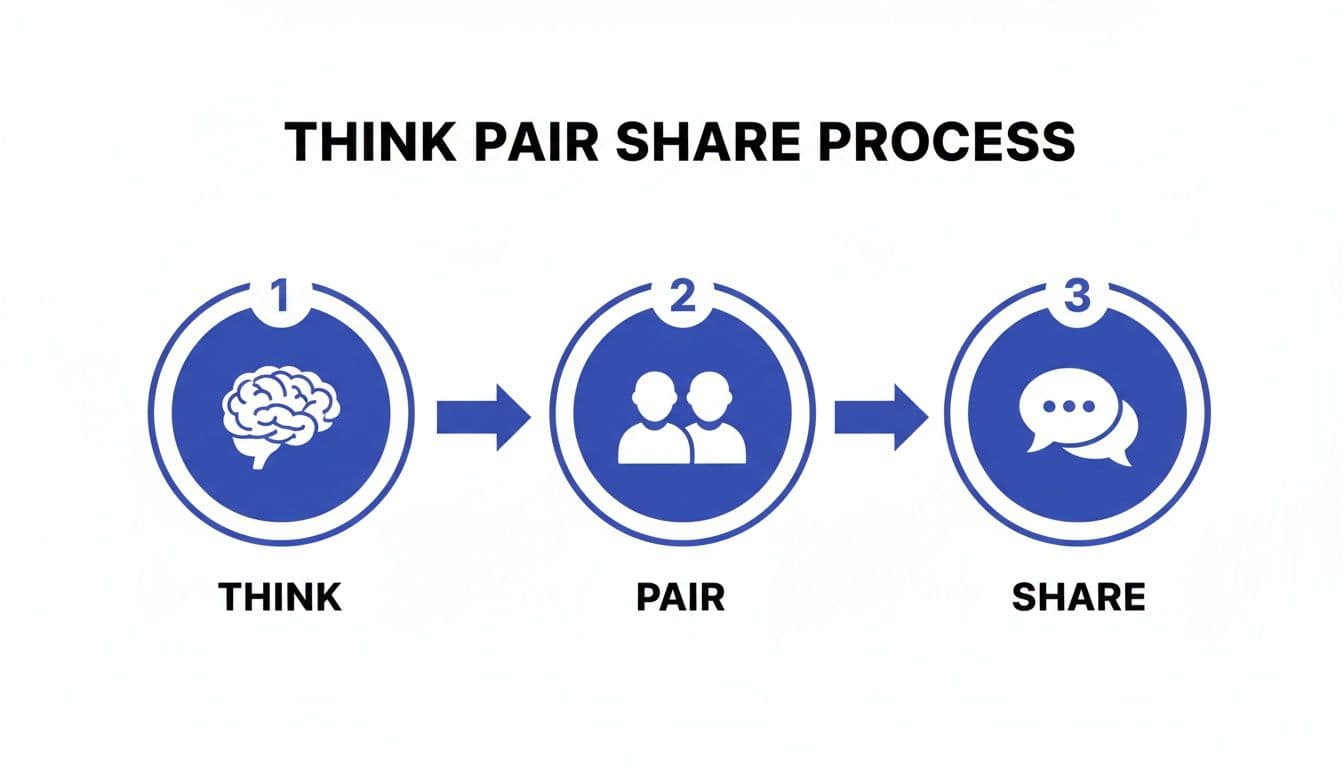
As you can see, the process moves logically from individual thinking to collaborative discussion and finally to a confident group conversation. It's a framework that naturally builds a more inclusive and participatory classroom.
Why It Actually Works
I'll never forget trying to draw participation from my quietest students. It felt like an uphill battle until I started using this method. Suddenly, they had a safety net. They could test their ideas with one person before facing the whole class, and it made all the difference.
The research backs this up, too. A 2023 study in middle school math classes found that using Think Pair Share boosted overall student comments by 19%. Even better, it led to an 87% increase in the number of detailed, substantive explanations from students. Kids across the board said they just felt more confident chiming in.
This structured approach is a cornerstone of cooperative learning, which focuses on building positive interdependence among students. Instead of competing, learners work together toward a common goal, supporting each other's understanding along the way.
To give you a quick reference, here’s a simple breakdown of what’s happening at each stage for both you and your students.
The Three Stages of Think Pair Share at a Glance
| Stage | What Students Do | What the Teacher Does |
|---|---|---|
| Think | Listen to the prompt and reflect individually. | Poses a clear, open-ended question and provides quiet wait time. |
| Pair | Discuss their ideas with a partner, listen, and refine their thinking. | Monitors pairs, listens in on conversations, and provides clarification if needed. |
| Share | Share their pair's key ideas or conclusions with the larger group. | Facilitates the whole-class discussion, calling on different pairs to share. |
Ultimately, consistently using a simple routine like this helps create a stronger, more dynamic classroom community where every student knows their voice matters.
Setting the Stage for Productive Dialogue
A great Think-Pair-Share session doesn't just happen by accident. The real magic is in the prep work you do before you even ask the first question. It's all about creating a classroom environment where students feel safe enough to take intellectual risks and have real conversations.
This groundwork starts with being intentional about how you set up the "pair" in Think-Pair-Share.

Forming Intentional Partnerships
Letting students pick their own partners is tempting, I get it. But it almost always leads to off-task chatter and can leave some students feeling left out. Strategic pairing is a core part of a successful think-pair-share teaching strategy. Over the years, I've landed on a few methods that work wonders, depending on my lesson goals.
- Clock Buddies: This is a fantastic way to pre-plan partners for a whole unit. At the start, students fill out a "clock" with a different partner for each hour. When it's time to pair up, I just call out, "Find your 3 o'clock buddy!" It's a quick, organized way to mix things up.
- Strategic Grouping: When we're tackling more complex topics, this is my go-to. I might pair a student who's confident with the material with someone who needs a bit more support. Or, I'll group students with complementary strengths. This takes knowing your students well, but the payoff in peer learning is huge.
- Randomizers: Sometimes, you just need quick, random pairs. I've used everything from popsicle sticks with names on them to simple online wheel spinners. This keeps things fresh and helps everyone get used to working with all of their classmates.
No matter which method you land on, the goal is to be purposeful. The right partner can completely change the quality of the conversation that follows.
Teaching Students How to Talk
Just as important as who students talk to is teaching them how to have a respectful, academic conversation. We can't just assume they know how to do this. We have to model it, practice it, and make our expectations crystal clear.
Anchor charts are an absolute lifesaver here. We create one together at the beginning of the year with sentence starters that guide discussions.
Key Takeaway: Providing sentence starters like "I agree with you because..." or "Can you explain what you mean by...?" gives students the language they need to move beyond simple agreement and engage in deeper dialogue.
These simple scaffolds lower anxiety for hesitant speakers and push everyone to give more thoughtful responses.
Getting the Pacing Just Right
Finally, let's talk about timing. Nailing the pacing is crucial for keeping the energy and focus high. Give them too little time for the "Think" stage, and they'll feel rushed. Let the "Pair" stage go on for too long, and you'll hear that off-task chatter start to creep in.
Here are some general timeframes I stick to, but I always adjust based on my students and the complexity of the prompt:
| Grade Level | Think Phase | Pair Phase | Share Phase |
|---|---|---|---|
| K–2 | 1 minute | 2–3 minutes | 5 minutes |
| 3–5 | 2 minutes | 3–5 minutes | 5–8 minutes |
| 6–12 | 2–3 minutes | 5–7 minutes | 8–10 minutes |
I always have a visual timer projected on the board. It helps students manage their own time and keeps the activity moving at a good clip. These intentional steps—thoughtful pairing, explicit instruction, and smart timing—are what turn a simple activity into a powerful learning routine.
Crafting Prompts That Spark Real Thinking
The heart of any great Think–Pair–Share session is the prompt. Let's be honest, a simple recall question will only get you simple recall answers. But a truly thought-provoking prompt? That’s where the magic happens.
Designing questions that spark genuine curiosity and demand critical thinking is an art, but it's one you can absolutely master. The goal is to get past surface-level stuff and into prompts that are open-ended, inferential, and evaluative. We want students analyzing, debating, and connecting ideas on their own.
Beyond "What Happened Next?"
Let's look at how to level up your prompts. Instead of just asking for a definition, we want students to wrestle with a concept's meaning and application.
Here are a few examples that push thinking to the next level:
- ELA: Instead of, "Who is the main character?" try, "If the main character from our last story met the protagonist of this one, what advice would they give each other?"
- Math: Move beyond, "What's the answer to problem 5?" to something like, "There are three different ways to solve this problem. Find one way on your own, then find a different way with your partner."
- Science: Instead of asking, "What are the stages of the water cycle?" pose a scenario: "A town is facing a severe drought. Looking at the water cycle, where could you intervene to make the biggest impact, and what might be an unintended consequence?"
- Social Studies: Ditch, "What year did the Civil War begin?" for a meatier question like, "What single event do you believe was the true point of no return leading up to the Civil War, and why?"
When you get students discussing and strategizing together like this, Think–Pair–Share becomes an excellent way to improve problem-solving skills in any subject.
Teacher Tip: Don't be afraid to use rich media as your prompt. A compelling photograph, a short video clip without context, or a complex data chart can be a powerful launchpad for student discussion and inquiry.
AI as Your Creative Partner
Coming up with dozens of these deep, engaging prompts for every lesson can be exhausting. I get it. This is where AI has become an absolute game-changer in my own planning process.
An AI teaching assistant like Kuraplan can be an incredible partner here. You just give it a topic and a grade level, and it generates a whole bank of standards-aligned, thought-provoking questions in seconds. It frees you up to focus less on the "what" and more on guiding the rich conversations that follow.
Of course, to get the most out of these prompts, they need to connect to your learning goals. If you need a refresher, our guide on how to write objectives for lesson plans is a great place to start.
The best prompts for the think pair share teaching strategy don't have one right answer. They're intentionally a little messy. They invite multiple perspectives and push students to build arguments supported by evidence. This is where the real thinking happens, turning a simple routine into a powerful engine for critical thought.
Adapting Think Pair Share for Every Learner
The real magic of the think pair share teaching strategy isn't in a rigid script—it's in its flexibility. Think of it as a sturdy framework you can easily bend and shape to meet the diverse needs of every single student in your classroom. This is where we move from just teaching a strategy to truly embedding equity into our daily practice.
Genuine differentiation is all about making sure every student has a meaningful way into the conversation. It's about proactively taking down barriers so that everyone can participate, process their thoughts, and feel confident sharing. That means having the right scaffolds and extensions ready to go at just the right moment.
Scaffolds for Developing Learners and English Language Learners
For students who need a bit more of a runway—including English Language Learners or those with learning disabilities—a few simple scaffolds can make a world of difference. The whole point is to lower the mental load of how to share, so they can focus their energy on what they want to share.
Here are a few of my tried-and-true supports that I keep in my back pocket:
- Sentence Frames: Giving students starters like "I noticed that..." or "I predict..." provides a structure that helps them articulate their thoughts with confidence.
- Visual Aids: Kicking off the prompt with an image, a diagram, or even a short video clip can be a game-changer for learners who get bogged down by large blocks of text.
- Graphic Organizers: A simple three-column chart for "My Idea," "My Partner's Idea," and "Our Shared Idea" is fantastic for helping students organize their thinking through each phase.
These tools don't just help struggling students, either. I've found they often benefit everyone in the room by making abstract ideas much more concrete and manageable.
Don't forget the power of smart pairing. When I intentionally partner a student who needs support with a peer who is feeling confident, it creates a natural opportunity for peer teaching and modeling. It’s a win-win.
Extending the Challenge for Advanced Learners
Differentiation isn't just about providing support; it's also about pushing students who are ready to go deeper. The last thing any of us want is for our advanced learners to check out because they're bored. Think Pair Share has some simple, built-in ways to stretch their thinking without creating a whole separate lesson plan.
Instead of giving them totally different work, try these quick extensions:
- Deeper Prompts: Just tweak the question to ask why or how. For example, "Why does this historical event still matter today?" or "How could you apply this scientific principle to solve a new problem?"
- Leadership Roles: You can assign them the role of "Discussion Leader" in their pair. Their job is to ask clarifying questions and make sure both partners get a chance to contribute to the conversation.
With so many variables in the classroom, I know that creating differentiated materials for every single lesson can feel completely overwhelming. This is where a tool like Kuraplan can be a lifesaver. It helps me generate varied prompts, find visual aids, and even create tiered graphic organizers in just a few minutes, ensuring I have the right resources on hand for every learner.
Here’s a quick-glance table to summarize some of these ideas.
Think Pair Share Differentiation Strategies
| Learning Need | 'Think' Stage Support | 'Pair' Stage Support | 'Share' Stage Support |
|---|---|---|---|
| English Language Learners | Provide key vocabulary with visuals; offer the prompt in their native language if possible. | Pair with a supportive, patient partner; provide sentence starters for discussion. | Allow them to share a key phrase or draw their idea on the board. |
| Students with Learning Disabilities | Break down multi-step prompts; use a graphic organizer to capture ideas. | Use a timer to structure the conversation; model the conversation with a student first. | Offer the option to share their partner's idea or a jointly created one. |
| Advanced/Gifted Learners | Ask a more complex, open-ended question that requires synthesis or evaluation. | Assign a leadership role to facilitate deeper conversation or play devil's advocate. | Ask them to summarize multiple group ideas or connect the discussion to a broader concept. |
| Shy or Anxious Students | Give them the prompt ahead of time; allow them to write or draw their thoughts first. | Pair with a trusted, familiar peer. | Don't force them to share first; let them "pass" once or twice if needed. |
Ultimately, a well-differentiated Think Pair Share ensures that every student leaves the conversation feeling seen, heard, and a little bit smarter than they were before.
Assessing Learning Without Adding to Your Grading Pile
How can you really tell if all that great classroom chatter is leading to deeper understanding? The think-pair-share teaching strategy is a goldmine for formative assessment, but only if you know what to listen for and how to capture it without drowning in paperwork.
The goal isn't to create another pile of papers to grade. It’s about gathering quick, actionable insights that tell you what your next instructional move should be.
Low-Prep Assessment Methods
The most powerful assessment tool you have during this activity is your own observation. As you circulate the room during the 'Pair' stage, you're not just monitoring behavior—you're actively collecting data.
Listen in on those conversations. Are students on topic? Are they using academic vocabulary? Are they building on each other's ideas or just agreeing? These quick mental notes are invaluable.
- Simple Checklists: Keep a clipboard with a class roster handy. A simple system of checks and pluses can track participation, use of evidence, or grasp of a key concept. It takes seconds per group but gives you a solid overview by the end of the activity.
- Exit Tickets: A classic for a reason. After the 'Share' phase, ask one focused question on a sticky note or small slip of paper. For example, "What is one new idea you heard from another pair today?" This gives you a snapshot of individual takeaways and group synthesis.
These methods are designed to be fast and informative, helping you gauge understanding in the moment. You can learn more about these techniques in our guide to formative assessment examples.
Using Rubrics and Digital Tools
For moments when you need something a bit more structured, a simple rubric can bring clarity without adding complexity. Instead of grading the content of their discussion, focus on the process. Did they listen to their partner? Did they both contribute? Did they stay on topic?
To streamline this, an AI tool like Kuraplan can be incredibly helpful. It can generate simple, objective-aligned rubrics in seconds that focus specifically on collaboration and discussion skills, taking one more thing off your plate.
The evidence for the effectiveness of peer discussion is compelling. A 2022 study on teaching complex math found that the 'pair' stage was the most effective part of the strategy, leading to comprehension gains of 20-30% over traditional methods.
Digital tools can also lighten the load. For instance, platforms highlighted on WhisperAI's education page could provide transcripts of student discussions, helping with qualitative assessment without adding to your grading workload. The key is to find methods that give you the data you need without sacrificing precious planning time.
Solving Common Think Pair Share Challenges
Even with a killer prompt and the best intentions, a think pair share teaching strategy can sometimes fall flat. You know the scene: one pair is done in ten seconds, another is debating their weekend plans, and a third is sitting in total silence. It happens to all of us.
The trick isn't to give up on the strategy. It's about having a few simple moves ready to go when things get rocky. Knowing how to handle these little hiccups is what makes Think-Pair-Share a truly reliable part of your teaching toolkit.
Handling Uneven Participation and Off-Task Chatter
This is probably the most common hurdle. You’ll see one student monopolizing the conversation or pairs drifting off-topic entirely. When this happens, it's usually a sign that the activity needs just a little more structure.
Here are a couple of my favorite fixes:
- Use a Talking Stick: It sounds almost too simple, but giving pairs an object like a pen or a whiteboard marker to pass back and forth really works. Only the person holding the "stick" can talk. It’s a physical cue that reminds them to share the airtime.
- Assign Roles: Give each student a specific job. Partner A could be the "Idea Generator" while Partner B is the "Questioner" who asks clarifying questions. This gives both students a clear sense of purpose and keeps them engaged.
These small tweaks can make a huge difference in keeping the conversations focused and making sure everyone gets a chance to contribute.
When Pairs Finish Too Quickly or Get Stuck
You’ve got the fast finishers who shout, "We're done!" after thirty seconds, and on the other end, the pairs who are completely stumped. Both scenarios can throw off the rhythm of the lesson.
For those who finish early, I always have an extension prompt in my back pocket. Something as simple as, "Great, now can you think of a real-world example?" or "How would your answer change if this part of the problem was different?" pushes them to think more deeply.
When a pair gets stuck, it’s a goldmine for a teachable moment. I quietly listen in to figure out what's going on. Is the prompt confusing? Are they missing some key background knowledge? Your quick diagnosis can help you clarify things for the whole group.
And don't forget, that peer-to-peer conversation is where so much of the learning happens. In fact, research shows the 'pair' phase often has a bigger impact on test scores than the individual 'think' phase. The dialogue is that powerful. You can dig into the data in this study on boosting geometry performance.
My Go-To Fix: When I notice a few pairs struggling with the same thing, I’ll pause the activity. I'll say something like, "I'm hearing some great confusion around X. Let's talk about that as a class for a minute." It validates their struggle and turns a stumbling block into a learning win for everyone.
Want to make sure you're always ready for those "what-if" moments? Kuraplan can help you generate differentiated prompts, extension activities, and even visual aids in seconds. Start planning smarter today with Kuraplan.