
To write an effective lesson objective, you need a clear, student-centered statement that spells out what learners will be able to do by the end of the lesson.
The best ones follow a simple formula: an action verb (like 'identify' or 'construct'), a specific task (what students will actually do), and measurable criteria for success (how well they need to do it). This structure turns a vague goal into a clear target for you and your students.
Why Clear Objectives Are Your Secret Teaching Weapon
Let's be honest, writing objectives often feels like just another box to check for an observation. It’s that one line on the template we rush to fill in before diving into the "real" planning—the activities, the worksheets, the fun stuff. But what if that single sentence was the most powerful tool you have for a focused, engaged, and successful classroom?
Think of your lesson plan objective as the GPS for your lesson. Without a clear destination programmed in, you and your students are just driving around. You might see some interesting things, but you’ll likely get lost, take unnecessary detours, and end up frustrated. A well-written objective eliminates that confusion right from the start.
From Chaos to Clarity
I remember an early attempt at teaching the water cycle to my third graders. My "objective" was something vague like "Students will learn about the water cycle." The lesson was a mess. Some kids were coloring, others were asking off-topic questions, and I was just trying to "cover" evaporation and condensation. No one, including me, really knew what the point was.
The next day, I tried again with a new objective: "Students will be able to draw and label the four main stages of the water cycle." The difference was night and day. Every student knew their exact mission. That single, clear goal transformed a chaotic lesson into a meaningful learning experience. Understanding this power extends beyond traditional lesson plans, informing how to create impactful resources like when you are making educational videos that teach effectively.
A strong objective is the difference between hoping your students learn and ensuring they do. It shifts the focus from teacher activity ('I will teach…') to student mastery ('They will be able to…').
This simple shift is crucial. When objectives are clear, they do more than just guide the lesson; they also positively influence student behavior. Students who know what they are supposed to be doing are far less likely to be disengaged or disruptive.
It’s the move from just "covering material" to making sure your students are actually mastering it. That shift makes your job as a teacher more effective and, ultimately, a lot more rewarding.
Crafting Objectives That Are Actually Measurable
We’ve all heard the word "measurable" thrown around in staff meetings. We nod along, but what does it really mean on a Tuesday afternoon when you’re just trying to plan your next lesson?
Let's cut through the jargon. A measurable objective is just a fancy way of saying you can see or hear that a student has learned something. It’s the difference between hoping students "understand" the Civil War and knowing they can "compare and contrast" two primary source documents from that era. One is a vague hope; the other is a concrete action you can actually check.
Getting your objectives right transforms a lesson plan from a tangled mess of ideas into a clear, focused pathway for you and your students.
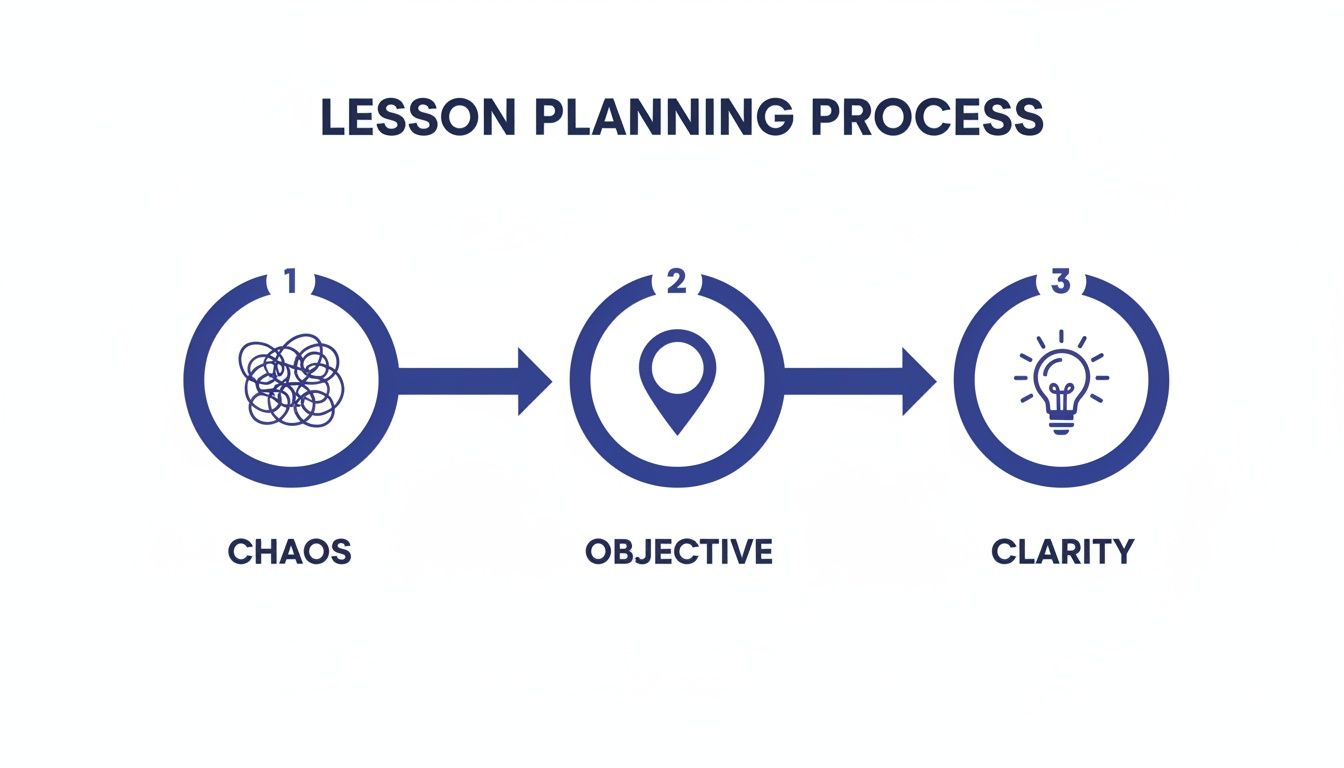
A strong objective isn't just a starting point—it's the flashlight that illuminates the entire lesson.
Pick Verbs That Show Action
The secret to a measurable objective is simple: the verb. Words like "know," "learn," or "understand" are the enemies of a clear objective because you can't see a student doing them. How do you measure "knowing"? You can't.
Instead, you need action verbs—words that describe a performance. This is where frameworks like Bloom's Taxonomy, while sometimes feeling a bit academic, are actually your best friend. Think of it as a cheat sheet for powerful verbs.
This table shows how a simple verb swap can make all the difference.
From Vague to Actionable Choosing the Right Verbs
| Vague Verb (Avoid) | Strong Verb (Use Instead) | Bloom's Taxonomy Level |
|---|---|---|
| Understand | Explain, Summarize, Infer | Understanding |
| Know | List, Label, Define | Remembering |
| Learn | Solve, Demonstrate, Build | Applying |
| Appreciate | Justify, Critique, Defend | Evaluating |
Choosing stronger verbs automatically forces you to think about what you want students to produce as evidence of their learning.
Instead of saying "Students will learn about photosynthesis," you could say:
- List the ingredients needed for photosynthesis. (Remembering)
- Explain the process in their own words. (Understanding)
- Diagram the cycle on a poster. (Applying)
- Compare photosynthesis to cellular respiration. (Analyzing)
- Formulate a hypothesis about what would happen with limited sunlight. (Creating)
Each of these gives you something specific to look for. It’s not surprising that a study by the National Center for Education Statistics found that 92% of K-12 teachers struggled to write effective objectives, with time being the biggest hurdle. The payoff is huge, though; lessons with clear objectives can boost student engagement by as much as 34%. You can explore more data on how lesson planning impacts student outcomes on PRB.org.
The Simple Three-Part Formula for Objectives
To keep things straightforward, many teachers lean on a simple formula. You might have heard it called the ABCD model, but let’s break it down into plain English. A solid objective usually has three parts:
- Condition: When or with what? (Given a map of the United States...)
- Behavior: What will the student do? (Your action verb goes here.) (...the student will identify...)
- Criterion: How well? (...all 13 original colonies with 90% accuracy.)
Put them together, and you have a rock-solid, measurable objective.
Pro-Tip: Don't get lost in the formal structure. The real goal is clarity. As long as your objective answers "Who will do what, under what conditions, and how well?" you’re on the right track.
See It In Action
Let's look at a few examples for different grade levels.
- Kindergarten (ELA): After listening to The Very Hungry Caterpillar, students will sequence four main events from the story by placing picture cards in the correct order.
- 5th Grade (Math): Using a protractor, students will measure and classify five different angles (acute, obtuse, right) with 100% accuracy.
- 9th Grade (History): Given a political cartoon from the Progressive Era, students will write a short paragraph that analyzes its main message, citing at least one specific visual detail as evidence.
See? Each one includes a condition, a clear action, and a success metric. No ambiguity. You know exactly what to look for to decide if the lesson worked. This clarity is a lifesaver, and having a good structure helps. You can explore more options by checking out these free lesson plan templates for teachers that build in space for these components.
Of course, coming up with these from scratch every single time can feel like a lot. This is where smart tools come in. An AI planner like Kuraplan, for example, can generate measurable objectives aligned to your topic and grade level, suggesting powerful verbs and even assessment criteria so you’re not starting from a blank page.
Connecting Objectives to Your Curriculum Standards
You’ve done it. You’ve crafted a sharp, measurable objective with a strong action verb. Now for the part that can feel like a scavenger hunt: connecting it to your curriculum standards without getting bogged down in dense, jargon-filled documents.
Think of your standards as the roadmap for the entire school year. Your daily objectives are the specific turns you take on that journey. Aligning them isn't just about checking a box for your administration; it's about making sure every lesson is intentionally building toward a bigger, more coherent destination for your students.
Unpacking the Standard Without Getting Overwhelmed
Let’s be honest, standards can be intimidating. They’re often written in a way that feels completely disconnected from the reality of a classroom. The trick is to "unpack" them by breaking them down into two simple parts: the content (what students need to know) and the skill (what students need to do).
For example, a standard might read: CCSS.ELA-LITERACY.RI.5.2 - Determine two or more main ideas of a text and explain how they are supported by key details; summarize the text.
Let's break that down:
- Content: Main ideas, key details, summarizing.
- Skill: Determine, explain, summarize.
Once you see the core skills, you can write objectives that directly target them. An objective like, "After reading a non-fiction article, students will write a one-paragraph summary that includes two main ideas and supporting details," hits that standard dead-on.
From Compliance to Coherence
This process does more than just tick a box. It ensures every lesson has a purpose that fits into a larger puzzle. Since the widespread adoption of frameworks like the Common Core State Standards, which reached 41 US states, this alignment has become non-negotiable. And it works—the focus on measurable, standards-aligned outcomes has contributed to a 22% improvement in reading proficiency for grades 3-8. You can dig into more of these global education statistics on LessonPlanet.com.
Aligning your objectives to standards is what turns a collection of good lessons into a great, cohesive curriculum. It’s the invisible thread that connects September to May.
This alignment ensures that students aren't just learning isolated facts but are systematically building the skills they need for the next level. Every small step you plan with your daily objectives contributes to that long-term success.
Making the Connection Practical
So, how do you do this consistently without losing hours to planning? First, don't try to tackle everything at once. Focus on the key standards for your current unit and keep a simplified "cheat sheet" of them nearby.
Here are a few tips I've found helpful:
- Start with the Standard: Before you even think about an activity, look at the standard you need to address. Let it guide your objective, not the other way around.
- Use the Same Language: Whenever possible, borrow the key verbs and terms directly from the standard when you write your objective. This makes the connection obvious and keeps you on track.
- Map It Out: At the beginning of a unit, quickly map out which standards you'll cover each week. This bird's-eye view prevents you from trying to cram too much into a single lesson.
This whole process can still feel like a huge time sink, and that's where technology can be a massive help. Modern AI tools are getting incredibly good at this kind of heavy lifting.
For instance, a platform like Kuraplan can automatically suggest relevant standards as you type your lesson topic. It can take a simple idea like "teaching fractions" and instantly pull up the correct grade-level standards and even draft objectives that align perfectly. This frees you up to focus on the creative side of teaching. Learn more about how AI can streamline your lesson planning in our guide.
By making standards the foundation of your objectives, you're not just following rules. You're building a thoughtful, intentional, and powerful learning journey for every student in your classroom.
Designing Assessments That Truly Match Your Goals
An objective, no matter how perfectly written, is just words on a page until you can prove your students actually learned something. So, how will you know if they got it? This is where your assessment comes in—it’s the bridge between your goal and the proof that learning happened.

This isn't about slapping a high-stakes test at the end of a unit. It’s about building in quick, simple checks for understanding that tell you who's on track and who needs a little more support, right in the moment.
From Objective to Evidence
Your assessment should be a direct reflection of your objective. If your objective asks students to "compare," your assessment needs to give them something to compare. If it asks them to "construct," they need to build something. It seems simple, but it's a common place for lesson plans to get disconnected.
Let’s say your objective is: "Students will be able to analyze the main character's motivations in Chapter 3 by citing two pieces of textual evidence."
Your assessment shouldn't be a multiple-choice quiz about random plot points. Instead, it could be something like:
- An exit ticket asking: "What are two things the main character did in this chapter and why did they do them? Use evidence from the text."
- A quick Think-Pair-Share where partners discuss the character's choices and reasoning.
- A short paragraph response jotted down in their notebooks.
Each of these directly measures the exact skill outlined in your objective. Of course, setting goals is just the first step; you also need to design robust instruction. For more ideas on that, check out these strategies for creating engaging and effective training materials.
Define What Success Looks Like
This is where success criteria come into play. Think of them as a student-friendly checklist that breaks down your objective. They clearly answer the question, "What does a good one look like?"
For our character analysis objective, the success criteria might look like this:
- I can state the main character's motivation clearly.
- I can find two quotes or examples from the text.
- My examples directly support my idea about why the character did what they did.
When students have these criteria in front of them, they know exactly what’s expected. It empowers them to self-assess their own work before turning it in, which is a huge step toward building independence.
Your objective tells students what they need to do. Your success criteria tell them how to do it well. This pairing removes ambiguity and empowers students to own their learning.
Translating Objectives into Practical Tools
Let’s get even more practical. Your "Students Will Be Able To" (SWBAT) statement is your starting point. You can directly translate its key components into an assessment tool like a rubric or a simple checklist.
Objective: SWBAT construct a five-sentence paragraph that includes a topic sentence and three supporting details.
This objective contains all the ingredients for a simple checklist you can give to students.
| Checklist Item | Student Check | Teacher Check |
|---|---|---|
| My paragraph has exactly five sentences. | ☐ | ☐ |
| My first sentence is a clear topic sentence. | ☐ | ☐ |
| I have at least three supporting details. | ☐ | ☐ |
| My details are related to my topic sentence. | ☐ | ☐ |
This kind of clarity makes grading faster for you and feedback much more meaningful for your students. The whole process becomes more cohesive when the assessment is baked in from the very start.
This seamless flow from goal to evidence is where AI planning tools are becoming a game-changer. Imagine an assistant in a platform like Kuraplan that not only helps you write a standards-aligned objective but then instantly generates a corresponding rubric or a set of assessment questions. It creates a perfect loop, ensuring that what you plan, what you teach, and what you measure are all in perfect sync—saving you a ton of time and guesswork.
Writing Objectives for Every Learner in Your Classroom
We’ve all been there. You craft what you think is the perfect lesson objective, only to find it’s too easy for a few students and completely out of reach for others. A one-size-fits-all objective is a bit like a one-size-fits-all t-shirt—it technically fits, but it’s rarely a good fit for everyone.
Your classroom is filled with a dynamic mix of learners. Some will grasp a concept in a flash, others will get there with a little support, and a few might need a more foundational starting point. So how do you write an objective that challenges all of them?

This is where the real art of teaching comes in: differentiation. This isn't about lowering your standards. It’s about creating multiple pathways for students to meet the same high standard, ensuring everyone is appropriately challenged and supported.
Start with a Core Objective
First things first, establish your anchor. Write a solid, grade-level core objective that you expect the majority of your class to achieve.
From this anchor point, you can build out. You’ll create extensions for students who are ready to fly and simplified versions for those who need a bit more scaffolding. This process, often called tiering, is a game-changer. It ensures everyone is working toward the same learning goal, just at a different depth.
Let's walk through an example for a 4th-grade ELA lesson on identifying the main idea.
- Core Objective: Students will be able to identify the main idea of a grade-level paragraph and support it with two key details from the text.
This is a great starting point, but we know it won't work for every single student.
Create Tiers for Different Readiness Levels
Now, let's build from our core objective. We'll create two more tiers: one for learners who need more support and another for those ready for enrichment. You can easily do this by adjusting the verb (think Bloom's Taxonomy), changing the complexity of the task, or modifying the level of support you provide.
- Support Tier: Students will be able to choose the main idea from three given options and highlight one supporting detail in the text with teacher guidance.
- Enrichment Tier: Students will be able to summarize the main idea and supporting details of two different paragraphs and compare their underlying themes.
See how all three objectives are still focused on the main idea? The skill is the same, but the expectations are tailored. This is also a fantastic strategy for students with IEPs or 504 plans, letting you build accommodations right into your lesson's DNA.
Keeping all of this organized can feel like a headache, which is where a good digital teacher planner can really help you track differentiated goals for different student groups.
The key to differentiation is not changing the destination (the learning standard), but providing different routes to get there. It’s about ensuring every student makes meaningful progress from their unique starting point.
This approach honors each student's journey. Instead of some students feeling bored and others feeling overwhelmed, everyone has a clear and achievable target.
I know what you're thinking—writing multiple tiers for every lesson sounds like a ton of extra work. This is an area where technology provides a huge lift. AI-powered platforms like Kuraplan are designed for this exact challenge. You can input your core objective, and the tool can instantly suggest tiered objectives and differentiated activities for various learner profiles, turning what used to be a long planning session into a task that takes just minutes.
Common Objective Writing Mistakes and How to Fix Them
We’ve all been there. You draft an objective that looks great on paper, but the moment the lesson kicks off, you realize it’s not working. It’s a classic teacher frustration, but spotting these common pitfalls is the first step to writing objectives that actually stick.
This isn't a new problem. Back in 1962, educator Norman Gronlund was already pushing for objectives focused on what students could do, not just what teachers planned to teach. When that advice was ignored, it often led to performance gaps. The push for measurable goals eventually helped boost high school graduation rates from just 71% to 86%. You can read more about the history of educational objectives to see how these ideas have shaped modern teaching.
Think of this section as your troubleshooting guide. Let's walk through the most common mistakes I see teachers make and, more importantly, how to fix them for good.
Mistake 1 Writing an Activity Instead of an Outcome
This is, without a doubt, the number one trap. We get so focused on the fun activity we've planned—the worksheet, the group project, the experiment—that we mistake the process for the goal.
An activity is the path you take; an outcome is the destination.
- Before: "Students will complete a worksheet on the Pythagorean theorem."
- The Problem: Finishing a worksheet doesn't prove anything. A student could guess, copy from a neighbor, or get every single problem wrong. The task itself isn't the skill.
- After: "Students will be able to calculate the length of a missing side of a right triangle using the Pythagorean theorem for 4 out of 5 problems correctly."
The Fix: Before you finalize your objective, ask yourself this simple question: "After my students do this thing, what will they know or be able to do that they couldn't before?" The answer is your real objective.
Mistake 2 Using Vague Verbs
Words like "understand," "learn," "know," and "appreciate" feel right, but they're teacher nightmares. Why? Because you can't see them, hear them, or measure them. How do you grade "understanding" on an exit ticket? You can't.
Vague verbs lead to vague lessons and even vaguer assessments. If you can't measure it, you can't confidently say your students learned it.
- Before: "Students will understand the causes of the American Revolution."
- The Problem: This gives you zero clarity. What does "understand" look like in practice? A nod? A feeling?
- After: "Students will be able to list three primary causes of the American Revolution and explain how each contributed to the conflict."
The Fix: Lean on strong, observable action verbs from a framework like Bloom's Taxonomy. My rule of thumb is this: if I can't physically see or hear a student doing the verb, I need to pick a new one.
Mistake 3 Creating Goals That Are Too Broad
It’s easy to get ambitious and try to cram a whole unit's worth of learning into one 45-minute lesson. I’ve done it. We’ve all done it. But it just sets everyone up for failure.
- Before: "Students will be able to write a research paper."
- The Problem: That's not a lesson; that's a whole marking period! Writing a research paper involves dozens of smaller, distinct skills that need to be taught one by one.
- After: "Students will be able to formulate a thesis statement for a research paper."
The Fix: Break it down. Take that huge, multi-week goal and slice it into bite-sized daily objectives. Focus on one specific skill at a time. This not only makes learning feel more manageable for your students but also makes your teaching way more targeted and effective. Tools like Kuraplan can actually help with this by suggesting focused, daily objectives that build toward your larger unit goals.
Frequently Asked Questions About Lesson Objectives
Let's tackle some of the most common questions that pop up when we're trying to nail down our lesson objectives. These are the things we chat about in the staff room or search for late at night. Here are some clear, straight-to-the-point answers.
How Many Objectives Should a Lesson Have?
Honestly, less is more. Stick to 1-2 primary objectives for a single lesson. This keeps your instruction tight and focused, giving students a real chance to master the concept. When we try to cram too much in, we often end up with surface-level understanding that vanishes by the next day.
And what's the difference between a goal and an objective? Think of it this way: a goal is the big, long-term destination (e.g., "Students will become confident writers"). The objectives are the specific, measurable steps that get them there, like "Students will be able to write a five-sentence paragraph with a clear topic sentence."
Do I Need to Share the Objective with Students?
Yes, absolutely! Sharing the objective with your class in kid-friendly language is one of the most powerful things you can do. When students know why they're doing something and what the finish line looks like, their engagement and motivation go through the roof. It gives them ownership over their own learning.
Posting the objective isn't just for your administrator's observation—it's for your students. It turns the lesson from something that's happening to them into something they are actively a part of.
And is "SWBAT" the only way to phrase it? Not at all. "Students Will Be Able To" is a classic for a reason, but many of us now prefer "I can..." statements because they're so student-centered. The format doesn't matter nearly as much as making sure the objective is specific, measurable, and crystal clear to everyone in the room.
Ready to stop guessing and start creating perfectly crafted objectives in minutes? Kuraplan uses AI to generate standards-aligned, measurable, and differentiated objectives for any lesson, giving you more time to focus on teaching. Try Kuraplan and simplify your planning today.