Animal Classification Dichotomous Key
A free science worksheet ready for your classroom. Open in Kuraplan to grab the print-ready PDF, customize it for your students, or generate a fresh version in seconds.
Animal Classification Dichotomous Key
🦘 Part 1: Vertebrates vs Invertebrates
Scientists use _________________ keys to help classify and identify animals. These tools help organise the _____________ of life on Earth by using observable _____________ to group animals.
🔍 Part 2: Using a Dichotomous Key
Simple Dichotomous Key:
1a. Animal has a backbone or spine → Go to 2
1b. Animal has no backbone → INVERTEBRATE
2a. Animal has fur or hair → MAMMAL (vertebrate)
2b. Animal has feathers → BIRD (vertebrate)
2c. Animal has scales and lives in water → FISH (vertebrate)
2d. Animal has scales and lives on land → REPTILE (vertebrate)
Kangaroo: ____
Huntsman spider: ____
Kookaburra: ____
Blue-tongue lizard: ____
Jellyfish: ____
Platypus: ____
Redback spider: ____
Murray cod: ____
🌏 Part 3: Indigenous Knowledge and Classification
🎨 Part 4: Create Your Own Classification
🧠 Part 5: Challenge Questions
Reason 1: _________________________________________________
Reason 2: _________________________________________________
About This Worksheet
Free in Kuraplan
Sign up free, grab the PDF, and customize it for your class.
Print-Ready
Formatted for standard paper. Clean layout, easy to read.
AI-Generated
Created with Kuraplan's AI, designed for real classroom use.
For Teachers & Parents
Use in classrooms, for homework, tutoring, or homeschool.
Need a custom version of this worksheet?
Kuraplan's AI generates custom worksheets in seconds — differentiated for every learner, aligned to your curriculum.
Generate Custom Worksheets — FreeMore Science Worksheets
Year 8 Biology Review
Free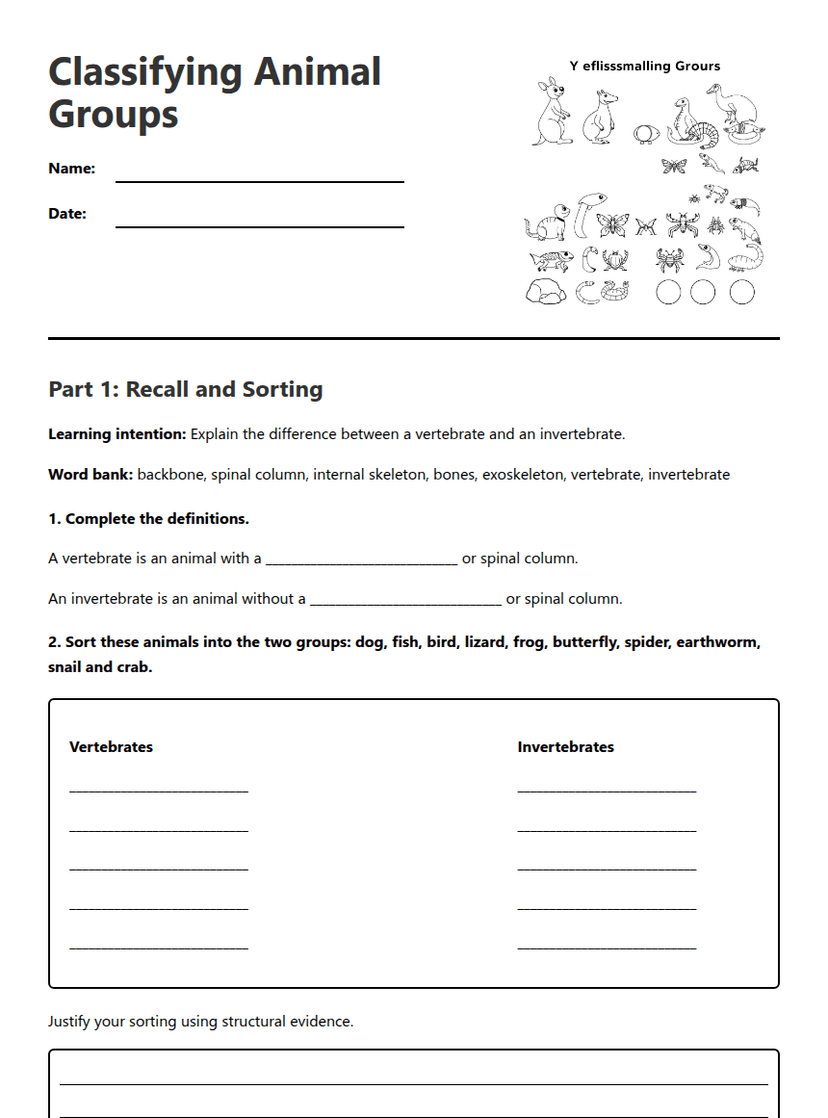
Classifying Animal Groups
Free
Living Things Investigation
Free
Reproduction and Species Survival
Free
Genetics and Variation Refresher
Free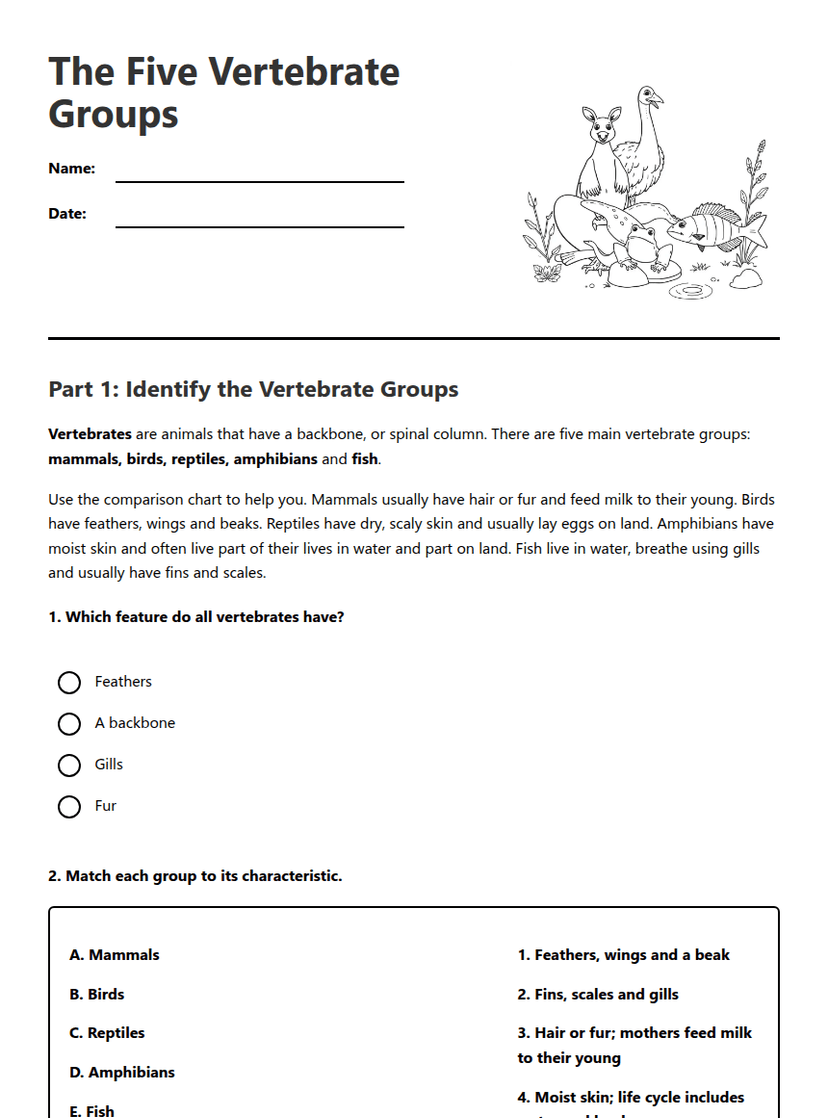
The Five Vertebrate Groups
Free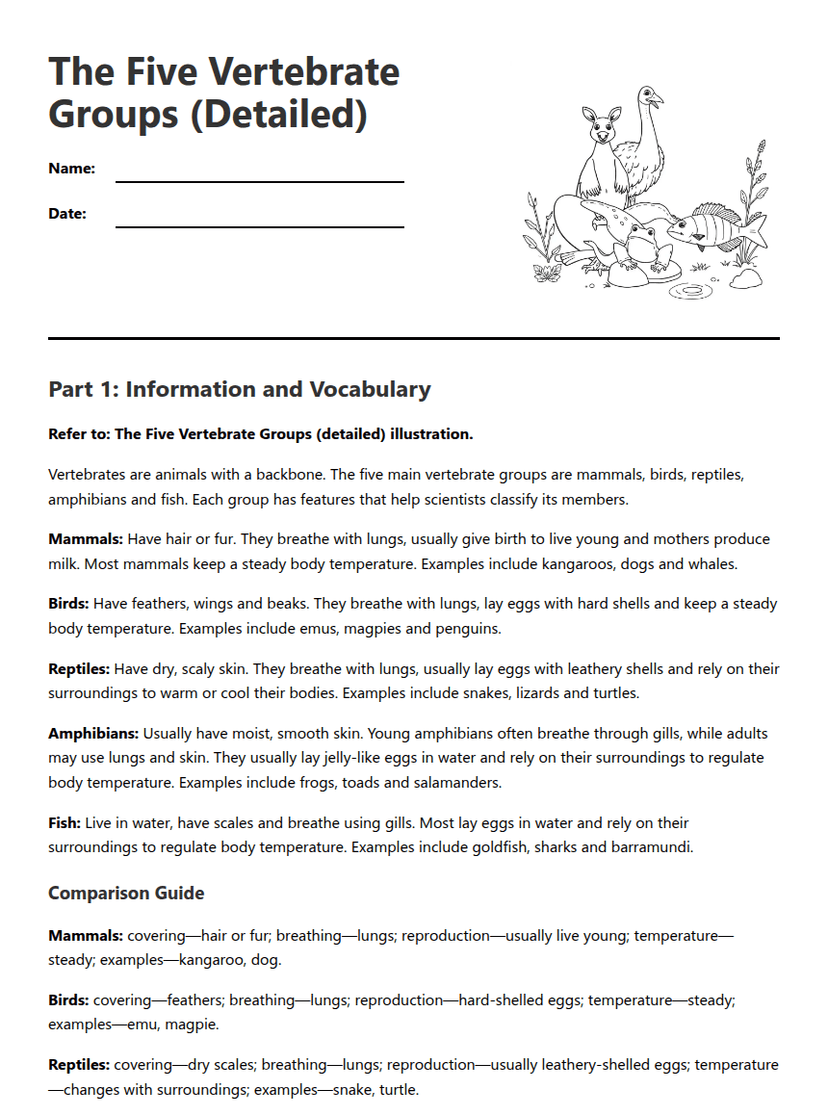
The Five Vertebrate Groups Worksheet
Free