Area and Perimeter Challenge
A free maths worksheet ready for your classroom. Open in Kuraplan to grab the print-ready PDF, customize it for your students, or generate a fresh version in seconds.
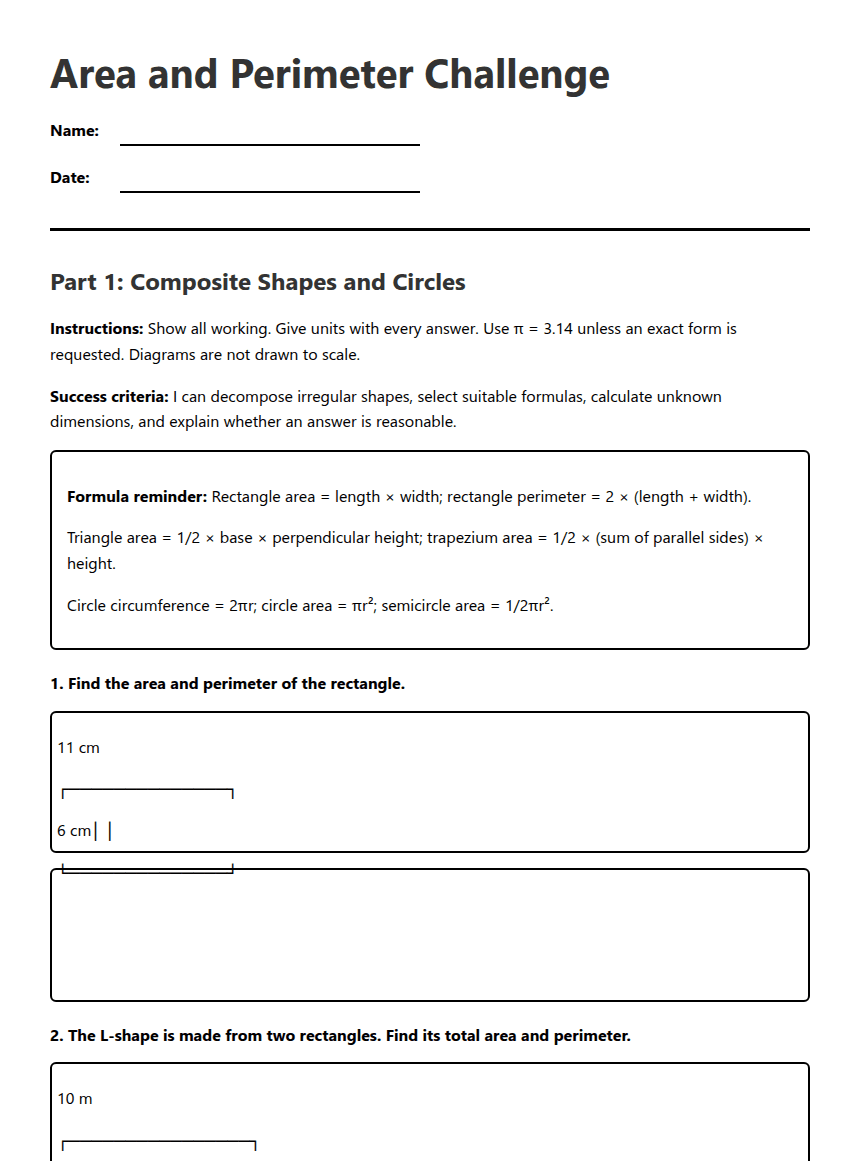
Area and Perimeter Challenge
Part 1: Composite Shapes and Circles
Instructions: Show all working. Give units with every answer. Use π = 3.14 unless an exact form is requested. Diagrams are not drawn to scale.
Success criteria: I can decompose irregular shapes, select suitable formulas, calculate unknown dimensions, and explain whether an answer is reasonable.
Formula reminder: Rectangle area = length × width; rectangle perimeter = 2 × (length + width).
Triangle area = 1/2 × base × perpendicular height; trapezium area = 1/2 × (sum of parallel sides) × height.
Circle circumference = 2πr; circle area = πr²; semicircle area = 1/2πr².
11 cm
┌──────────────┐
6 cm│ │
└──────────────┘
10 m
┌────────────────┐
│ │ 4 m
9 m │ └──────┐
│ │ 5 m
└───────────┐ │
└───────────┘
6 m
14 cm
┌──────────┐
5 cm│ │
└──────────────┘
22 cm
12 cm
┌────────────────┐
7 cm│ │
└───────╮ ╭─────┘
╰──╯
semicircle, diameter 7 cm
16 m
┌────────────────────┐
10 m │ ◯ r = 3 m │
└────────────────────┘
┌───────┐
│ └───┐
┌───┘ │
│ │
└───────────────┘
Grid coordinates: (0,0), (0,2), (3,2), (3,4), (6,4), (6,0)
Part 2: Algebra, Scale and Reasoning
Differentiation supports
Support: Draw auxiliary lines to split each composite shape into rectangles, triangles or circles. Highlight known lengths and use a formula list. Check that all lengths use the same unit before calculating.
Advanced learners: Solve questions 8, 11 and 12 algebraically, compare two possible decompositions, and investigate how changing one dimension affects area and perimeter.
Answer Key
1. Area = 11 × 6 = 66 cm². Perimeter = 2(11 + 6) = 34 cm.
2. Split into 10 m × 4 m and 6 m × 5 m rectangles. Area = 40 + 30 = 70 m². Missing vertical side = 9 m and missing horizontal side = 10 − 6 = 4 m. Perimeter = 10 + 4 + 6 + 5 + 4 + 9 = 38 m.
3. Area = 1/2(14 + 22) × 5 = 90 cm². The sloping side difference is 8 cm; using the diagram’s right-triangle split gives a sloping length of approximately 9.43 cm. Perimeter = 14 + 22 + 5 + 9.43 = 50.43 cm approximately.
4. Semicircle radius = 3.5 cm. Rectangle area = 84 cm². Semicircle area = 1/2 × 3.14 × 3.5² = 19.235 cm². Total area = 103.235 cm². Outside perimeter = 12 + 12 + 7 + 3.14 × 3.5 = 41.99 cm.
5. Rectangle area = 16 × 10 = 160 m². Pond area = 3.14 × 3² = 28.26 m². Shaded area = 160 − 28.26 = 131.74 m².
6. Using the grid, area = (3 × 2) + (3 × 4) = 18 cm². Perimeter = 3 + 2 + 3 + 4 + 6 + 2 = 20 cm.
7. Length = 96 ÷ 8 = 12 cm. Perimeter = 2(12 + 8) = 40 cm.
8. 2(x + 4) + 2x = 32; 4x + 8 = 32; x = 6. Dimensions are 10 cm by 6 cm. Area = 60 cm².
9. Circumference = 2 × 22/7 × 14 = 88 m, so 88 m. Area = 22/7 × 14² = 616 m², so 616 m².
10. Actual length = 7.2 × 25 = 180 m. Actual width = 4.8 × 25 = 120 m. Area = 180 × 120 = 21,600 m². Perimeter = 2(180 + 120) = 600 m.
11. Sam is incorrect. Area depends on r². If r = 2 cm, area = 12.56 cm²; if r = 4 cm, area = 50.24 cm², which is four times as large, not twice as large.
12. Answers will vary. A valid design must have an area from 150 cm² to 170 cm² and a perimeter from 50 cm to 60 cm, with clearly labelled dimensions and correct calculations.
Final reflection
Which strategy helped you most: decomposing a shape, using a formula, writing an equation, or checking whether your answer was reasonable? Explain briefly.
About This Worksheet
Free in Kuraplan
Sign up free, grab the PDF, and customize it for your class.
Print-Ready
Formatted for standard paper. Clean layout, easy to read.
AI-Generated
Created with Kuraplan's AI, designed for real classroom use.
For Teachers & Parents
Use in classrooms, for homework, tutoring, or homeschool.
Need a custom version of this worksheet?
Kuraplan's AI generates custom worksheets in seconds — differentiated for every learner, aligned to your curriculum.
Generate Custom Worksheets — Free