Bushido Karate Adventure
A free social sciences worksheet ready for your classroom. Open in Kuraplan to grab the print-ready PDF, customize it for your students, or generate a fresh version in seconds.
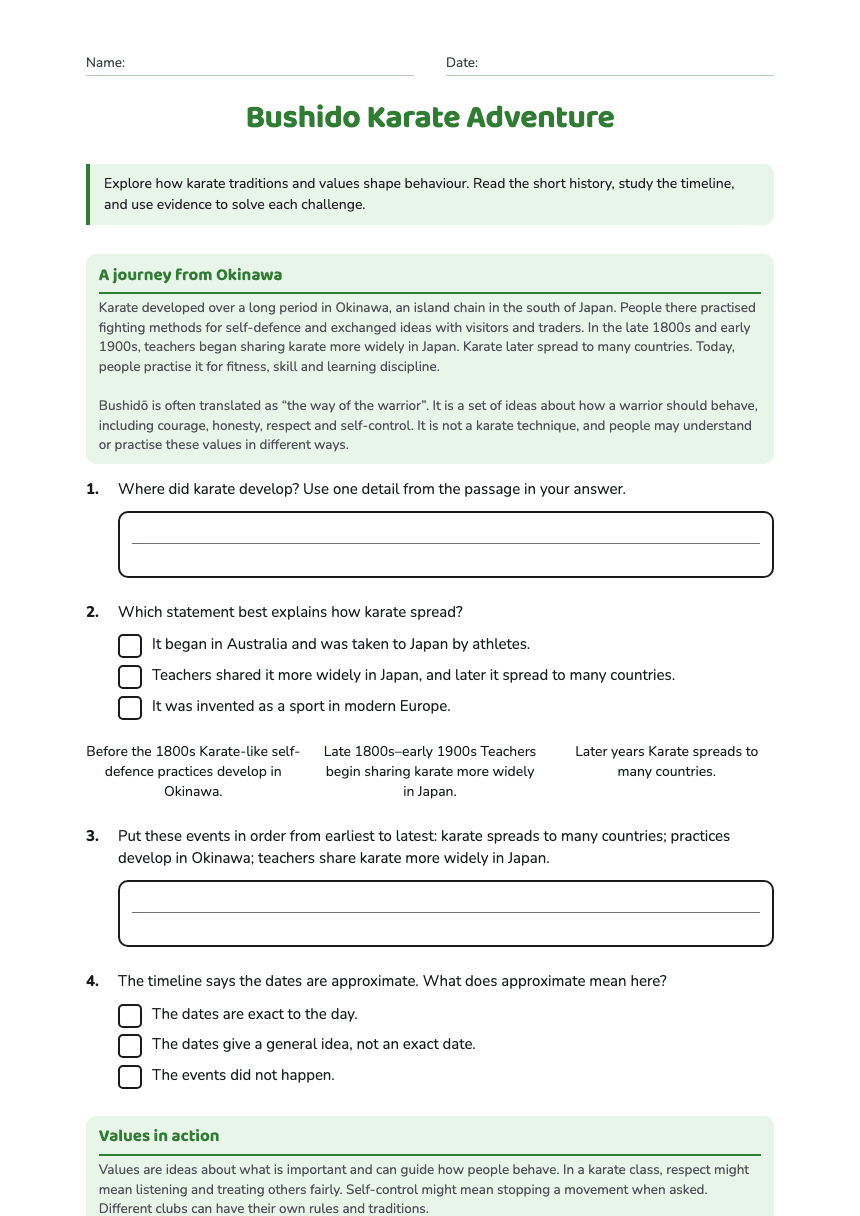
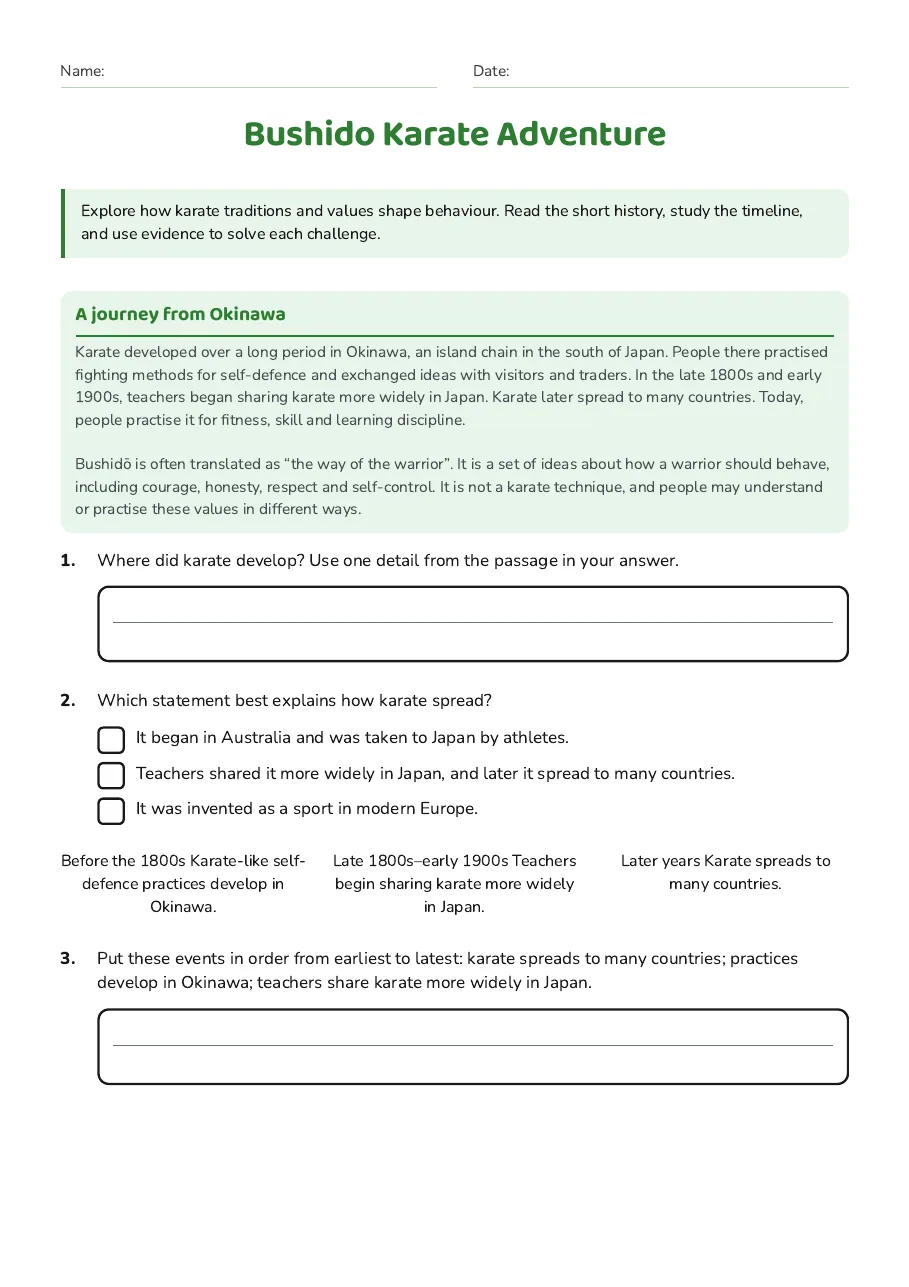
Bushido Karate Adventure
A journey from Okinawa
Karate developed over a long period in Okinawa, an island chain in the south of Japan. People there practised fighting methods for self-defence and exchanged ideas with visitors and traders. In the late 1800s and early 1900s, teachers began sharing karate more widely in Japan. Karate later spread to many countries. Today, people practise it for fitness, skill and learning discipline. Bushidō is often translated as “the way of the warrior”. It is a set of ideas about how a warrior should behave, including courage, honesty, respect and self-control. It is not a karate technique, and people may understand or practise these values in different ways.
- It began in Australia and was taken to Japan by athletes.
- Teachers shared it more widely in Japan, and later it spread to many countries.
- It was invented as a sport in modern Europe.
Before the 1800s Karate-like self-defence practices develop in Okinawa.
Late 1800s–early 1900s Teachers begin sharing karate more widely in Japan.
Later years Karate spreads to many countries.
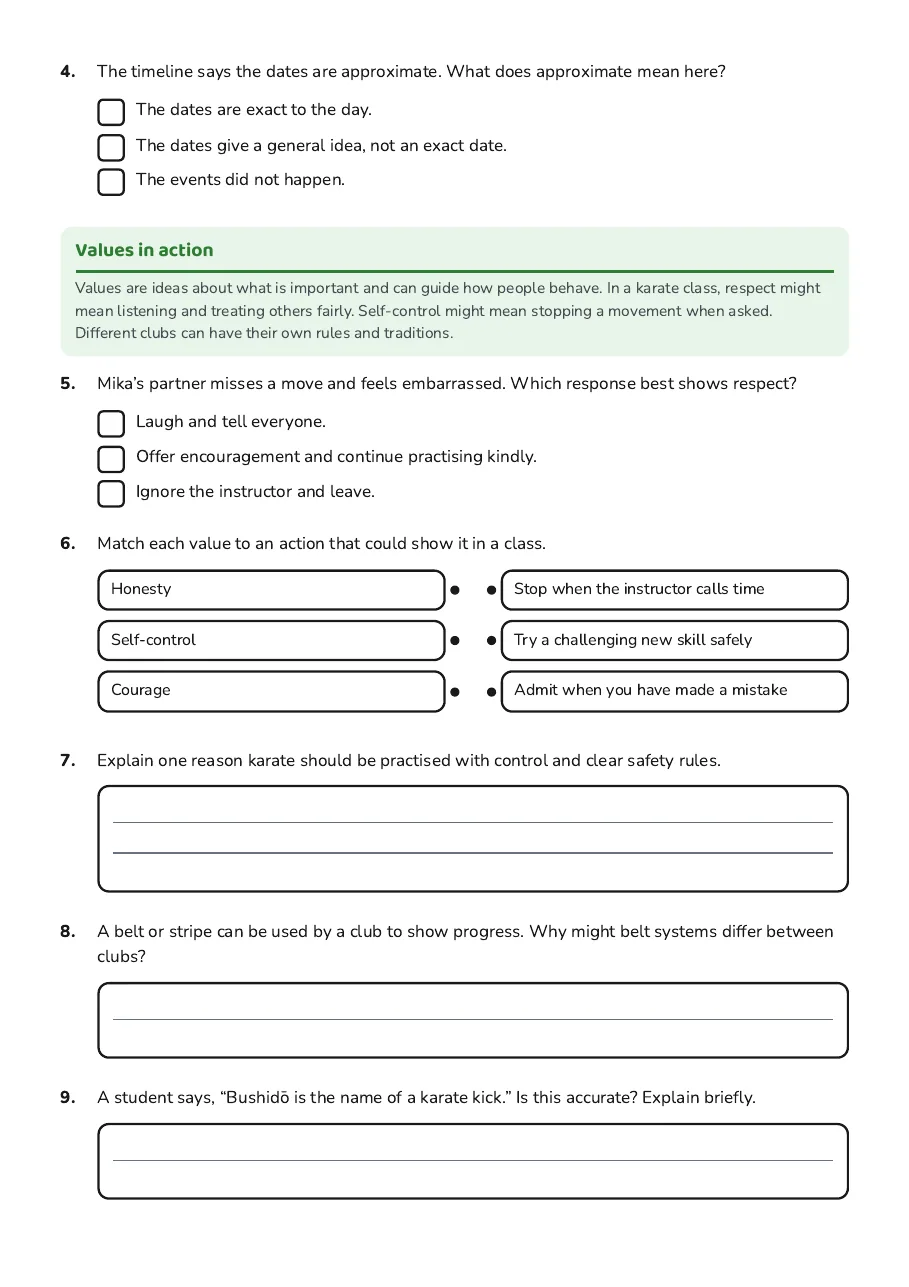
- The dates are exact to the day.
- The dates give a general idea, not an exact date.
- The events did not happen.
Values in action
Values are ideas about what is important and can guide how people behave. In a karate class, respect might mean listening and treating others fairly. Self-control might mean stopping a movement when asked. Different clubs can have their own rules and traditions.
- Laugh and tell everyone.
- Offer encouragement and continue practising kindly.
- Ignore the instructor and leave.
- Honesty
- Self-control
- Courage
- Stop when the instructor calls time
- Try a challenging new skill safely
- Admit when you have made a mistake
3 printable pages
Page 1
Page 2
Page 3
About This Worksheet
Free in Kuraplan
Sign up free, grab the PDF, and customize it for your class.
Print-Ready
Formatted for standard paper. Clean layout, easy to read.
AI-Generated
Created with Kuraplan's AI, designed for real classroom use.
For Teachers & Parents
Use in classrooms, for homework, tutoring, or homeschool.
Need a custom version of this worksheet?
Kuraplan's AI generates custom worksheets in seconds — differentiated for every learner, aligned to your curriculum.
Generate Custom Worksheets — Free