Drains and Bugs Exploration
A free science worksheet ready for your classroom. Open in Kuraplan to grab the print-ready PDF, customize it for your students, or generate a fresh version in seconds.
Drains and Bugs Exploration
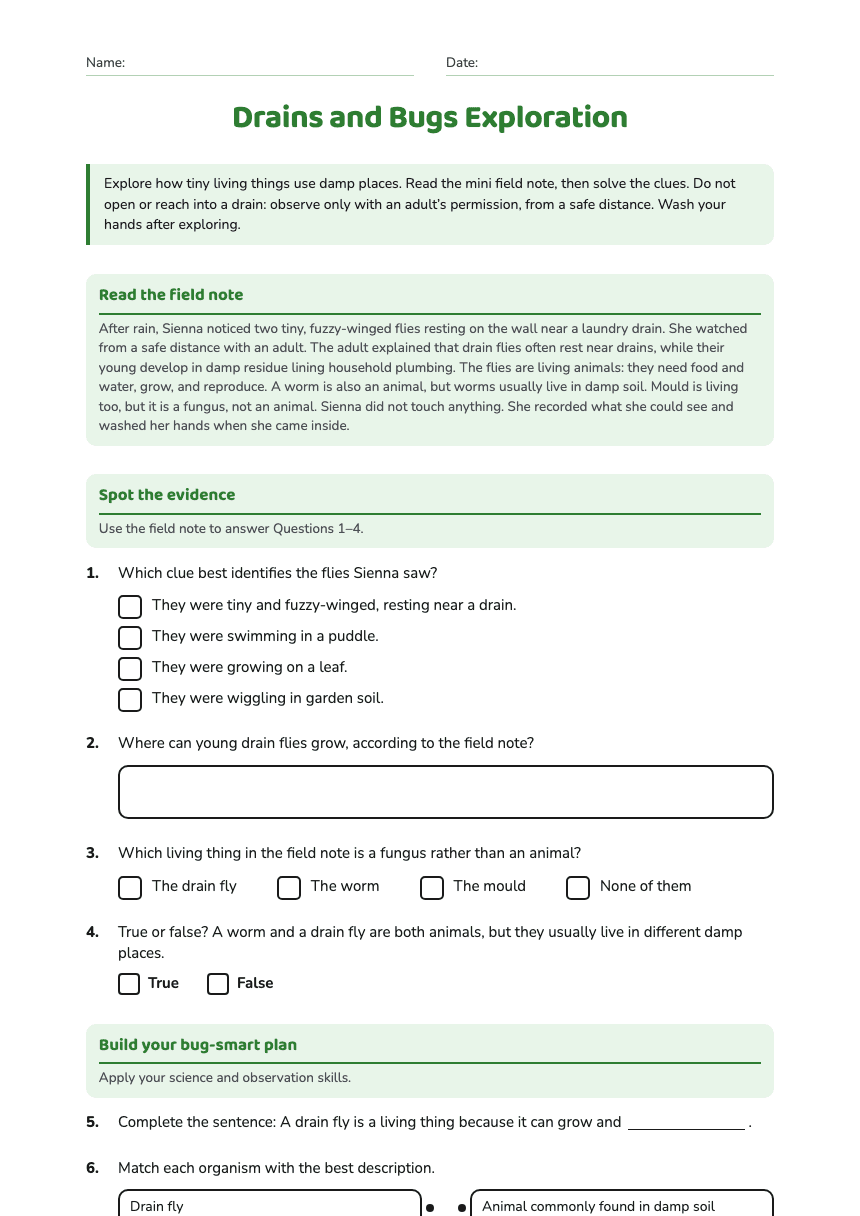
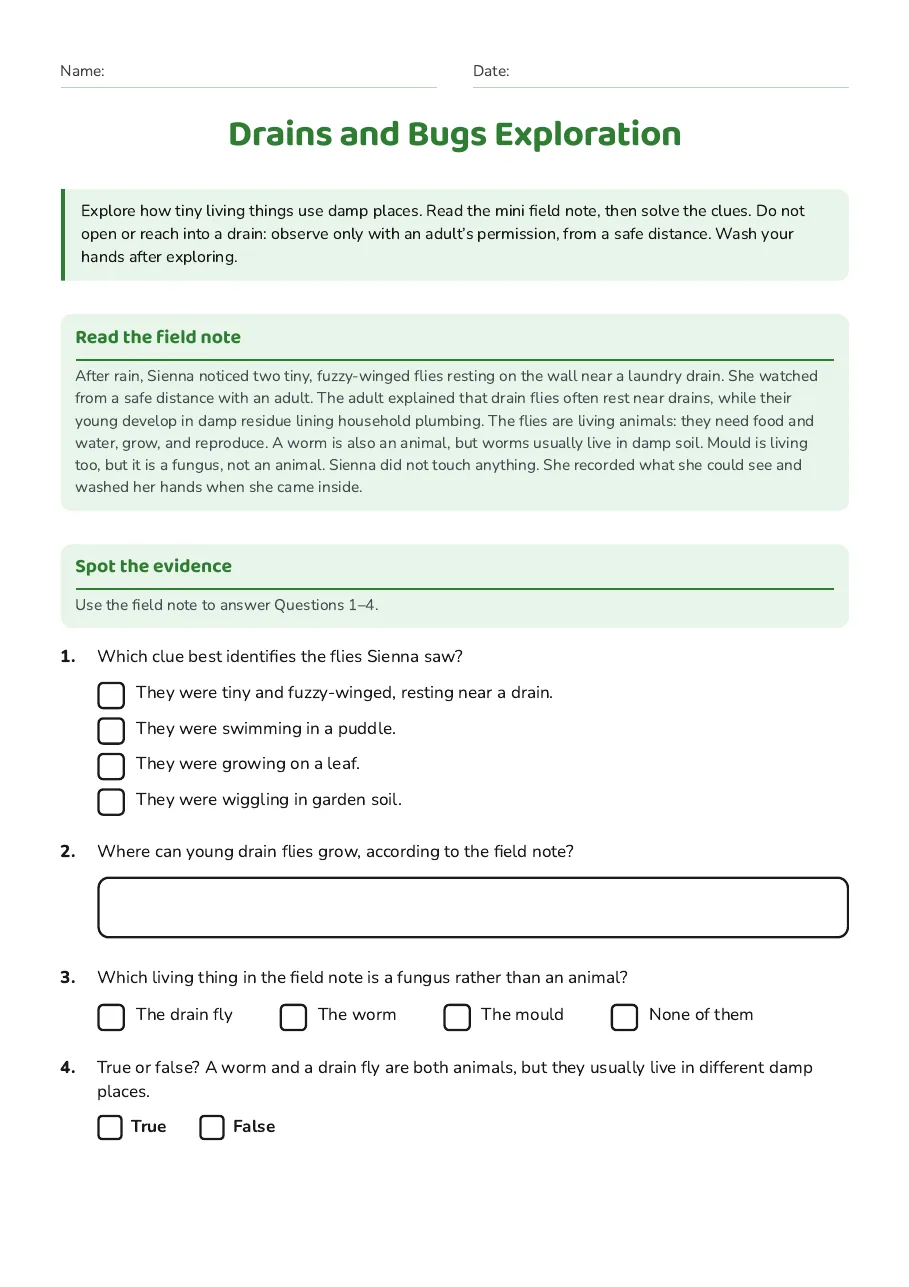
Read the field note
After rain, Sienna noticed two tiny, fuzzy-winged flies resting on the wall near a laundry drain. She watched from a safe distance with an adult. The adult explained that drain flies often rest near drains, while their young develop in damp residue lining household plumbing. The flies are living animals: they need food and water, grow, and reproduce. A worm is also an animal, but worms usually live in damp soil. Mould is living too, but it is a fungus, not an animal. Sienna did not touch anything. She recorded what she could see and washed her hands when she came inside.
Spot the evidence
Use the field note to answer Questions 1–4.
- They were tiny and fuzzy-winged, resting near a drain.
- They were swimming in a puddle.
- They were growing on a leaf.
- They were wiggling in garden soil.
- The drain fly
- The worm
- The mould
- None of them
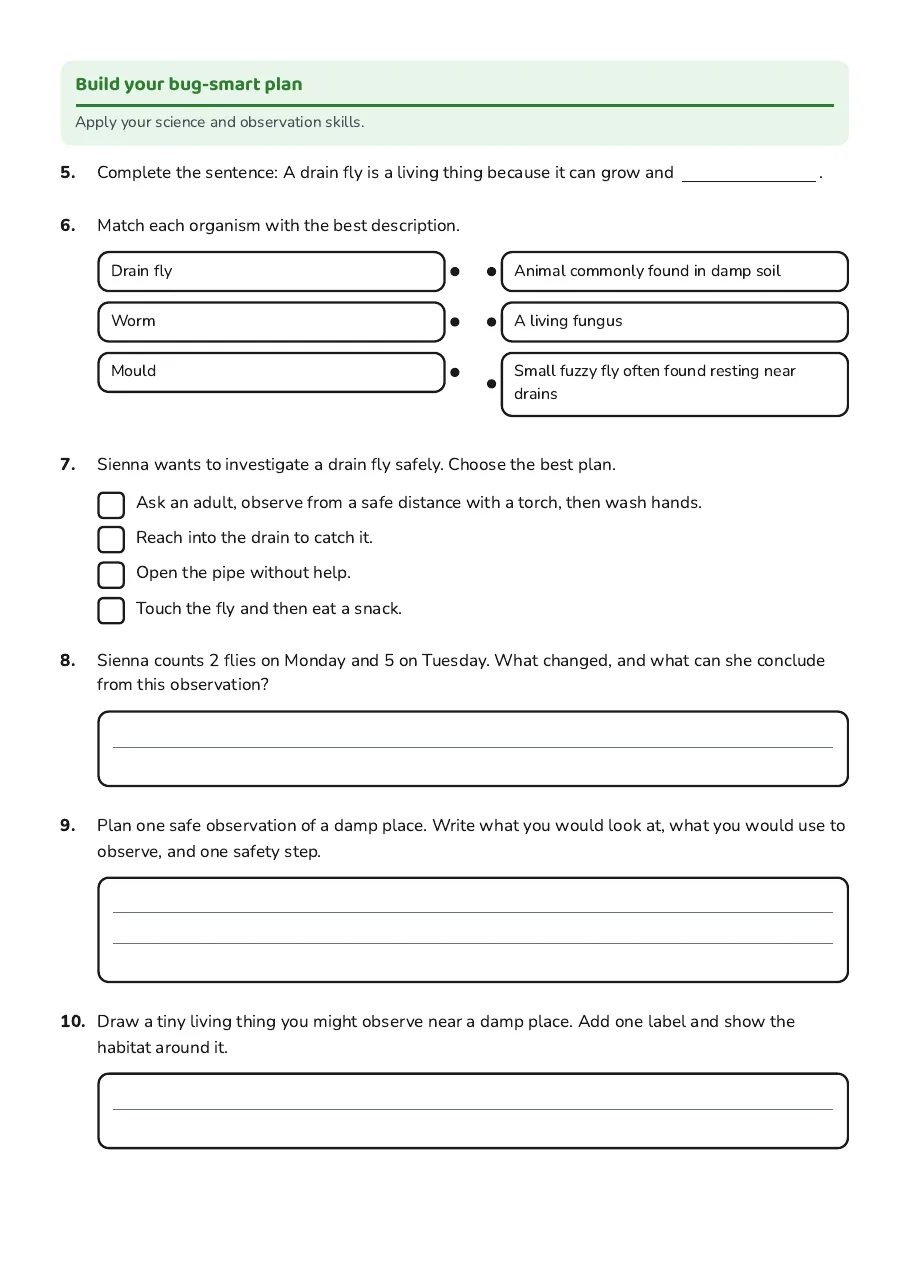
Build your bug-smart plan
Apply your science and observation skills.
- Drain fly
- Worm
- Mould
- Animal commonly found in damp soil
- A living fungus
- Small fuzzy fly often found resting near drains
- Ask an adult, observe from a safe distance with a torch, then wash hands.
- Reach into the drain to catch it.
- Open the pipe without help.
- Touch the fly and then eat a snack.
2 printable pages
Page 1
Page 2
About This Worksheet
Free in Kuraplan
Sign up free, grab the PDF, and customize it for your class.
Print-Ready
Formatted for standard paper. Clean layout, easy to read.
AI-Generated
Created with Kuraplan's AI, designed for real classroom use.
For Teachers & Parents
Use in classrooms, for homework, tutoring, or homeschool.
Need a custom version of this worksheet?
Kuraplan's AI generates custom worksheets in seconds — differentiated for every learner, aligned to your curriculum.
Generate Custom Worksheets — Free