Earth and Space Concepts
A free science worksheet ready for your classroom. Open in Kuraplan to grab the print-ready PDF, customize it for your students, or generate a fresh version in seconds.
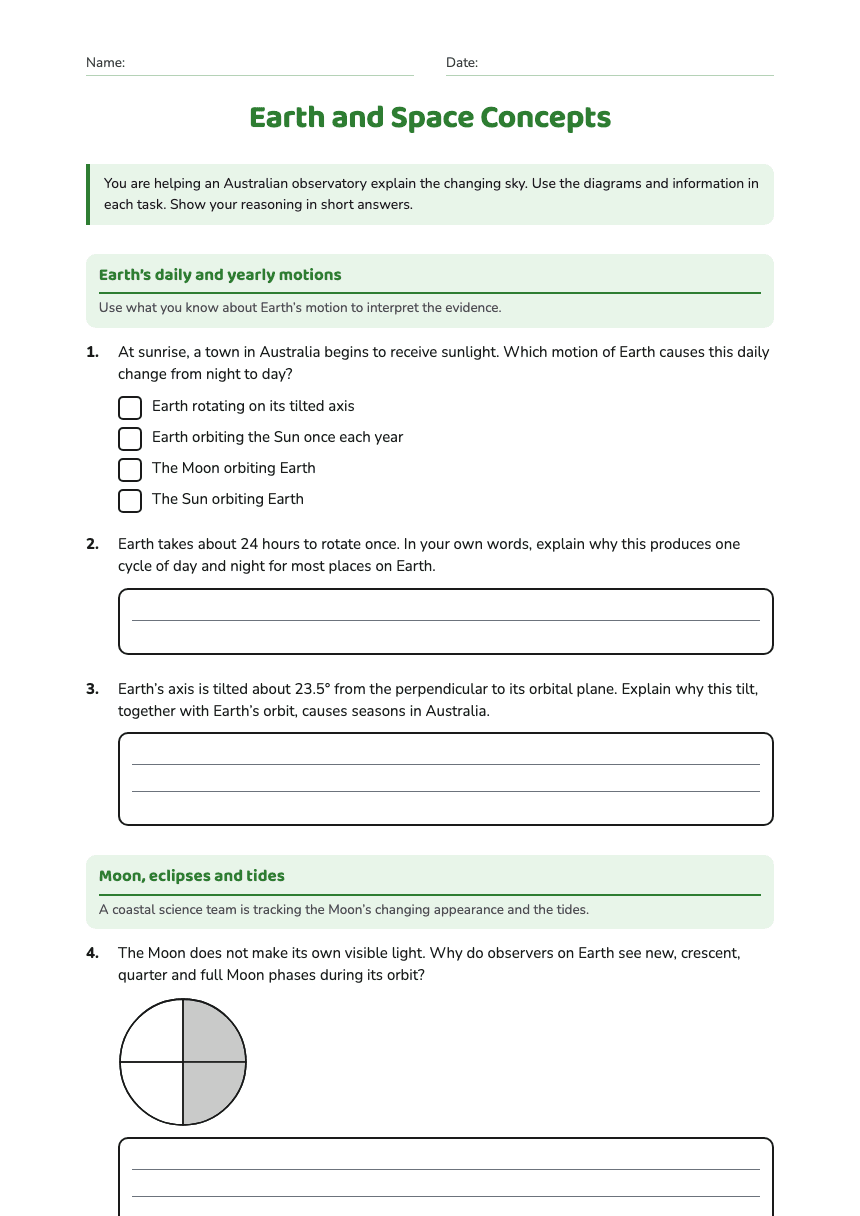
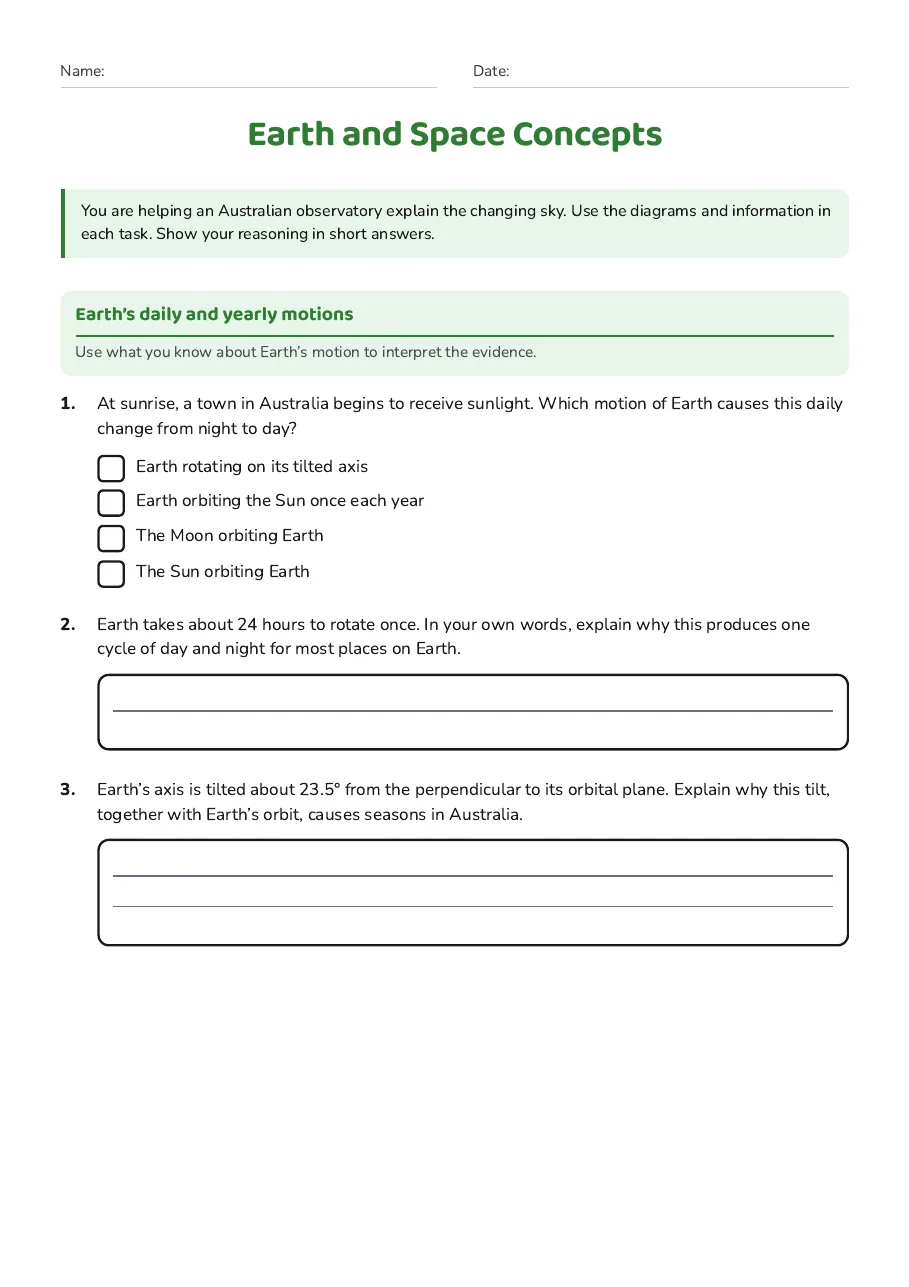
Earth and Space Concepts
🌍 Part 1: Multiple Choice Questions
Choose the best answer for each question by filling in the circle.
✏️ Part 2: Short Answer Questions
Answer the following questions in the spaces provided.
a) When it is summer in Australia, it is _____________ in the Northern Hemisphere.
b) The closest star to Earth is the _____________.
c) High tides occur approximately every _____________ hours.
🔬 Part 3: Extended Response
Answer the following question with detailed explanations.
📋 Answer Key
Multiple Choice Answers:
1. B - Earth's rotation on its axis causes day and night as different parts face the Sun.
2. B - Earth completes one rotation in 24 hours (one day).
3. B - Earth's 23.5° axial tilt causes seasons as different hemispheres receive varying amounts of direct sunlight.
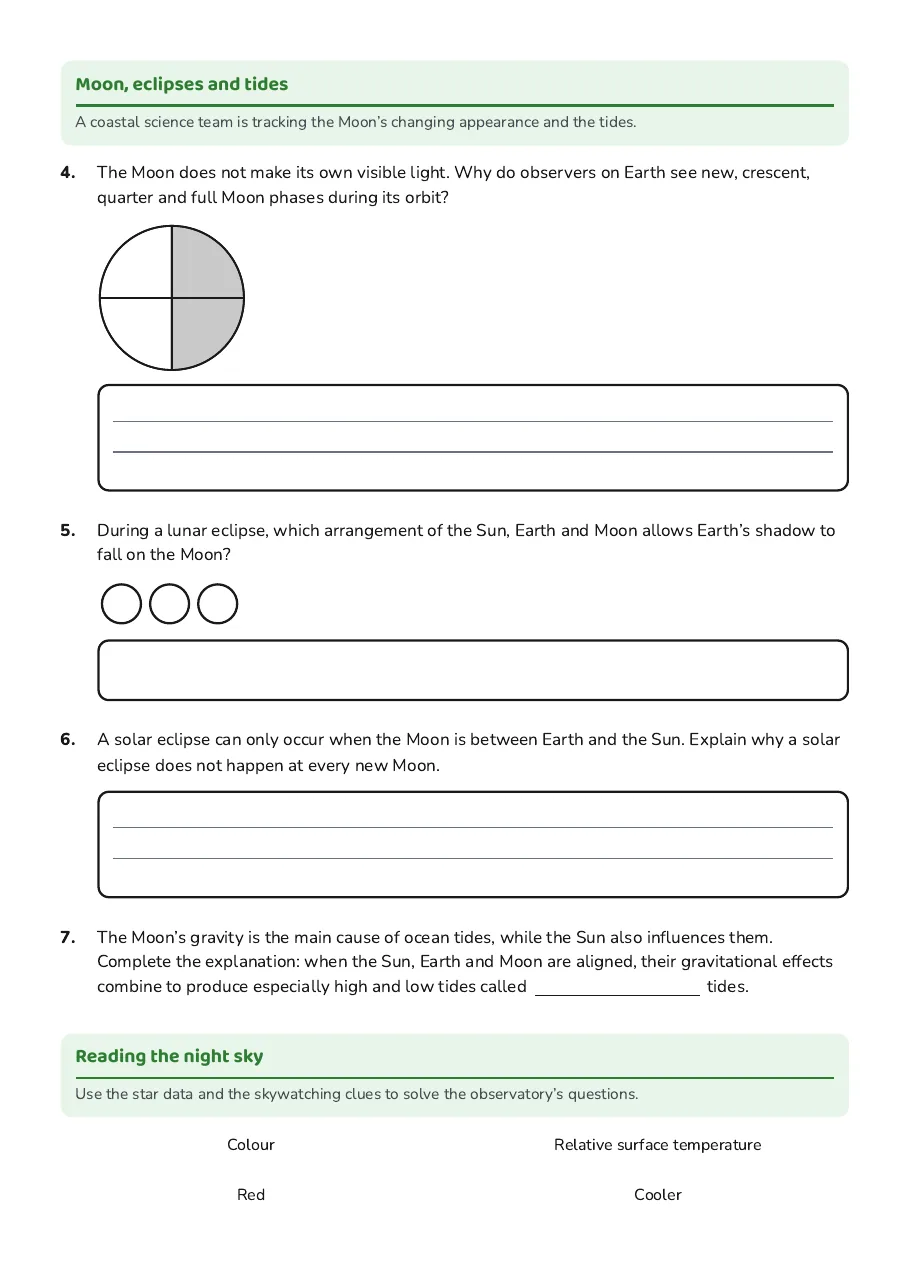
4. B - During a lunar eclipse, Earth casts a shadow on the Moon by passing between the Sun and Moon.
5. C - The Moon's gravity is the primary cause, with the Sun's gravity also contributing to tidal patterns.
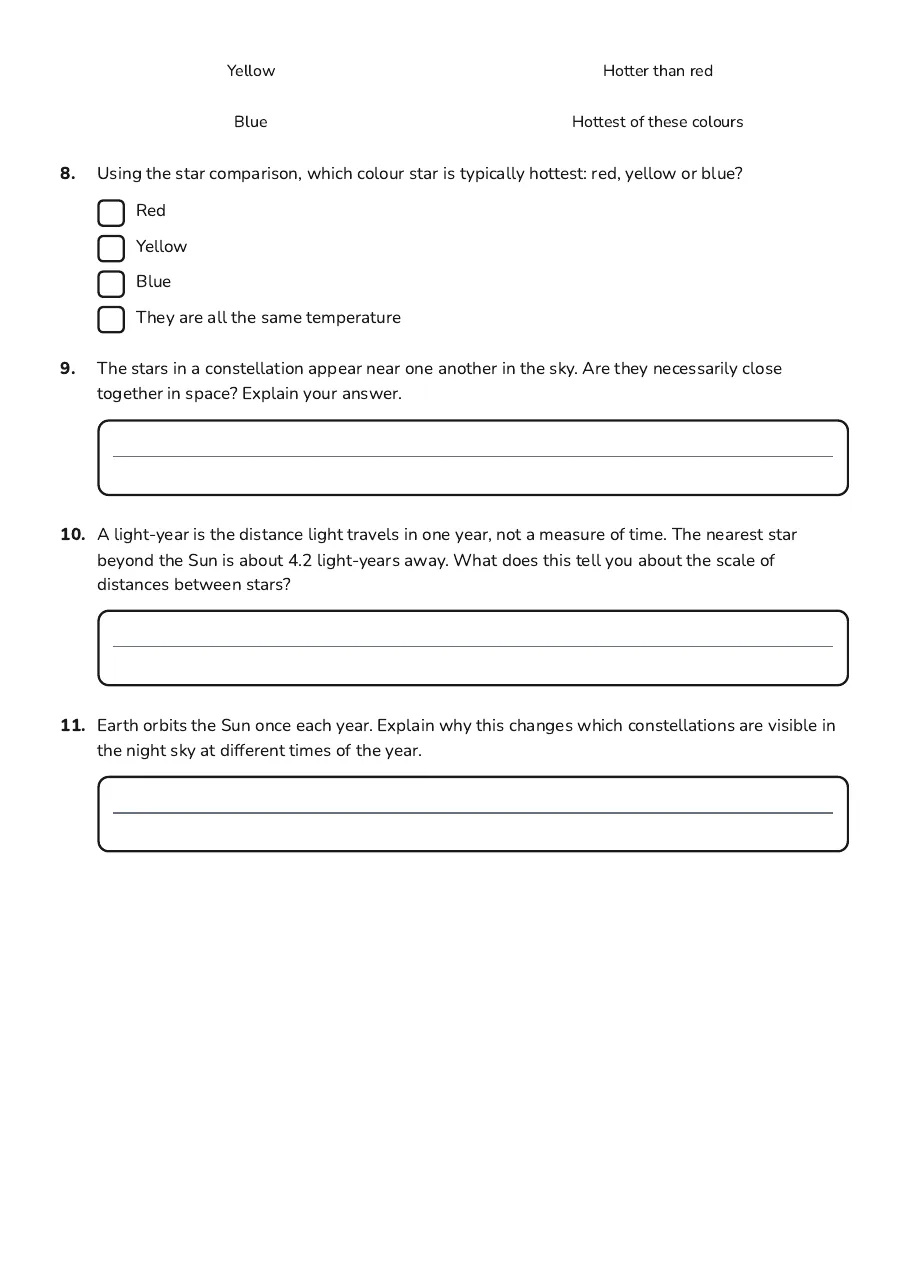
6. B - A light-year measures the distance light travels in one year (about 9.5 trillion kilometres).
7. C - Blue stars are the hottest, while red stars are the coolest.
Short Answer Responses:
8. We see different lunar phases because the Moon orbits Earth, and we see different amounts of the Moon's sunlit side depending on the Moon's position relative to Earth and the Sun.
9. A solar eclipse occurs when the Moon passes between Earth and the Sun, casting a shadow on Earth. This happens because the Moon blocks the Sun's light from reaching certain areas on Earth's surface.
10. We see different constellations throughout the year because Earth orbits the Sun, changing our nighttime view of space. As Earth moves in its orbit, different parts of the sky become visible at night.
11. a) winter b) Sun c) 12
Extended Response Sample Answer:
12. Objects in our solar system vary greatly in size and distance. Planets appear similar in size to stars when viewed from Earth due to perspective and distance differences. Planets are much closer to us (within our solar system) but are relatively small. Stars are enormous but appear small because they are incredibly far away - the nearest star (other than our Sun) is over 4 light-years away. A light-year is the distance light travels in one year (about 9.5 trillion kilometres), demonstrating the vast scales in space. This explains why both planets and distant stars can appear as small points of light in our sky despite their very different actual sizes and distances.
About This Worksheet
Free in Kuraplan
Sign up free, grab the PDF, and customize it for your class.
Print-Ready
Formatted for standard paper. Clean layout, easy to read.
AI-Generated
Created with Kuraplan's AI, designed for real classroom use.
For Teachers & Parents
Use in classrooms, for homework, tutoring, or homeschool.
Need a custom version of this worksheet?
Kuraplan's AI generates custom worksheets in seconds — differentiated for every learner, aligned to your curriculum.
Generate Custom Worksheets — FreeMore Science Worksheets
Danforth: Authority and Conscience
Free
Natural Resources Science
Free
Natural Resources Science
Free
Vitamins, Minerals, and Protein Science
Free
Exploring Science Materials
Free
Waka Buoyancy Science Worksheet
Free
Science Skills Made Simple
Free