ScienceFreePrintable

Earth & Space Science Quiz

A free science worksheet ready for your classroom. Open in Kuraplan to grab the print-ready PDF, customize it for your students, or generate a fresh version in seconds.
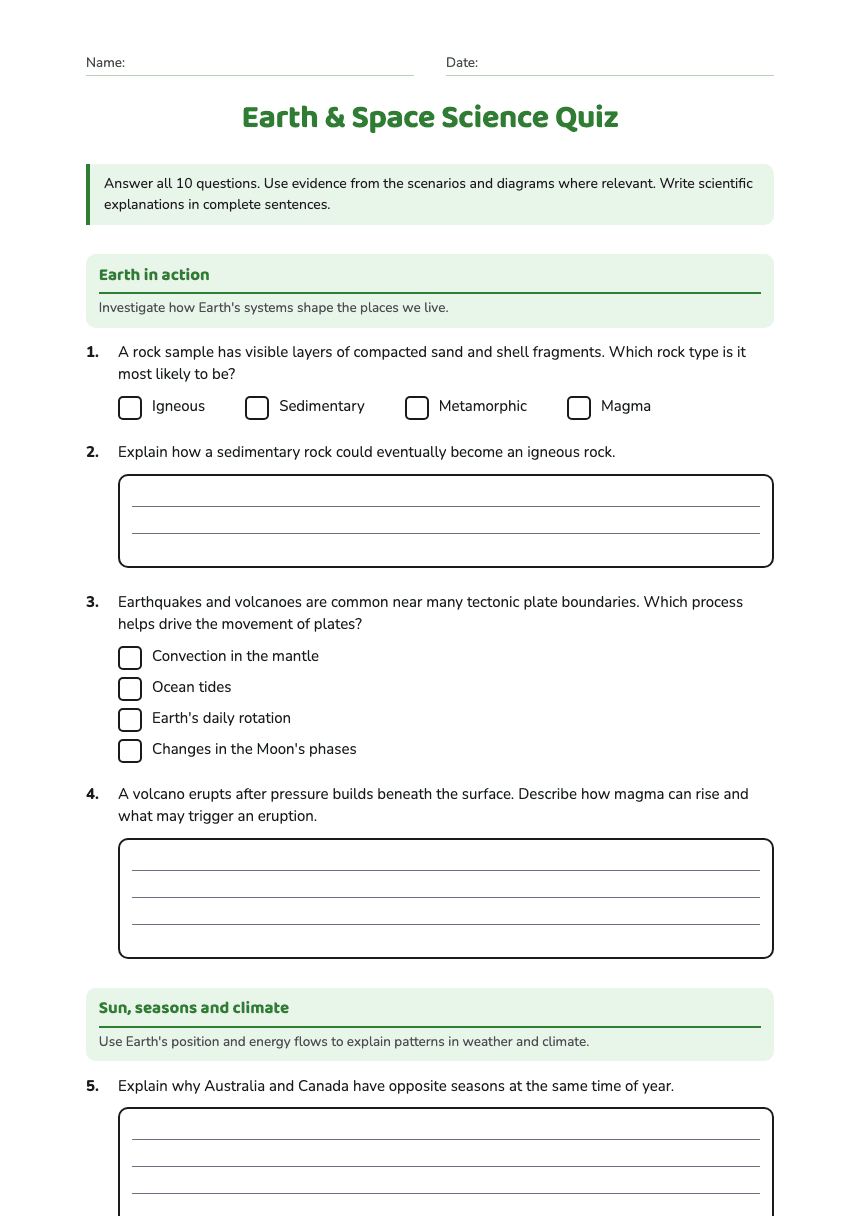
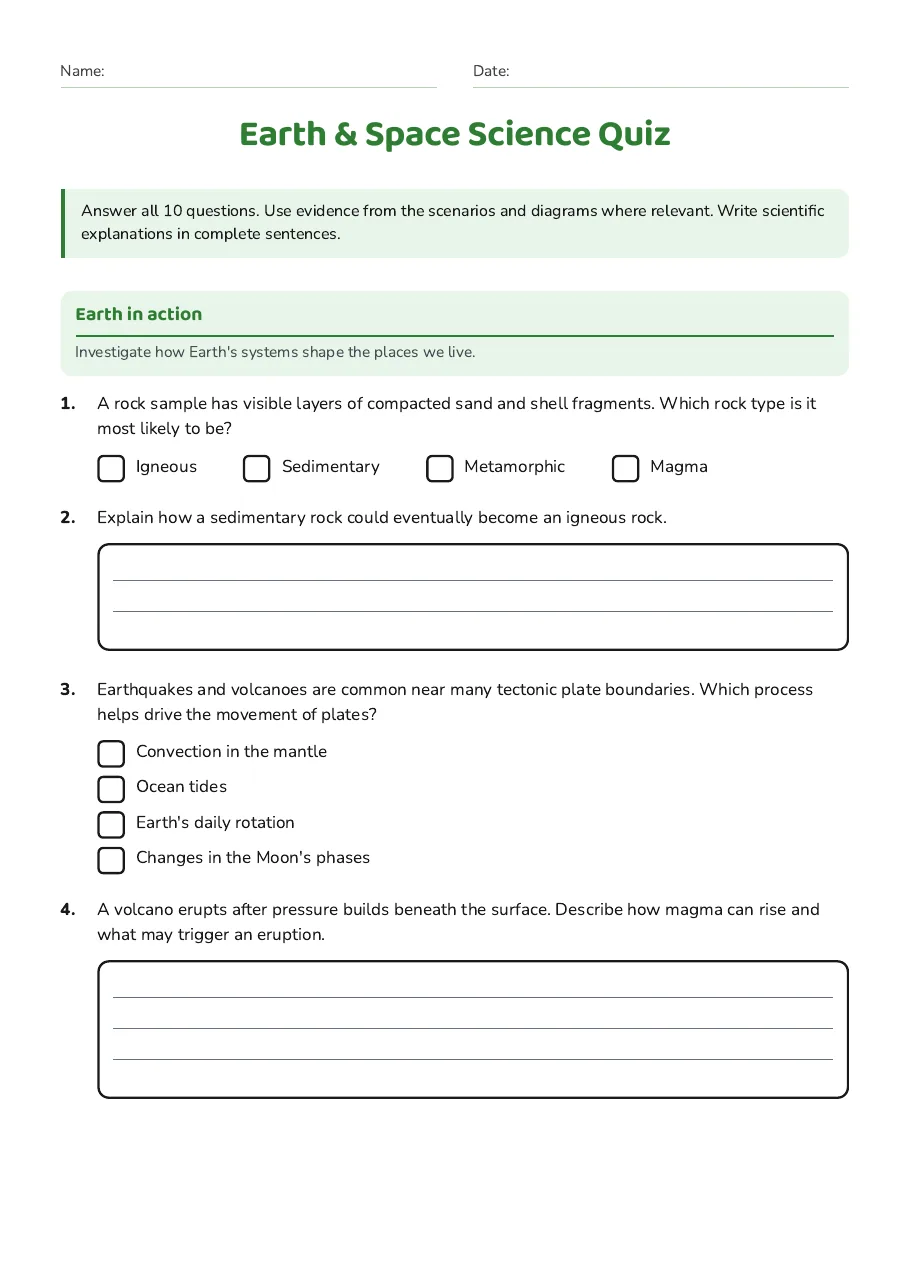
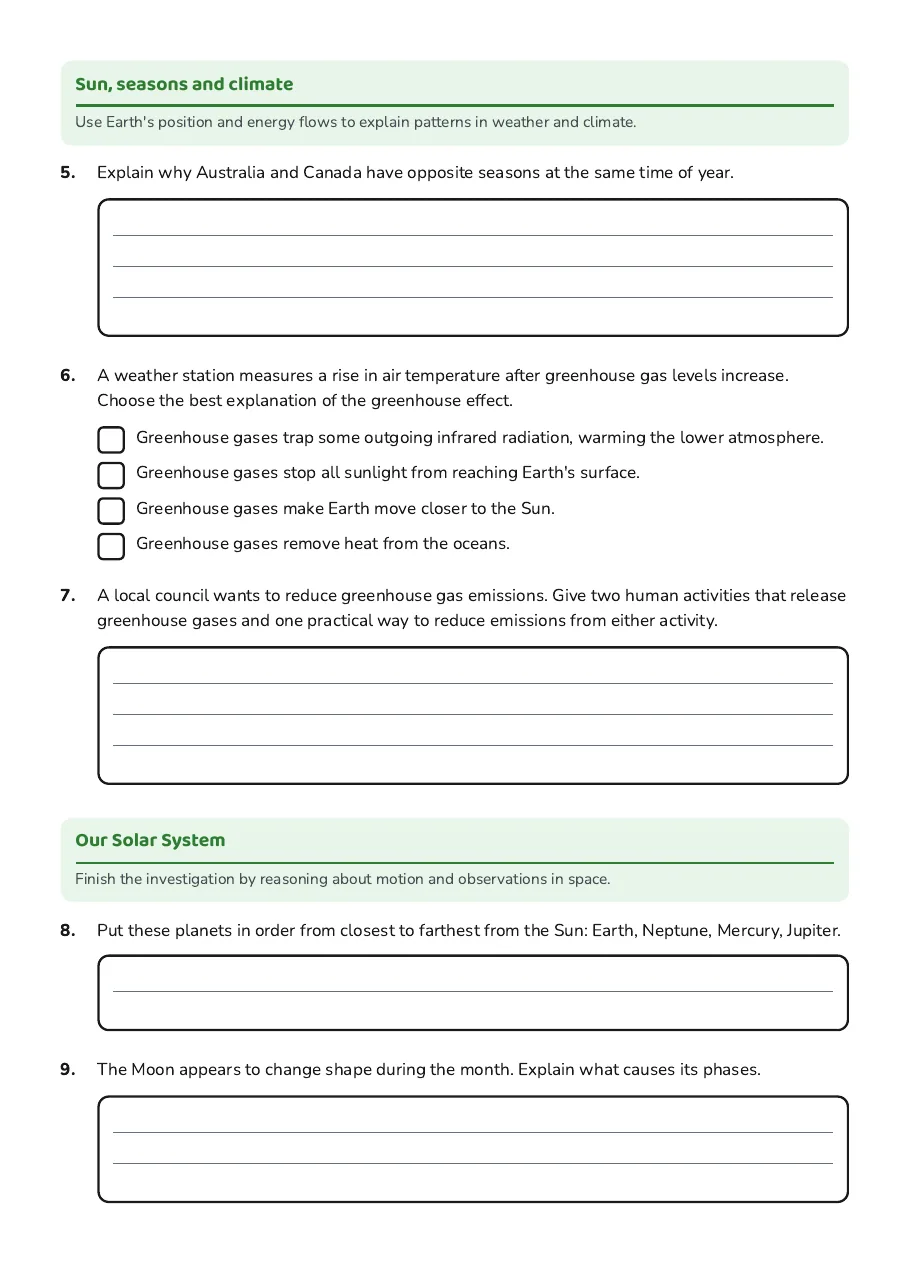
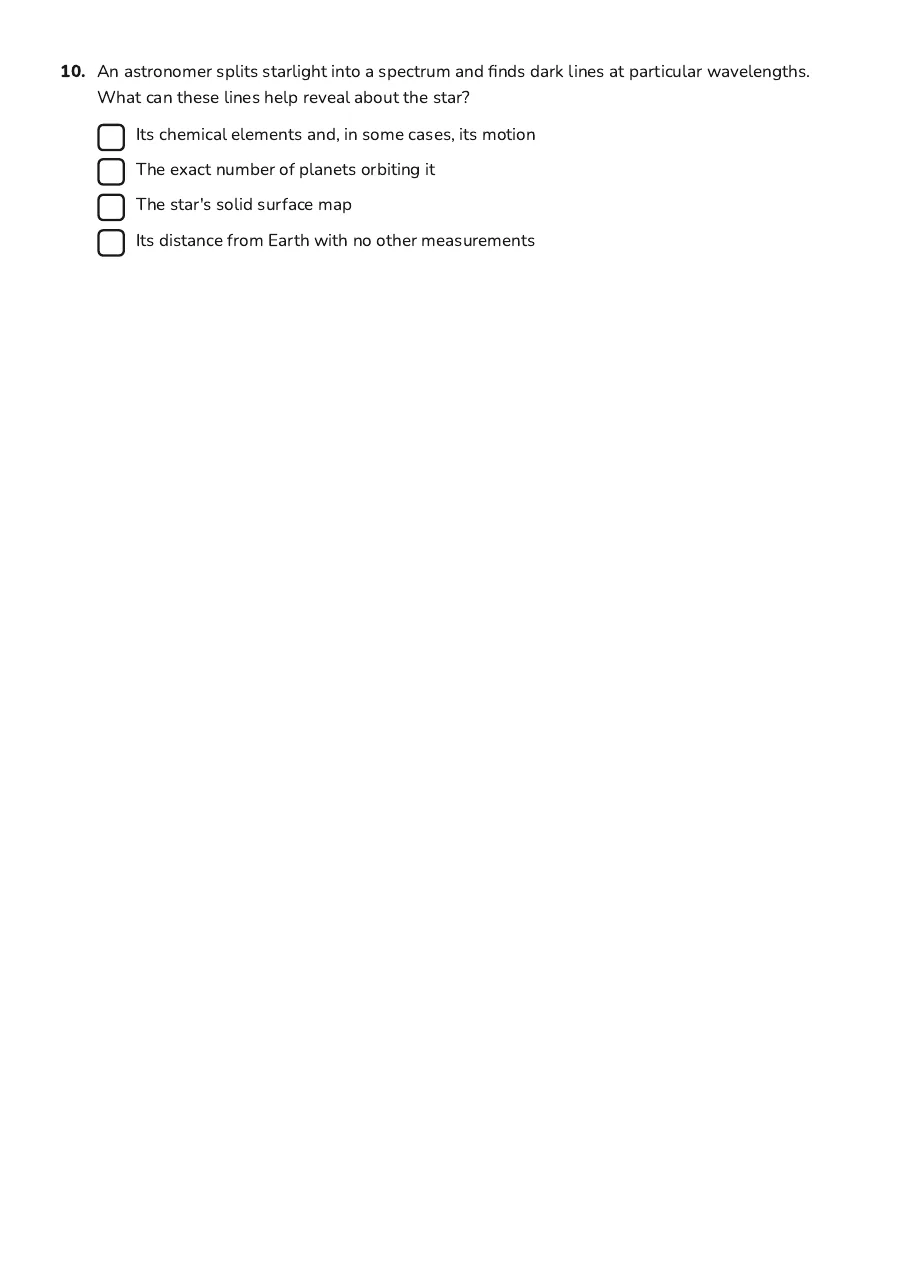
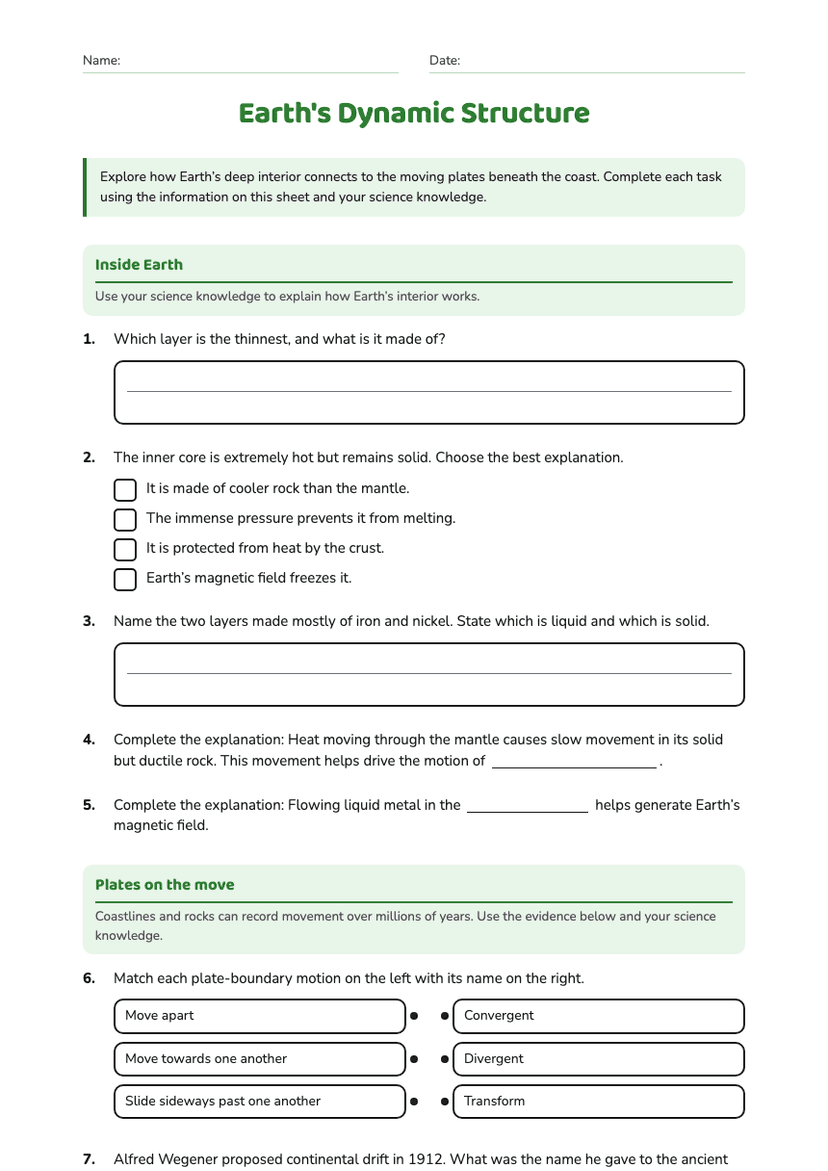
Earth & Space Science Quiz worksheet preview

Earth & Space Science Quiz

Instructions: Answer all questions clearly. For multiple choice, circle the correct letter. For short answers, write in complete sentences where appropriate.

🌍 Part 1: Earth's Systems and Structure

1. Which of Earth's spheres contains all living organisms?

a) Atmosphere

b) Biosphere

c) Hydrosphere

d) Geosphere

2. The process where sedimentary rock is transformed into metamorphic rock requires:

a) Only heat

b) Only pressure

c) Heat and pressure

d) Cooling and crystallisation

3. Tectonic plates move because of:

a) Ocean currents

b) Convection currents in the mantle

c) Gravitational pull from the moon

d) Magnetic field changes

4. Explain how the three types of rock in the rock cycle are connected to each other.
5. Name two renewable resources and two non-renewable resources found on Earth.

Renewable: _________________ and _________________

Non-renewable: _________________ and _________________

6. Earthquakes are most likely to occur:

a) In the centre of tectonic plates

b) Along tectonic plate boundaries

c) Only under the ocean

d) Only on continents

7. Describe what causes volcanoes to form and erupt.

🌤️ Part 2: Climate and Weather Systems

8. The main driver of Earth's weather patterns is:

a) The Moon's gravity

b) Solar energy from the Sun

c) Ocean tides

d) Volcanic activity

9. Seasons on Earth are caused by:

a) Earth's distance from the Sun changing

b) The tilt of Earth's axis

c) Solar flares

d) The Moon's orbit

10. Which greenhouse gas is most abundant in Earth's atmosphere?

a) Carbon dioxide

b) Methane

c) Water vapour

d) Nitrogen

11. Explain why it's summer in Australia when it's winter in Canada.
12. List three human activities that contribute to climate change.

🚀 Part 3: Solar System and Space

13. The correct order of planets from the Sun is:

a) Mercury, Venus, Earth, Mars, Jupiter, Saturn, Uranus, Neptune

b) Mercury, Mars, Earth, Venus, Jupiter, Saturn, Uranus, Neptune

c) Venus, Mercury, Earth, Mars, Jupiter, Saturn, Neptune, Uranus

d) Mercury, Venus, Mars, Earth, Jupiter, Saturn, Uranus, Neptune

14. Tides on Earth are primarily caused by:

a) Earth's rotation

b) The Sun's gravity

c) The Moon's gravity

d) Ocean currents

15. What keeps planets in orbit around the Sun?

a) Magnetic force

b) Gravitational force

c) Solar wind

d) Atmospheric pressure

16. A light-year measures:

a) Time

b) Distance

c) Speed

d) Brightness

17. Explain why we see different phases of the Moon throughout the month.
18. How do telescopes help astronomers study distant objects in space?
19. The day/night cycle on Earth is caused by:

a) Earth orbiting the Sun

b) Earth rotating on its axis

c) The Moon's orbit

d) Solar flares

20. What information can astronomers gather about stars using spectroscopy?

📋 Answer Key

1. b) Biosphere

2. c) Heat and pressure

3. b) Convection currents in the mantle

4. Igneous rocks can weather to form sedimentary rocks; sedimentary rocks can be heated/pressurised to form metamorphic rocks; any rock type can melt to form magma that cools into igneous rock.

5. Renewable: solar, wind, water, biomass; Non-renewable: coal, oil, natural gas, uranium

6. b) Along tectonic plate boundaries

7. Magma rises from the mantle due to pressure and heat; erupts when pressure builds up in magma chamber.

8. b) Solar energy from the Sun

9. b) The tilt of Earth's axis

10. c) Water vapour

11. Earth's hemispheres are tilted differently towards the Sun at different times of year due to Earth's axial tilt.

12. Burning fossil fuels, deforestation, industrial processes, agriculture, transport

13. a) Mercury, Venus, Earth, Mars, Jupiter, Saturn, Uranus, Neptune

14. c) The Moon's gravity

15. b) Gravitational force

16. b) Distance

17. The Moon orbits Earth; we see different amounts of the sunlit side depending on Moon's position.

18. Telescopes collect and focus light, allowing us to see distant, faint objects and analyse their light.

19. b) Earth rotating on its axis

20. Chemical composition, temperature, motion, distance

About This Worksheet

Free in Kuraplan

Sign up free, grab the PDF, and customize it for your class.

Print-Ready

Formatted for standard paper. Clean layout, easy to read.

AI-Generated

Created with Kuraplan's AI, designed for real classroom use.

For Teachers & Parents

Use in classrooms, for homework, tutoring, or homeschool.

Need a custom version of this worksheet?

Kuraplan's AI generates custom worksheets in seconds — differentiated for every learner, aligned to your curriculum.

Generate Custom Worksheets — Free
No credit card Curriculum-aligned Under 60 seconds