Geometry Angles and Shapes
A free maths worksheet ready for your classroom. Open in Kuraplan to grab the print-ready PDF, customize it for your students, or generate a fresh version in seconds.
Geometry Angles and Shapes
Formula and Equations Reference
Use these rules and formulas to help solve the questions.
Straight-line angles: a + b = 180°
Angles around a point: a + b + c + d = 360°
Triangle angle sum: a + b + c = 180°
Quadrilateral angle sum: the interior angles add to 360°
Polygon interior-angle sum: (n − 2) × 180°, where n is the number of sides
Rectangle area: A = l × w
Rectangle perimeter: P = 2(l + w)
Triangle area: A = ½ × b × h
Similarity scale factor: k = corresponding length ÷ original length
Part 1: Core Geometry Skills
Curriculum links: AC9M7M04, AC9M7M05, AC9M8M01 and AC9M8SP01.
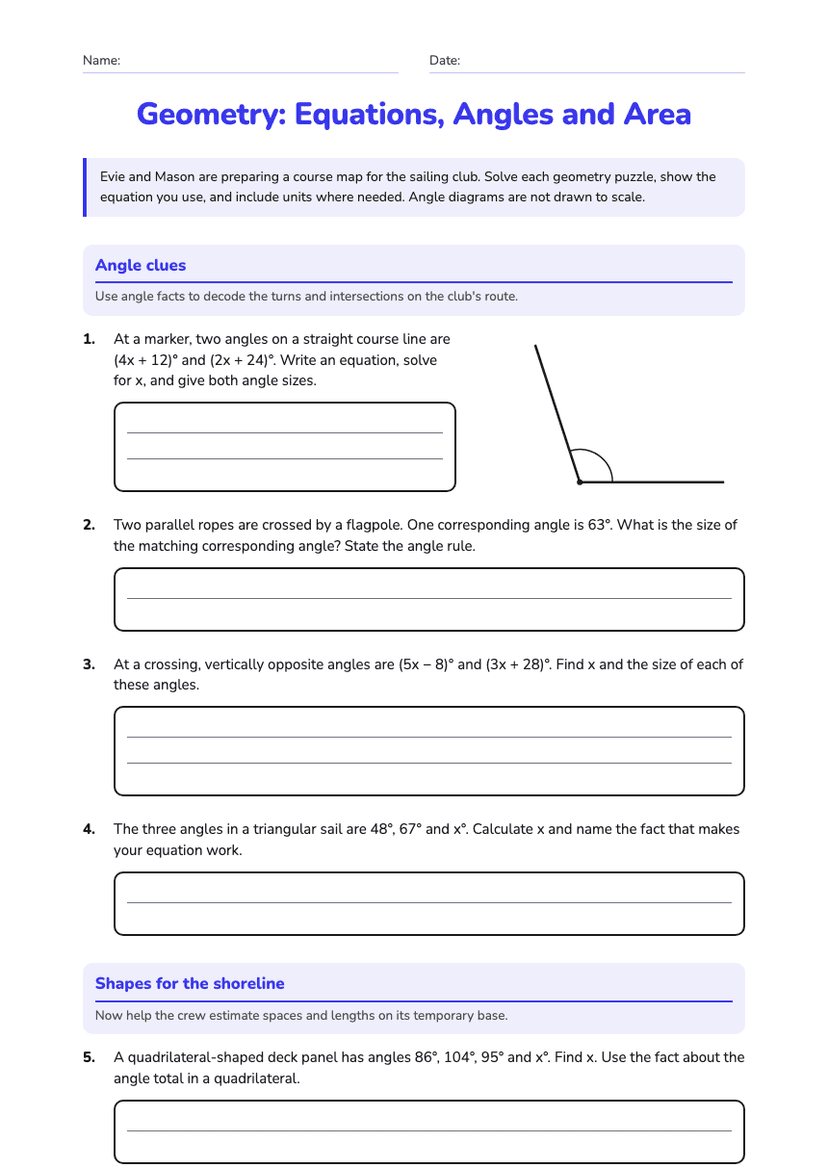
Worked example: When two parallel lines are crossed by a transversal, corresponding angles are equal, alternate angles are equal, and co-interior angles add to 180°. In a triangle, the interior angles add to 180°. In a quadrilateral, they add to 360°.
Answer: __________°
Answer: __________°
Answer: __________°
Answer: __________°
Part 2: Shapes, Measurement and Challenge
Method reminder: For a composite shape, split it into familiar rectangles or triangles. Add the areas. For perimeter, add the lengths of the outside edges only.
Answer: __________ m²
Answer: __________ m
Answer: __________ cm²
Teacher Answer Key
1. 68°. Corresponding angles in parallel lines are equal.
2. 112°. Co-interior angles add to 180°, so 180° − 68° = 112°.
3. Using a + b + c = 180°: 47° + 86° = 133°; 180° − 133° = 47°.
4. Polygon sum = (5 − 2) × 180° = 540°. Each angle = 540° ÷ 5 = 108°.
5. Vertically opposite angles are equal; angles on a straight line add to 180°; triangle angles add to 180°.
6. Whole rectangle area = l × w = 10 × 6 = 60 m². Removed area = 4 × 2 = 8 m². Remaining area = 52 m².
7. Add the outside edges: 10 + 4 + 2 + 6 + 4 + 8 = 34 m.
8. ½ × (8 + 14) × 5 = ½ × 22 × 5 = 55 cm².
9. Yes. The triangles are congruent by SSS because all three corresponding side lengths are equal.
10. Yes. Using k = corresponding length ÷ original length, 6 ÷ 3 = 2. Each side in Triangle B is twice the corresponding side in Triangle A, so the scale factor is 2. The corresponding angles are equal.
11. Responses should show the same angle sizes, with every corresponding side in the larger triangle twice the length of the smaller triangle.
About This Worksheet
Free in Kuraplan
Sign up free, grab the PDF, and customize it for your class.
Print-Ready
Formatted for standard paper. Clean layout, easy to read.
AI-Generated
Created with Kuraplan's AI, designed for real classroom use.
For Teachers & Parents
Use in classrooms, for homework, tutoring, or homeschool.
Need a custom version of this worksheet?
Kuraplan's AI generates custom worksheets in seconds — differentiated for every learner, aligned to your curriculum.
Generate Custom Worksheets — Free