Geometry in Simple Steps
A free maths worksheet ready for your classroom. Open in Kuraplan to grab the print-ready PDF, customize it for your students, or generate a fresh version in seconds.
Geometry in Simple Steps
📚 Part 1: Rules and a Reliable Method
Formulae box
Triangle angle sum: the three angles add to 180°.
Polygon interior angle sum: (number of sides − 2) × 180°.
Rectangle area: A = length × width.
Triangle area: A = ½ × base × perpendicular height.
Parallelogram area: A = base × perpendicular height.
Perimeter: add the lengths of all the outside sides.
Pythagoras: a² + b² = c², where c is the longest side opposite the right angle.
Key terms
Interior angle: an angle inside a shape. Parallel lines: lines that stay the same distance apart and never meet. Composite shape: a shape made from two or more simpler shapes.
How to solve geometry problems
1. Identify the shape, measurements and what is unknown.
2. Choose the correct formula or angle rule.
3. Substitute the known numbers.
4. Calculate carefully.
5. Include units, such as cm, cm² or °.
6. Check that your answer is sensible.
Step 1: Identify the rule: the angles in a triangle add to ________.
Step 2: Substitute: 50° + 60° + x = ________°.
Step 3: Calculate: x = 180° − ________° = ________°.
Step 1: Perimeter formula: P = 2 × length + 2 × width.
Step 2: P = 2 × 8 + 2 × 3 = ________ m.
Step 3: Area formula: A = length × width = 8 × 3 = ________ m².
Support prompt: Perimeter measures around the outside; area measures the surface inside.
✏️ Part 2: Practise the Steps
Step 1: Write the angle rule.
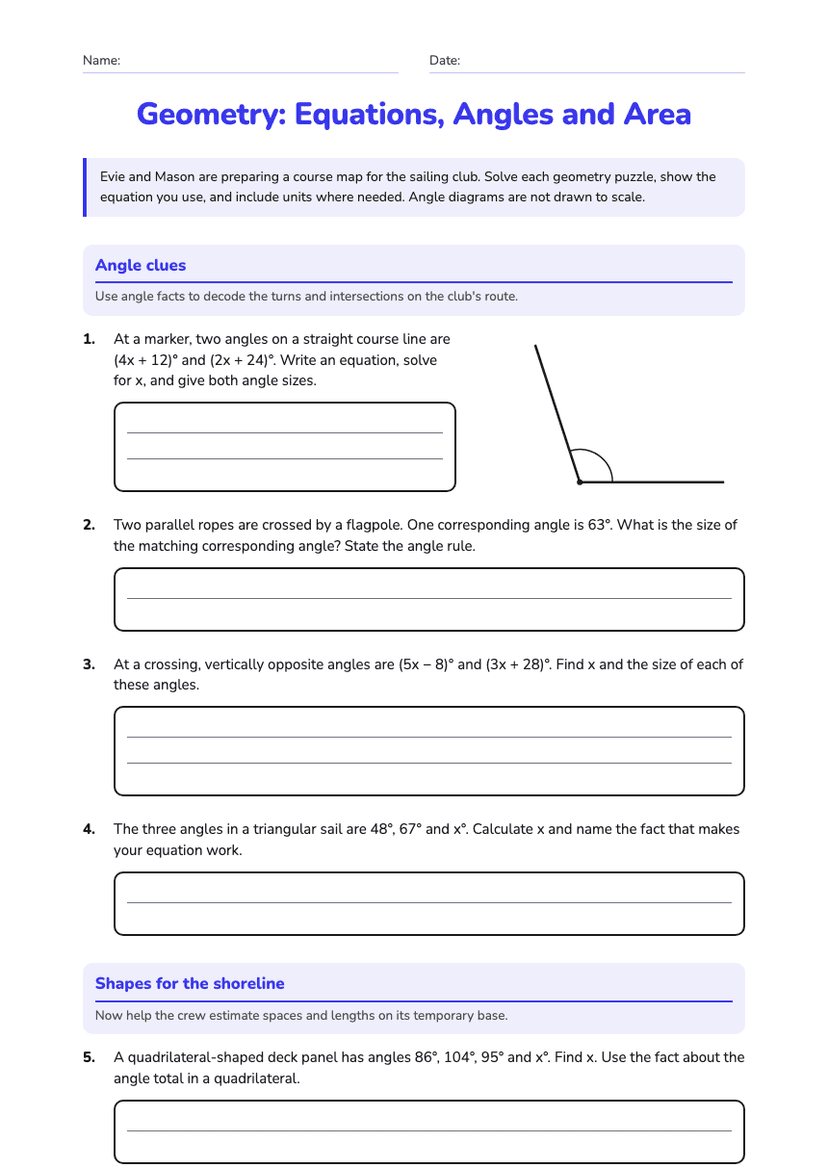
Step 2: Write an equation using 48°, 67° and x.
Step 3: Solve and include the degree symbol.
Step 1: A quadrilateral has an interior angle sum of ________°.
Step 2: x = 360° − (90° + 85° + 110°) = ________°.
Step 1: Use (n − 2) × 180°: (________ − 2) × 180° = ________°.
Step 2: Divide the sum by 5: ________° ÷ 5 = ________°.
a) the corresponding angle: ________°
b) the alternate angle: ________°
c) the co-interior angle on the same side: ________°
Support prompt: Corresponding and alternate angles are equal. Co-interior angles add to 180°.
Step 1: Area = (10 × 6) − (4 × 2) = ________ cm².
Step 2: Add the lengths around the new outside boundary to find the perimeter: ________ cm.
Step 1: c² = 6² + 8² = ________.
Step 2: c = √________ = ________ cm.
🌟 Part 3: Extension and Check Your Answers
Show the formula, substitution, calculation and units.
Concise answer key
1. Triangle sum = 180°; 50° + 60° + x = 180°; x = 70°.
2. P = 2 × 8 + 2 × 3 = 22 m; A = 8 × 3 = 24 m².
3. x = 180° − (48° + 67°) = 65°.
4. Quadrilateral sum = 360°; x = 360° − 285° = 75°.
5. (5 − 2) × 180° = 540°; 540° ÷ 5 = 108° each.
6. Corresponding = 68°; alternate = 68°; co-interior = 180° − 68° = 112°.
7. Area = 60 − 8 = 52 cm². Perimeter = 10 + 6 + 6 + 2 + 4 + 4 = 32 cm.
8. c² = 6² + 8² = 100; c = √100 = 10 cm.
9. Area = 12 × 5 = 60 cm²; perimeter = 2 × (12 + 7) = 38 cm.
10. Hexagon sum = (6 − 2) × 180° = 720°; each angle = 720° ÷ 6 = 120°.
Curriculum links: AC9M7M01, AC9M7M04, AC9M7M05, AC9M8M01 and AC9M8M06.
About This Worksheet
Free in Kuraplan
Sign up free, grab the PDF, and customize it for your class.
Print-Ready
Formatted for standard paper. Clean layout, easy to read.
AI-Generated
Created with Kuraplan's AI, designed for real classroom use.
For Teachers & Parents
Use in classrooms, for homework, tutoring, or homeschool.
Need a custom version of this worksheet?
Kuraplan's AI generates custom worksheets in seconds — differentiated for every learner, aligned to your curriculum.
Generate Custom Worksheets — Free