Grade 8 Probability Answers
A free maths worksheet ready for your classroom. Open in Kuraplan to grab the print-ready PDF, customize it for your students, or generate a fresh version in seconds.
Grade 8 Probability — Answer Key
🎯 Success Criteria
By the end of this lesson, students should be able to:
✅ Express probability as a fraction, decimal, and percentage
✅ Identify complementary events and use P(A') = 1 − P(A)
✅ Construct and interpret sample spaces for two-step experiments
✅ Calculate theoretical probability and compare to experimental results
✅ Use tree diagrams and tables to find probabilities of compound events
📚 Part 1: Multiple Choice — Answers
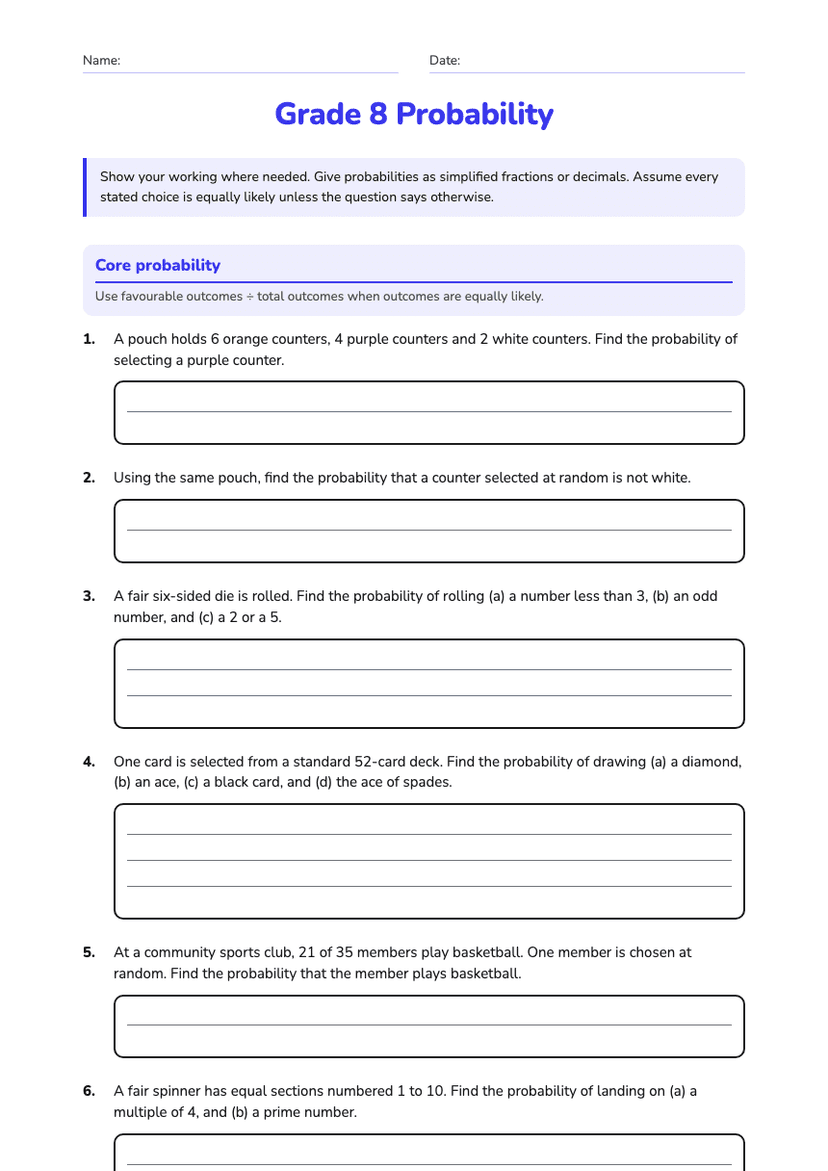
C) 1/2 ✅ → 5/10 = 1/2
D) 2/5B) 0.65 ✅ → 1 − 0.35 = 0.65
C) 0.70 D) 1.35C) 1/3 ✅ → Outcomes {5, 6} = 2/6 = 1/3
D) 2/3C) 4 ✅ → {HH, HT, TH, TT}
D) 6C) 1/2 ✅ → Even: {2,4,6,8} = 4/8 = 1/2
D) 5/8✏️ Part 2: Short Answer — Answers
✅ Answer: P(girl) = 15/25 = 3/5 = 0.6 = 60%
✅ Answer: P(heart) = 13/52, P(king) = 4/52, P(king of hearts) = 1/52
P(heart OR king) = 13/52 + 4/52 − 1/52 = 16/52 = 4/13
✅ Sample Space (12 outcomes):
H1, H2, H3, H4, H5, H6 | T1, T2, T3, T4, T5, T6
P(Heads AND odd) = 3/12 = 1/4 → Favourable: {H1, H3, H5}
(a) What is the experimental probability of rolling a 3?
(b) How does this compare to the theoretical probability?
✅ (a) Experimental P(3) = 14/60 = 7/30 ≈ 0.233 (23.3%)
✅ (b) Theoretical P(3) = 1/6 ≈ 0.167 (16.7%). The experimental result is slightly higher. With more trials, the experimental probability should get closer to 1/6 (Law of Large Numbers).
✅ Answer: P(pie) = 18/30 = 3/5 → P(roll) = 1 − 3/5 = 2/5 = 0.4 = 40%
🌟 Extension Activity — Advanced Learners
For students working beyond the standard level (ICAS / Maths Olympiad preparation):
✅ Answer: Total outcomes = 36. Sums that are prime: 2 (1 way), 3 (2 ways), 5 (4 ways), 7 (6 ways), 11 (2 ways) = 15 favourable outcomes.
P(prime sum) = 15/36 = 5/12
✅ Answer:
P(both red) = 4/7 × 3/6 = 12/42 = 2/7
P(both blue) = 3/7 × 2/6 = 6/42 = 1/7
P(same colour) = 2/7 + 1/7 = 3/7
🧩 Differentiation Strategies
• Provide a vocabulary card with key terms: probability, outcome, event, sample space, complementary events
• Allow use of fraction walls or number lines to compare probabilities (0 = impossible, 1 = certain)
• Pre-draw sample space tables for Questions 8–9 so students only need to fill in values
• Focus on Questions 1–7 only; mark Questions 11–12 as optional
• Complete all questions in Parts 1 and 2 independently
• Use tree diagrams or tables to organise two-step problems
• Self-check answers using this answer key after completing the worksheet
• Complete all questions including the two extension problems (Q11 and Q12)
• Challenge: Create their own two-dice probability question and swap with a partner
• Research task: Investigate the difference between independent and dependent events — write a short explanation with an example
• Explore: How does probability apply to real-life situations in sport, weather forecasting, or medicine?
About This Worksheet
Free in Kuraplan
Sign up free, grab the PDF, and customize it for your class.
Print-Ready
Formatted for standard paper. Clean layout, easy to read.
AI-Generated
Created with Kuraplan's AI, designed for real classroom use.
For Teachers & Parents
Use in classrooms, for homework, tutoring, or homeschool.
Need a custom version of this worksheet?
Kuraplan's AI generates custom worksheets in seconds — differentiated for every learner, aligned to your curriculum.
Generate Custom Worksheets — Free