ScienceFreePrintable

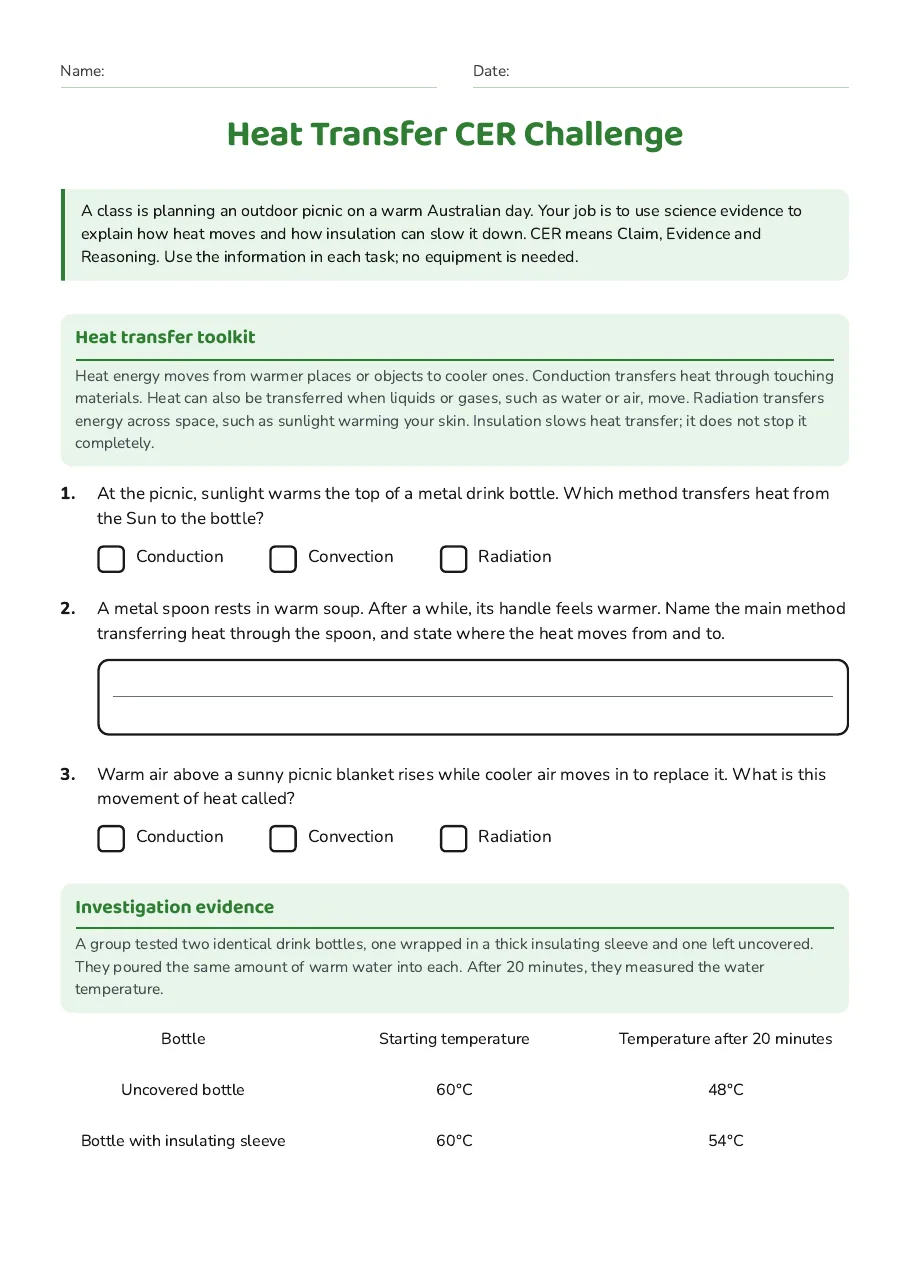
Heat Transfer CER Challenge

A free science worksheet ready for your classroom. Open in Kuraplan to grab the print-ready PDF, customize it for your students, or generate a fresh version in seconds.
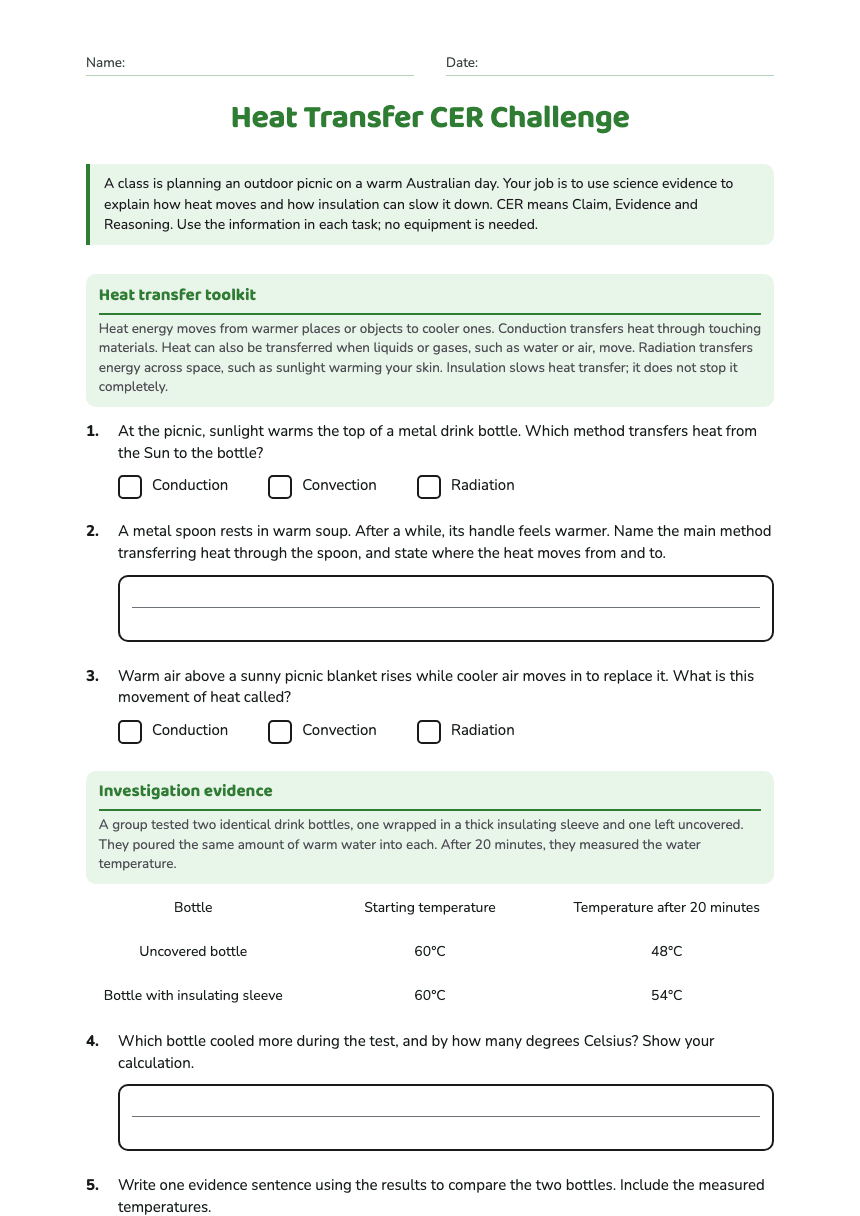
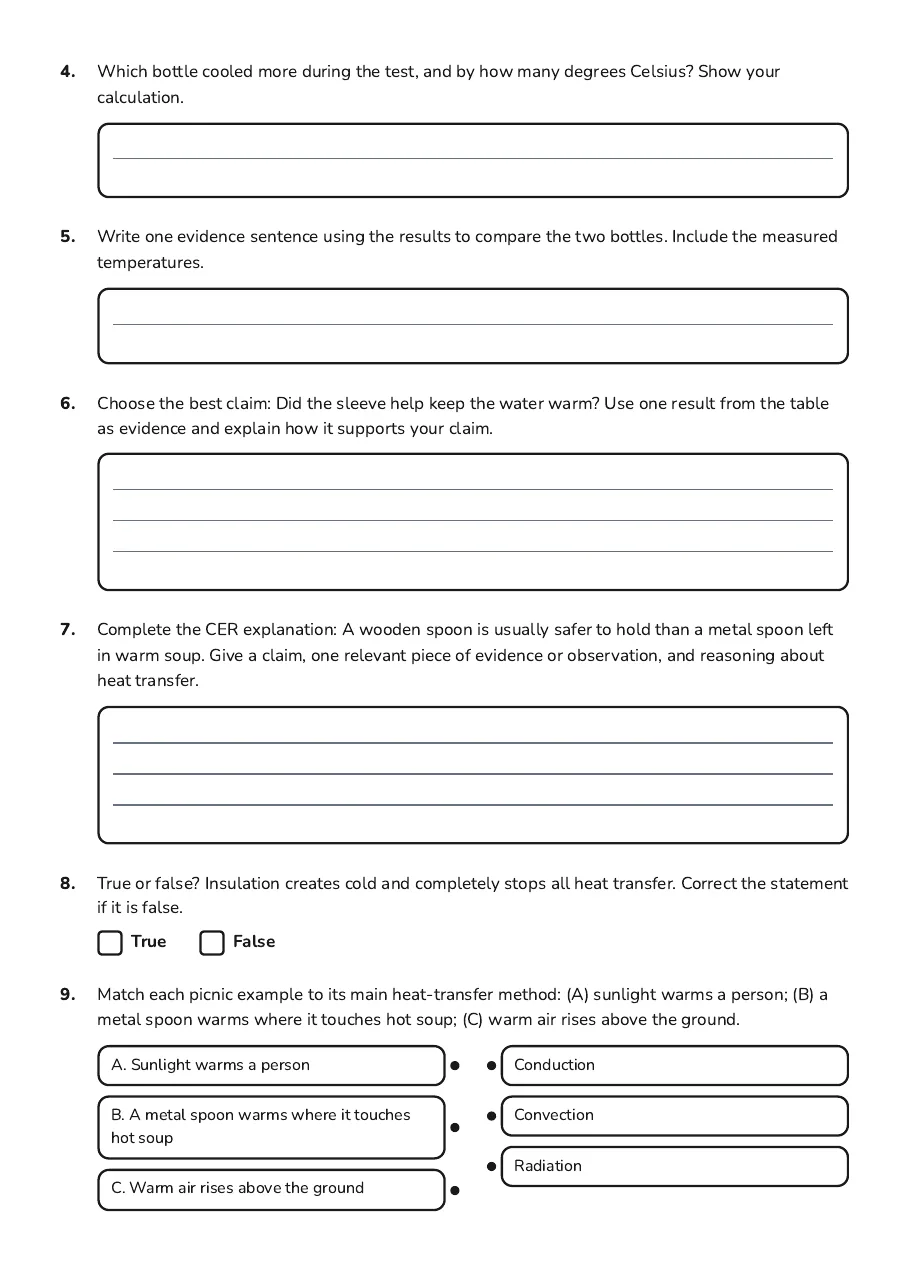
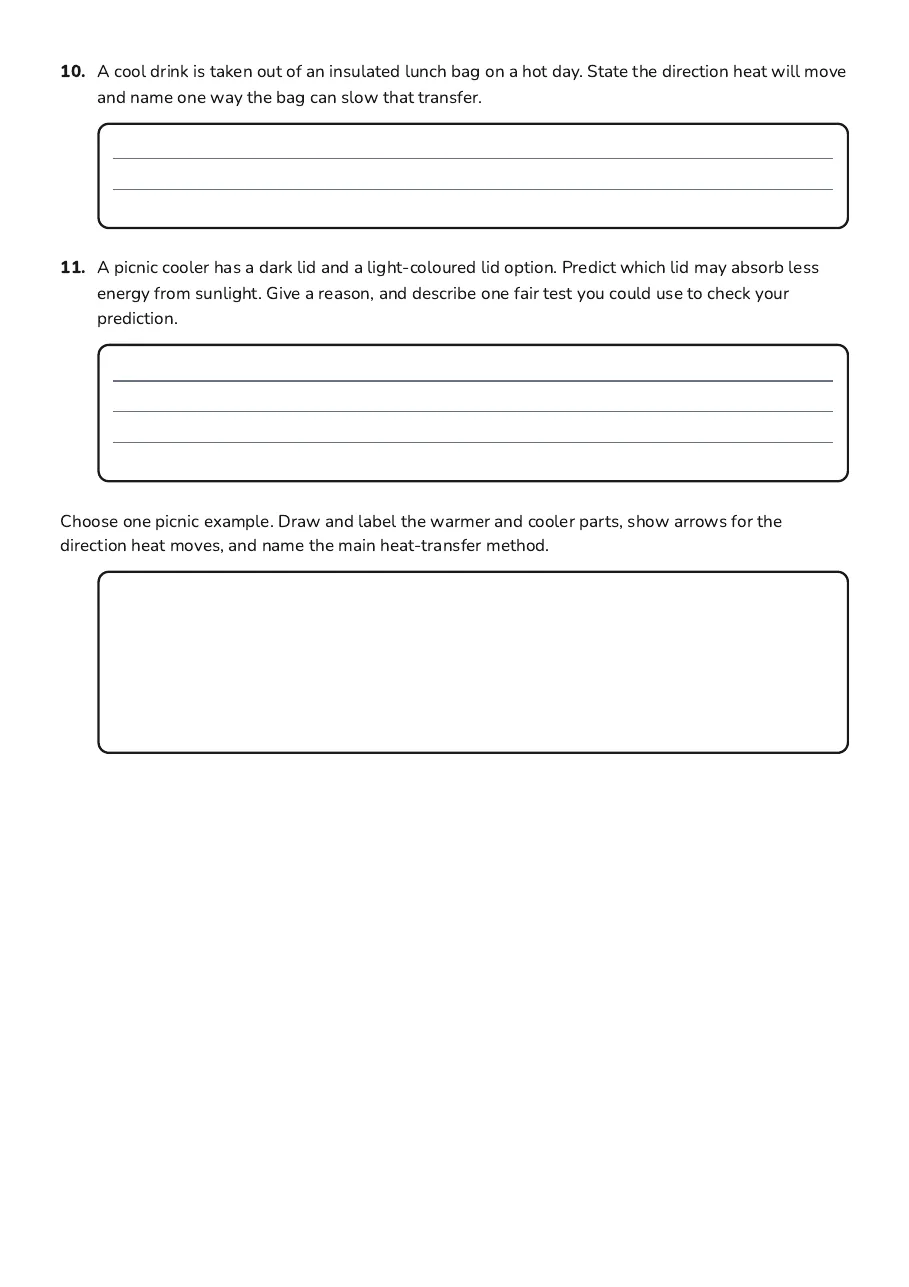
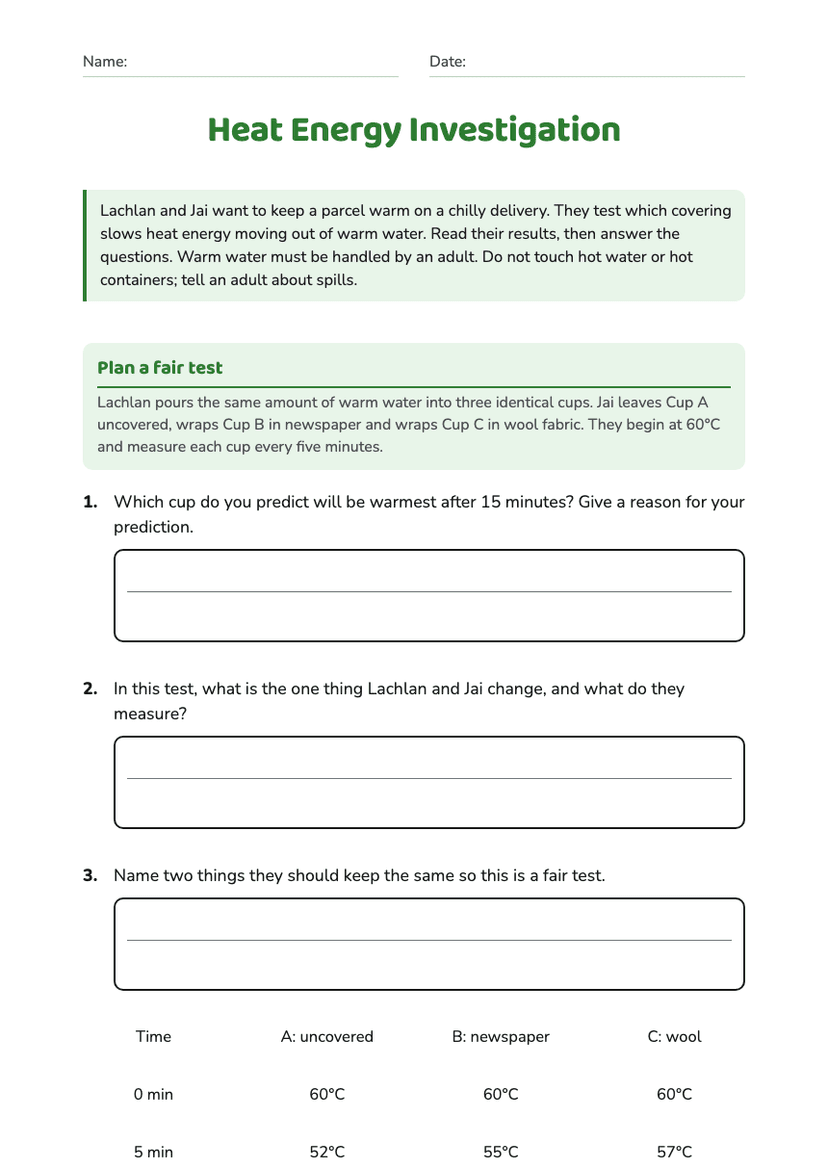
Heat Transfer CER Challenge worksheet preview

Appendix 2: Heat Transfer Application Challenge

Part A: Identify the Heat Transfer

Remember: Heat energy moves from a warmer object or place to a cooler object or place.

Conduction transfers heat through touching. Convection transfers heat by the movement of a fluid, such as air or water. Radiation transfers heat across space, without direct contact.

Word bank: conduction, convection, radiation, warmer, cooler, touch, moving air, moving water, insulation, heat energy

1. Match each familiar scenario to the most likely main method of heat transfer.
A. Metal saucepan handle becomes hot
B. Wooden spoon stays cooler in a saucepan
C. Warm air rises above a heater
D. A thermos keeps a drink warm
E. An insulated lunchbox slows warming
F. A person feels warmth from sunlight
Conduction
Convection
Radiation
Insulation slows heat transfer
2. Choose two scenarios above. For each one, explain where the heat moved from and to.

Scenario: ________________________________

Scenario: ________________________________

3. Before testing, predict which handle will transfer heat faster: metal or wood. Explain your prediction.

Part B: Build a CER Explanation

Use observations from your investigation stations. Do not touch hot equipment. Record what you observed, not what you expected to happen.

4. Evidence record

Station A: Spoons in warm water

What changed? What stayed the same? What was the direction of heat movement?

Station B: Dark and light containers under a lamp

What did you observe about warmth or temperature?

Station C: Food colouring in warm and cool water

How did the colouring move?

5. Worked CER example: Wood is safer than metal for a saucepan handle.

Claim: A wooden saucepan handle is safer to hold than a metal saucepan handle because wood transfers heat more slowly.

Evidence: In the warm-water investigation, the metal spoon handle became warm before the wooden spoon handle.

Reasoning: Heat moved from the warmer water through the spoon towards the cooler handle. Metal is a better conductor than wood, so it transferred heat faster. The wooden handle stayed cooler for longer.

6. Complete your own CER: Which material would be better for a saucepan handle, metal or wood?

Claim

Evidence Use one observation from Station A.

Reasoning Explain how the evidence supports your claim.

7. CER challenge: Explain how a thermos or insulated lunchbox helps slow heat transfer.

Claim

Evidence Use an observation, test result or labelled diagram from your investigation.

Reasoning Explain how insulation affects the movement of heat.

8. Student choice CER: Choose an everyday example of heat transfer, such as sunlight warming your skin, warm air above a heater, a cool drink warming, or soup cooling.

My example: ________________________________________________

Claim I think the main method is __________________ because...

Evidence I observed or know that...

Reasoning Heat moved from __________________ to __________________ by...

Part C: Reflect and Check

9. Can more than one method of heat transfer occur in one situation? Use an example to explain your answer.
10. Draw and label one example of heat transfer. Include arrows showing heat moving from warmer to cooler.

Sentence starter: Heat moved from the __________________ object to the __________________ object by __________________.

Teacher Answer Guide

Part A, Question 1: A—conduction; B—insulation slows conduction; C—convection; D—insulation slows heat transfer; E—insulation slows heat transfer; F—radiation.

Question 2: Accept explanations showing heat moving from warmer to cooler. Examples: heat moved from warm water to the spoon; heat moved from the lamp or Sun to the container or person; heat moved through moving warm water.

Question 3: Accept a justified prediction. Expected result: metal transfers heat faster than wood.

Question 4: Responses should accurately describe station observations. Expected patterns include metal warming sooner, different warmth or temperature under the lamp, and colouring moving through warm water due to convection.

Questions 6–8: Look for a clear claim, relevant evidence from an observation or result, and reasoning that explains heat movement using scientific vocabulary.

Question 9: Yes. For example, a saucepan can transfer heat by conduction through its metal, while warm air above it moves by convection and the hot surface also gives off radiation.

Question 10: Diagram should include a familiar example, labels, arrows and the direction from warmer to cooler.

Assessment focus: Students identify heat transfer methods, record observations, use evidence and explain conclusions through scientific inquiry.

About This Worksheet

Free in Kuraplan

Sign up free, grab the PDF, and customize it for your class.

Print-Ready

Formatted for standard paper. Clean layout, easy to read.

AI-Generated

Created with Kuraplan's AI, designed for real classroom use.

For Teachers & Parents

Use in classrooms, for homework, tutoring, or homeschool.

Need a custom version of this worksheet?

Kuraplan's AI generates custom worksheets in seconds — differentiated for every learner, aligned to your curriculum.

Generate Custom Worksheets — Free
No credit card Curriculum-aligned Under 60 seconds