Heat Transfer Investigation Sheet
A free science worksheet ready for your classroom. Open in Kuraplan to grab the print-ready PDF, customize it for your students, or generate a fresh version in seconds.
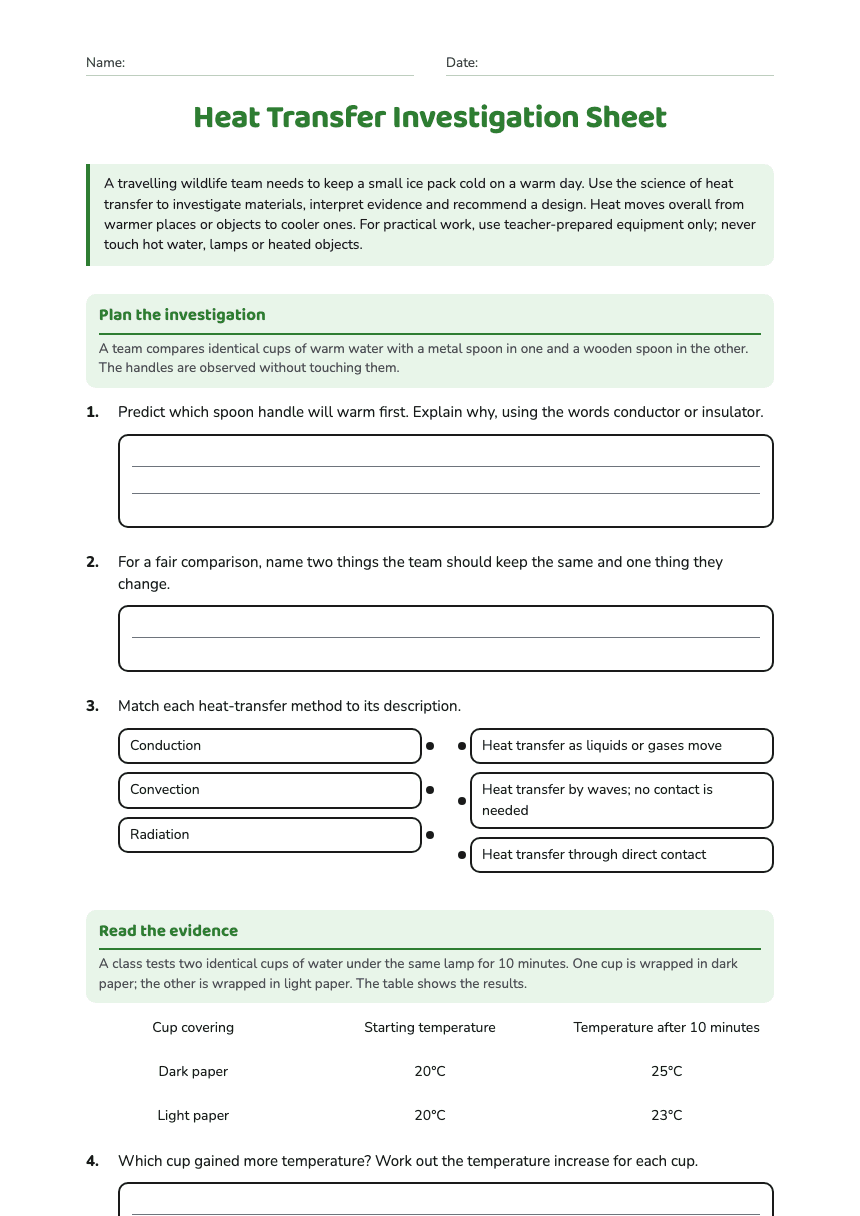
Heat Transfer Investigation Sheet
Part 1: Prepare to Investigate
Learning intention: We are learning how heat energy moves from warmer objects to cooler objects by conduction, convection and radiation.
Success criteria:
I can identify the three methods of heat transfer. I can make a prediction and record observations. I can work safely and draw a labelled scientific diagram. I can explain that heat moves from a warmer object to a cooler object.
Safety reminder: Observe hot materials carefully. Do not touch hot water, lamps or equipment. Follow your teacher’s instructions, wear safety glasses when asked and keep water away from electrical equipment.
Word bank: heat warmer cooler conduction convection radiation observation evidence
Helpful sentence starters: I predict ______ because ______. Heat may move from ______ to ______. My evidence could be ______.
Part 2: Investigation Stations
At each station, record a prediction, the setup, your observations, a labelled diagram with arrows and the likely method of heat transfer.
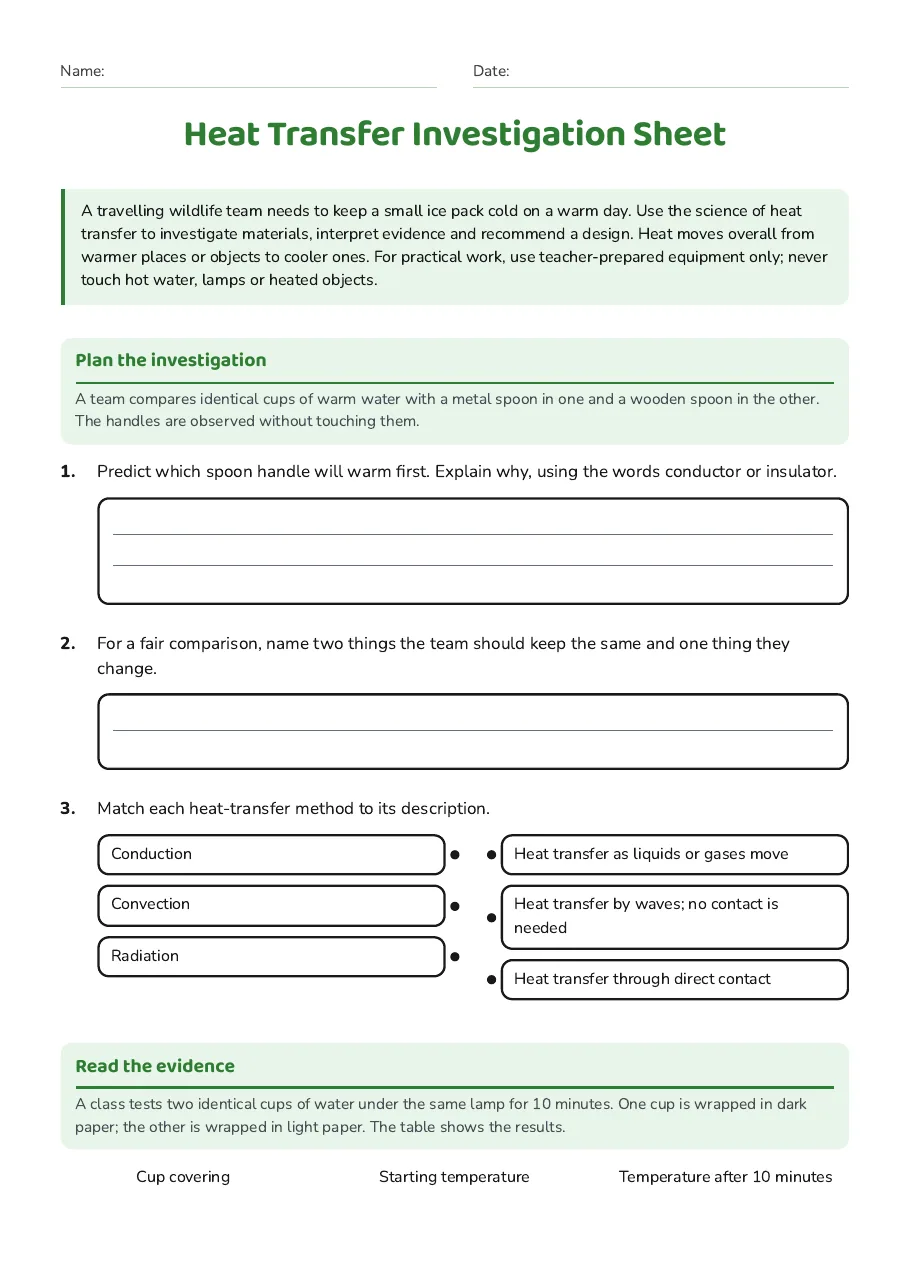
Station A: Conduction — Metal and Wooden Spoons
Setup: One end of a metal spoon and one end of a wooden spoon are placed in separate cups of warm water. Observe which handle becomes warm first. Do not touch the water or equipment.
Materials/setup and observations:
Likely heat-transfer method: ____________________
Label and draw the spoons, warm water and arrows showing heat movement.
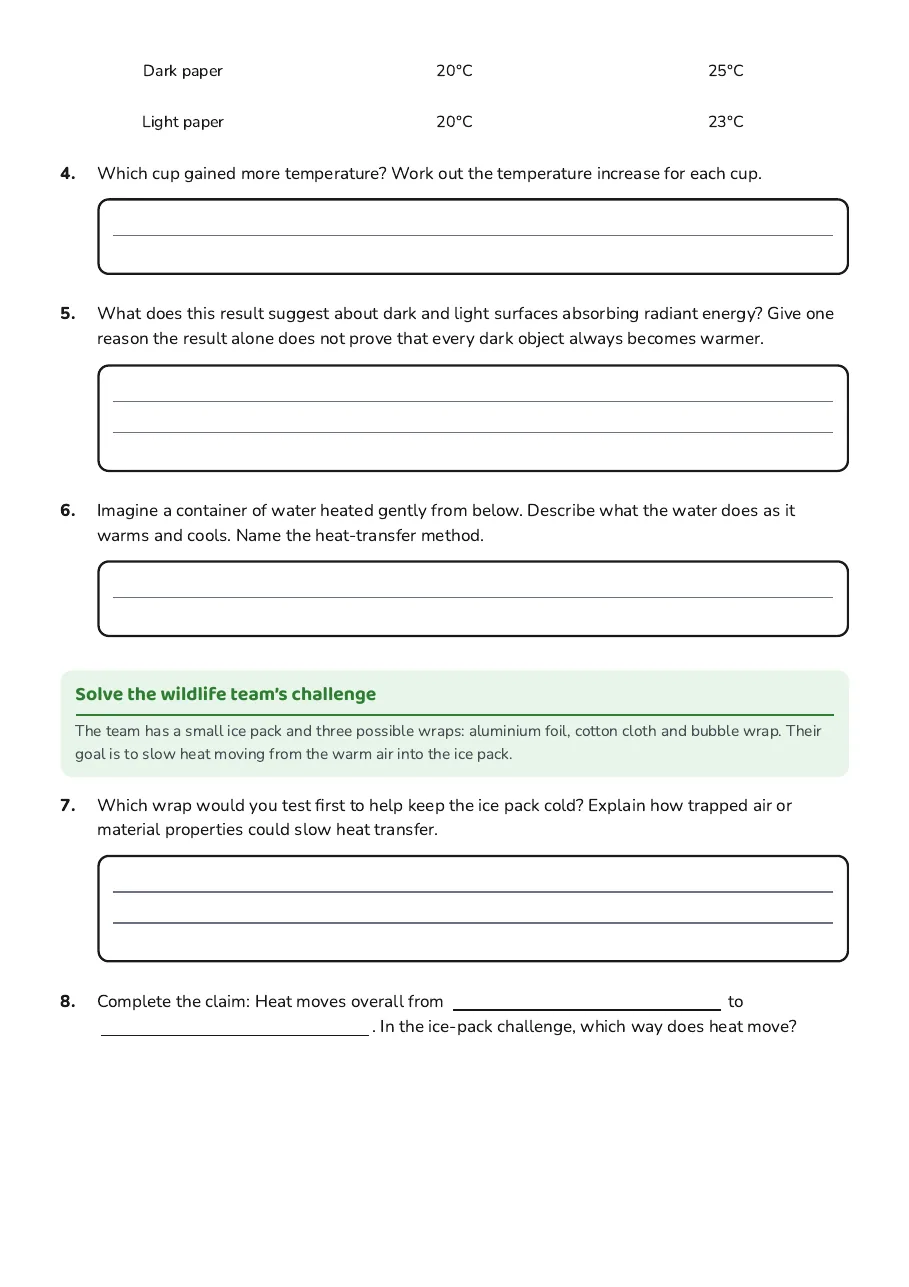
Station B: Radiation — Dark and Light Cups
Setup: Two identical cups are covered, one with dark paper and one with light paper. A lamp shines on both cups. Observe warmth or temperature without touching the lamp.
Materials/setup and observations:
Likely heat-transfer method: ____________________
Label and draw the lamp, cups and arrows showing heat movement across space.
Station C: Convection — Food Colouring in Water
Setup: Food colouring is carefully added to clear warm water and cool water. Observe how the colour moves. The teacher may add the colouring.
Materials/setup and observations:
Likely heat-transfer method: ____________________
Label and draw the water, food colouring and arrows showing movement.
Part 3: Compare, Explain and Apply
Everyday Applications
For each example, name the method and the direction of heat transfer.
Method: ____________________ Heat moved from ____________________ to ____________________.
Exit Ticket
Draw and label one example of heat transfer. Include arrows showing the direction of heat movement.
Write one sentence using warmer, cooler and the correct method.
Teacher Answer Guide — Separate Final Page
1. Answers may vary. Metal is the expected prediction because it usually conducts heat faster than wood.
2. Conduction: through touching. Convection: moving air or water. Radiation: across space without touching.
Station A: The metal spoon handle is expected to become warm first. Method: conduction. Heat moves from the warmer water along the spoon towards the cooler handle and surroundings.
Station B: The dark-covered cup is expected to become warmer. Method: radiation. Heat moves from the lamp across space to the cups. Accept results supported by students’ observations.
Station C: The warm water should show more movement as warm water rises and cooler water sinks. Method: convection. Heat moves from warmer water to cooler water as the water circulates.
Comparison questions: Accept accurate observations. Students should identify the investigated material or temperature as changing while keeping the containers, lamp or spoon size as similar as possible. Heat moves from warmer objects or areas to cooler objects or areas.
Conclusion: Example: Heat moved from the warm water to the metal spoon by conduction, as shown by the metal handle becoming warm.
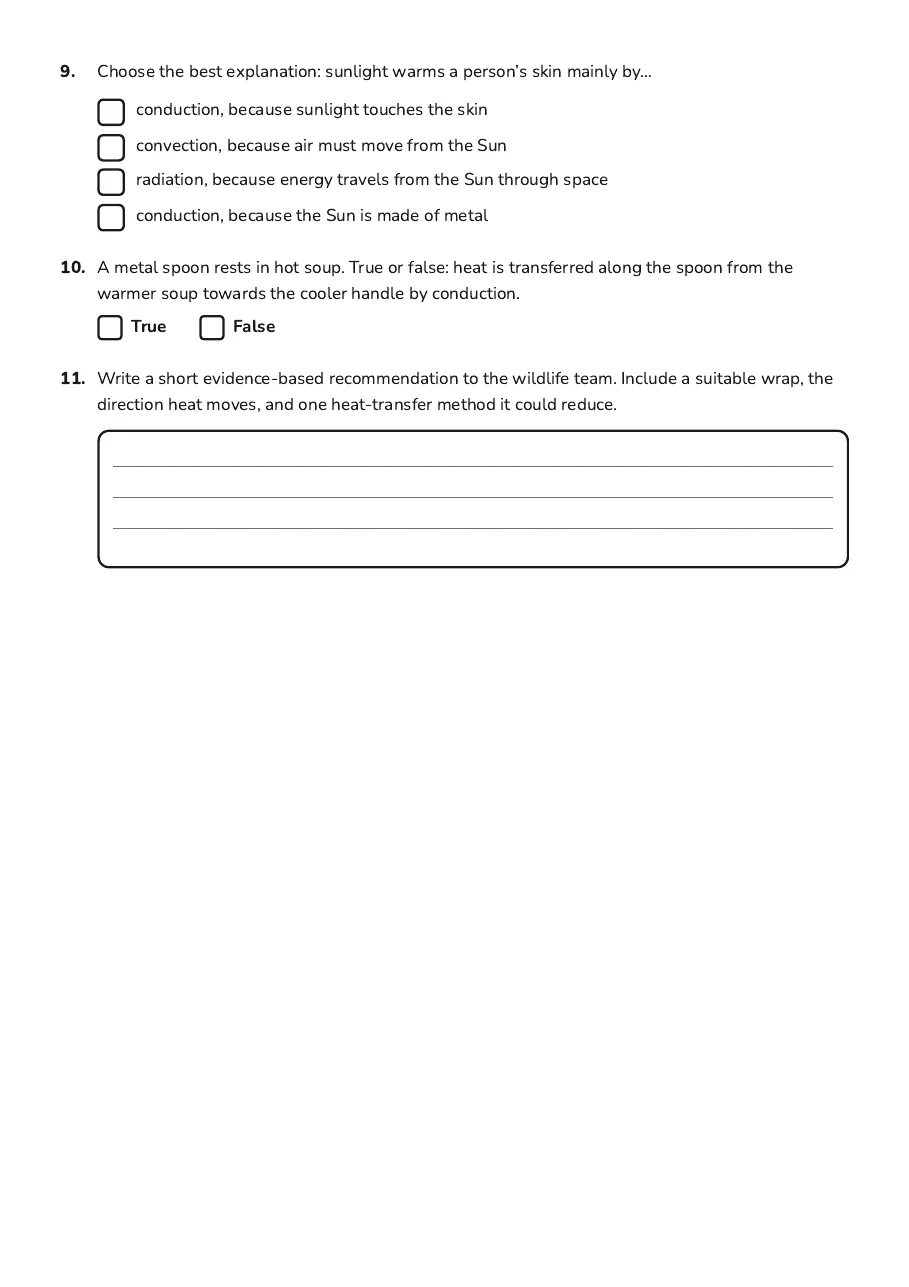
Applications: Saucepan handle—conduction, from the hot saucepan to the handle. Warm air above a heater—convection, from the heater or warmer air near it to the cooler surrounding air. Sunlight warming skin—radiation, from the Sun to the cooler skin.
Exit ticket: Look for one labelled example, arrows showing direction, the correct method and a sentence correctly using warmer, cooler and conduction, convection or radiation.
Differentiation: Support students may use: “Heat moved from ______ to ______ because ______.” “The ______ was warmer than the ______.” “This is ______ because ______.” Extension students may explain how insulation slows heat transfer or identify more than one method in an example.
About This Worksheet
Free in Kuraplan
Sign up free, grab the PDF, and customize it for your class.
Print-Ready
Formatted for standard paper. Clean layout, easy to read.
AI-Generated
Created with Kuraplan's AI, designed for real classroom use.
For Teachers & Parents
Use in classrooms, for homework, tutoring, or homeschool.
Need a custom version of this worksheet?
Kuraplan's AI generates custom worksheets in seconds — differentiated for every learner, aligned to your curriculum.
Generate Custom Worksheets — FreeMore Science Worksheets
Danforth: Authority and Conscience
Free
Natural Resources Science
Free
Natural Resources Science
Free
Vitamins, Minerals, and Protein Science
Free
Exploring Science Materials
Free
Waka Buoyancy Science Worksheet
Free
Science Skills Made Simple
Free