Hunter-Gatherer Survival Strategies
A free social sciences worksheet ready for your classroom. Open in Kuraplan to grab the print-ready PDF, customize it for your students, or generate a fresh version in seconds.
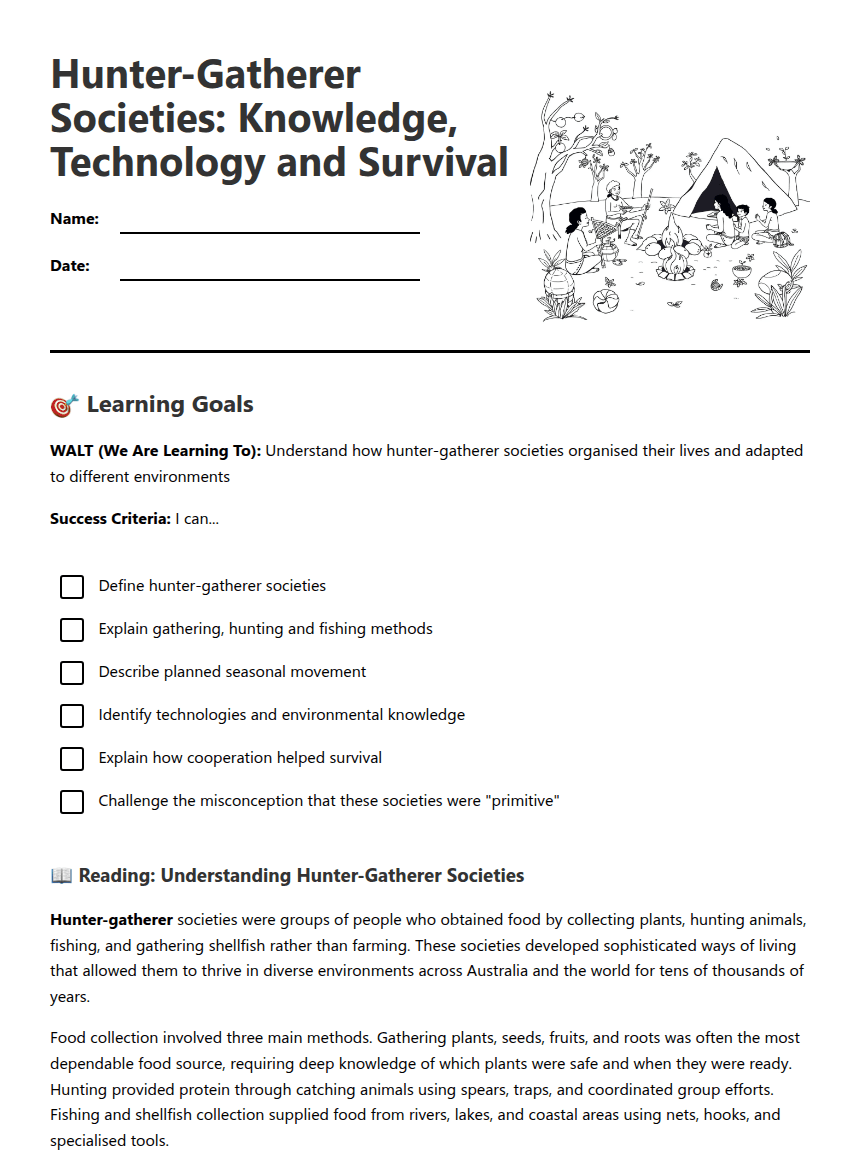
Hunter-Gatherer Societies: Knowledge, Technology and Survival
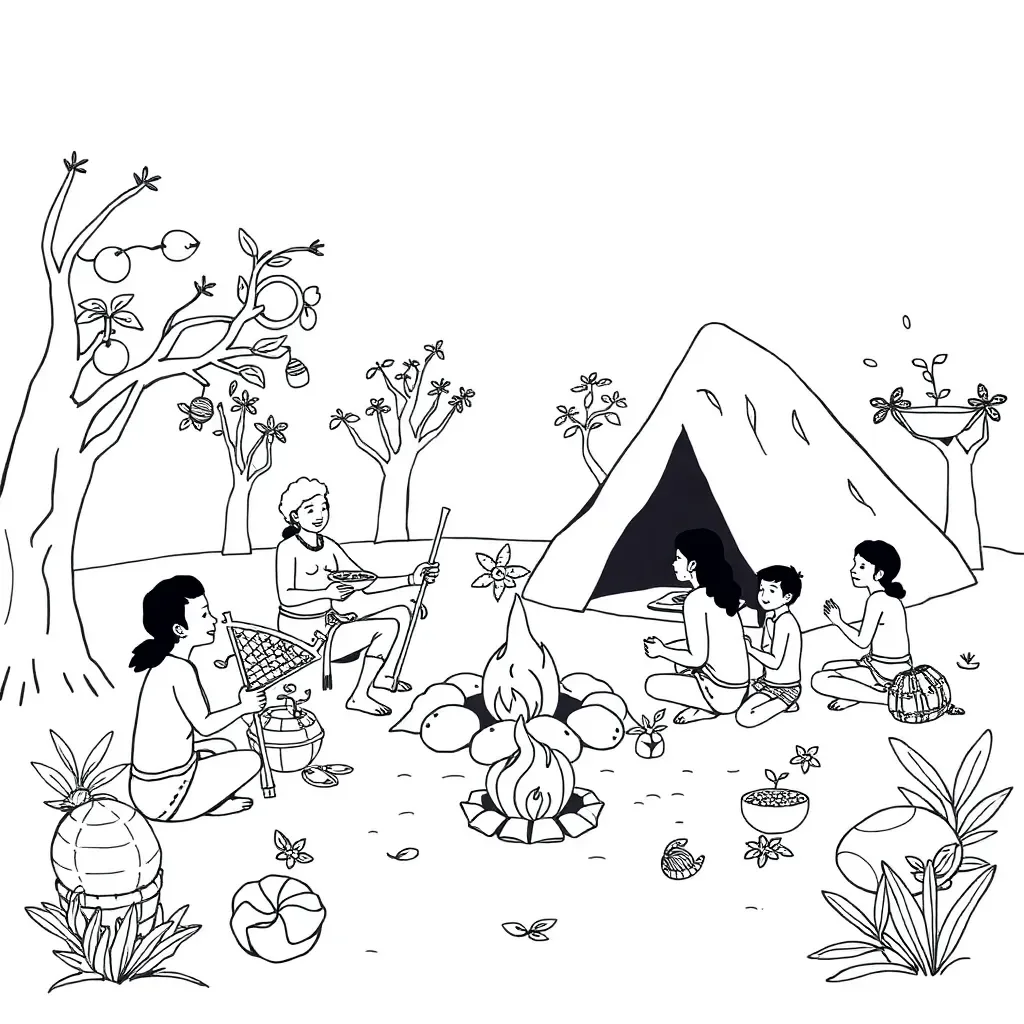
🎯 Learning Goals
WALT (We Are Learning To): Understand how hunter-gatherer societies organised their lives and adapted to different environments
Success Criteria: I can...
📖 Reading: Understanding Hunter-Gatherer Societies
Hunter-gatherer societies were groups of people who obtained food by collecting plants, hunting animals, fishing, and gathering shellfish rather than farming. These societies developed sophisticated ways of living that allowed them to thrive in diverse environments across Australia and the world for tens of thousands of years.
Food collection involved three main methods. Gathering plants, seeds, fruits, and roots was often the most dependable food source, requiring deep knowledge of which plants were safe and when they were ready. Hunting provided protein through catching animals using spears, traps, and coordinated group efforts. Fishing and shellfish collection supplied food from rivers, lakes, and coastal areas using nets, hooks, and specialised tools.
Rather than wandering randomly, these societies practiced seasonal movement - carefully planned travel based on when and where food sources would be available. Some groups established long-term camps near reliable water sources, whilst others moved regularly following animal migrations or plant seasons. Many created semi-permanent camps they returned to year after year.
Environmental knowledge was crucial for survival. People needed to know where to find water during dry seasons, which plants were medicinal, how to read weather patterns, and how to track animals. This knowledge was passed down through generations of careful teaching and observation.
Technology included sophisticated tools made from stone, wood, bone, and plant fibres. Stone tools were crafted for cutting and scraping, whilst wooden spears and digging sticks helped gather food. People created baskets and containers for carrying, grinding stones for processing seeds, and fishing equipment like nets and hooks. They built appropriate shelters, made clothing from animal skins and plant fibres, and mastered fire-making techniques.
Cooperation was essential for survival. People shared food, cared for children and elderly members, worked together during hunts, and supported each other during difficult times. Knowledge was shared freely, ensuring everyone could contribute to the group's survival.
Archaeological evidence including artefacts (tools and objects), hearths (fire places), and shell middens (ancient refuse sites containing shells) shows these societies were highly organised and successful. The term "primitive" is inaccurate and disrespectful - these societies developed complex systems perfectly adapted to their environments that sustained them for thousands of years.
📝 Quick Check Questions
a) _________________ b) _________________ c) _________________
a) _________________ b) _________________
🔤 Vocabulary Matching
Instructions: Match each term with its correct definition by writing the letter in the circle.
📊 Concept Sort
Instructions: Sort these examples under the correct headings. Write each letter in the appropriate box.
Examples to sort:
A. Knowing where water is found B. Stone cutting tool C. Sharing food D. Animal bones at campsite
E. Reading animal tracks F. Fishing net G. Teaching children H. Charcoal from hearth
I. Understanding seasonal plant growth J. Basket K. Caring for injured person L. Shell midden
🔍 Source Detective
Remember: Observation is what you can directly see. Inference is an explanation based on evidence.
Source A: Stone Cutting Tool
A sharp-edged stone tool with signs of use and careful shaping
Source B: Ancient Hearth
Circular arrangement of stones containing charcoal and burnt animal bones
🏆 Extension Activity
About This Worksheet
Free in Kuraplan
Sign up free, grab the PDF, and customize it for your class.
Print-Ready
Formatted for standard paper. Clean layout, easy to read.
AI-Generated
Created with Kuraplan's AI, designed for real classroom use.
For Teachers & Parents
Use in classrooms, for homework, tutoring, or homeschool.
Need a custom version of this worksheet?
Kuraplan's AI generates custom worksheets in seconds — differentiated for every learner, aligned to your curriculum.
Generate Custom Worksheets — Free