Making a Nation Vocabulary
A free social sciences worksheet ready for your classroom. Open in Kuraplan to grab the print-ready PDF, customize it for your students, or generate a fresh version in seconds.
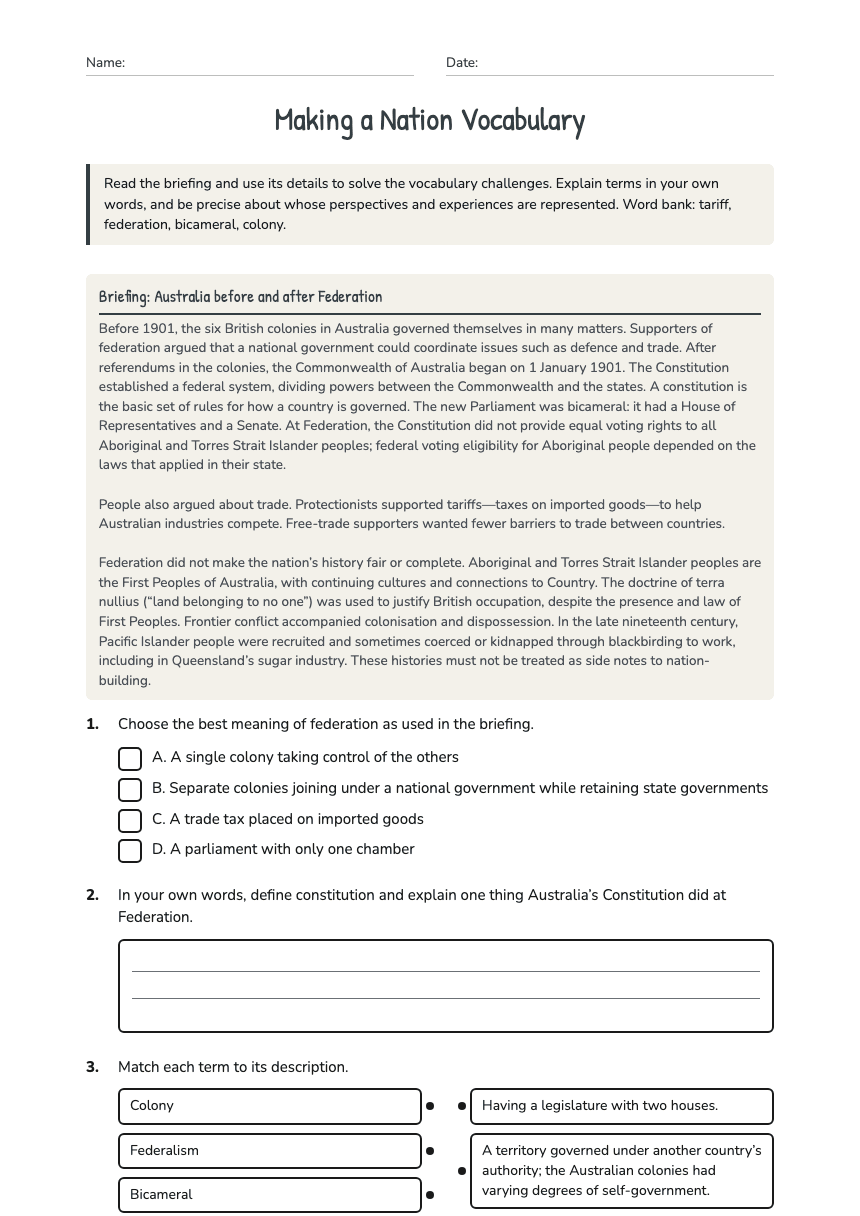
Making a Nation Vocabulary
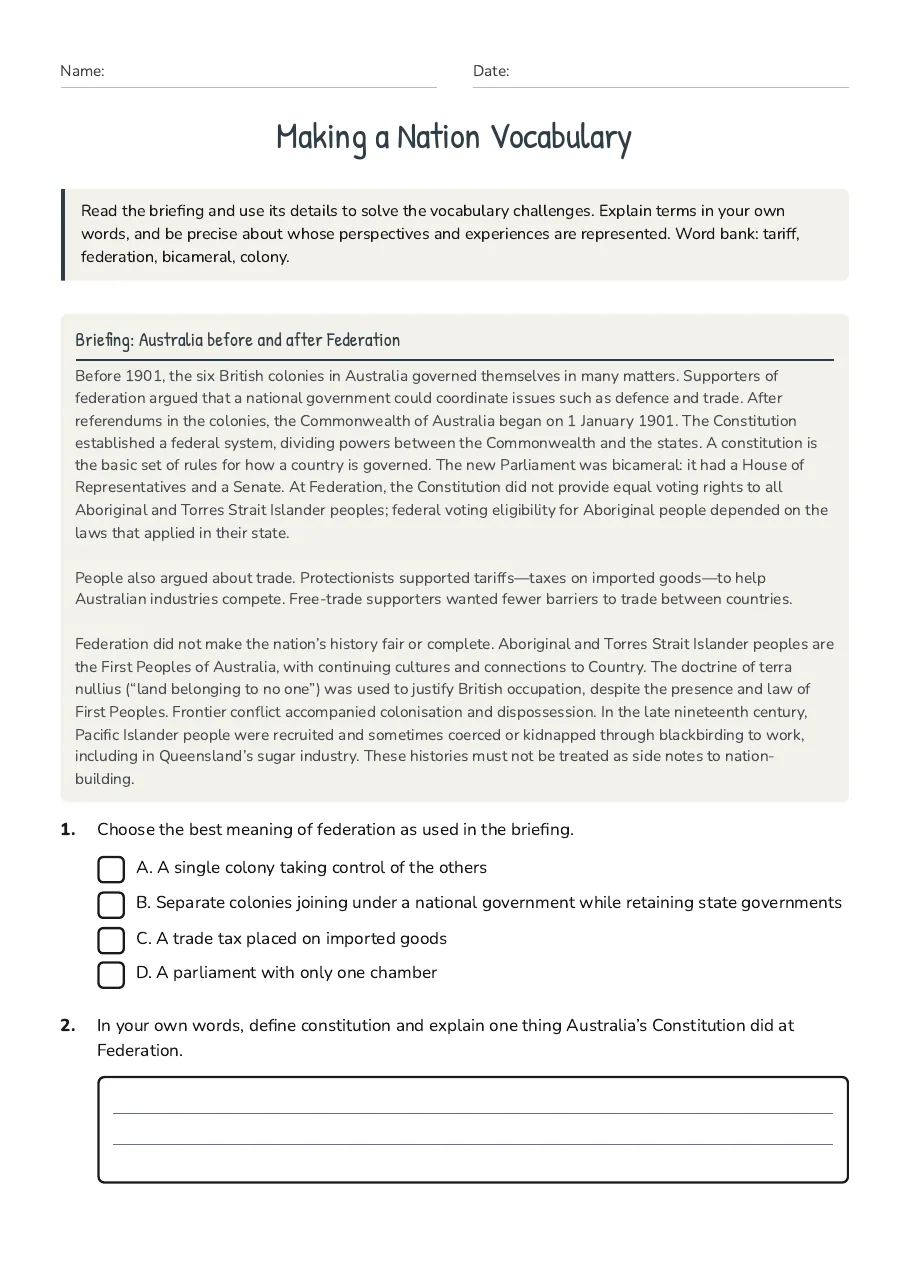
Briefing: Australia before and after Federation
Before 1901, the six British colonies in Australia governed themselves in many matters. Supporters of federation argued that a national government could coordinate issues such as defence and trade. After referendums in the colonies, the Commonwealth of Australia began on 1 January 1901. The Constitution established a federal system, dividing powers between the Commonwealth and the states. A constitution is the basic set of rules for how a country is governed. The new Parliament was bicameral: it had a House of Representatives and a Senate. At Federation, the Constitution did not provide equal voting rights to all Aboriginal and Torres Strait Islander peoples; federal voting eligibility for Aboriginal people depended on the laws that applied in their state. People also argued about trade. Protectionists supported tariffs—taxes on imported goods—to help Australian industries compete. Free-trade supporters wanted fewer barriers to trade between countries. Federation did not make the nation’s history fair or complete. Aboriginal and Torres Strait Islander peoples are the First Peoples of Australia, with continuing cultures and connections to Country. The doctrine of terra nullius (“land belonging to no one”) was used to justify British occupation, despite the presence and law of First Peoples. Frontier conflict accompanied colonisation and dispossession. In the late nineteenth century, Pacific Islander people were recruited and sometimes coerced or kidnapped through blackbirding to work, including in Queensland’s sugar industry. These histories must not be treated as side notes to nation-building.
- A. A single colony taking control of the others
- B. Separate colonies joining under a national government while retaining state governments
- C. A trade tax placed on imported goods
- D. A parliament with only one chamber
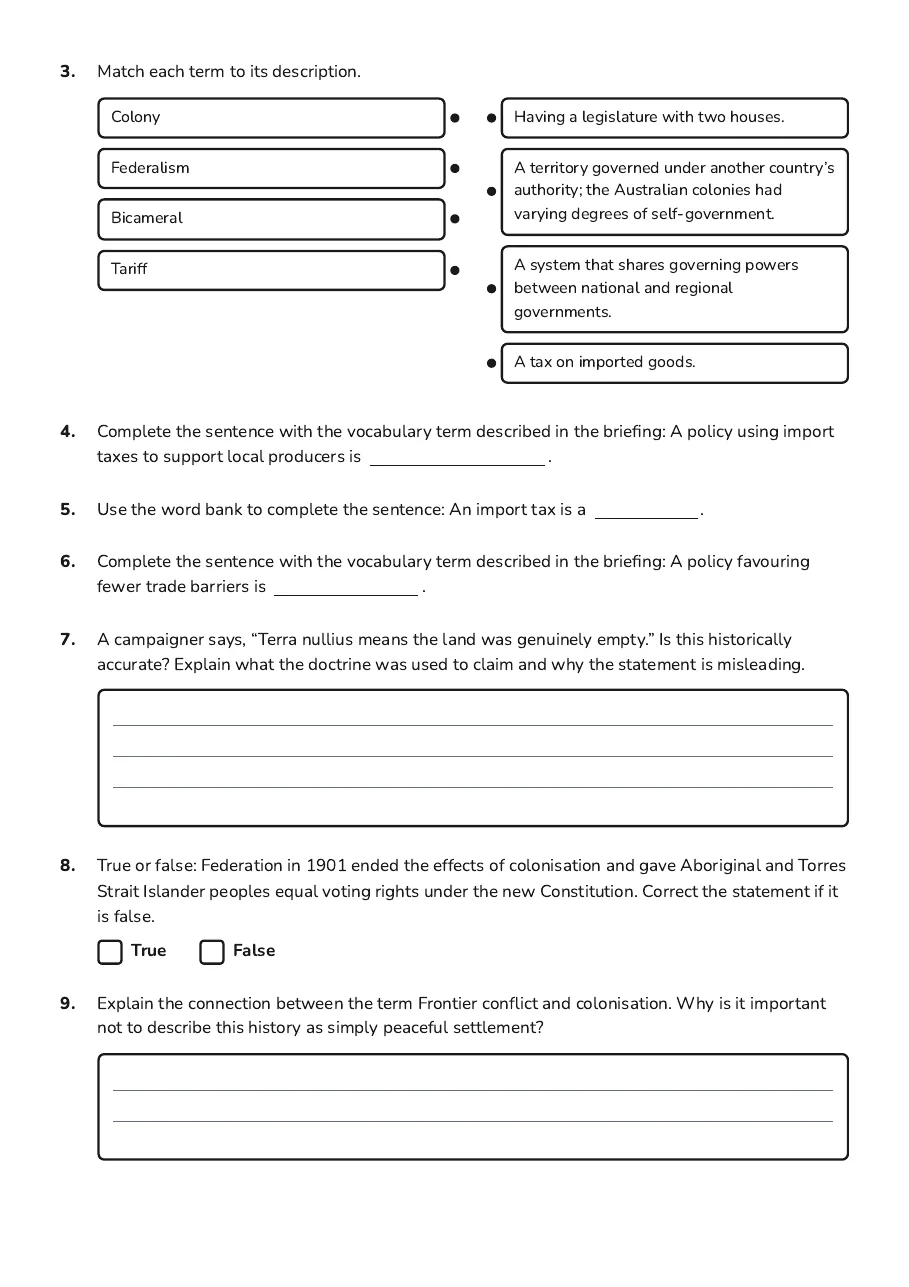
- Colony
- Federalism
- Bicameral
- Tariff
- Having a legislature with two houses.
- A territory governed under another country’s authority; the Australian colonies had varying degrees of self-government.
- A system that shares governing powers between national and regional governments.
- A tax on imported goods.
3 printable pages
Page 1
Page 2
Page 3
About This Worksheet
Free in Kuraplan
Sign up free, grab the PDF, and customize it for your class.
Print-Ready
Formatted for standard paper. Clean layout, easy to read.
AI-Generated
Created with Kuraplan's AI, designed for real classroom use.
For Teachers & Parents
Use in classrooms, for homework, tutoring, or homeschool.
Need a custom version of this worksheet?
Kuraplan's AI generates custom worksheets in seconds — differentiated for every learner, aligned to your curriculum.
Generate Custom Worksheets — Free