Particle Properties Exploration
A free science worksheet ready for your classroom. Open in Kuraplan to grab the print-ready PDF, customize it for your students, or generate a fresh version in seconds.
Particle Properties Exploration
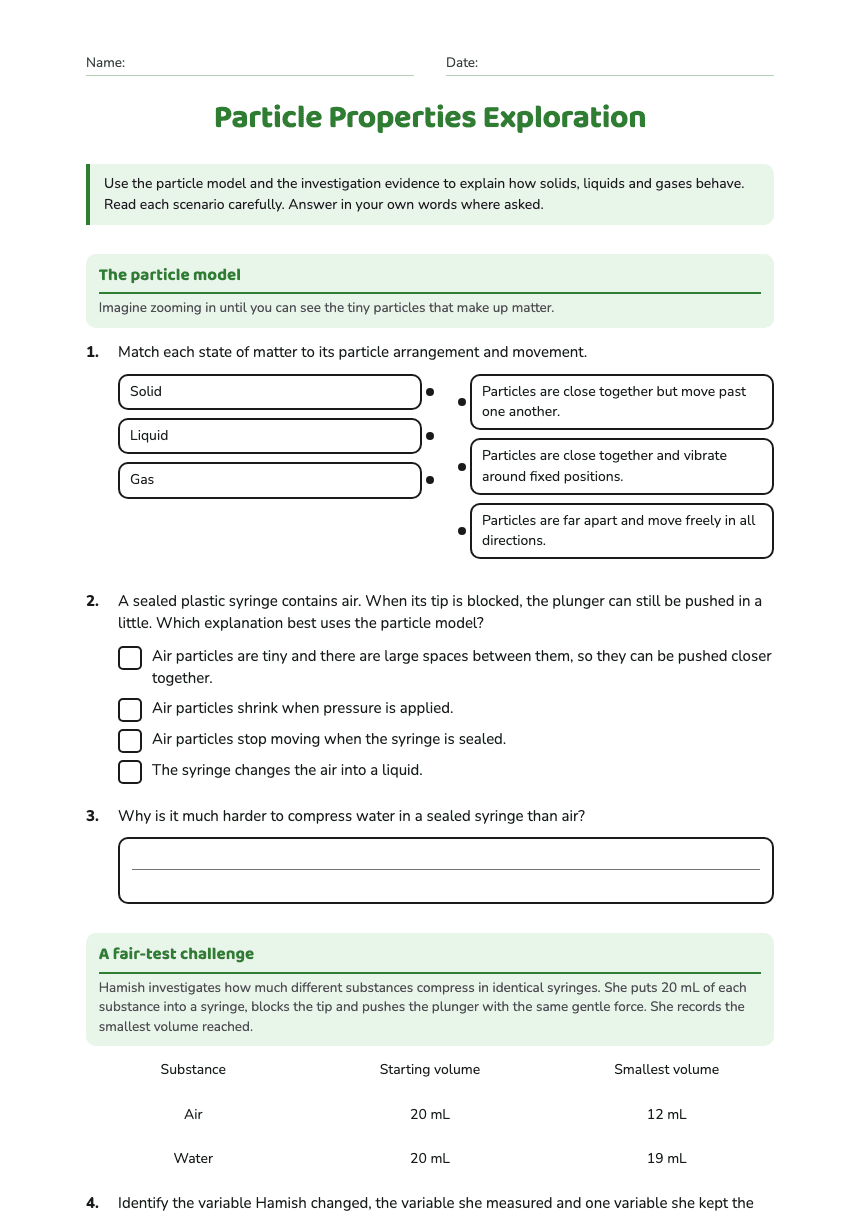
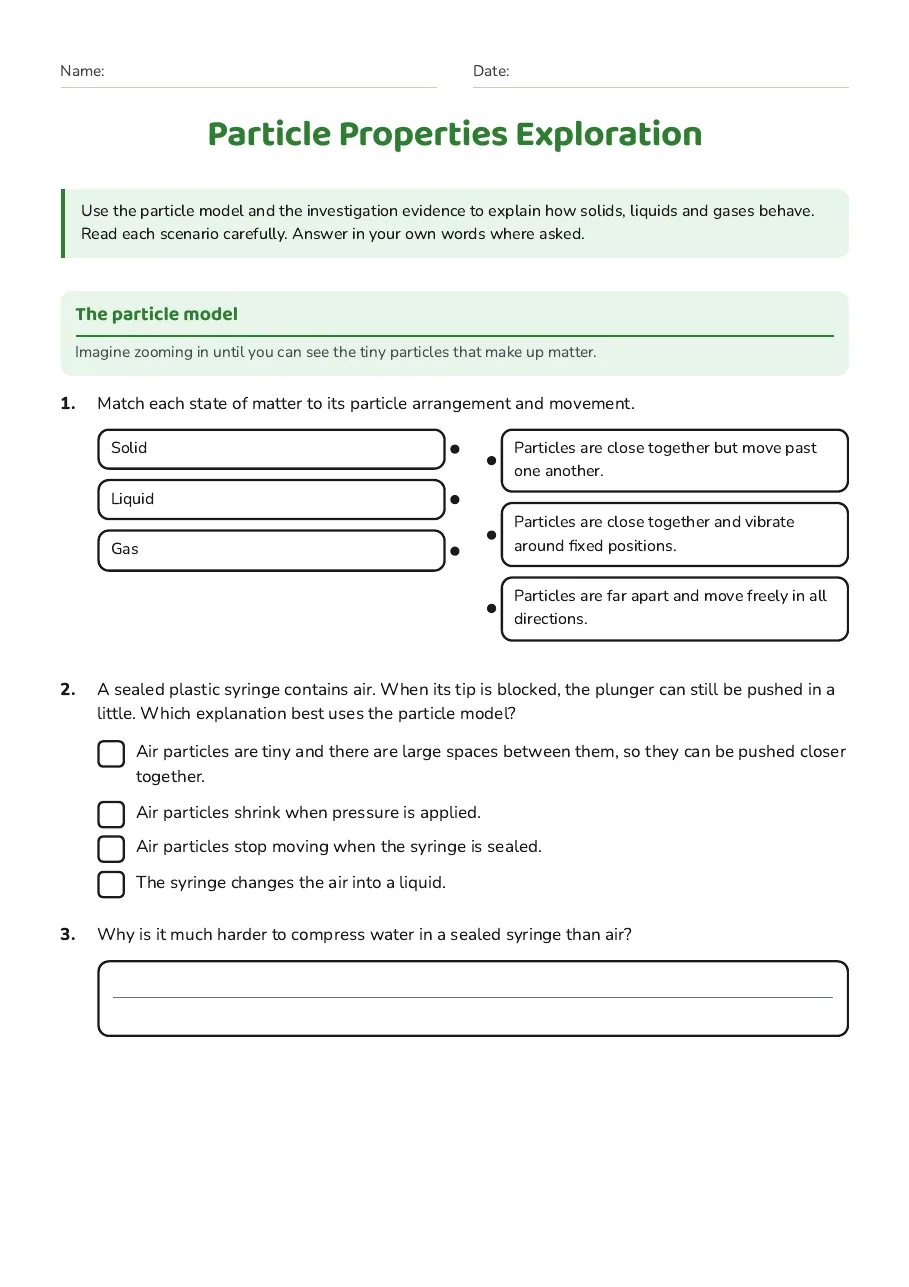
The particle model
Imagine zooming in until you can see the tiny particles that make up matter.
- Solid
- Liquid
- Gas
- Particles are close together but move past one another.
- Particles are close together and vibrate around fixed positions.
- Particles are far apart and move freely in all directions.
- Air particles are tiny and there are large spaces between them, so they can be pushed closer together.
- Air particles shrink when pressure is applied.
- Air particles stop moving when the syringe is sealed.
- The syringe changes the air into a liquid.
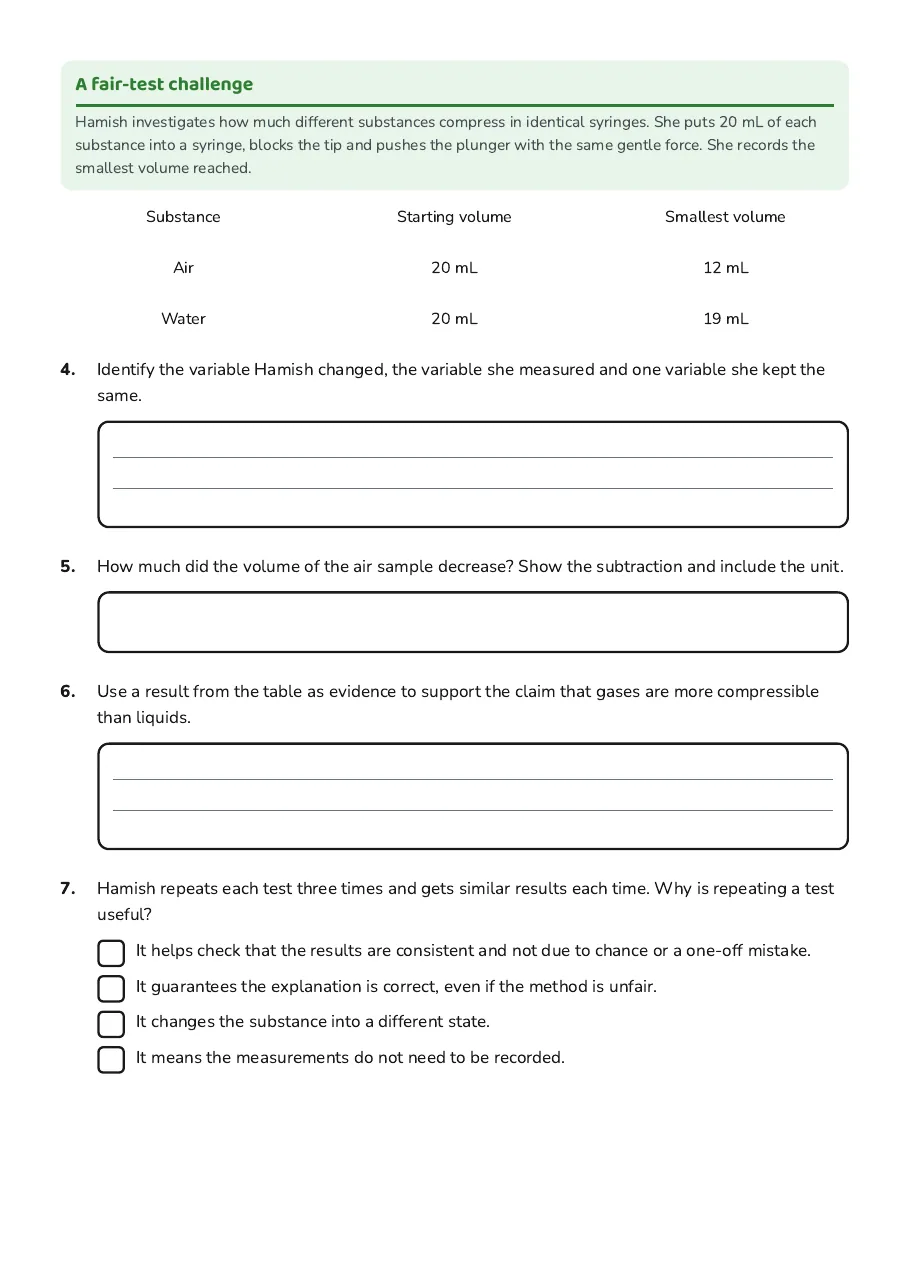
A fair-test challenge
Hamish investigates how much different substances compress in identical syringes. She puts 20 mL of each substance into a syringe, blocks the tip and pushes the plunger with the same gentle force. She records the smallest volume reached.
Substance
Starting volume
Smallest volume
Air
20 mL
12 mL
Water
20 mL
19 mL
- It helps check that the results are consistent and not due to chance or a one-off mistake.
- It guarantees the explanation is correct, even if the method is unfair.
- It changes the substance into a different state.
- It means the measurements do not need to be recorded.
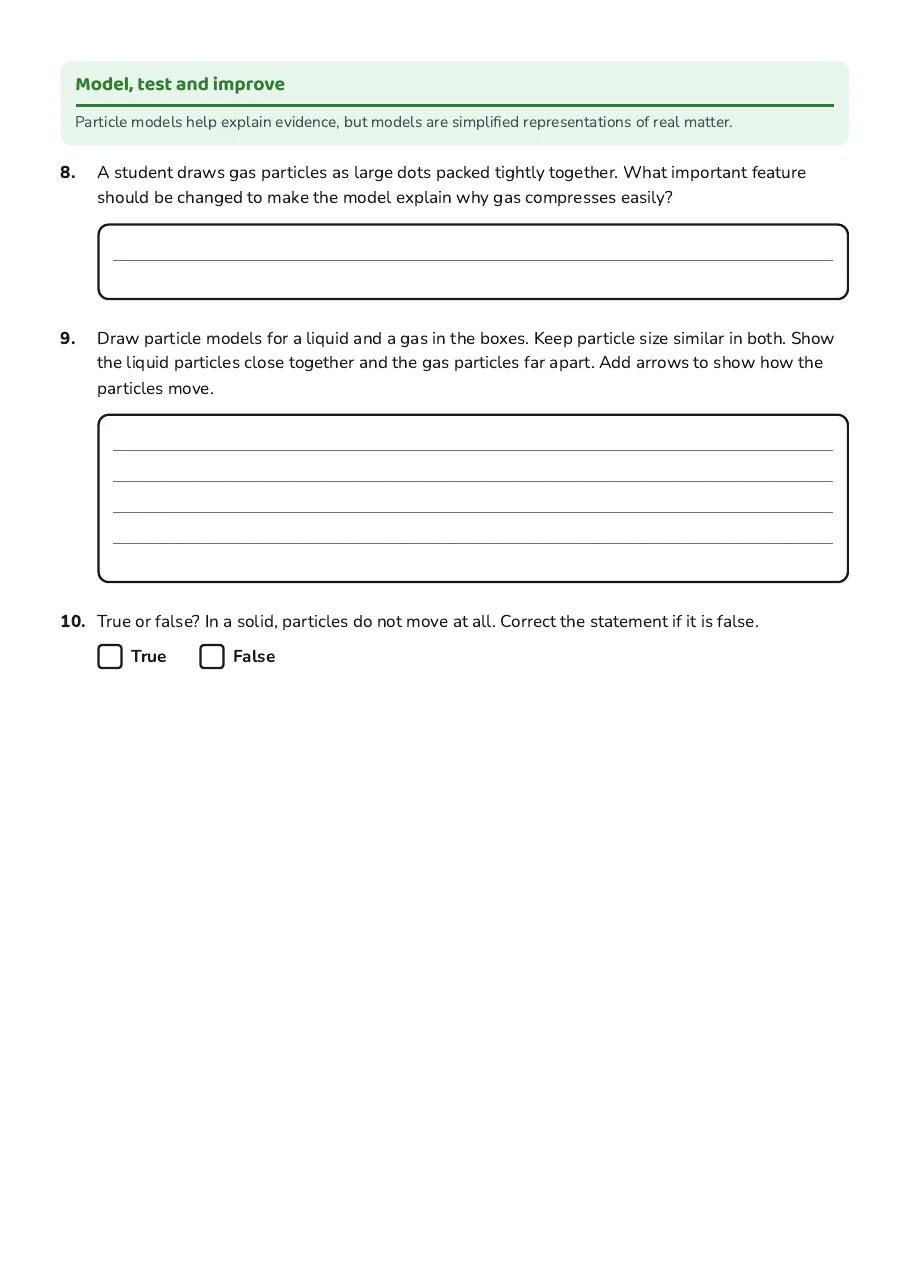
Model, test and improve
Particle models help explain evidence, but models are simplified representations of real matter.
3 printable pages
Page 1
Page 2
Page 3
About This Worksheet
Free in Kuraplan
Sign up free, grab the PDF, and customize it for your class.
Print-Ready
Formatted for standard paper. Clean layout, easy to read.
AI-Generated
Created with Kuraplan's AI, designed for real classroom use.
For Teachers & Parents
Use in classrooms, for homework, tutoring, or homeschool.
Need a custom version of this worksheet?
Kuraplan's AI generates custom worksheets in seconds — differentiated for every learner, aligned to your curriculum.
Generate Custom Worksheets — FreeMore Science Worksheets
Recycled Materials Picture Worksheet
Free
Separating Mixtures Techniques
Free
Material Properties Basics
Free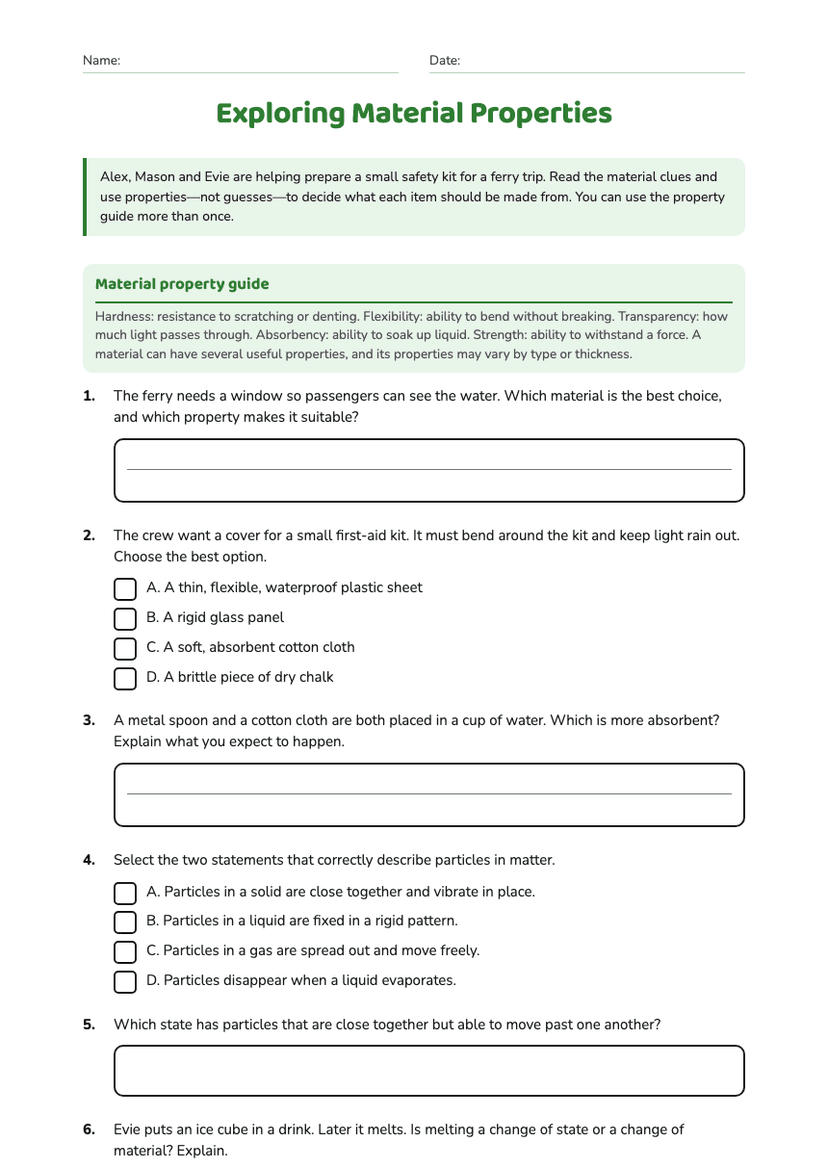
Exploring Material Properties
Free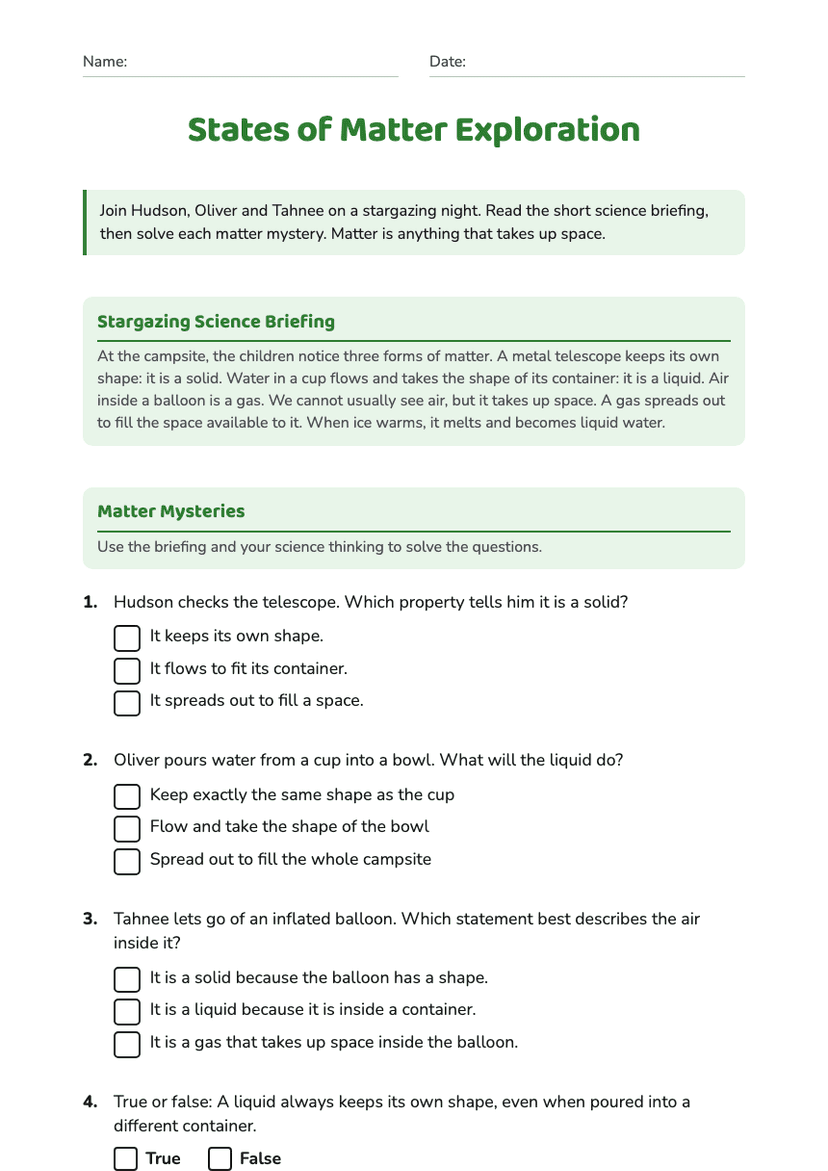
States of Matter Exploration
Free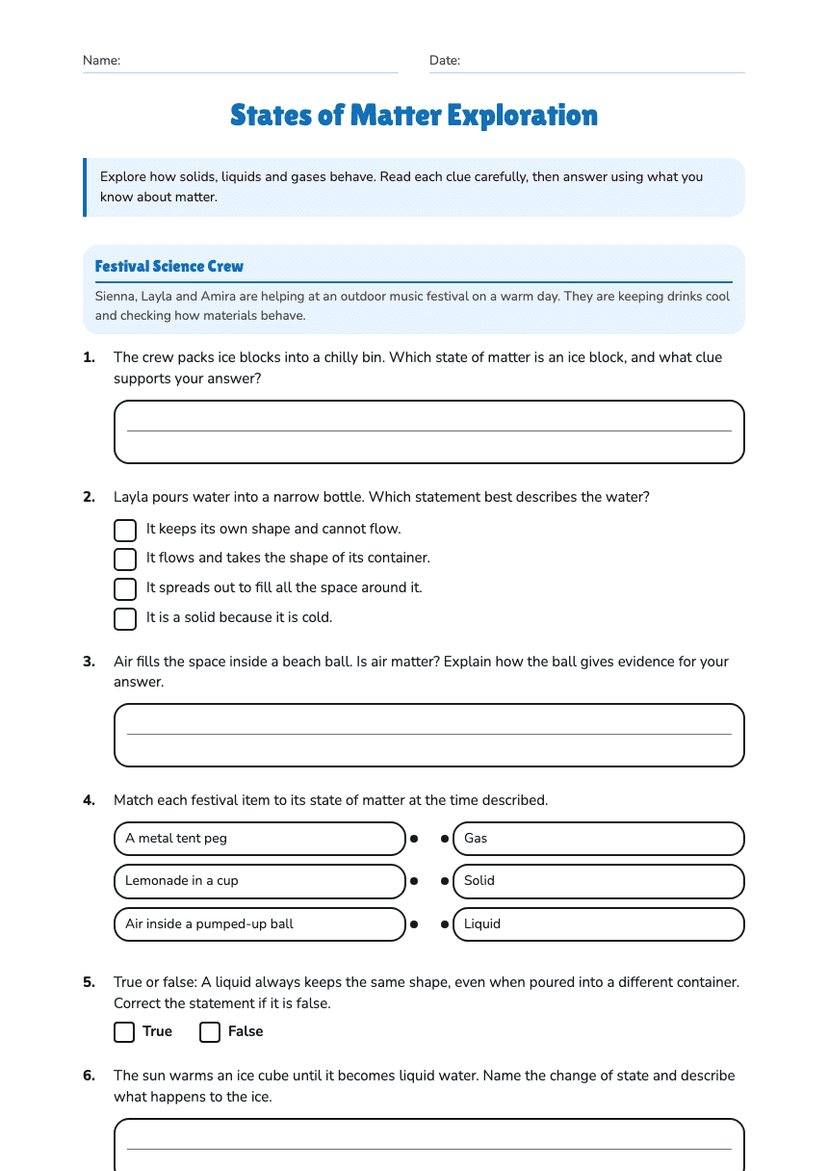
States of Matter Exploration
Free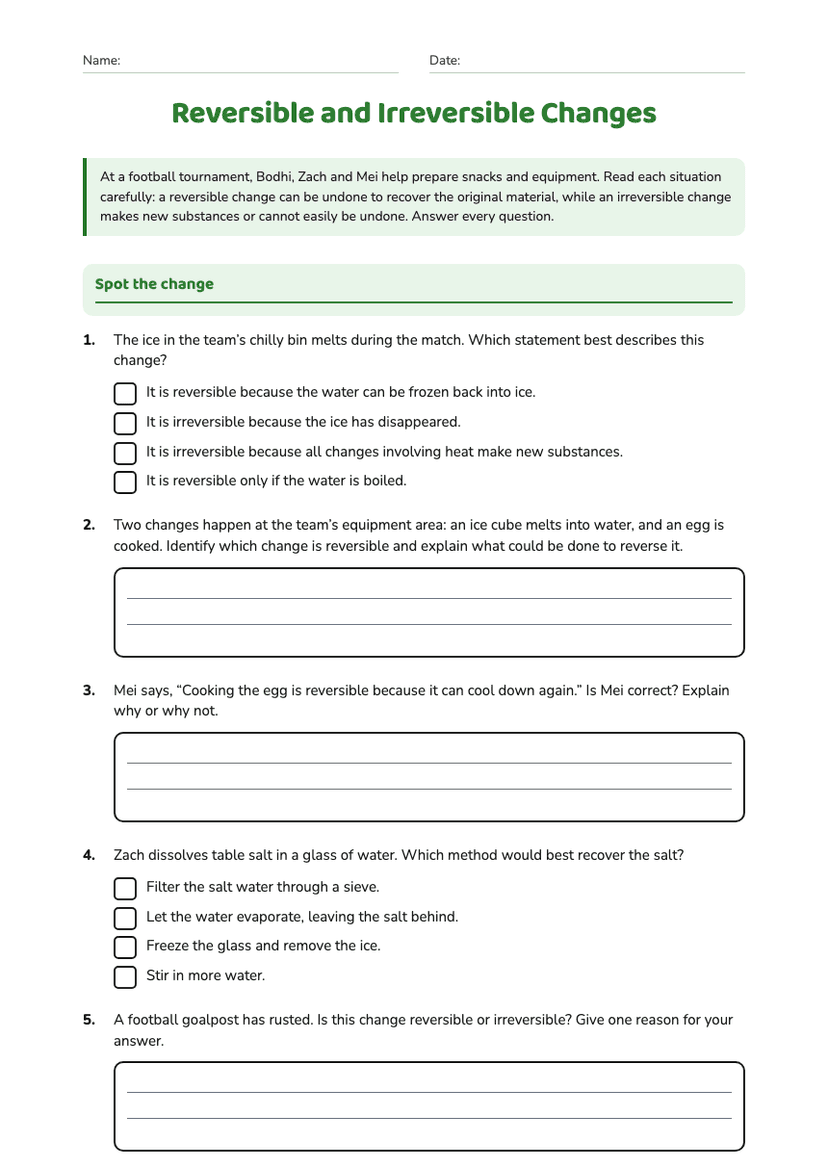
Reversible and Irreversible Changes
Free