ScienceFreePrintable

Standing Waves Analysis Report

A free science worksheet ready for your classroom. Open in Kuraplan to grab the print-ready PDF, customize it for your students, or generate a fresh version in seconds.
Standing Waves Analysis Report worksheet preview
Name:Date:

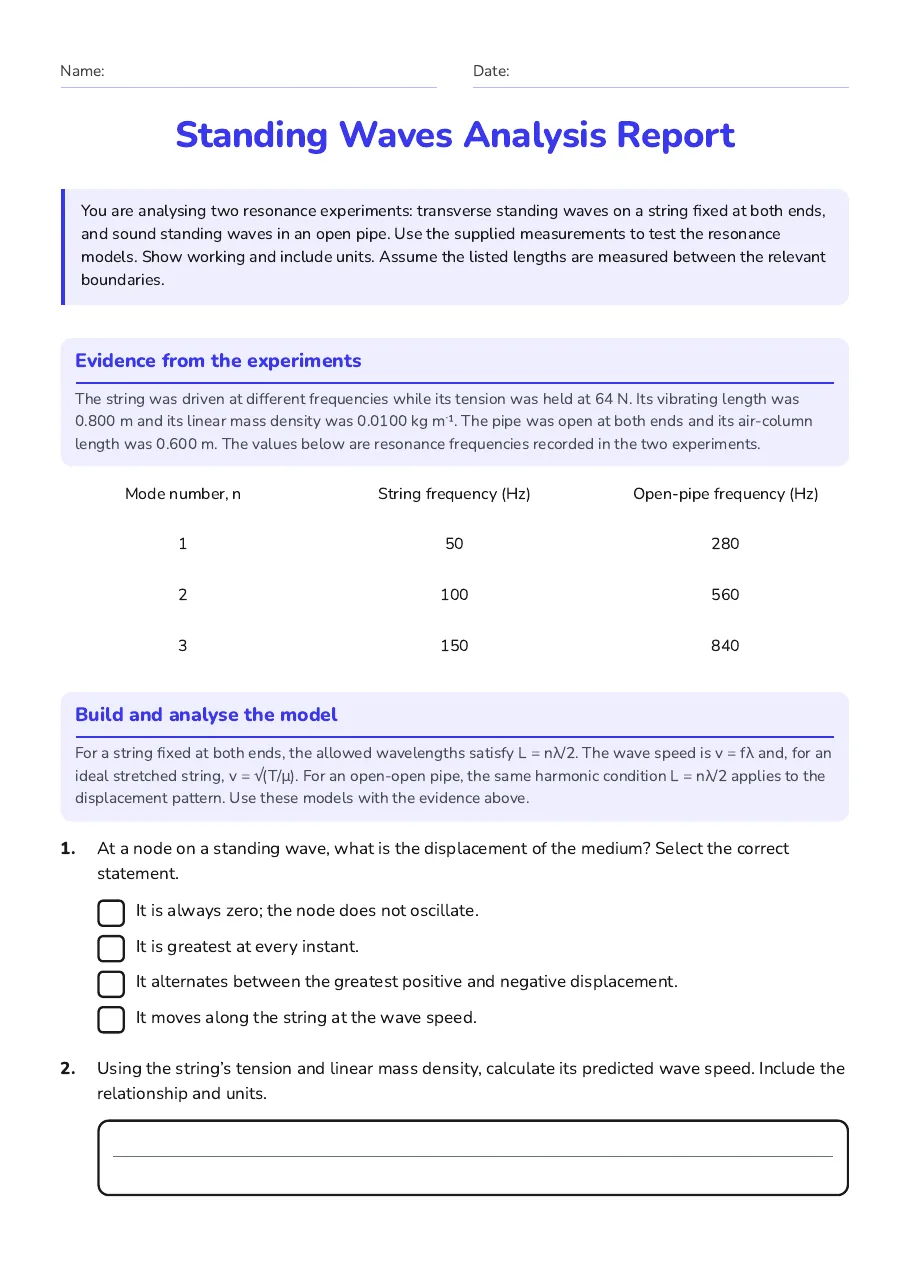
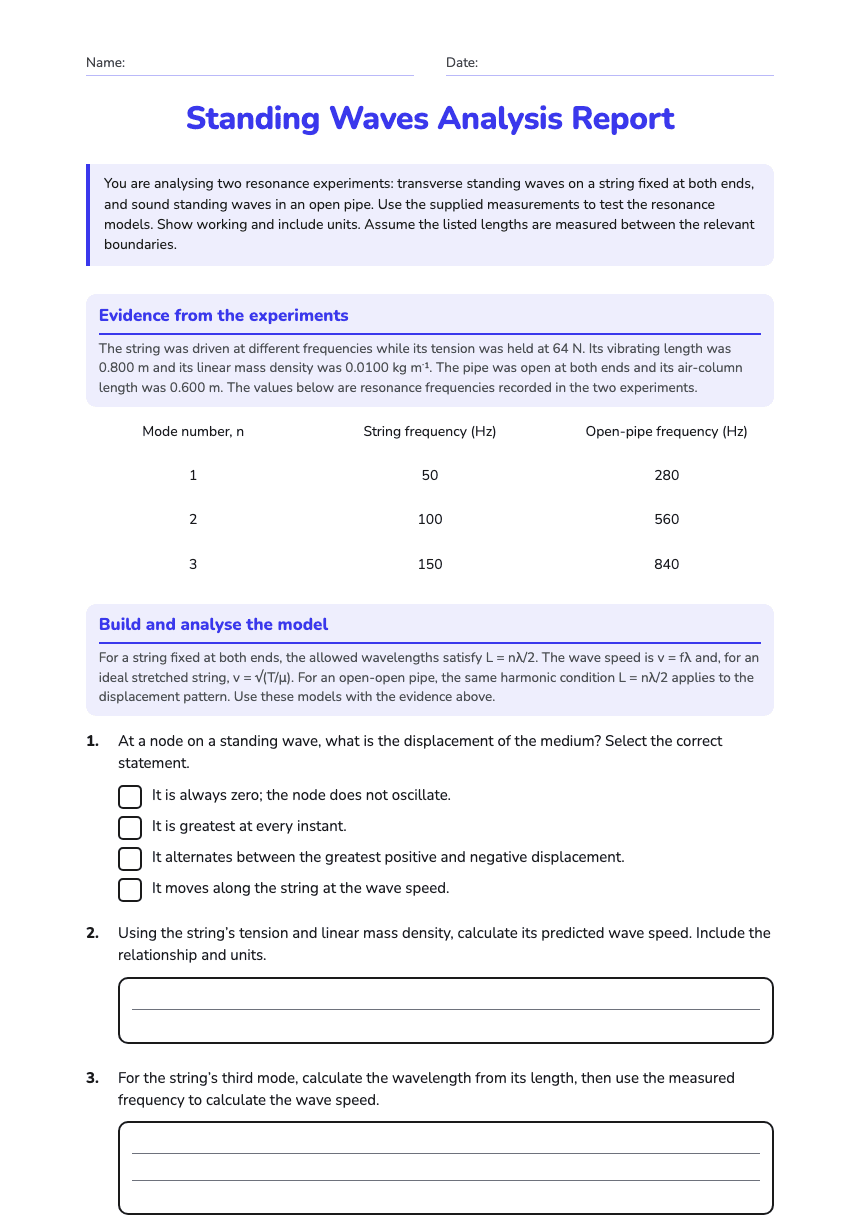
Standing Waves Analysis Report

You are analysing two resonance experiments: transverse standing waves on a string fixed at both ends, and sound standing waves in an open pipe. Use the supplied measurements to test the resonance models. Show working and include units. Assume the listed lengths are measured between the relevant boundaries.

Evidence from the experiments

The string was driven at different frequencies while its tension was held at 64 N. Its vibrating length was 0.800 m and its linear mass density was 0.0100 kg m⁻¹. The pipe was open at both ends and its air-column length was 0.600 m. The values below are resonance frequencies recorded in the two experiments.

Mode number, n

String frequency (Hz)

Open-pipe frequency (Hz)

1

50

280

2

100

560

3

150

840

Build and analyse the model

For a string fixed at both ends, the allowed wavelengths satisfy L = nλ/2. The wave speed is v = fλ and, for an ideal stretched string, v = √(T/μ). For an open-open pipe, the same harmonic condition L = nλ/2 applies to the displacement pattern. Use these models with the evidence above.

1.At a node on a standing wave, what is the displacement of the medium? Select the correct statement.
  • It is always zero; the node does not oscillate.
  • It is greatest at every instant.
  • It alternates between the greatest positive and negative displacement.
  • It moves along the string at the wave speed.
2.Using the string’s tension and linear mass density, calculate its predicted wave speed. Include the relationship and units.
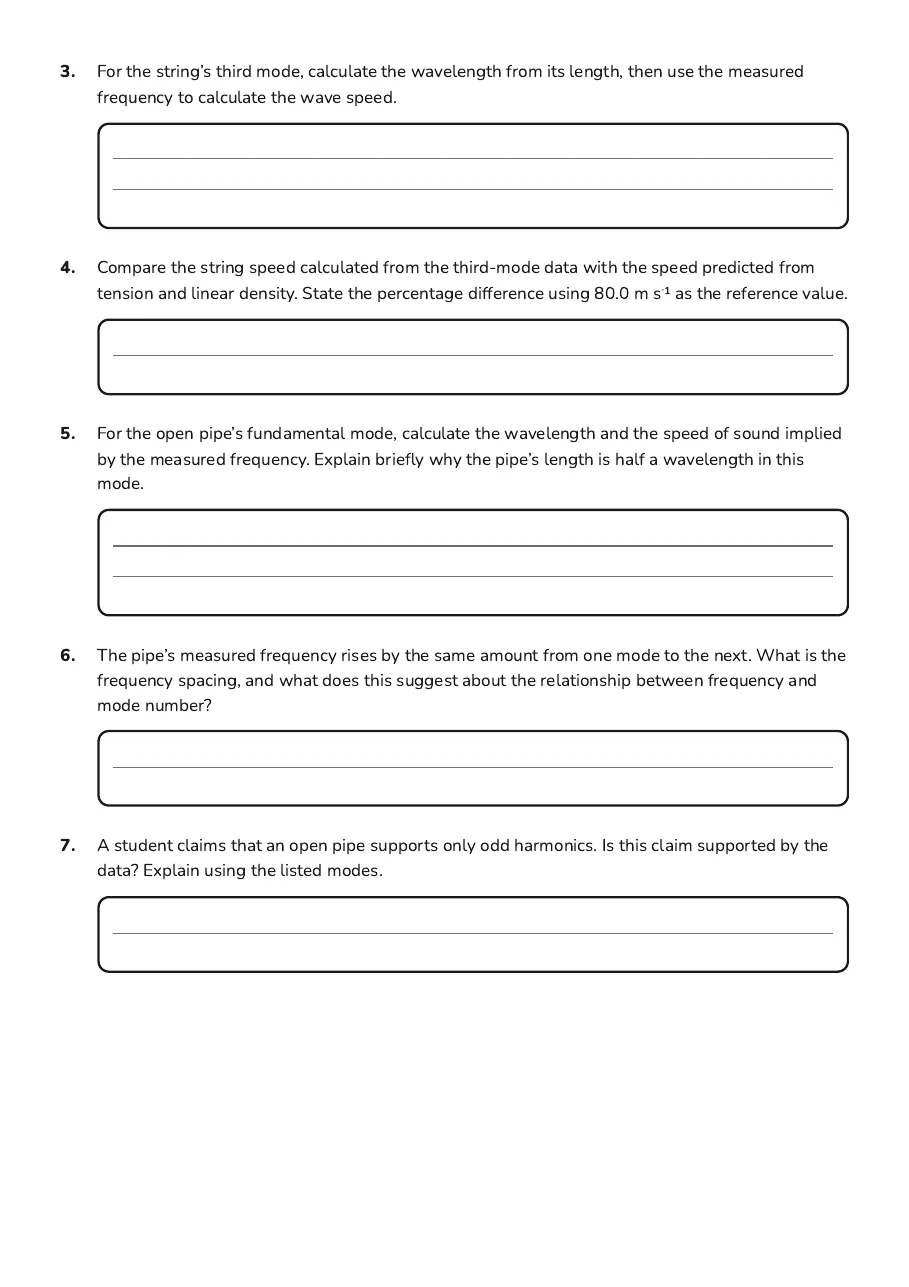
3.For the string’s third mode, calculate the wavelength from its length, then use the measured frequency to calculate the wave speed.
4.Compare the string speed calculated from the third-mode data with the speed predicted from tension and linear density. State the percentage difference using 80.0 m s⁻¹ as the reference value.
5.For the open pipe’s fundamental mode, calculate the wavelength and the speed of sound implied by the measured frequency. Explain briefly why the pipe’s length is half a wavelength in this mode.
6.The pipe’s measured frequency rises by the same amount from one mode to the next. What is the frequency spacing, and what does this suggest about the relationship between frequency and mode number?
7.A student claims that an open pipe supports only odd harmonics. Is this claim supported by the data? Explain using the listed modes.
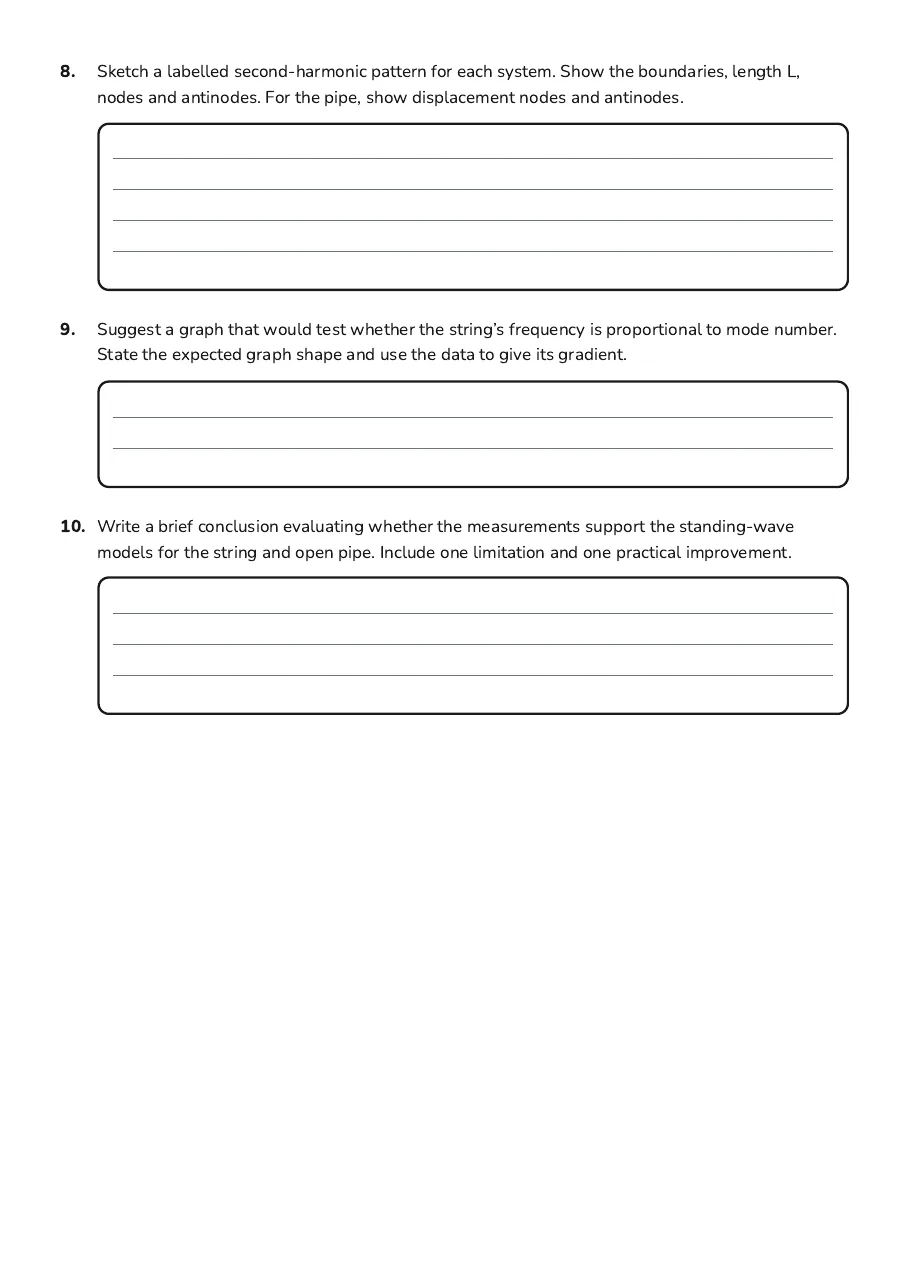
8.Sketch a labelled second-harmonic pattern for each system. Show the boundaries, length L, nodes and antinodes. For the pipe, show displacement nodes and antinodes.
9.Suggest a graph that would test whether the string’s frequency is proportional to mode number. State the expected graph shape and use the data to give its gradient.
10.Write a brief conclusion evaluating whether the measurements support the standing-wave models for the string and open pipe. Include one limitation and one practical improvement.

3 printable pages

  • Standing Waves Analysis Report, page 1 of 3: Evidence from the experiments, Build and analyse the model

    Page 1

  • Standing Waves Analysis Report, page 2 of 3: 3. For the string’s third mode, calculate the wavelength from its length, then use the…

    Page 2

  • Standing Waves Analysis Report, page 3 of 3: 8. Sketch a labelled second-harmonic pattern for each system. Show the boundaries, length…

    Page 3

About This Worksheet

Free in Kuraplan

Sign up free, grab the PDF, and customize it for your class.

Print-Ready

Formatted for standard paper. Clean layout, easy to read.

AI-Generated

Created with Kuraplan's AI, designed for real classroom use.

For Teachers & Parents

Use in classrooms, for homework, tutoring, or homeschool.

Need a custom version of this worksheet?

Kuraplan's AI generates custom worksheets in seconds — differentiated for every learner, aligned to your curriculum.

Generate Custom Worksheets — Free
No credit card Curriculum-aligned Under 60 seconds