Volcano Eruptions Worksheet
A free science worksheet ready for your classroom. Open in Kuraplan to grab the print-ready PDF, customize it for your students, or generate a fresh version in seconds.
Volcano Eruptions Worksheet
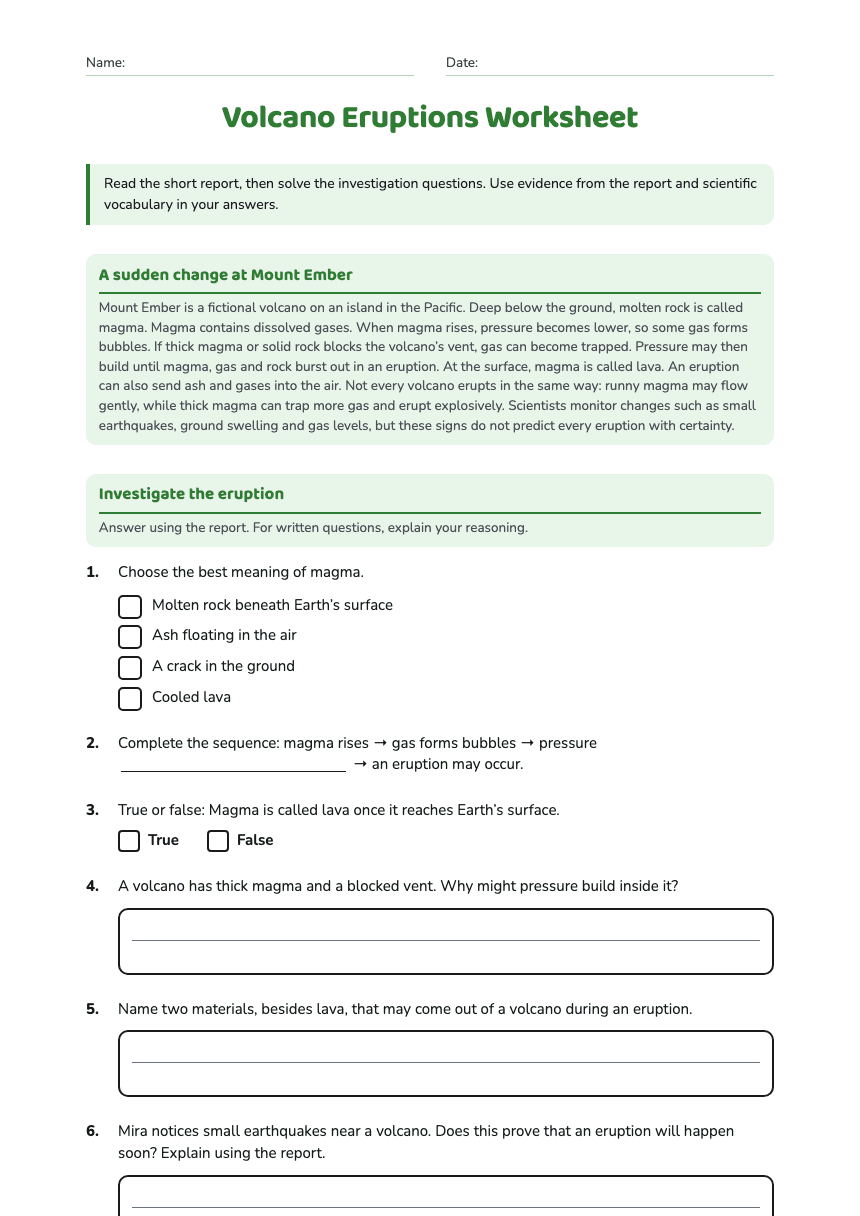
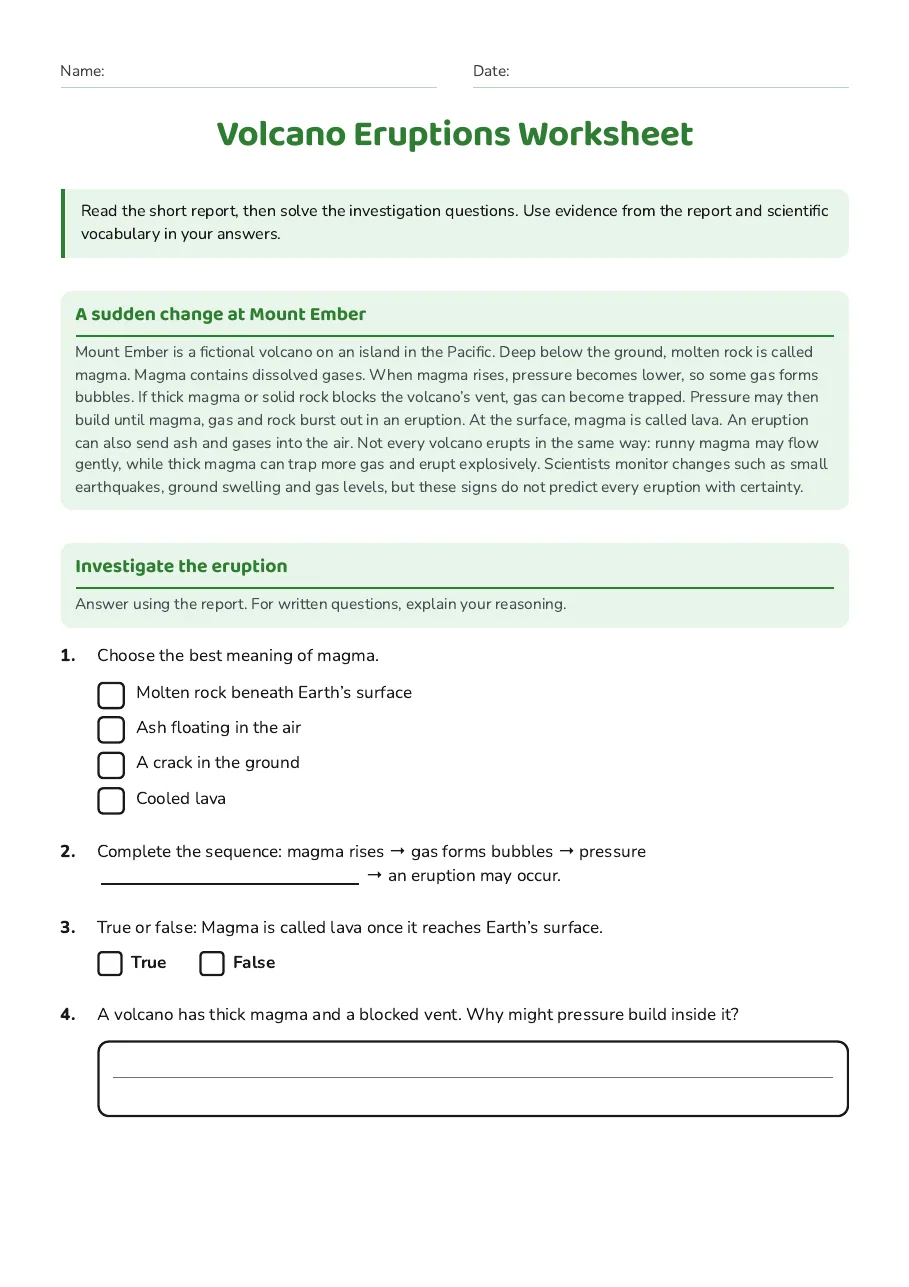
A sudden change at Mount Ember
Mount Ember is a fictional volcano on an island in the Pacific. Deep below the ground, molten rock is called magma. Magma contains dissolved gases. When magma rises, pressure becomes lower, so some gas forms bubbles. If thick magma or solid rock blocks the volcano’s vent, gas can become trapped. Pressure may then build until magma, gas and rock burst out in an eruption. At the surface, magma is called lava. An eruption can also send ash and gases into the air. Not every volcano erupts in the same way: runny magma may flow gently, while thick magma can trap more gas and erupt explosively. Scientists monitor changes such as small earthquakes, ground swelling and gas levels, but these signs do not predict every eruption with certainty.
Investigate the eruption
Answer using the report. For written questions, explain your reasoning.
- Molten rock beneath Earth’s surface
- Ash floating in the air
- A crack in the ground
- Cooled lava
2 printable pages
Page 1
Page 2
About This Worksheet
Free in Kuraplan
Sign up free, grab the PDF, and customize it for your class.
Print-Ready
Formatted for standard paper. Clean layout, easy to read.
AI-Generated
Created with Kuraplan's AI, designed for real classroom use.
For Teachers & Parents
Use in classrooms, for homework, tutoring, or homeschool.
Need a custom version of this worksheet?
Kuraplan's AI generates custom worksheets in seconds — differentiated for every learner, aligned to your curriculum.
Generate Custom Worksheets — Free