MathsFreePrintable
Volume Exploration Worksheet
A free maths worksheet ready for your classroom. Open in Kuraplan to grab the print-ready PDF, customize it for your students, or generate a fresh version in seconds.
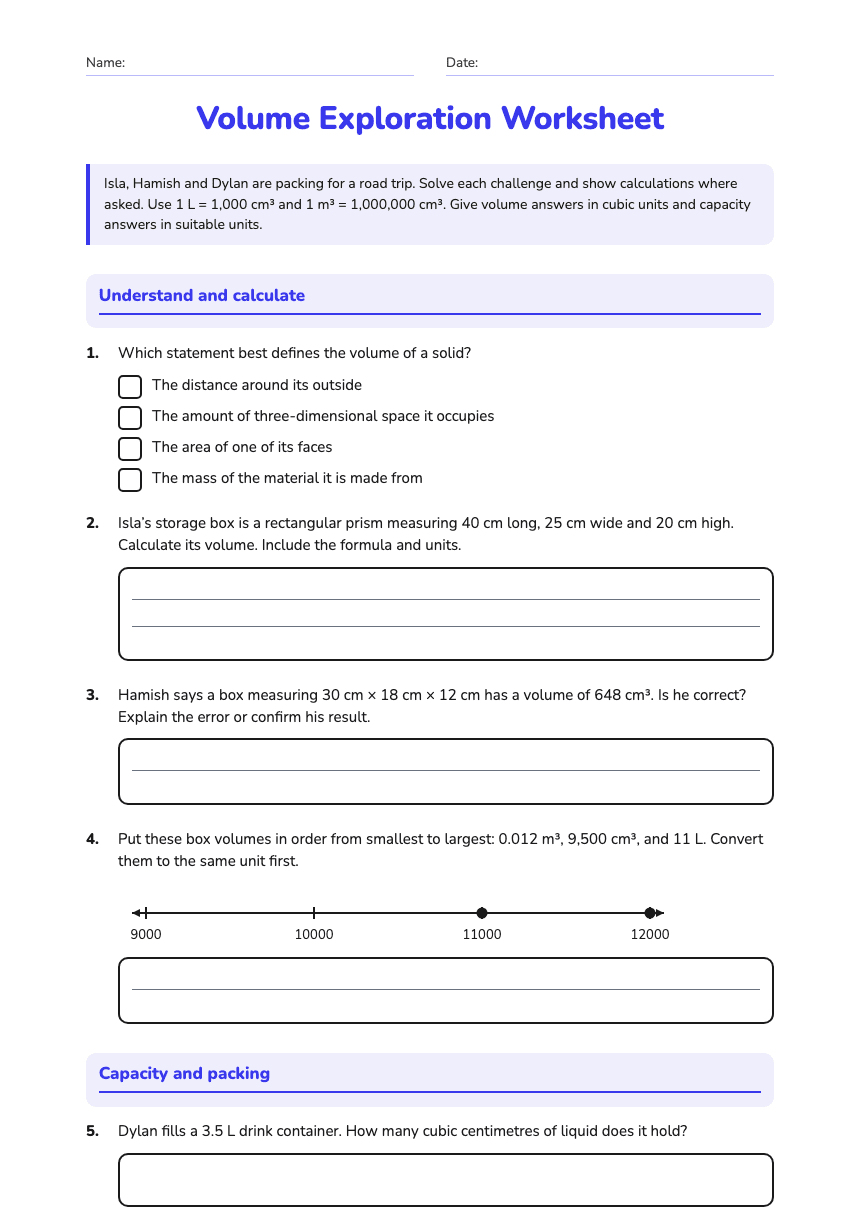
Name:Date:
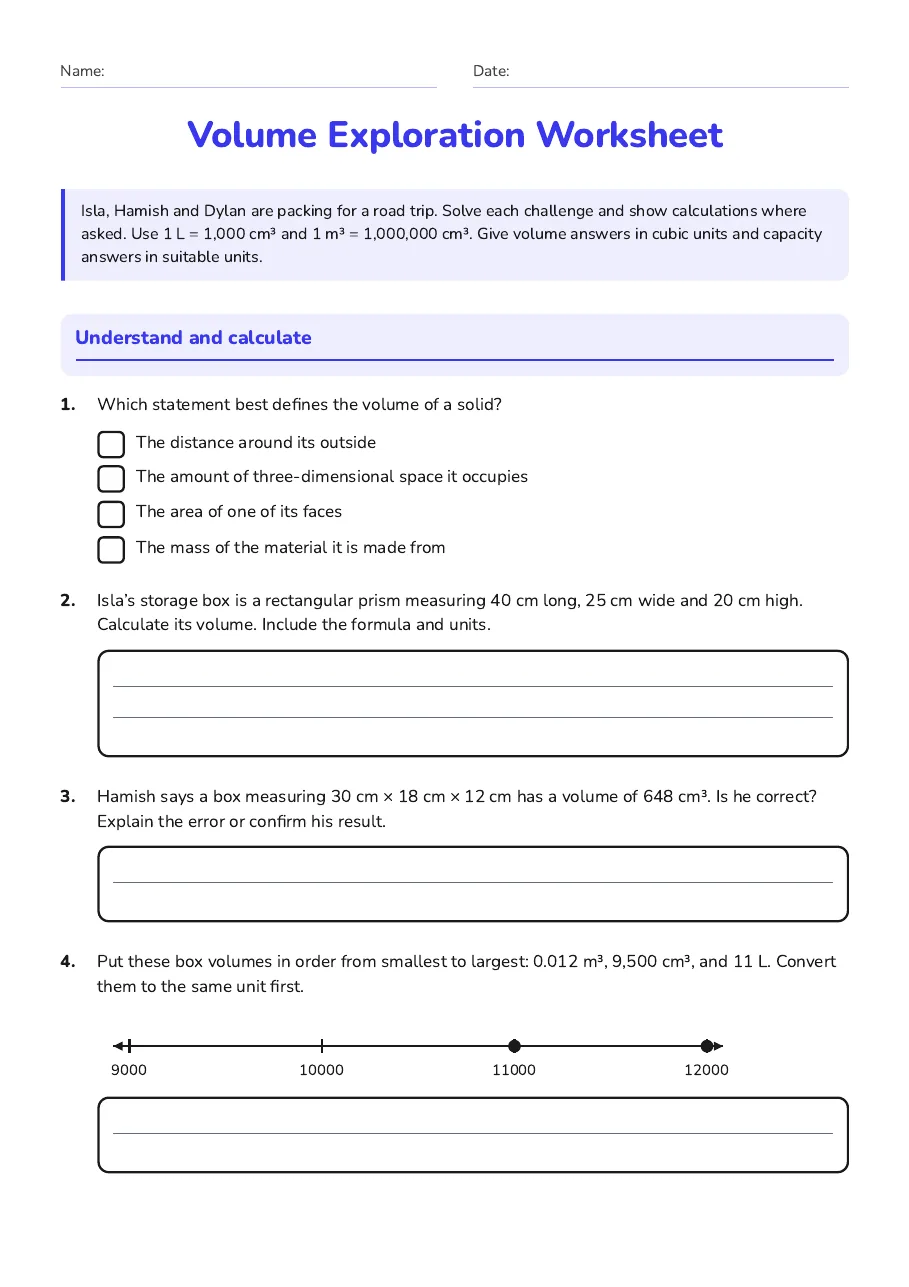
Volume Exploration Worksheet
Isla, Hamish and Dylan are packing for a road trip. Solve each challenge and show calculations where asked. Use 1 L = 1,000 cm³ and 1 m³ = 1,000,000 cm³. Give volume answers in cubic units and capacity answers in suitable units.
Understand and calculate
1.Which statement best defines the volume of a solid?
- The distance around its outside
- The amount of three-dimensional space it occupies
- The area of one of its faces
- The mass of the material it is made from
2.Isla’s storage box is a rectangular prism measuring 40 cm long, 25 cm wide and 20 cm high. Calculate its volume. Include the formula and units.
3.Hamish says a box measuring 30 cm × 18 cm × 12 cm has a volume of 648 cm³. Is he correct? Explain the error or confirm his result.
4.Put these box volumes in order from smallest to largest: 0.012 m³, 9,500 cm³, and 11 L. Convert them to the same unit first.
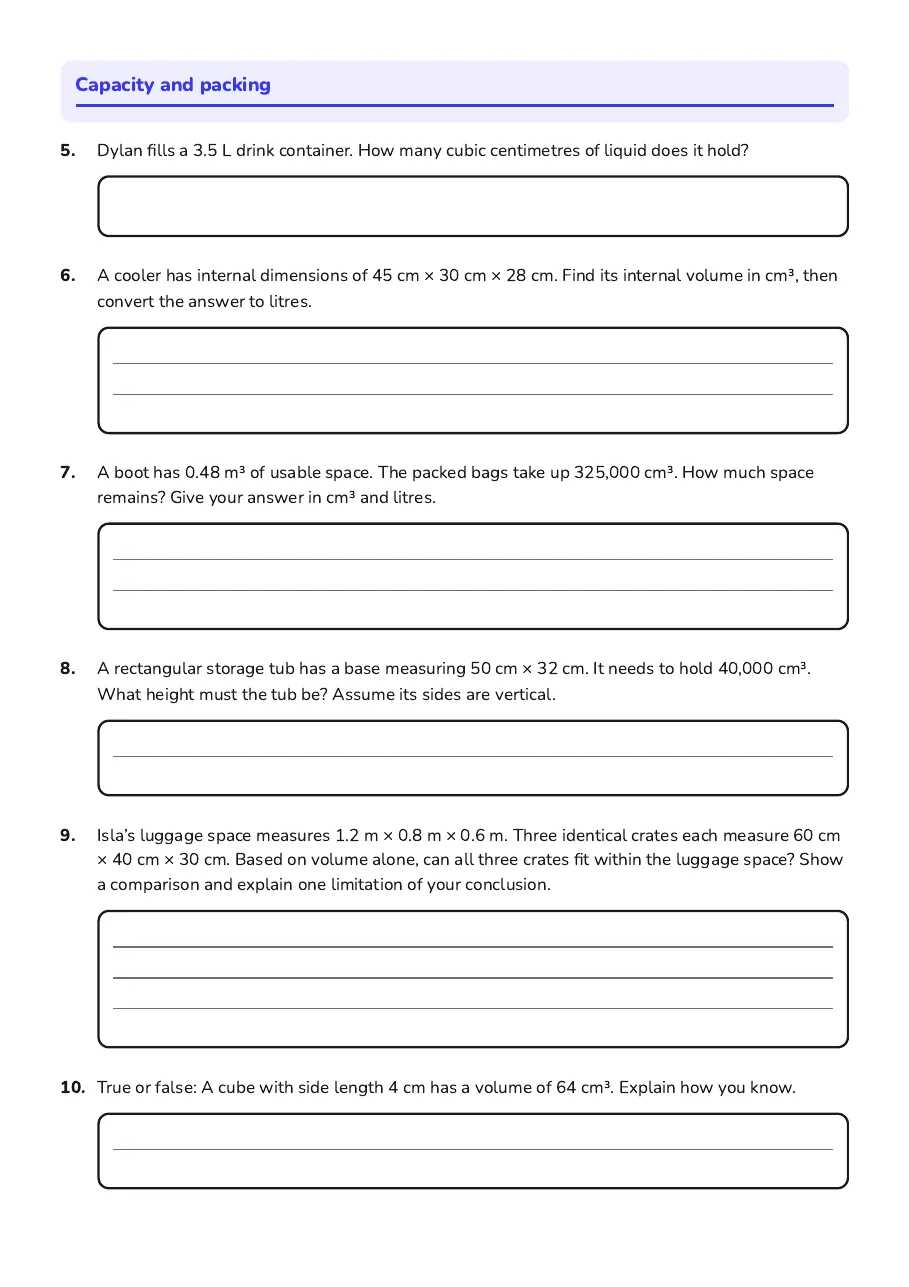
Capacity and packing
5.Dylan fills a 3.5 L drink container. How many cubic centimetres of liquid does it hold?
6.A cooler has internal dimensions of 45 cm × 30 cm × 28 cm. Find its internal volume in cm³, then convert the answer to litres.
7.A boot has 0.48 m³ of usable space. The packed bags take up 325,000 cm³. How much space remains? Give your answer in cm³ and litres.
8.A rectangular storage tub has a base measuring 50 cm × 32 cm. It needs to hold 40,000 cm³. What height must the tub be? Assume its sides are vertical.
9.Isla’s luggage space measures 1.2 m × 0.8 m × 0.6 m. Three identical crates each measure 60 cm × 40 cm × 30 cm. Based on volume alone, can all three crates fit within the luggage space? Show a comparison and explain one limitation of your conclusion.
10.True or false: A cube with side length 4 cm has a volume of 64 cm³. Explain how you know.
2 printable pages
Page 1
Page 2
About This Worksheet
Free in Kuraplan
Sign up free, grab the PDF, and customize it for your class.
Print-Ready
Formatted for standard paper. Clean layout, easy to read.
AI-Generated
Created with Kuraplan's AI, designed for real classroom use.
For Teachers & Parents
Use in classrooms, for homework, tutoring, or homeschool.
Need a custom version of this worksheet?
Kuraplan's AI generates custom worksheets in seconds — differentiated for every learner, aligned to your curriculum.
Generate Custom Worksheets — Free No credit card Curriculum-aligned Under 60 seconds
More Maths Worksheets
Year 10
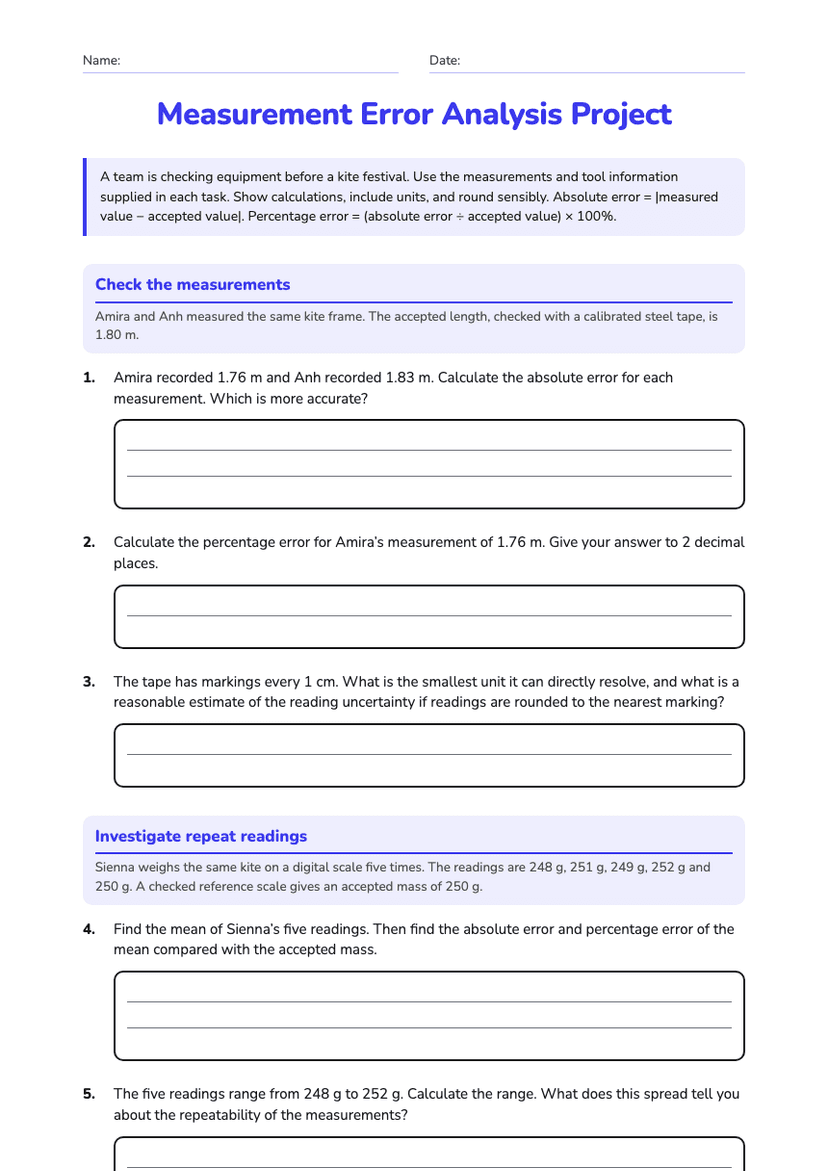
Measurement Error Analysis Project
Free
Foundation–1
Step into Measuring
Free
Year 5
Measuring Capacity Accurately
Free
Foundation–1
My Measuring Adventure!
Free
Area Practice with Support
Free
Year 3
Doghouse Design Measurements
Free
Year 5
Metric Measurement Bingo
Free
Year 2