📋 Instructions
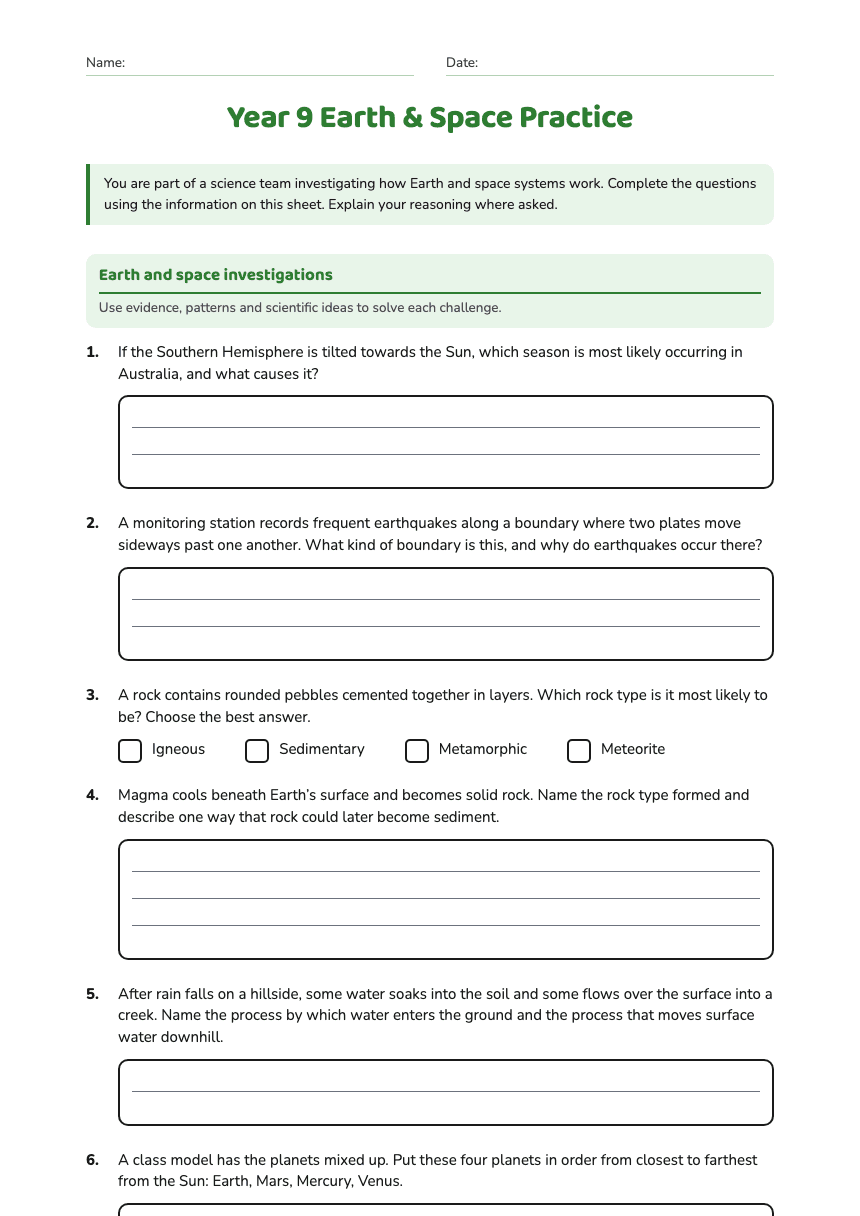
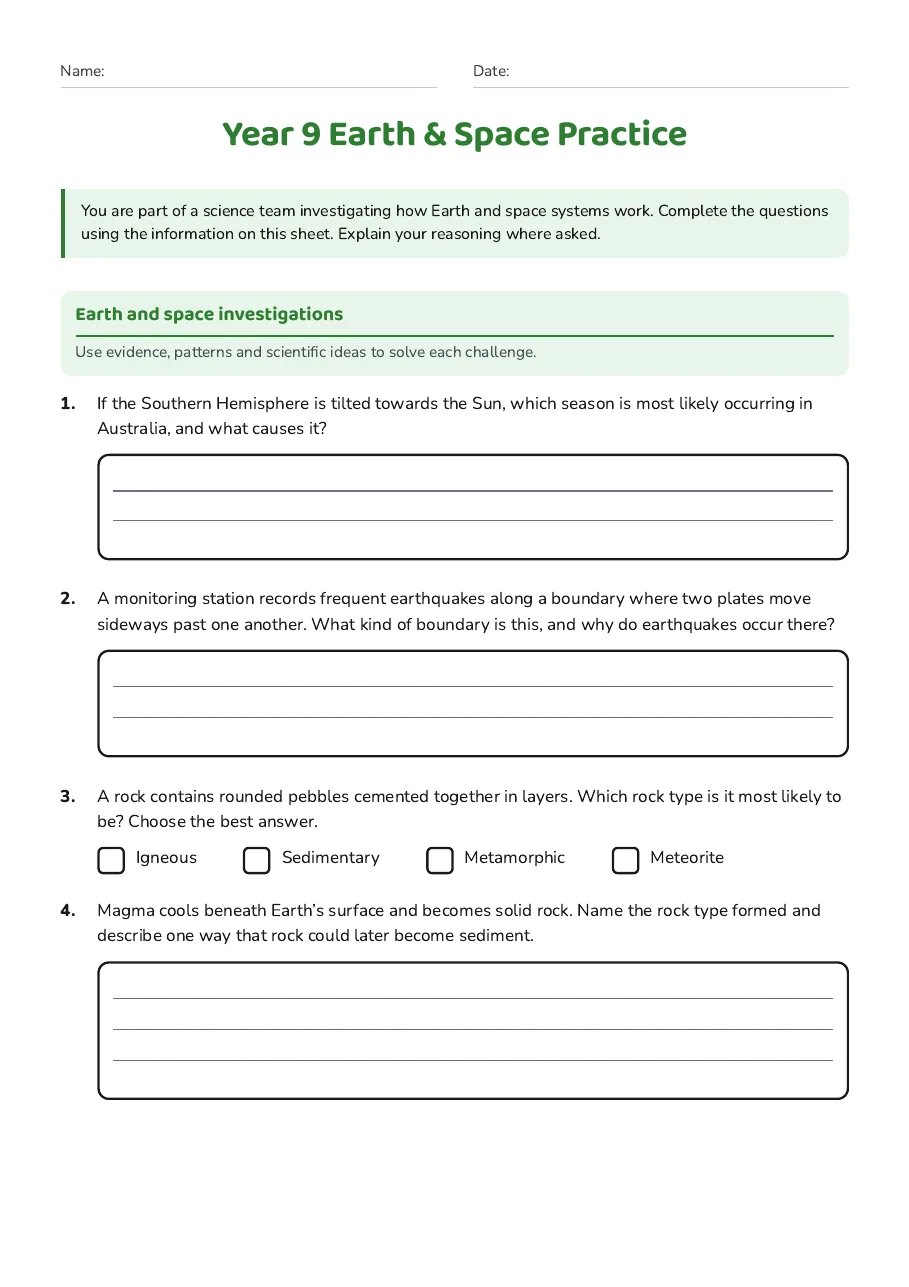
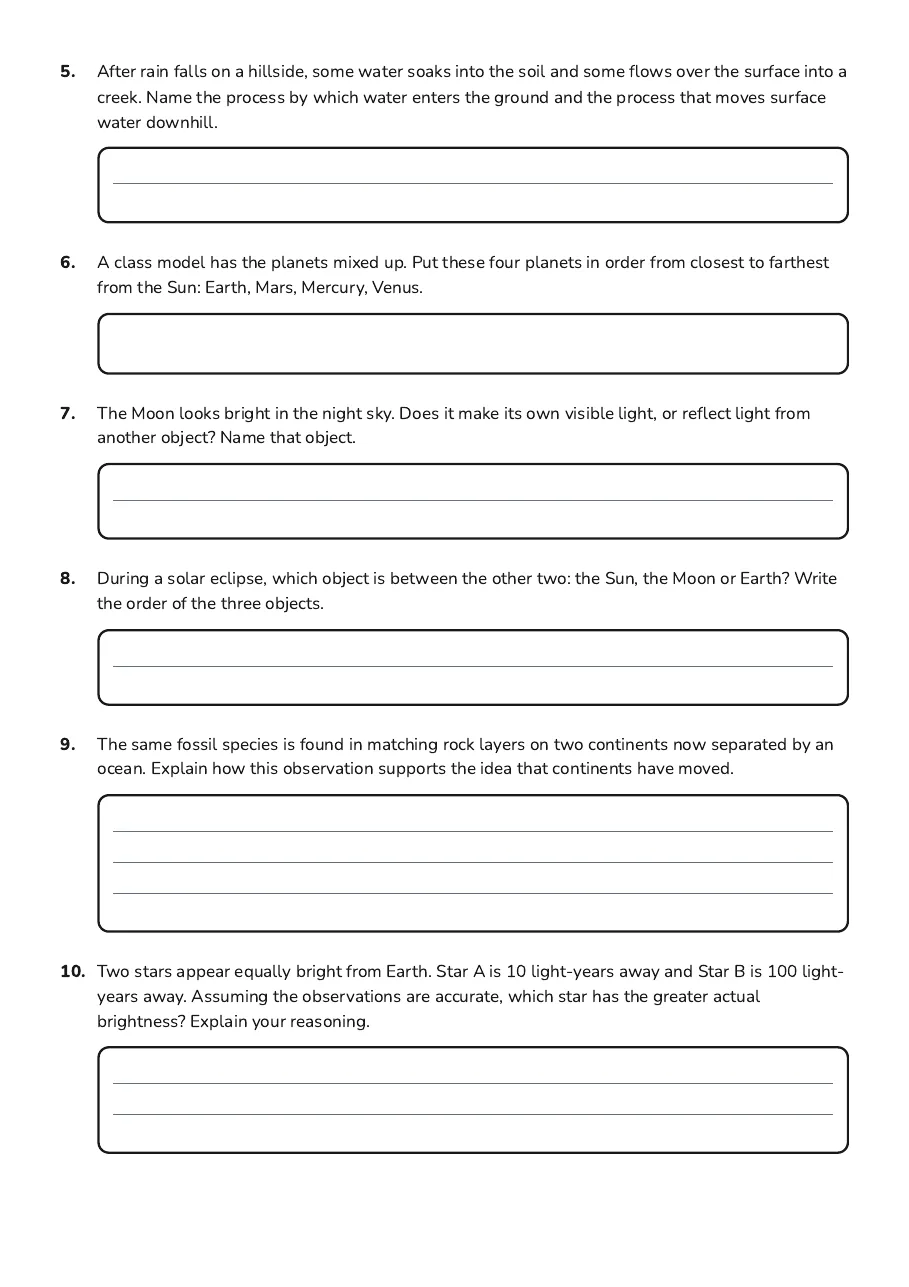
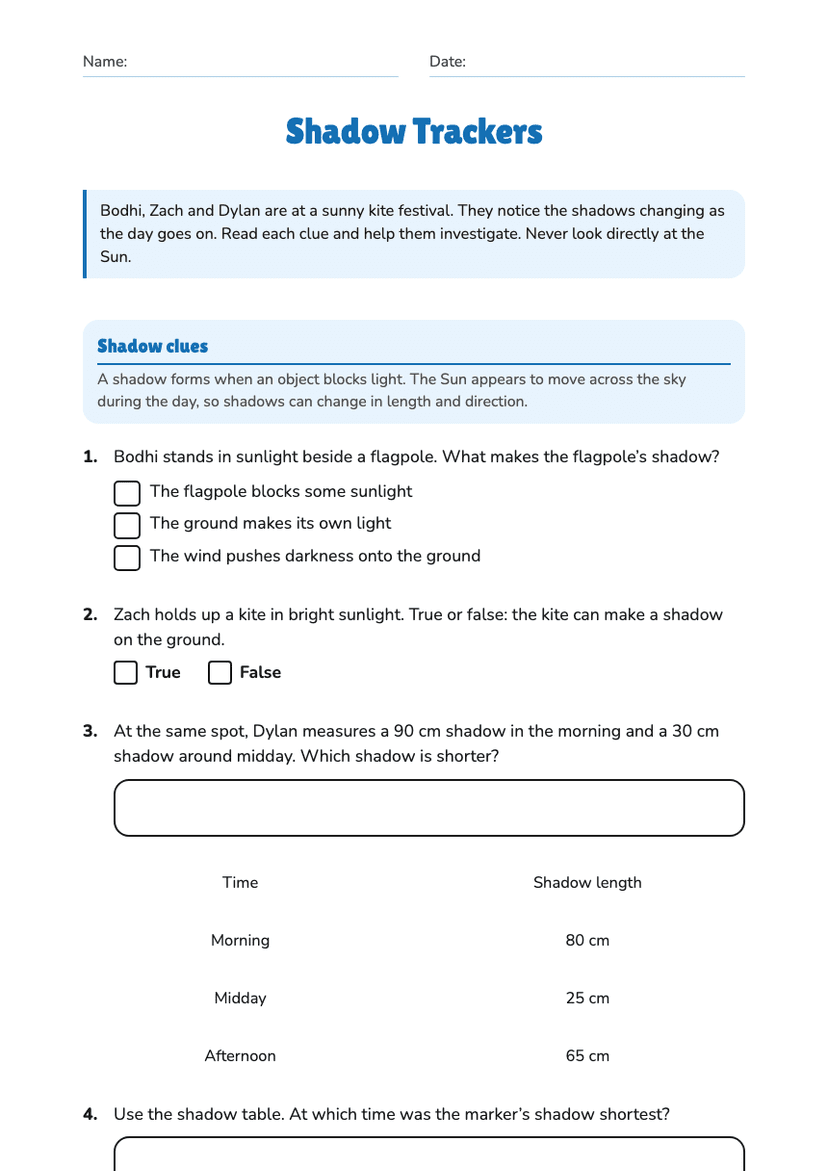
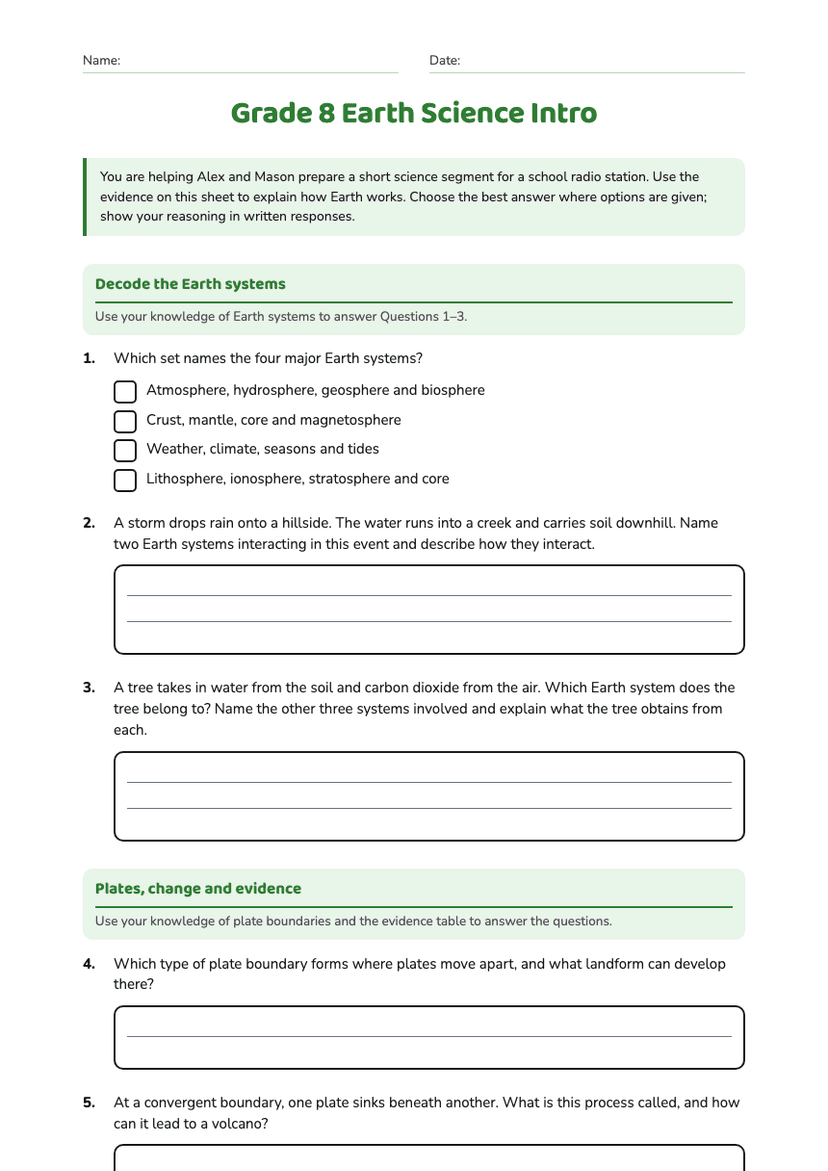
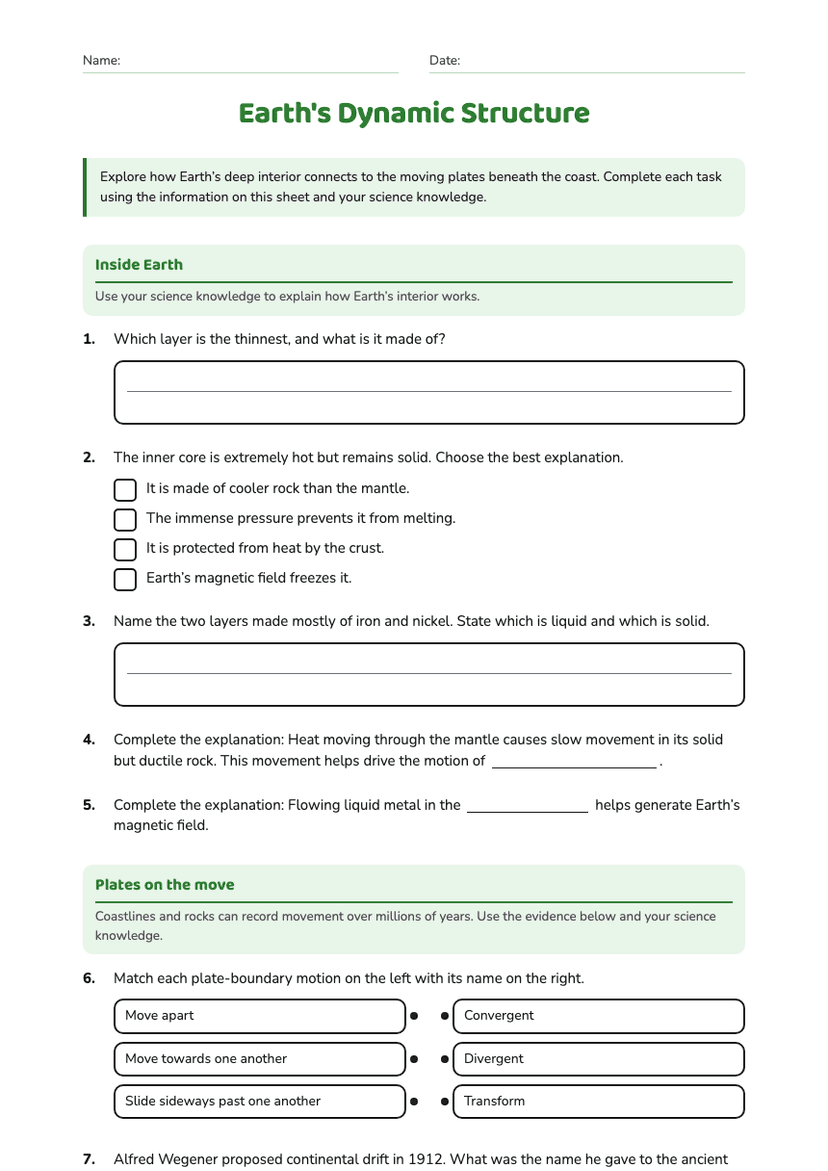
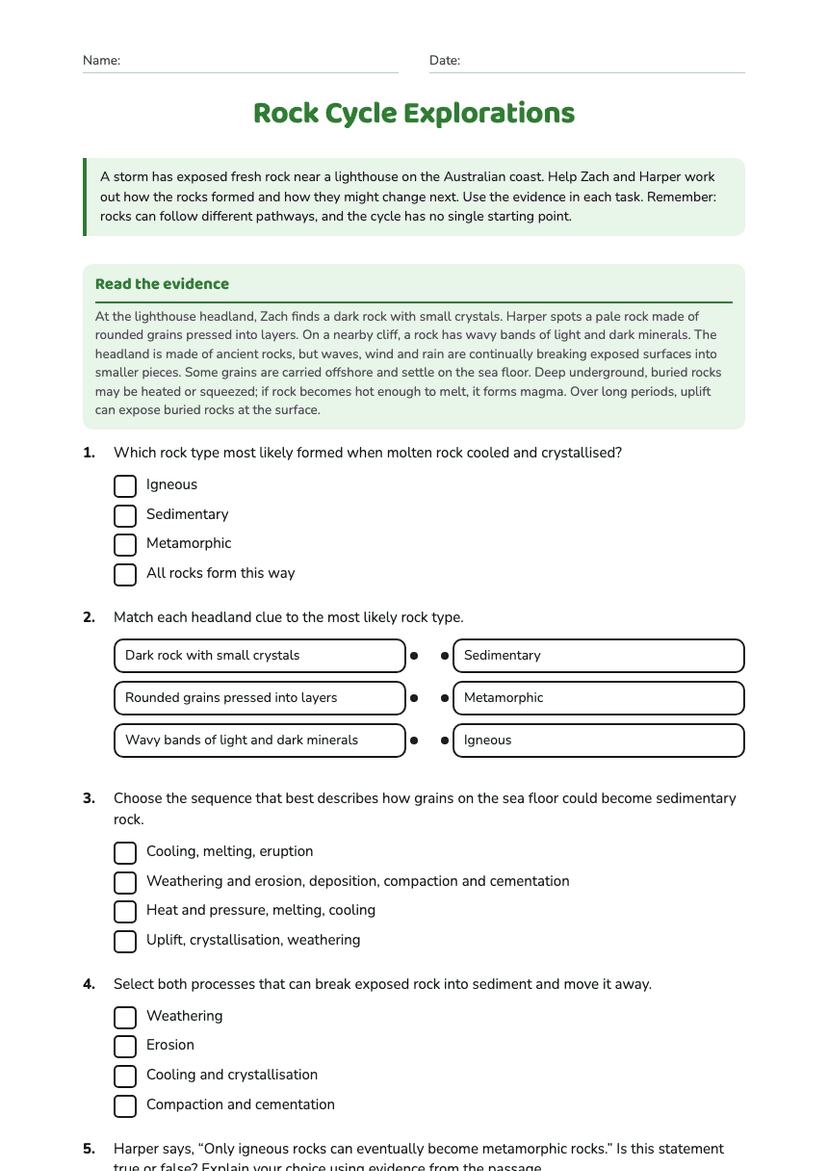
Complete all 47 questions. Read each question carefully and choose the best answer for multiple choice questions. Show your thinking for short answer questions. Use the data provided in diagrams and tables to answer interpretation questions.
🌍 Part A: Multiple Choice Questions (1-25)
Circle the letter of the best answer.
1. Which layer of Earth is the thickest?
A) Crust
B) Mantle
C) Outer core
D) Inner core
2. What type of rock is formed by cooling magma?
A) Sedimentary
B) Metamorphic
C) Igneous
D) Fossil
3. Which process breaks down rocks into smaller pieces without changing their composition?
A) Chemical weathering
B) Physical weathering
C) Erosion
D) Deposition
4. What evidence supports the theory of plate tectonics?
A) Matching fossils across oceans
B) Similar rock formations on different continents
C) Ocean floor spreading
D) All of the above
5. Most earthquakes occur at:
A) Plate boundaries
B) The centre of continents
C) Ocean centres
D) Mountain peaks
6. What drives the water cycle?
A) Wind
B) Solar energy
C) Ocean currents
D) Gravity only
7. During evaporation, water changes from:
A) Liquid to gas
B) Gas to liquid
C) Solid to liquid
D) Solid to gas
8. Which planet is closest to the Sun?
A) Venus
B) Mercury
C) Earth
D) Mars
9. What causes day and night on Earth?
A) Earth's orbit around the Sun
B) Earth's rotation on its axis
C) The Moon's phases
D) Distance from the Sun
10. What causes seasons on Earth?
A) Distance from the Sun
B) Earth's tilted axis
C) Solar flares
D) Ocean currents
11. A solar eclipse occurs when:
A) Earth blocks sunlight from reaching the Moon
B) The Moon blocks sunlight from reaching Earth
C) The Sun blocks light from the Moon
D) Clouds cover the Sun
12. What shape are planetary orbits?
A) Perfect circles
B) Ellipses (ovals)
C) Squares
D) Figure-8 shapes
13. What keeps planets in orbit around the Sun?
A) Magnetism
B) Gravity
C) Solar wind
D) Atmospheric pressure
14. Why do some stars appear brighter than others?
A) They are all the same brightness
B) Distance and actual brightness both matter
C) Only distance matters
D) Only size matters
15. How do we observe distant objects in space?
A) By the light they emit or reflect
B) By their sound
C) By their smell
D) By their magnetic fields only
16. Which type of plate boundary creates new ocean floor?
A) Transform boundary
B) Convergent boundary
C) Divergent boundary
D) Subduction zone
17. What is the main component of the atmosphere?
A) Oxygen
B) Carbon dioxide
C) Nitrogen
D) Water vapour
18. Which process moves weathered rock from one place to another?
A) Weathering
B) Erosion
C) Deposition
D) Crystallisation
19. What is the correct order of planets from the Sun?
A) Mercury, Venus, Earth, Mars, Jupiter, Saturn, Uranus, Neptune
B) Venus, Mercury, Earth, Mars, Jupiter, Saturn, Uranus, Neptune
C) Mercury, Venus, Mars, Earth, Jupiter, Saturn, Uranus, Neptune
D) Mercury, Venus, Earth, Jupiter, Mars, Saturn, Uranus, Neptune
20. During which season in Australia is Earth closest to the Sun?
A) Summer
B) Winter
C) Autumn
D) Spring
21. What type of volcano typically forms at divergent plate boundaries?
A) Shield volcanoes
B) Stratovolcanoes
C) Cinder cones
D) Supervolcanoes
22. What happens during transpiration?
A) Water evaporates from oceans
B) Water vapour condenses into clouds
C) Plants release water vapour through their leaves
D) Rain falls to the ground
23. Which of these is NOT a terrestrial planet?
A) Mercury
B) Venus
C) Jupiter
D) Mars
24. What causes tides on Earth?
A) Earth's rotation
B) Solar wind
C) Gravitational pull of the Moon and Sun
D) Ocean currents
25. Why does the Sun appear to move across the sky during the day?
A) The Sun orbits Earth
B) Earth rotates on its axis
C) The Sun rotates on its axis
D) Atmospheric refraction
✏️ Part B: Short Answer and Fill-in-the-Blank (26-40)
26. Name the three main types of rocks: __________, __________, and __________.
27. What is the name of the supercontinent that existed millions of years ago? __________
28. List two factors that affect the rate of weathering:
29. Explain why Australia experiences summer when the Northern Hemisphere experiences winter:
30. The process where water soaks into the ground is called __________.
31. Name the four inner planets in order from the Sun:
32. What is the difference between a meteor and a meteorite?
33. The point on Earth's surface directly above an earthquake's focus is called the __________.
34. Describe what happens at a transform plate boundary:
35. Why do we have leap years?
36. The imaginary line around Earth's middle is called the __________.
37. Name two greenhouse gases:
38. What is the main difference between P-waves and S-waves in earthquakes?
39. The asteroid belt is located between which two planets? __________ and __________
40. Explain why we always see the same side of the Moon from Earth:
📊 Part C: Data Interpretation and Scenarios (41-47)
41. Study this simple data about earthquake magnitudes:
Richter Scale Data:
Magnitude 2.0: Often not felt
Magnitude 4.0: Felt by many people
Magnitude 6.0: Can cause damage to buildings
Magnitude 8.0: Major earthquake, widespread damage
An earthquake measuring 5.5 on the Richter scale would most likely:
A) Not be felt by anyone
B) Be felt by many people but cause little damage
C) Cause major building damage
D) Destroy entire cities
42. Look at this water cycle data:
Annual Water Movement:
Ocean evaporation: 86% of total evaporation
Land evaporation: 14% of total evaporation
Precipitation over oceans: 78% of total precipitation
Precipitation over land: 22% of total precipitation
Based on this data, where does most water vapour in the atmosphere come from?
43. Planet comparison scenario: Planet X takes 687 Earth days to orbit the Sun and has two small moons. Planet Y takes 225 Earth days to orbit the Sun and has no moons. Which planets from our solar system are these most likely to be?
44. Scenario: A geologist finds identical fossils of land animals on two continents separated by an ocean. How does this support the theory of plate tectonics?
45. Climate scenario: A city located at 30°S latitude experiences its wettest months during June, July, and August. Explain why this pattern makes sense:
46. Star observation scenario: Two stars appear equally bright in the night sky. Star A is 10 light-years away, and Star B is 100 light-years away. Which star is actually brighter, and why?
47. Volcano scenario: A volcanic island chain shows older islands to the northwest and younger islands to the southeast, with active volcanoes only on the southeastern islands. What does this pattern suggest about the movement of the tectonic plate?
🤔 Check Your Thinking
Reflect on these questions:
1. Which Earth and space concept do you find most interesting and why?
2. How do Earth's systems (atmosphere, hydrosphere, geosphere) work together?
3. What questions do you still have about space and astronomy?
📝 Answer Key
Multiple Choice (1-25):
1.B, 2.C, 3.B, 4.D, 5.A, 6.B, 7.A, 8.B, 9.B, 10.B, 11.B, 12.B, 13.B, 14.B, 15.A, 16.C, 17.C, 18.B, 19.A, 20.B, 21.A, 22.C, 23.C, 24.C, 25.B
Short Answer (26-40):
26. Igneous, sedimentary, metamorphic
27. Pangaea
28. Temperature, rainfall/moisture, rock type, time
29. Earth's tilt means when Southern Hemisphere tilted toward Sun (summer), Northern Hemisphere tilted away (winter)
30. Infiltration
31. Mercury, Venus, Earth, Mars
32. Meteor burns up in atmosphere; meteorite reaches ground
33. Epicentre
34. Plates slide past each other horizontally
35. Earth's orbit takes 365.25 days, extra day every 4 years
36. Equator
37. Carbon dioxide, methane, water vapour
38. P-waves faster, travel through liquids; S-waves slower, solids only
39. Mars and Jupiter
40. Moon's rotation period equals its orbital period
Data/Scenarios (41-47):
41.B, 42. Oceans, 43. Planet X=Mars, Planet Y=Venus, 44. Continents were once connected, 45. Winter in Southern Hemisphere, 46. Star B (further away but appears same brightness), 47. Plate moving southeast over hotspot