Any guide for teachers worth its salt needs to talk about more than just what to teach. It has to get real about the overwhelming challenge of managing the job itself. We need practical ways to handle impossible workloads, differentiate for every student, and create meaningful assessments—all without giving up our nights and weekends. This guide is all about giving you actionable solutions to get your time back and find that spark again.
The Reality of Teacher Workload Today

Let’s be honest. The demands placed on teachers have never been higher. Every year seems to bring bigger classes, a wider range of student needs, and a mountain of administrative tasks that pull us away from what we actually signed up for: teaching.
The pressure is relentless. We’re expected to be instructors, counselors, data analysts, and curriculum designers all at once, often with shoestring budgets and not nearly enough hours in the day. This isn't just a feeling; it's a systemic problem hitting educators everywhere.
More Than Just a Job
The daily grind is so much more than just planning and delivering lessons. Hours are spent after the last bell grading, answering parent emails, and tweaking materials for students who need just a little more support. This constant cycle is exhausting, making it tough to bring the creative energy our students deserve. The issue isn't a lack of passion—it's a lack of capacity.
This reality is a fast track to teacher burnout, a topic that needs to be taken seriously. Burnout isn't a personal failure; it's a predictable response to an unsustainable job.
We do not learn from experience…we learn from reflecting on experience. — John Dewey
Simply acknowledging this reality is the first real step forward. Once we understand the hurdles, we can start finding practical, smart solutions that help us work smarter, not harder.
Acknowledging the Systemic Challenge
The roots of teacher burnout run deep in our education system. The expectation to constantly do more with less has become the default setting, leaving countless talented educators feeling isolated and completely overwhelmed. It’s a vicious cycle that impacts brand-new teachers and seasoned veterans alike, pushing too many to leave the profession. Sometimes, getting outside help through professional coaching can provide invaluable support and fresh strategies for navigating the job's demands.
This guide is for every teacher who loves what they do but knows there has to be a more sustainable way to do it. It’s about arming you with the tools and strategies to thrive, not just survive. In the sections ahead, we’ll map out a clear path to a more efficient and rewarding planning process, giving you back control.
Building a Strong Unit Planning Foundation
A solid unit plan is the single most important tool in my teaching arsenal. It’s the roadmap that keeps me sane and ensures my students are actually building skills, not just completing random activities.
But let’s be real: staring at a blank template while trying to juggle a dozen different standards can feel completely draining. It’s this kind of overwhelming, behind-the-scenes work that contributes to teacher burnout. When planning becomes a source of dread, it slowly chips away at our passion. This is especially true for new educators.
The statistics are sobering. Young teachers often enter the classroom full of energy, only to burn out fast. According to OECD's recent findings, a heavy workload is a major factor driving an exodus that fuels a global teacher shortage.
So, how do we build a strong foundation without burning ourselves out? It starts by breaking the process down into manageable parts, focusing on the big picture before diving into daily details.
Unpacking the Standards
Before you can even think about activities, you need a crystal-clear understanding of what students must know and be able to do. This means going beyond just reading the standard. You have to "unpack" it.
I used to just copy and paste the standard into my planbook, but that wasn't enough. Now, I rewrite each standard in my own words, focusing on two key elements:
- The Nouns: These are the core concepts or content students need to master. For a history standard, this might be "the causes of the American Revolution."
- The Verbs: These are the skills students must demonstrate. Think words like "analyze," "compare," "evaluate," or "explain."
This simple act of translation turns dense educational jargon into a practical checklist. It becomes your anchor for the entire unit.
A well-crafted unit plan isn’t about scripting every moment; it's about creating a clear path toward a meaningful destination. It gives you the freedom to be creative and responsive, knowing you have a solid structure to fall back on.
This initial step ensures everything that follows—every lesson, activity, and assessment—is directly tied to your end goals.
Identifying the Essential Questions
Once you’ve unpacked the standards, it's time to frame the unit with essential questions. These are the big, open-ended questions that spark curiosity and guide inquiry. They don't have a single right answer and should make students think deeply.
For example, a unit on ecosystems might have essential questions like:
- How do living things depend on each other for survival?
- What happens when one part of an ecosystem is disrupted?
These questions do more than just guide your lessons; they give students a reason to care about the content. They transform learning from memorizing facts into solving a compelling puzzle. We have another great resource if you're looking for more tips on planning a unit from start to finish.
Sequencing Lessons for Maximum Impact
With your standards unpacked and essential questions defined, you can start sequencing your lessons. A common mistake is planning day-by-day without a logical flow. A great unit builds momentum, with each lesson scaffolding on the last.
Think of it like building a house. You wouldn't put up the walls before pouring the foundation.
- Start with the Hook: Launch the unit with an engaging activity that introduces the essential questions and gets students excited.
- Build Foundational Knowledge: The first few lessons should introduce key vocabulary and core concepts. This is where you lay the groundwork.
- Deepen Understanding: Introduce more complex tasks like analysis, group projects, or debates where students apply their new knowledge.
- Assess and Refine: Use formative assessments along the way to see who's getting it and who needs more support before the final summative assessment.
This process can still be time-consuming, which is where modern tools offer a huge helping hand. An AI assistant like Kuraplan can take your topic and standards and instantly generate a logically sequenced unit outline. It handles the structural heavy lifting, freeing you to focus on adding your creative touch and tailoring activities for your specific students. It’s a powerful guide for teachers navigating today's classroom demands.
Crafting Engaging Daily Lessons Efficiently
Once your unit plan is locked in, it’s time to shift focus to the daily lessons. This is where the real connections are made, and where we get to see those amazing "aha!" moments from our students. But let's be real—it's also where our planning time can vanish.
Trying to create fresh, engaging, and differentiated lessons every single day is one of the biggest hurdles we face as teachers. The pressure is on to meet every student's needs, especially as class sizes seem to grow while resources do the opposite.
The current state of education is tough, to say the least. UNESCO’s Global Report on Teachers projects a staggering global shortage of 44 million teachers by 2030. A shocking 58% of this gap is due to teachers leaving the profession. For those of us still in the classroom, that translates to bigger workloads and creeping burnout. You can dig into the numbers yourself by exploring the complete UNESCO global report.
This is why finding a smarter way to plan our daily lessons isn't just a nice idea—it's a survival strategy.
Differentiating Without Drowning
Differentiation is at the core of great teaching, but it’s also the part of the job that can push us to our breaking point. How do you actually support struggling learners and challenge your high-flyers in the same 50-minute block?
The trick is to build that flexibility in from the start, not as an afterthought.
Here are a few manageable ways to do it:
- Tiered Activities: Instead of one-size-fits-all, create three versions of a worksheet. The concept stays the same, but you vary the complexity or scaffolding. One group might be identifying main ideas, while another is analyzing the author's purpose.
- Choice Boards: Give students a menu of options for how they want to practice a skill. This empowers them to choose tasks that fit their readiness level and personal interests.
- Flexible Grouping: Mix it up with whole-group instruction, small-group work, and individual practice. A quick exit ticket at the end of class can tell you exactly who needs to be in a small reteaching group with you tomorrow.
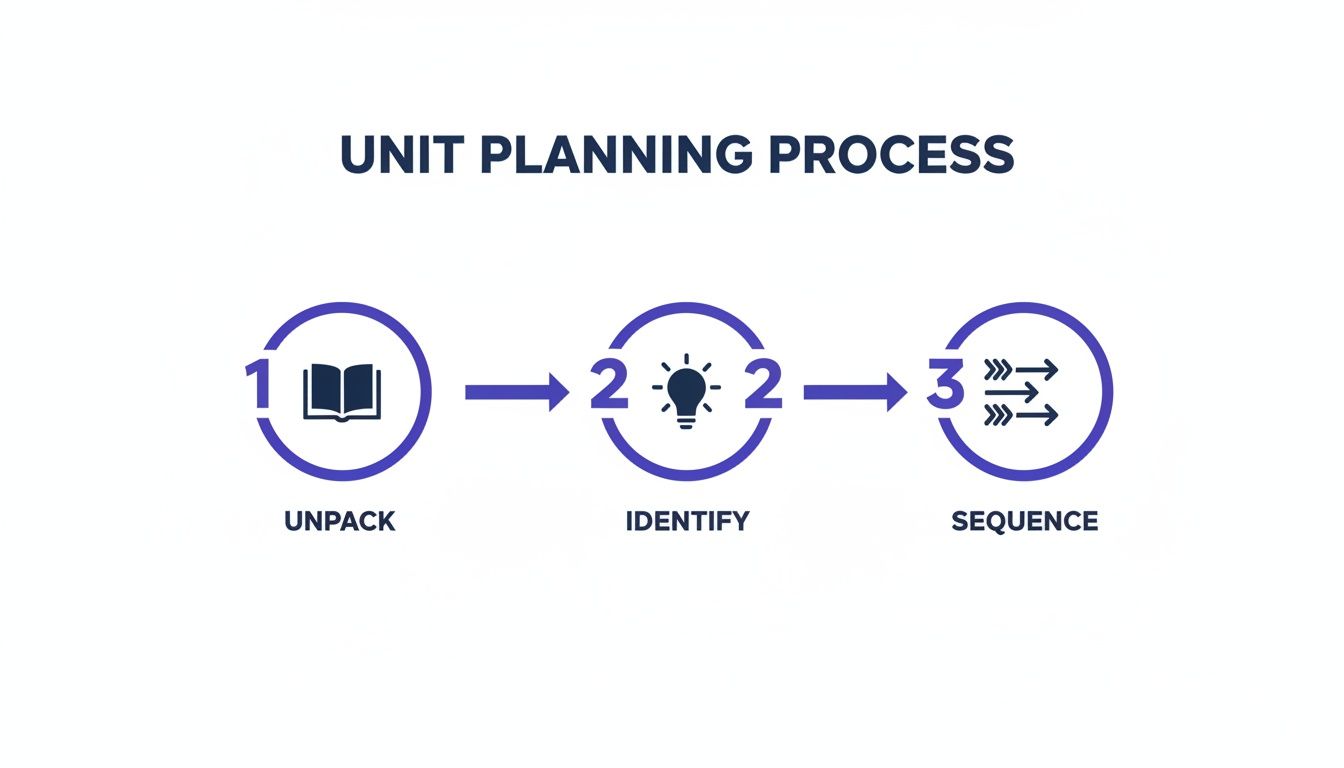
This process—unpacking standards, identifying clear goals, and then sequencing your lessons—is the foundation of any solid unit plan.
The Power of a Solid Lesson Structure
You don't need to reinvent the wheel every single day. What you need is a reliable lesson structure you can plug your content into. This saves so much mental energy and gives students a predictable, comfortable routine.
A simple, powerful structure might look like this:
- Warm-Up (5 mins): A quick review of a previous skill or a question to get them thinking about the day’s topic.
- Mini-Lesson (10-15 mins): This is your time for direct instruction. Keep it short, sweet, and to the point.
- Work Period (20-25 mins): Here’s where students get to practice. It’s the perfect spot for your tiered activities or flexible grouping.
- Closing (5 mins): Bring everyone back together for a quick share-out or an exit ticket to check for understanding.
Having a go-to framework like this changes the question from, "What on earth am I going to do tomorrow?" to "What content am I putting into my framework tomorrow?" It's a small shift in thinking that makes a massive difference to your workload.
Using an AI Assistant as Your Co-Planner
This is where an AI assistant like Kuraplan completely changes the game. Instead of spending hours creating three different versions of a worksheet or trying to come up with an engaging warm-up, you can get it all done in minutes.
The difference in time and mental load is night and day. Just look at the comparison:
Traditional vs AI-Powered Lesson Planning
| Planning Task | Traditional Method (Time/Effort) | With Kuraplan (Time/Effort) |
|---|---|---|
| Daily Lesson Plan | 30–60 minutes: Brainstorming, structuring, and aligning to standards from scratch. | <5 minutes: Generate a complete, standards-aligned plan with a prompt. |
| Differentiated Materials | 1-2 hours: Manually creating tiered worksheets, choice boards, or leveled readings. | <10 minutes: Instantly generate multiple versions of activities for different learners. |
| Assessments & Worksheets | 45-90 minutes: Writing questions, formatting, and creating answer keys. | <5 minutes: Create quizzes, exit tickets, and worksheets with one click. |
| Creative Hooks/Warm-Ups | 15-30 minutes: Searching online for fresh, engaging ideas. | <1 minute: Get dozens of relevant, creative ideas instantly. |
As you can see, the time savings add up fast, giving you back hours each week.
Think of AI as your super-efficient teaching assistant. It handles the tedious, time-consuming parts of planning, freeing you up to focus on the art of teaching—making connections and bringing the content to life for your students.
The AI doesn't just spit out a generic template. It can:
- Generate Differentiated Materials: Need those tiered worksheets or different ways to present information? Done.
- Brainstorm Creative Hooks: Get fresh ideas for warm-ups and activities that will actually grab your students' attention.
- Align to Standards Automatically: It ensures your daily lessons are always tied back to your unit goals and state standards without you having to manually cross-reference everything.
This approach turns a task that used to take hours into a quick process of review and refinement. You take the excellent foundation the AI provides and add your own magic—your unique teaching style and, most importantly, your knowledge of your students. It's the ultimate way for teachers to finally reclaim their time.
Creating Assessments Without the Formatting Headaches
You’ve just wrapped up a fantastic lesson. The kids were hooked, the energy was buzzing, and you can tell they got it. Now for the crucial next step: checking for understanding. But this is often where our precious planning time evaporates—somewhere between writing good questions and wrestling with a word processor.
We’ve all been there. What should be a quick 30-minute task of creating an exit ticket spirals into a two-hour ordeal. Aligning columns, getting the spacing just right, and making sure everything prints neatly on one page is a frustrating time-sink that pulls us away from the parts of our job that actually matter.
This isn't just a personal struggle; it’s happening against a backdrop of a global teacher shortage. Data shows a critical need for millions of teachers globally, with many positions in the U.S. being filled by under-certified staff or left vacant. This leads to bigger classes and fewer resources, making every single minute of planning time count. You can dig into the data on this pressing issue in this in-depth analysis from EdWeek.
Designing Assessments That Actually Measure Learning
Before we even think about fonts and spacing, we have to ask the most important question: what are we actually trying to measure? A great assessment isn't just about getting another grade in the book; it's about seeing what students truly know and where the gaps are.
The best assessments link directly back to your lesson's learning objectives. If your goal was for students to "analyze the author's tone," a multiple-choice quiz on vocabulary words just isn't going to tell you what you need to know.
Try using a mix of assessment types to get a clearer picture of student mastery:
- Formative Assessments: These are your quick, low-stakes checks during the learning process. Think exit tickets, a quick thumbs-up/thumbs-down, or a "pair and share."
- Summative Assessments: These measure what students learned at the end of a unit. This is your classic test, project, or essay.
Mixing it up gives you constant feedback, so you can adjust your teaching on the fly instead of waiting until the end of a unit to discover who was lost from day one.
The purpose of an assessment is not to ambush students, but to give them an opportunity to show what they know. When designed well, an assessment is a tool for learning, not just a measure of it.
That simple shift in mindset—from "catching kids out" to "letting kids show"—can change everything about how you design your assessments.
Escaping the Worksheet Formatting Trap
It’s 9 PM. You're fighting with Microsoft Word, trying to stop an image from blowing up your entire page layout. The amount of time we waste just on formatting worksheets and quizzes is unbelievable.
This is exactly where an AI tool can become a teacher's best friend. Platforms like Kuraplan are designed to get rid of this headache completely. Instead of building an assessment from scratch, you can take the lesson plan you already have and instantly turn it into a perfectly formatted, printable worksheet.
Imagine generating these in just a few seconds:
- Multiple-Choice Quizzes: Pulled directly from your lesson's key concepts.
- Fill-in-the-Blank Worksheets: Ideal for checking key terms and vocabulary.
- Matching Activities: A great way to review definitions or connect ideas.
- Open-Ended Questions: To prompt deeper, more critical thinking.
The AI handles all the numbering, spacing, and layout issues. What used to be a tedious, manual chore becomes a one-click action. This frees you up to focus on analyzing the results and figuring out what to teach next.
Making Your Materials More Engaging with Custom Visuals
Let's face it: a wall of text is boring for anyone, but it's especially uninspiring for students. Visuals like diagrams, charts, and illustrations are incredibly powerful for making complex ideas stick. But finding the right visual can send you down an internet rabbit hole for an hour.
This is another area where AI tools can make a huge difference. Many modern planning platforms, including Kuraplan, now come with AI-powered visual generation. You just type a description of the image you need, and the AI creates a custom, kid-friendly visual for your materials.
Need a simple diagram of the water cycle for your science worksheet? Or an illustration of a historical event for a social studies quiz? You can generate it in seconds, tailored perfectly to your lesson. This not only makes your assessments more engaging but also provides real support for your visual learners, turning a frustrating search into a quick, creative part of your workflow.
Using AI as Your 24/7 Planning Partner
Let's be honest: a perfect lesson plan is only half the battle. Classroom management, real-time problem-solving, and those completely unpredictable moments—that's the other half of teaching.
Even with the most detailed unit map, things happen. A student asks a brilliant, completely off-topic question that you have to answer. An activity that was a huge hit last year falls flat with this group. You suddenly realize you need a better way to explain a tough concept, and you need it now.
These are the moments that define our teaching, but they can also be incredibly draining. We’re constantly making high-stakes instructional decisions on the fly. What if you had an experienced instructional coach you could tap into anytime?
An AI Assistant as Your Instructional Coach
This is where a modern AI teaching assistant really shines. Think of it less as a content factory and more as your personal, on-demand thought partner. It’s that "colleague" you can turn to at 10 PM when you have a burst of inspiration or a moment of panic about tomorrow's lesson.
An AI tool like the one built into Kuraplan is specifically designed to understand the daily grind of teaching. You can ask it for instant, practical suggestions tailored to exactly what you need in that moment.
For example, you could ask:
- "Give me three creative warm-up activities for an 8th-grade history lesson on the Silk Road."
- "My students are so bored with our vocabulary review. Suggest a game we can play to make it more engaging."
- "What's a simple analogy to explain photosynthesis to 4th graders?"
In seconds, you get actionable ideas you can use right away. No more endless scrolling through teacher blogs to find a solution.
Think of your AI assistant as a mentor in your pocket. It offers reassurance, clear direction, and practical tools that work in real classrooms, supporting you from day one.
This kind of immediate support makes a huge difference in feeling more confident and less isolated. It’s like having a team of veteran educators ready to brainstorm whenever you need them. For more ideas on using this technology, check out our guide on how to use AI to do lesson planning for teachers.
Solving Problems Beyond the Lesson Plan
A 24/7 planning partner can help with so much more than just instructional content. The challenges we face are all over the map, and an AI assistant can provide support across the board.
Think about these common classroom headaches:
- Managing Classroom Dynamics: You could ask for strategies to help two students collaborate better or for ideas to quiet a chatty class during transitions.
- Parent Communication: Stuck on how to phrase a sensitive email to a parent? The AI can help you draft a professional, empathetic message that gets your point across clearly.
- Adapting on the Fly: If a lesson is moving faster than you planned, you can quickly ask for an extension activity to challenge your early finishers.
This isn't about replacing your professional judgment; it's about boosting it. The AI provides the spark or the framework, and you—the expert in your classroom—decide how to best use it.
Exploring a range of educational technology tools for teachers can open up even more ways to streamline your workflow. The goal is always the same: finding support that lets you focus your energy on the students in front of you. This new wave of tech helps make a demanding job more manageable and, ultimately, more sustainable.
A Few Common Questions About Modern Planning
Jumping into new tools always brings up questions. As teachers, we're hardwired to be cautious—we have to be sure any new strategy will actually help our students, not just pile more work onto our already full plates. Let's walk through some of the most common questions that come up when we talk about modern planning tools.
My goal here is to give you clear, honest answers. I want you to feel confident and ready to build a smarter planning process that gives you back your weekends.
How Can An AI Tool Really Understand My Specific Classroom Needs?
This is the big one, isn't it? The best AI tools for educators, like Kuraplan, aren't just spitting out generic text. They're built on a foundation of curriculum standards, proven teaching methods, and pedagogical frameworks.
When you tell it your grade, subject, and topic, the AI uses those frameworks to generate content that’s already aligned with what you need to teach. But the real magic happens next. You can add specific details—like your students' current skill levels, their interests, or the limited resources you have in your classroom. The AI then refines everything based on your unique context.
It’s not here to replace your expertise; it’s here to give you a solid, standards-aligned starting point so you don't have to build everything from the ground up. You’re always the expert in the room.
I'm Not Very Tech-Savvy. Are These AI Planning Tools Hard To Use?
Honestly? Not at all. Platforms like Kuraplan are designed for busy teachers, not software engineers. The whole experience is built to feel intuitive and simple.
Most of the time, it's as easy as typing what you need in plain English. For example:
- "Create a 4th-grade lesson on ecosystems."
- "Generate a hands-on activity for learning fractions."
- "Make a vocabulary worksheet for The Great Gatsby."
The system handles all the complex stuff behind the scenes. Most teachers I know are able to create their first full lesson plan or worksheet in just a few minutes. The goal of this tech is to lighten your load, not add another complicated program to learn.
An AI tool should feel like a helpful colleague, not a complicated piece of software you have to master. Its purpose is to simplify your workload so you can focus on the human side of teaching.
Will Using AI Make My Lessons Feel Generic and Cookie-Cutter?
This is a totally valid fear, but I’ve found the reality is the exact opposite. Think of AI as your personal brainstorming partner. It takes on the most tedious parts of planning—like hunting down standards, structuring the lesson, and formatting worksheets.
That process frees up your mental energy. Instead of getting bogged down in the mechanics, you can focus on what you do best:
- Adding your personality: Weave your unique teaching style and humor into the lesson.
- Customizing activities: Tweak the AI-generated ideas to perfectly match what gets your students excited.
- Leading great discussions: Spend more time thinking about the thought-provoking questions you’ll ask.
You're using the AI's output as a strong foundation to build on. It actually helps you be more creative and personal, not less.
Ready to stop the late-night planning grind and get your time back? Kuraplan is the all-in-one AI planning partner designed by educators, for educators. Create standards-aligned lessons, differentiate materials, and generate assessments in minutes, not hours. Join over 30,000 teachers who are working smarter, not harder.