
Improving your school culture is all about intentionally shaping the daily experiences of everyone in the building—students and staff alike. It’s about building an environment on a foundation of trust, shared purpose, and psychological safety, where people genuinely feel seen, valued, and connected.
Defining the Real Culture of Your School
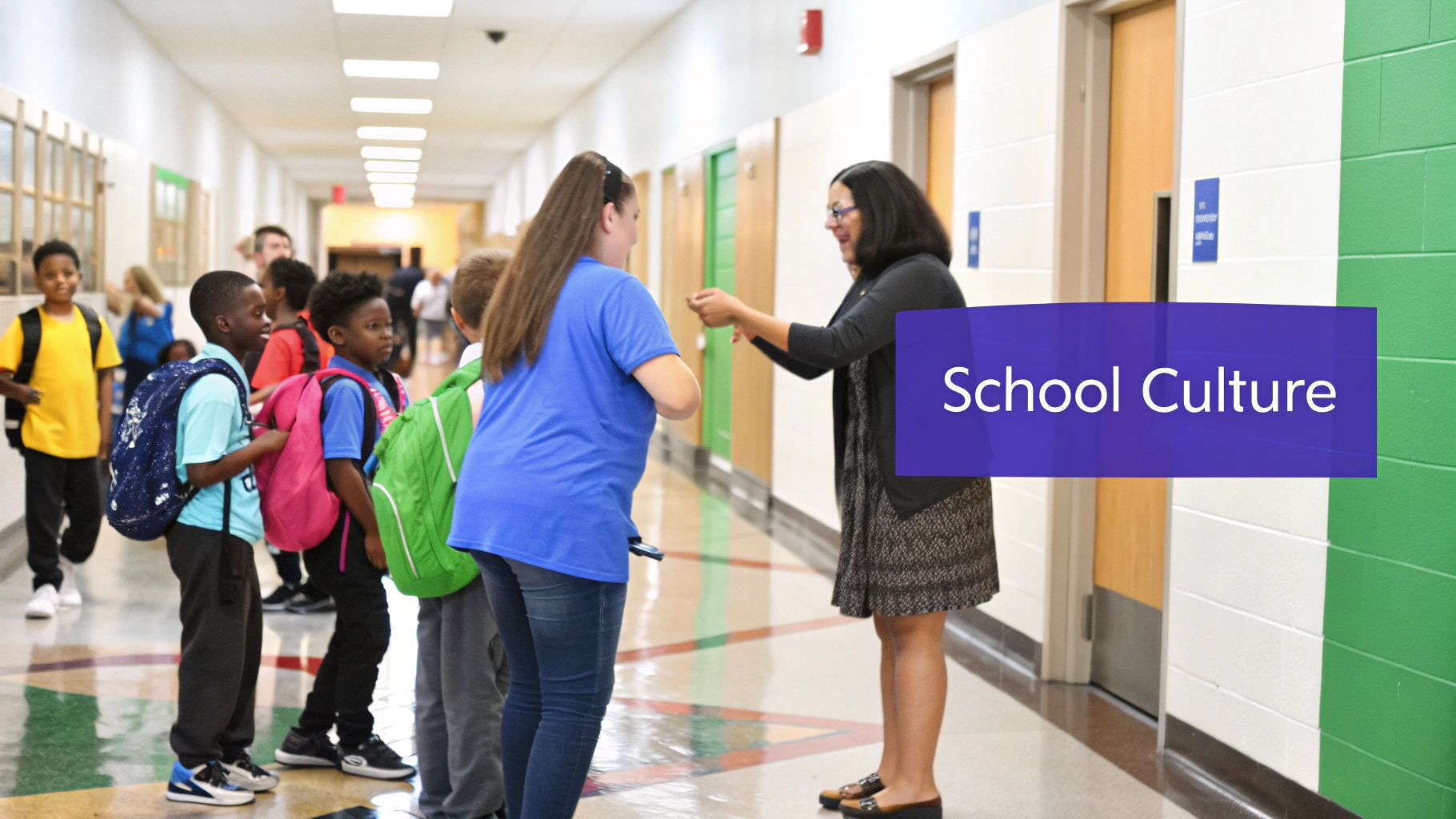
Forget the mission statement hanging in the lobby for a moment. What does your school actually feel like in the hallways between classes? What's the vibe during a tense staff meeting or in the cafeteria at lunchtime? That's your real culture.
School culture isn’t a document; it’s the living, breathing ecosystem of shared values, beliefs, and behaviours that define your school. It’s simply "the way we do things around here." It shows up in how adults speak to students (and to each other) and whether collaboration feels authentic or just another forced initiative.
A positive culture has a ripple effect on everything from academic outcomes to teacher retention. When the foundation is strong, students feel safe, engaged, and motivated to learn. But when it's fractured, you see the fallout: behaviour incidents tick up, disengagement spreads, and a general sense of apathy can exhaust even the most dedicated educators.
Moving Beyond Buzzwords
To actually improve your school culture, you need an honest baseline of where you stand right now. It's about looking past the buzzwords and assessing the tangible signs of your school's health. Think of it like a "culture audit"—not for judgment, but for clarity.
This isn’t just a nice-to-have; creating positive workplace culture is a core leadership strategy that influences everything from daily interactions to long-term success. The same principles absolutely apply in a school setting.
So, let's get real. Ask yourself and your colleagues these questions to get a true sense of your starting point.
Key Insight: Your school's culture is the invisible force shaping every interaction. It’s less about the values you hang on the wall and more about what your daily actions prove you value.
Your Quick Culture Audit Checklist
Take a moment for an honest reflection on your school's environment. This simple checklist can help you pinpoint strengths and, more importantly, identify those areas ripe for growth.
- Trust and Safety: Do staff and students feel safe to take risks, ask for help, or admit mistakes without fear of blame?
- Relationships: Are relationships—among staff and between staff and students—generally positive, respectful, and supportive? Or are they strained and transactional?
- Shared Purpose: Does everyone, from the principal to the newest teacher to the students, truly understand and feel connected to the school's mission?
- Collaboration: Is working together authentic and productive, or does it feel like just another box to check on the to-do list?
- Recognition: Do you celebrate effort and growth, or is the focus solely on final outcomes and test scores?
Getting a clear, honest picture of where you are is the most crucial first step. It gives you the map you need to build a meaningful plan for where you want to go.
Cultivating Leadership That Inspires Trust

A positive school culture is driven from the top, but it’s truly built from the ground up. This all starts when administrators shift from being managers of systems to becoming genuine cultural leaders. It’s less about enforcing rules and much more about modelling the very behaviours you want to see in your hallways.
Think about it: vulnerability, active listening, and celebrating effort over just outcomes. These aren't just buzzwords; they're the actions that build real trust. When leaders demonstrate these qualities, it gives everyone else permission to do the same, creating a foundation of psychological safety.
Be Visible and Approachable
The most powerful leadership doesn't happen behind a closed office door. When you make a conscious effort to be present—in classrooms, hallways, and common areas—it sends a clear message: "I'm with you." It’s about being a participant in the school community, not just an observer from afar.
This simple act of being visible makes you more approachable and helps build authentic relationships. It also gives you a ground-level view of the daily realities your staff and students face, which is absolutely essential for making informed, empathetic decisions.
Key Takeaway: True cultural leadership is about presence, not just policy. Your visibility and willingness to listen build more trust than any top-down directive ever could.
This focus on people over paperwork is a huge driver of school improvement. In 2023, Global School Leaders partnered with 10 organisations to train 4,271 school leaders, an initiative that reached over a million students. This work proved that strengthening leadership is one of the most cost-effective ways to improve school culture and learning outcomes. You can explore the full impact of their work in the annual report.
Empower Teachers Instead of Micromanaging
One of the quickest ways to kill trust is to micromanage dedicated professionals. Empowering teachers means giving them the autonomy to make instructional decisions, trusting their expertise, and providing the resources they need to succeed.
When leaders shift their time from compliance checks to coaching conversations, the entire school benefits. A huge part of this is fostering genuine trust among your staff. If you're looking to go deeper, check out these excellent strategies for building trust in the workplace.
Here are a few practical ways you can start empowering your team:
- Protect Planning Time: Fiercely guard teachers' collaborative and individual planning periods. It's sacred.
- Encourage Innovation: Create space for teachers to experiment with new strategies without the fear of failure hanging over their heads.
- Ask for Input: Genuinely involve teachers in school-wide decisions that will actually affect their classrooms.
This is where smart tools can make a real difference. Using a platform like Kuraplan to streamline administrative tasks—like curriculum reviews and lesson planning—frees up invaluable time. That reclaimed time allows you to focus on the human side of leadership: coaching, listening, and building the relationships that truly define a thriving school culture. For those looking to grow their leadership skills, check out our insights on empowering tomorrow's leaders.
Nurturing the Whole Child Beyond Test Scores
When a school’s culture gets laser-focused on standardized test data, it's easy to fall into a trap: treating students like numbers on a spreadsheet. A genuinely positive school culture—the kind that actually moves the needle—looks beyond the data points to see and support the whole child. This means weaving Social-Emotional Learning (SEL) into the very fabric of the school day.
This isn’t about shoehorning another 30-minute lesson into an already bursting schedule. It's about embedding it into everything we do. It’s championing a growth mindset during a tough math problem, teaching resilience after a disappointing project grade, and creating classrooms where students feel safe enough to be themselves, quirks and all.
Integrating SEL into Daily Instruction
The best way I’ve seen this work is by making SEL a natural part of academic instruction. When students feel emotionally secure and understood, they are far more willing to take intellectual risks. This fusion of academic and emotional support is where the real magic happens.
Consider these small but powerful shifts:
- Morning Check-ins: Start the day with a simple "rose, bud, thorn" activity to get a quick pulse on how students are really feeling.
- "Mistake Meetings": Normalize errors by occasionally sharing your own mistakes and what you learned from them. This builds a classroom where mistakes are seen as opportunities for growth, not failures to be ashamed of.
- Reflective Journaling: End a lesson by having students jot down not just what they learned, but how they felt about the challenge.
These practices don't demand a huge time investment, but they pay massive dividends in building a community where every student feels seen and valued. For more practical ideas, check out this great list of social-emotional learning activities you can integrate right away.
Research consistently shows that schools prioritizing both academic and social-emotional growth see far better long-term student outcomes. It’s not a choice between rigor and well-being; it's about recognizing they are deeply intertwined.
This isn’t just a hunch; it's backed by solid evidence. A 2023 UChicago Consortium study revealed that high schools promoting growth in socioemotional development, behaviors, and test scores have up to double the positive long-term impact on students compared to those focusing only on academics. These "effective schools" nurture social well-being, academic effort, and attendance right alongside math and ELA scores, proving how vital a holistic approach is. You can discover more insights from this study on their website.
This table really highlights the difference between a school that nurtures the whole child versus one that's narrowly focused on test prep. The contrast in approach, actions, and especially outcomes is stark.
Holistic vs. Test-Focused School Culture
| Focus Area | Holistic Culture Approach | Test-Focused Culture Approach |
|---|---|---|
| Primary Goal | Develop well-rounded individuals who are academically competent, emotionally intelligent, and socially responsible. | Maximize standardized test scores and achieve high performance rankings. |
| Teacher Actions | Integrate SEL into lessons, build strong relationships, differentiate instruction, and celebrate effort and growth. | Focus on test-taking strategies, drill-and-practice, teach to the test, and prioritize students near the proficiency bubble. |
| Student Outcome | Increased engagement, stronger sense of belonging, greater resilience, improved critical thinking, and intrinsic motivation. | High test scores (potentially), but also higher anxiety, burnout, a fear of failure, and superficial learning. |
Seeing it laid out like this, it’s clear that a holistic culture invests in long-term success, while a test-focused approach often trades genuine learning for short-term gains.
Using Tools to Support Every Learner
A huge part of supporting the whole child is reducing the anxiety that comes with academic struggle. When students feel overwhelmed or left behind, their emotional well-being suffers, and so does their learning. This is where having the right tools becomes essential for improving school culture.
For instance, platforms like Kuraplan can be a teacher's best friend in this effort. It helps educators quickly adapt lessons and create differentiated materials, like visual aids for complex topics or simplified worksheets for students who need extra support. This level of personalization helps build the confidence that is essential for both academic and personal growth, ensuring every child feels capable of success.
Empowering Teachers with Real Support and Collaboration
A school’s culture lives and dies with its teachers. When educators feel isolated, overworked, and unheard, that exhaustion inevitably spills into their classrooms and impacts students. Building a positive school culture isn't about adding another pizza party to the calendar; it’s about intentionally creating a system that nurtures the professionals in your building.
This means creating genuine opportunities for meaningful collaboration and aggressively protecting teachers from the burnout that plagues our profession. When teachers have the time and mental space to connect with colleagues and refine their craft, everyone wins.
From Forced Meetings to Authentic Collaboration
We’ve all been in those meetings that could have been an email. True collaboration isn't about filling an hour on the schedule; it’s about solving problems together. The goal is to shift from top-down directives to peer-led growth.
This is where structures like Professional Learning Communities (PLCs) can shine—but only if they're implemented correctly. They need to be safe spaces where teachers can be vulnerable, share what’s not working, and get real feedback, not just turn in data sheets.
Key Insight: The best professional development doesn’t come from an outside expert. It comes from the teacher next door who just figured out a brilliant way to teach a tough concept.
This shift from isolated teaching to a collaborative, whole-child approach is a massive undertaking, as the model of education itself continues to evolve.
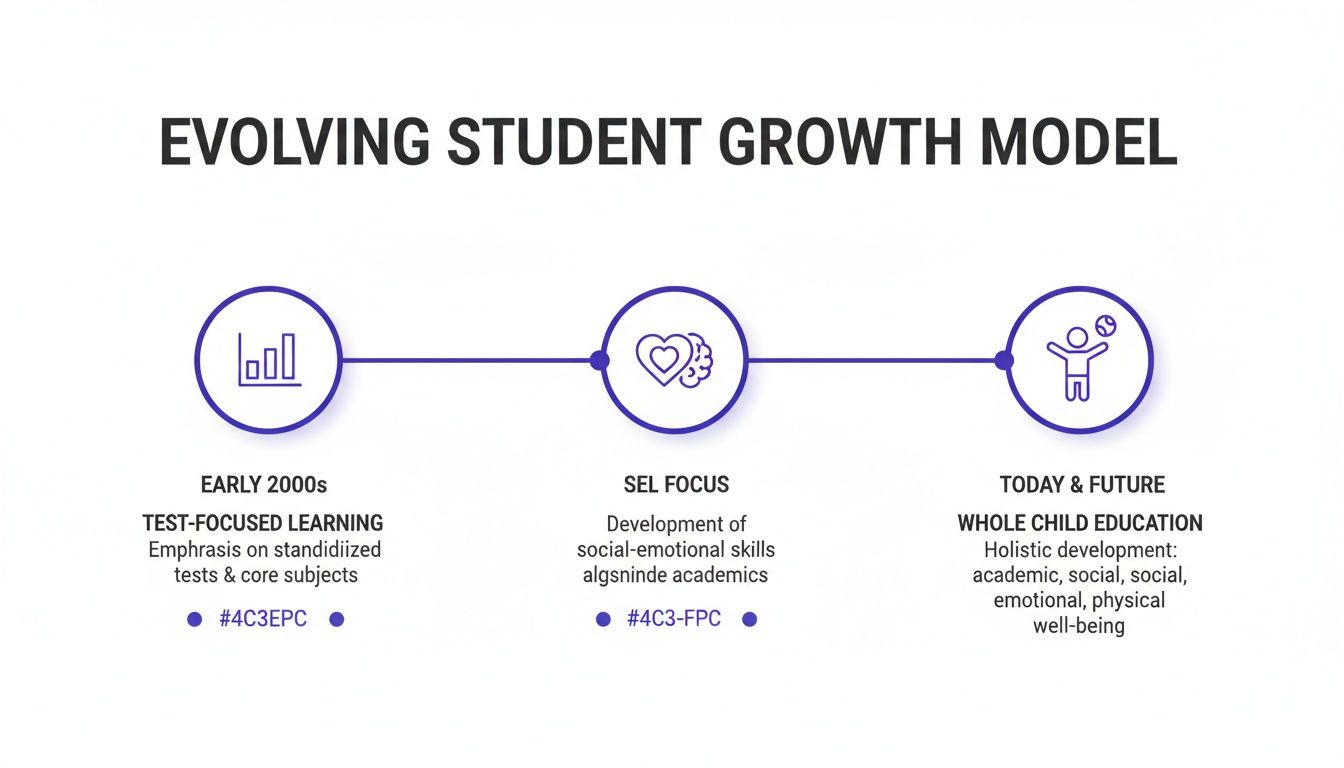
As you can see, supporting the whole child is a complex task that no single teacher can accomplish alone. It absolutely requires deep, authentic collaboration.
Tackling Teacher Burnout Head-On
Protecting teachers' time is one of the most powerful levers leaders have for improving school culture. When educators are drowning in administrative tasks and lesson planning, they have nothing left to give. The constant pressure to do more with less is a significant driver of teacher burnout, a topic we explore more deeply in our guide on finding real solutions to teacher burnout.
Here are a few non-negotiable strategies to give teachers back their time:
- Guard Planning Time: Treat individual and collaborative planning periods as sacred. Interruptions should be extremely rare and genuinely urgent.
- Cut Administrative Creep: Regularly audit all required paperwork, meetings, and duties. If it doesn't directly support student learning, question whether it’s truly necessary.
- Provide Better Tools: Equip your team with resources that actually reduce their workload, rather than adding another thing to their plate.
Modern AI tools can be a game-changer here. Using a platform like Kuraplan, teachers can generate high-quality, standards-aligned lesson plans, rubrics, and learning materials in minutes, not hours.
Imagine reclaiming even 3 to 5 hours a week. That’s time that can be poured back into what truly matters: collaborating with colleagues on a new unit, giving one-on-one feedback to a struggling student, or simply recharging. When you reduce the burden, you create the capacity for a positive culture to flourish.
Building Authentic Partnerships with Families
A strong school culture doesn't stop at the school gates; it extends right into every family's living room. If we're serious about improving school culture, we have to move beyond the standard monthly newsletter and the occasional parent-teacher night. It’s all about building genuine partnerships based on consistent, two-way communication.
When families feel like they are truly heard and valued partners in their child's education, their trust in the school skyrockets. This creates a powerful alliance that directly benefits students, making them feel supported both at home and in the classroom.
Moving Beyond One-Way Communication
For too long, the default mode of school-to-home communication has been a one-way street: the school sends info out, and parents receive it. End of story. But an authentic partnership is a dialogue. It's about opening up channels where parents can easily share insights, ask questions, and feel like their voice actually matters.
This doesn't have to be some massive, complicated new initiative. It could be as simple as using a messaging app that allows for quick questions or sending short, personalised "good news" notes home. The goal is to make communication frequent, accessible, and reciprocal.
Key Takeaway: Stop broadcasting information at families and start having conversations with them. Small, consistent efforts to create a two-way dialogue build more trust than a dozen glossy newsletters ever could.
This partnership is also a critical tool for navigating student challenges. Pearson’s 2023 School Report found that 27% of schools increased parent collaborations specifically to tackle pupil issues. While this number is down from previous years, it highlights that amid rising behavioural concerns, this parent-teacher alliance is more important than ever. You can read the full research about these findings on their website.
Making a Partnership Practical
Let’s be real: families are busy. Asking them to volunteer for a full day or attend meetings during work hours just isn't feasible for most. The key is to offer flexible and inclusive opportunities for them to engage that respect their time.
Here are a few ideas to get you started:
- "Five-Minute Volunteer" Roles: Create a list of small tasks parents can do from home, like cutting out materials for a project or helping proofread a class announcement.
- Virtual "Coffee with the Principal": Host informal Q&A sessions online at different times of the day to accommodate various work schedules.
- Family Learning Nights: Instead of a simple performance, host interactive events where families learn a new maths game or a reading strategy right alongside their child.
These kinds of approaches show parents you value their time while still giving them meaningful ways to connect with the school community.
Technology can be a huge ally here. For instance, a teacher using Kuraplan can generate a clear, visual worksheet for a science concept and share it directly with parents. This simple act gives them a window into the classroom, showing them exactly what their child is learning and how they can offer support at home. That level of transparency is incredibly powerful for building a true team-based approach to education.
Common Questions About Improving School Culture
Whenever we start talking about shifting school culture, a lot of the same questions pop up. It makes sense—as educators, we're wired to look ahead, anticipate hurdles, and get a clear picture of the road ahead. Here are some honest, straight-from-experience answers to the questions we hear most often.
How Long Does This Realistically Take?
Let's get real about the timeline. You can absolutely start seeing and feeling small, positive shifts within a few months. This could be more smiles in the hallway, more authentic collaboration in PLCs, or just a lighter, more energetic buzz in the staff lounge. These early wins are so important for morale and momentum.
But deep, lasting culture change? That's a marathon, not a sprint. To really get to a place where positive, supportive practices are just "how we do things here," you're looking at 2-3 years of focused, consistent work. The trick is to celebrate the small victories along the way and not get discouraged when things don't change overnight. Consistency beats intensity every single time.
The Biggest Mistake Schools Make
The most common trap is focusing on the superficial stuff instead of the systemic issues. A "jeans day" or a one-off pizza party is a nice gesture, but it’s not going to fix a deep-seated culture of burnout, distrust, or isolation. Real improvement means digging in and addressing the root causes.
Key Insight: Lasting change requires fixing the systems, not just treating the symptoms. A single event doesn't build culture; consistent, supportive daily practices do.
This looks like fiercely protecting teacher planning time, offering professional development that actually feels relevant and useful, and creating communication channels that are genuinely two-way. Another huge pitfall is a purely top-down approach. If staff don't have a voice and a real sense of ownership, the change will never stick.
How to Measure Real Improvement
You can't just rely on numbers or just on feelings—you need both to see the full picture.
On the data side of things, keep an eye on key metrics:
- Teacher retention rates: Are your best people choosing to stay year after year?
- Student attendance: Do kids actually want to be at school?
- Disciplinary referrals: Are you seeing a steady decrease in behaviour issues?
But data only tells part of the story. You also have to listen. Use simple, anonymous climate surveys for staff, students, and families to get honest feedback. Ask direct questions about belonging, safety, and support.
And finally, never underestimate the power of a simple "vibe check." Pay attention during informal moments. Are teachers laughing together in the workroom? Are students taking more academic risks in class? When you combine these real-life observations with the hard data, you'll know for sure if you're on the right track.
Ready to reclaim your planning time and build a more supportive environment for your team? Kuraplan empowers teachers by generating high-quality lesson plans, differentiated materials, and assessments in minutes. See how thousands of educators are reducing burnout and focusing more on their students. Start planning smarter today.