To teach reading fluency well, we have to zero in on three things: accuracy (reading the words right), rate (reading at a good pace), and prosody (reading with expression). When these three work together, they build that crucial bridge from just saying words to actually understanding what they mean.
What Reading Fluency Actually Looks and Sounds Like
Let's be real. We’ve all seen it in our classrooms.
There's the student who can painstakingly sound out every single word, but when they finish the page, has absolutely no idea what they just read. Then there's the speed-reader, the one who barrels through a paragraph so fast that comprehension gets left in the dust.
That’s not fluency.
Real fluency is something else entirely. It’s when a student reads with the same natural ease and expression they use when they talk. It’s that magical moment when decoding becomes so automatic that their brain is finally free to do the important work—thinking, wondering, and making connections with the text. That’s the goal.
The Three Pillars of Reading Fluency
To really get a grip on teaching fluency, we need to break it down into its three core parts. I think of them as the legs of a stool; if one is shorter than the others, the whole thing gets wobbly.
These pillars are accuracy, rate, and prosody.
Here's a quick look at what each one brings to the table and why it's so important in the classroom.
The Three Pillars of Reading Fluency
| Component | What It Is | What It Sounds Like | Why It Matters |
|---|---|---|---|
| Accuracy | Reading words correctly, the first time. | The student reads "house" instead of "horse." | The foundation. If words are misread, meaning is lost. |
| Rate | Reading at a natural, conversational speed. | Not too fast, not too slow. The pace doesn't trip up their understanding. | Too slow, and they forget the beginning of a sentence. Too fast, and they skip over key details. |
| Prosody | Reading with expression, rhythm, and phrasing. | Pausing at commas, raising their voice for a question, adding emphasis to important words. | This is the "secret sauce" that shows they're not just reading words—they're understanding the meaning behind them. |
When these three components come together, reading transforms.
Think about the difference between a student robotically reading, "The... dog... ran... fast," and another who reads, "The dog ran fast!" with a burst of energy. That little shift is where real comprehension ignites.
When students nail this, their mental energy is no longer tied up in the mechanics of sounding out words. Instead, it’s freed up for all the higher-level thinking we want to see. This is exactly why fluency is a non-negotiable for success in school and beyond.
Why Fluency Matters Now More Than Ever
The push for strong fluency instruction isn’t just good practice; it's urgent. The latest data on literacy paints a sobering picture and shows just how much our students need targeted support.
For instance, the NAEP Long-Term Trend assessment in 2023 found a 4-point drop in average reading scores for 13-year-olds compared to 2020. The declines were even sharper for students who were already struggling.
But we know what works. Solid, evidence-based instruction like modeled reading and echo reading is proven to move the needle. In fact, studies show these simple methods can boost fluency by as much as 25% in just eight weeks. You can dig into the numbers yourself by reading the full NAEP report on literacy trends.
Truly understanding what fluency is—that seamless blend of accuracy, rate, and expression—is the first, most important step. Once you know what to look and listen for, you're ready to start building it in your students.
Assessing Fluency Without The Stress
Before we can teach fluency, we have to know where our students are starting. But let's be honest, the term "fluency assessment" can sound intimidating—for us and our kids. My whole approach is about taking the stress out of it.
Think of it less like a formal test and more like a quick, one-on-one reading conference. I always find a quiet corner or my kidney table, away from the classroom buzz. The goal isn't to make anyone nervous; it's to get a real, authentic snapshot of their reading.
Getting a Baseline with WCPM
The classic starting point is measuring Words Correct Per Minute (WCPM). It’s a simple, effective way to get a baseline number for a student's reading speed and accuracy.
Here’s how I run a quick one-minute read:
- Choose the Right Text: Grab an unpracticed, grade-level passage. Make sure it’s long enough that the student won’t finish it in a minute. This used to take me ages, but now I use tools like Kuraplan to instantly generate leveled passages. It's a huge time-saver.
- Give Clear Instructions: I keep it simple and friendly. "I'm going to ask you to read this story out loud for one minute. Just do your best reading. If you get stuck, I'll help you out. Ready?"
- Time and Track: I start a 60-second timer and follow along on my own copy, marking any errors—words they skip, substitute, or hesitate on for more than three seconds.
- Calculate the Score: When the timer goes off, I put a bracket after the last word they read. The WCPM is just the total words read minus the errors.
This number gives you a solid piece of data right away. Is a student way below the benchmark for their grade? That’s a big clue about their automaticity.
Research consistently shows a strong link between WCPM and overall comprehension. For instance, UK assessments revealed a clear correlation (r=0.68) between oral reading fluency and reading comprehension scores. The readers in the lowest quartile were falling significantly behind by the end of primary school. Discover more insights on the connection between fluency and comprehension.
Looking Beyond the Numbers
But WCPM is just one piece of the puzzle. The real gold is in what you hear during that one-minute read. As you’re listening, ask yourself a few questions:
- What kind of errors are they making? Are they tripping over multi-syllable words? Are specific vowel teams or blends the culprit? This tells you exactly where you might need to circle back to foundational skills. For more on this, our guide on Mastering Phoneme Segmentation can be a great help.
- How’s their prosody? Are they reading like a robot, one word at a time? Or do they naturally pause at commas and periods? A lack of expression is often a dead giveaway that a student isn't really connecting with the meaning of the text.
- Are they self-correcting? Do they catch their own mistakes and go back to fix them? This is a fantastic sign that a student is actively thinking about what they're reading and whether it makes sense.
This qualitative data is where your best teaching insights come from. A low WCPM score tells you a student is slow, but listening closely tells you why. Is it a decoding problem? A pacing issue? Or maybe just a lack of confidence?
Each of those requires a completely different instructional path. When you combine the hard data from WCPM with your own expert observations, you get the full picture. That’s how you tailor your fluency instruction to what each student truly needs.
Your Daily 15 Minute Fluency Workout
Fluency isn’t built overnight. It’s the result of consistent, focused practice—small habits that add up to big gains. The good news? You don’t need a massive chunk of your day. A dedicated 15-minute "fluency workout" each day can make a world of difference.
This daily routine makes fluency practice a predictable and engaging part of your literacy block. It’s not just about reading more; it's about reading smarter. Think of it as a warm-up, getting students’ reading muscles ready for the heavier lifting of complex texts.
Designing Your 15 Minute Routine
The key to a successful fluency workout is a mix of structure and variety. You want high-impact activities that are easy to explain and run. I find it helps to stick to the same routine for a few weeks to build student confidence before switching things up to keep it fresh.
Here's a sample structure that works wonders in my classroom:
- Minute 1–2 Warm Up (Choral Reading): Start with the whole class. Project a short, familiar poem or a paragraph from a text you've already read. Reading it aloud together gets everyone’s voice warmed up and builds a great sense of community.
- Minute 3–7 Modeled and Echo Reading: Next, introduce the day's "workout text"—a short, grade-level passage. Read one sentence with great expression, then have the students echo it back, mimicking your prosody. This is where you directly model what fluent reading sounds like.
- Minute 8–13 Partner Practice (Repeated Readings): This is the core of the workout. Students pair up to practice the same short passage multiple times. The goal isn’t to finish first, but to make each reading smoother and more expressive.
This simple flow from whole-group to partner work provides a natural scaffold that supports all learners.
Making Partner Reading Work
Let's be real: partner reading can turn into chaos if it’s not managed well. I've been there. The secret is setting crystal-clear expectations from the get-go.
I use a simple "Coach and Player" model. One student is the "Player" (the reader), and the other is the "Coach" (the listener). The coach's job is to listen for smooth reading and offer one specific piece of positive feedback, like, "I liked how you made your voice sound like the character." Then they switch. This gives every student a purpose and keeps them on task.
Tracking progress from these daily workouts is essential. The process is straightforward, as you can see below.
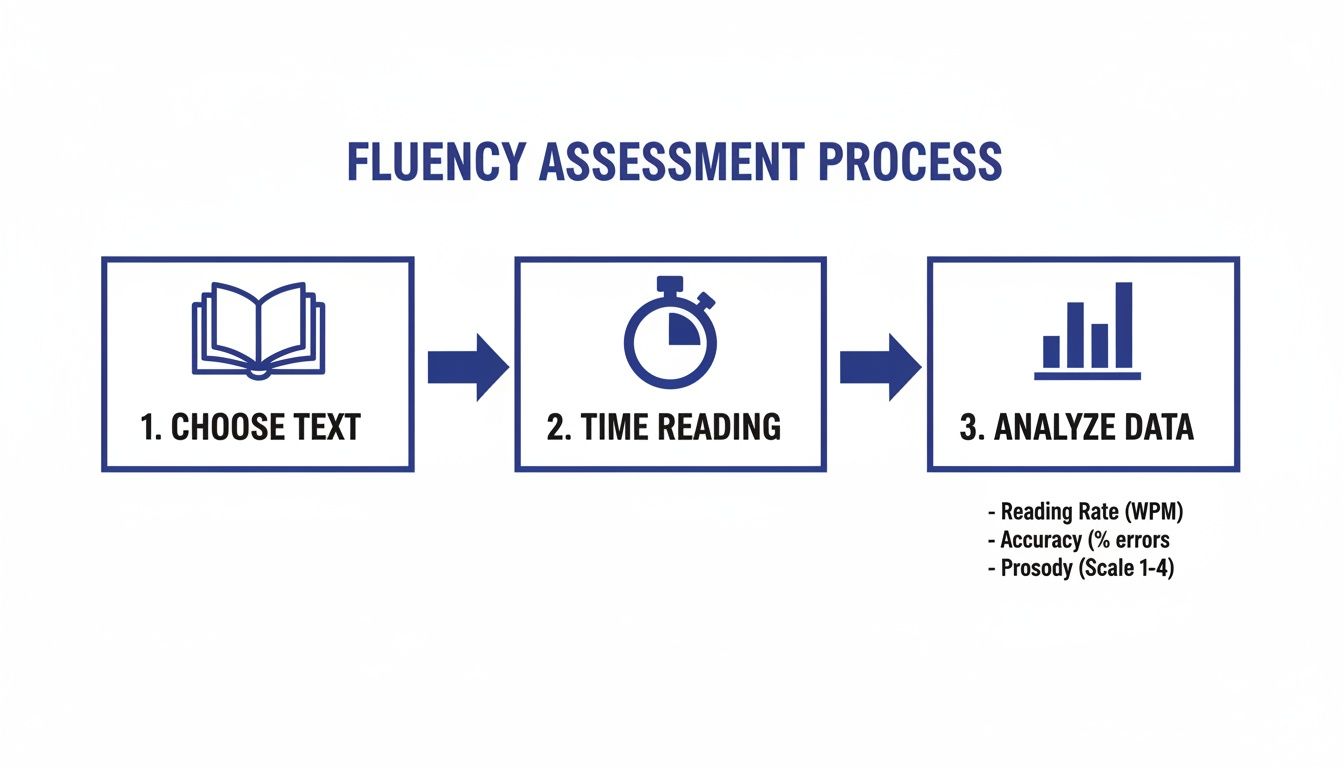
This really just boils down to choosing the right text, timing the read, and then looking at the data to figure out what to do next.
The Power of Repeated Readings
The most critical part of this workout is repeated reading. Why does it work so well? The first time a student reads a passage, their brain is focused on just getting the words right. By the second or third read, they’ve worked out the tricky spots.
This frees up mental energy to focus on the real skills of fluency: pacing, phrasing, and expression. They start to read the text not as a string of words, but as a meaningful message.
Research has shown time and again that rereading is a powerful driver of fluency. I’ve found that having students read a short passage three times is the sweet spot for seeing real improvement.
Finding the right texts for these daily drills can be a chore. You need short, engaging passages at just the right level. This is where AI tools can be a lifesaver. I often use Kuraplan to generate illustrated, decodable passages in seconds, which keeps my content fresh and my prep time way down. You can find more ideas on foundational skills in our guide on Building Phonemic Awareness.
For a creative way to generate new reading material, learning about YouTube to text transcription can help you quickly turn engaging videos into practice passages.
By committing to this daily 15-minute routine, you create a consistent space for students to practice, build confidence, and grow into the fluent, comprehending readers we know they can be.
Taking Fluency Beyond The Timed Reading
Alright, your students are getting the hang of the daily fluency workouts. Now it’s time for the fun part—where we move the focus from the stopwatch to the stage. This is where fluency practice starts to feel like play.
Performance-based strategies are a game-changer. Why? Because they put the spotlight squarely on prosody—the rhythm, expression, and emotion that bring words to life. This is how we push students beyond simply reading words correctly and quickly, getting them to think about how those words should sound to an audience.
This simple shift doesn't just build stronger readers; it builds incredible confidence and makes reading a genuinely joyful act.
The Magic of Reader’s Theater
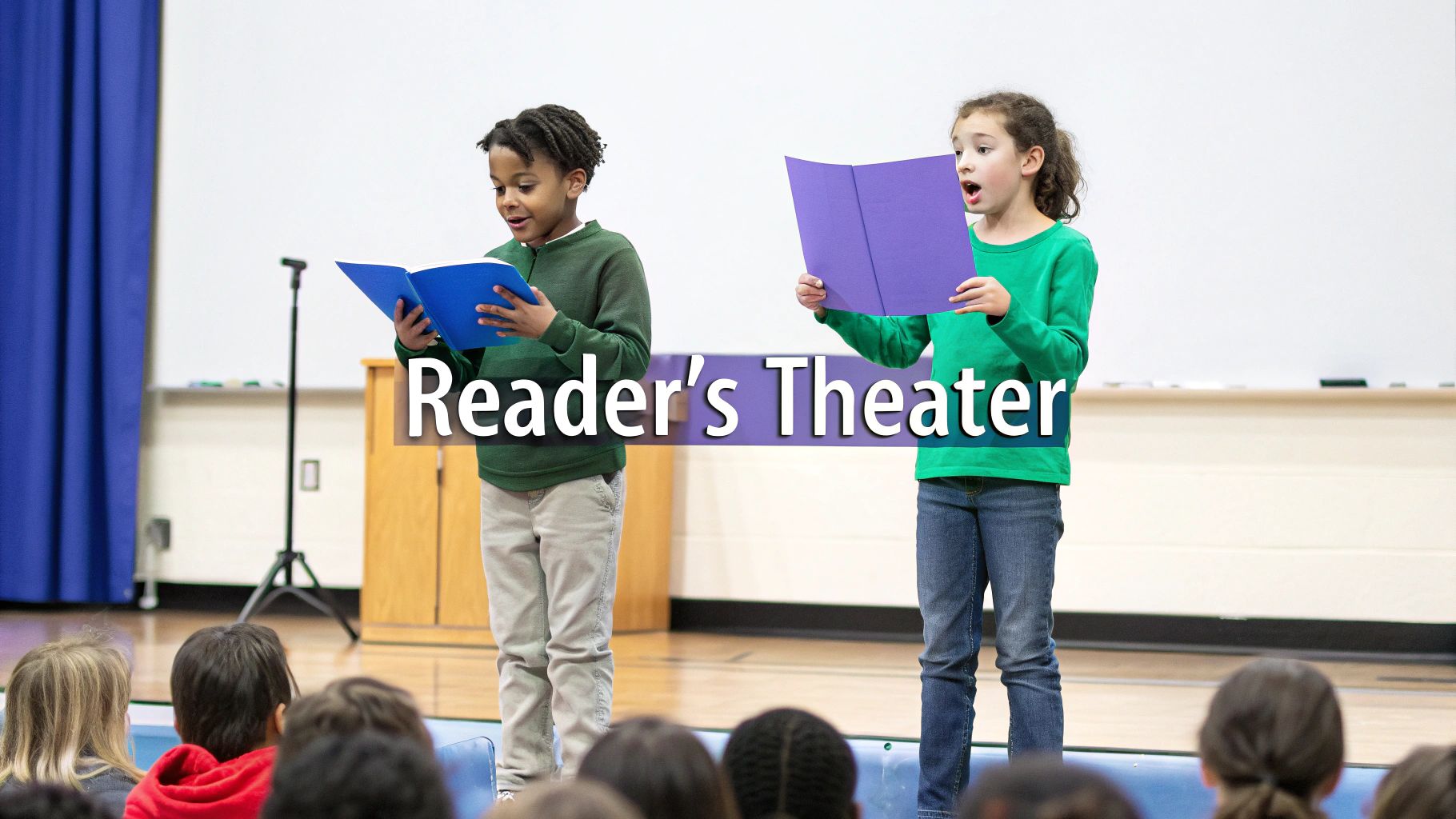
If you do just one thing to boost prosody, make it Reader’s Theater. It's my favorite way to get students to truly inhabit a text. The concept is simple: students perform a script by reading their parts aloud. They use their voices to convey character and emotion, all without the pressure of memorizing lines or dealing with complex props.
The real power here is that Reader's Theater gives reading an authentic purpose. Suddenly, they aren't just reading for you; they're reading to entertain their friends. That kind of intrinsic motivation is pure gold.
Here’s how to set it up for success:
- Find the Right Scripts: Start with short, simple scripts packed with dialogue. Look for stories with clear, strong emotions—happy, sad, surprised, or grumpy characters work wonders.
- Model Expressive Reading: Before handing out scripts, read a few lines yourself with some over-the-top expression. Show them what it sounds like when a character is whispering a secret or shouting with excitement.
- Coach, Don't Correct: As they practice, shift your mindset from corrector to performance coach. Instead of saying, "You read that word wrong," try asking, "How would your character say that line if they were feeling frustrated?"
Creating scripts used to be the most time-consuming part of this activity. I’d spend hours adapting short stories. Now, AI can be a massive help. Using a tool like Kuraplan, you can paste in a short story or fable and ask it to generate a simple Reader's Theater script. This cuts prep time down to almost nothing.
More Ways to Get Creative with Fluency
While Reader’s Theater is a classroom staple, it's not the only way to get students performing. The goal is always to give them a reason to read with expression.
Here are a few other ideas I've had success with:
- Poetry Slams: Poems are perfect for fluency work because their rhythm is baked right in. Host a low-key poetry slam where students can perform their favorite poems for the class. A little finger-snapping for applause goes a long way.
- Radio Reading Broadcasts: Have students pretend they're radio broadcasters. They can "go on the air" to read short news articles, weather reports, or even a chapter from a book. This naturally encourages a clear, engaging voice.
- Audiobook Creators: Let your students become audiobook narrators. They can choose a favorite picture book and use a tablet or phone to record themselves reading it aloud, complete with sound effects and different character voices.
These activities transform fluency practice from a chore into a creative performance. They also naturally build in repeated reading, as students will practice their parts multiple times to get them just right before the "show."
When we think about building out our fluency instruction, it's helpful to match the right activity to the specific skill we're trying to develop.
Engaging Fluency Activities and Their Primary Focus
| Activity | Primary Skill Targeted | Best For (Grade Levels) | Teacher Prep Level |
|---|---|---|---|
| Paired Reading | Accuracy, Rate, Prosody | K–5 | Low |
| Echo Reading | Prosody, Phrasing | K–3 | Low |
| Choral Reading | Rate, Accuracy | K–5 | Low |
| Reader's Theater | Prosody, Expression | 2–8 | Medium |
| Poetry Slams | Rhythm, Prosody | 3–12 | Low-Medium |
| Audiobook Recording | Expression, Pacing | 2–12 | Medium |
Each of these activities offers a unique way to practice, ensuring that fluency work stays fresh and engaging for every student.
The real beauty of these methods is how they tie fluency directly to comprehension. To read a line with the right emotion, a student must first understand the character's feelings and motivations. This creates a powerful feedback loop: better fluency leads to deeper understanding, and deeper understanding leads to more expressive reading.
To dive deeper into this connection, check out our guide on Comprehension Strategies Mastery.
By taking fluency beyond timed drills, you show students that reading isn't just a skill to be mastered—it's an art to be performed. You give them a chance to find their voice, build their confidence, and experience the pure joy of bringing a story to life.
Supporting Every Reader In Your Classroom
Every classroom is a beautiful mix of different abilities, which means fluency instruction can't be one-size-fits-all. The real magic happens when we meet each student exactly where they are—giving the right support to those who are struggling and the right challenge to those ready to soar.
But let's be clear: differentiation doesn't mean you need to write 25 unique lesson plans every night. It’s all about making smart, strategic tweaks to your core instruction. For some kids, that means circling back to the basics. For others, it’s about pushing them to think more deeply about the texts in front of them.
Scaffolding For Struggling Readers
For students still wrestling with decoding, fluency practice can feel like an uphill battle. The goal here is to provide a ton of support so they can feel what fluent reading is like, even if they can't quite get there on their own just yet.
- Audio-Supported Reading: This is a fantastic scaffold. Have students listen to an audio recording of a book while they follow along with the text. It models correct pacing and prosody without the pressure of performing.
- Structured Paired Reading: When you pair a stronger reader with a struggling reader, give them a clear routine. Maybe they read a passage together chorally first, then take turns reading it sentence by sentence. This gives them peer modeling in a really low-stakes, comfortable way.
When you're working with students facing specific learning challenges like dyslexia, the texts you choose matter immensely. For some great advice on this, check out this guide on finding the right books for dyslexia.
Extending For Advanced Readers
What about the kids who are already reading smoothly and accurately? Our job isn't done! The next step is to push them to a deeper level of analysis. We want to move them from thinking about how they read to why the author made certain choices.
Try giving these students extension activities that focus on author's craft:
- Punctuation Detectives: Challenge them to analyze how an author uses commas, dashes, and periods to control the pace of a story. Ask them, "Why did the author use a short, choppy sentence right here? What effect does that create?"
- Sentence Structure Analysis: Have them explore how varying sentence lengths can create a specific mood or rhythm. They can even try rewriting a paragraph to see how changing the sentences impacts the overall tone.
A global perspective is critical here. The PIRLS 2021 data, which spanned 57 countries, revealed a widespread reading crisis. It showed that 71% of comparable nations saw an increase in 4th graders falling below minimum proficiency levels. This really underscores why effective, targeted strategies are so important in every classroom.
Adapting For All Learners
Small adaptations can make a huge difference for English Language Learners and students with unique learning needs. Simple things like pre-teaching vocabulary, providing visual aids, or using sentence starters can reduce their cognitive load and make fluency practice feel much more accessible.
This is where modern tools can be a lifesaver. Differentiating a single text for multiple reading levels used to take hours of prep. An AI lesson planner like Kuraplan lets you do this in minutes. You can take one passage and instantly generate several versions—one with vocabulary support, another at a simpler reading level, and a third with extension questions.
This ensures every single student gets the just-right practice they need to make real progress. When you have the right tools, differentiation stops being an overwhelming task and becomes a powerful, manageable part of your daily instruction.
Answering Your Top Fluency Questions
It’s one thing to read about a strategy, but it's another to make it work with a classroom full of students on a busy Tuesday afternoon. Theory is great, but practice is where the real questions pop up.
Here are some of the most common, in-the-trenches questions I hear from fellow teachers about teaching reading fluency.
How Often Should I Assess Fluency?
For most of your students, a quick, one-minute check once per grading period is a solid benchmark. This gives you enough data to spot trends without turning your classroom into a constant testing zone.
For students in intervention groups or those you’re keeping a close eye on, you'll want more frequent data. I usually aim for a bi-weekly or monthly check-in with these kids. This helps you see if your strategies are actually working and lets you pivot quickly if they aren't. It’s about getting consistent data, not conducting lengthy, stressful tests.
What If a Student Is Accurate But Still Slow?
This is a classic sign that decoding hasn't quite clicked over into automaticity. The student is spending all their mental energy just figuring out the words, leaving very little brainpower for speed or expression.
The solution here is two-pronged. First, keep reinforcing those foundational phonics skills to build automaticity. Second, bring in repeated readings of a short, familiar text. Have the student read the same 100-word passage three or four times in a row.
Charting their WCPM each time gives them a huge confidence boost as they watch their speed climb. It’s a simple but powerful way to build that crucial automaticity.
The single most important element in fluency practice is rereading. A student reads a text poorly once, and the lesson moves on—that’s not effective. The learning happens when they read and re-read, transforming a text from one they can’t read well to one they can.
How Do I Teach Students to Read With Expression?
"My students sound like robots!" I hear this all the time. The key to teaching prosody is modeling, modeling, and more modeling.
Read sentences with over-the-top, dramatic emotion and have your students echo you back. Teach them to treat punctuation like a roadmap for their voice: periods are firm stop signs, commas are gentle yield signs, and question marks make your voice go up a little hill at the end.
Poetry and Reader's Theater are your best friends here because they practically demand expression. Another great trick is "phrase-cued reading." Just take a passage and mark it up with slashes (/) to show students where natural pauses between phrases should go. This is incredibly easy to do on passages you generate with an AI tool like Kuraplan, which can save you a ton of prep time.
How Can I Get Families to Help at Home?
Getting families on board is a game-changer, but you have to make it simple and fun. Nobody wants homework that feels like a battle.
Send home a short, silly poem or a two-person Reader's Theater script for them to practice together. Encourage families to simply listen to their child read for 10 minutes a day, focusing on praise instead of constant correction. The goal is positive practice, not perfection.
A great tip is to send home a link to a recording of yourself reading a passage—it's an easy way to model what fluent reading sounds like for both parents and kids.
Ready to reclaim your planning time and create differentiated, engaging fluency materials in minutes? With Kuraplan, you can instantly generate leveled reading passages, create custom Reader's Theater scripts, and design worksheets that meet every student's needs. Join over 30,000 teachers who are transforming their instruction. Start creating with Kuraplan today!