Crafting a lesson plan for kindergarten is a unique art form. It's about blending structured learning with the wonderful chaos of play, all while keeping a room full of five-year-olds hooked. The real goal is to build a roadmap that feels less like an adventure guide and more like a rigid script, turning curriculum standards into moments of genuine discovery.
The Reality of Kindergarten Lesson Planning
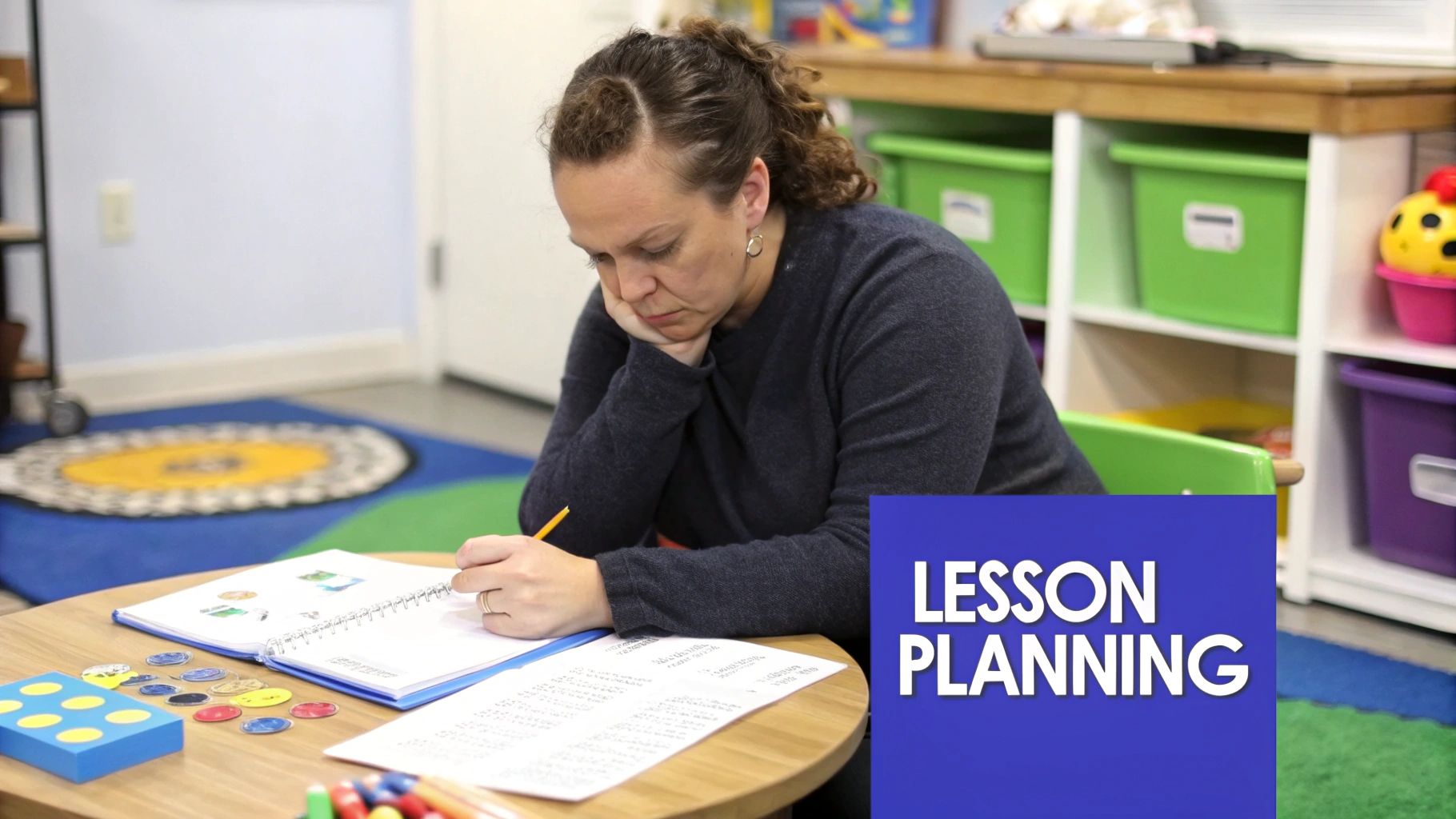
Let's be real. Planning lessons for kindergarten can feel like training for a marathon every single week. You're not just a teacher; you're the master orchestrator of learning, play, and emotional growth for a classroom of curious, energetic, and beautifully unpredictable little humans. The pressure to get it right is immense.
This isn't just about filling out a template. It's about designing experiences that actually stick. The toughest part is balancing the rigid demands of academic standards with the free-flowing, hands-on learning that kindergarteners need to thrive. That constant juggling act is exactly where the burnout starts to creep in.
The Weekly Planning Grind
The time commitment is staggering. On average, kindergarten teachers pour 10-15 hours per week into lesson planning alone. A 2024 survey found that a shocking 52% of teachers spend more than 20 hours a week just trying to match hands-on, age-appropriate activities with standards like Common Core or state-specific guidelines.
That time almost always spills over into evenings and weekends, stealing personal time and paving the road to exhaustion. It's a frustrating cycle that far too many of us are stuck in.
The old way of lesson planning forces teachers to be curriculum designers, activity creators, and administrative experts all at once. That's just not sustainable. It's time to shift our mindset toward smarter, more efficient planning.
A Smarter, More Sustainable Path
But what if planning didn't have to be this way? The goal isn’t to work harder—it’s to plan smarter. To really get this, it helps to explore different philosophies of early childhood education that are shaping how we teach today. This guide is all about helping you reclaim your time while creating lessons that have an even bigger impact.
Instead of reinventing the wheel every Sunday night, you can lean on systems and tools that do the heavy lifting for you. This is where modern AI tools built specifically for teachers, like Kuraplan, can be a total game-changer. Imagine generating standards-aligned activities, differentiation ideas, and even printable worksheets in a fraction of the time. This isn't about replacing your expertise. It's about amplifying it, so you can focus on what you love most: being there for your students.
Starting with Standards and Clear Objectives
Before you even think about glitter and glue sticks, every great kindergarten lesson plan is built on a solid foundation. This is where we anchor our fun, creative ideas to the real learning goals. It all starts with unpacking your curriculum standards, whether that's Common Core, EYFS, or your specific state's guidelines.
This first step can sometimes feel like trying to decipher a secret code. But it’s really about asking one simple question: “What do I actually want my students to know or be able to do by the end of this lesson?” Getting clear on that is your North Star for everything that follows.
Translating Standards into Kid-Friendly Goals
The real magic happens when you turn the formal language of standards into objectives that actually make sense in a kindergarten classroom. We need to ditch the academic jargon and create simple, powerful "I can" statements that you and your five-year-olds can understand and celebrate together.
This means breaking down a big, broad standard into a specific, observable action. When you’re creating kindergarten lesson plans, grounding your activities in clear objectives for foundational skills—like how to improve reading comprehension—is absolutely essential. It gives every activity a clear purpose.
A complex literacy standard, for example, doesn't have to be intimidating. Let's walk through how to make it concrete and actionable.
Here’s a quick look at how you can transform a formal standard into something you can actually use in the classroom.
Translating Standards into Kid-Friendly Objectives
| Curriculum Standard (Example CCSS.ELA-LITERACY.RF.K.3.A) | Teacher's Learning Objective | Student-Facing 'I Can' Statement |
|---|---|---|
| Isolate and pronounce the initial, medial vowel, and final sounds (phonemes) in three-phoneme (CVC) words. | Students will be able to identify and say the first sound of a given CVC word with 80% accuracy during a small group activity. | "I can tell you the first sound in a word, like /b/ in ball!" |
See the difference? That "I can" statement is something you can write on the board, say out loud, and have the kids repeat. It makes the learning target visible and achievable for everyone.
The Evolution of Planning and Modern Tools
Believe it or not, lesson planning has come a long way. Back in the 1960s, Maria Montessori's child-led principles influenced 15% of early childhood programs in the US. Fast forward to a 2025 analysis, and you'll find that only 22% of today's lesson plans fully integrate those crucial play-based standards.
In today's classrooms, 73% of kindergarten curricula mandate strict standards alignment, yet nearly half of teachers say they’re not happy with their planning tools. The administrative side of teaching has grown, and it's a real challenge.
This is where technology can genuinely make a teacher's life easier. Instead of spending your precious prep time manually cross-referencing every activity with a long list of standards, AI-powered tools can handle the heavy lifting.
A platform like Kuraplan, for instance, can instantly map your lesson idea—like a fun alphabet sorting game—to the correct curriculum standards. It saves you from the tedious administrative work, freeing you up to focus on what you do best: teaching creatively.
This alignment isn't just about checking a box for your principal. It’s about making sure that every fun activity, from painting to building with blocks, has a deliberate learning purpose behind it. That's the secret sauce for creating a lesson plan for kindergarten that is both playful and powerful. Our guide on how to build a great lesson plan PDF template can also give you a solid structure to start with.
Ultimately, starting with clear objectives transforms your lesson plan from a simple schedule of activities into a focused journey toward a specific learning destination. It gives your teaching direction and helps your students see exactly what they're working to achieve.
Designing Your Classroom Learning Flow
Alright, now for the really fun part—choreographing the actual learning experience. A great lesson plan for kindergarten is like a well-rehearsed dance. It has a clear beginning, middle, and end, with smooth transitions that keep everyone moving together. This is where you bring your objectives to life.
Think of this as setting the rhythm for your classroom. How you structure this flow can be the difference between a lesson that clicks and one that descends into chaos. When you intentionally plan the sequence and timing of each activity, you create a predictable yet exciting environment where your little learners can truly thrive.
This simple flowchart breaks down how we get from a big-picture standard to a kid-friendly goal.
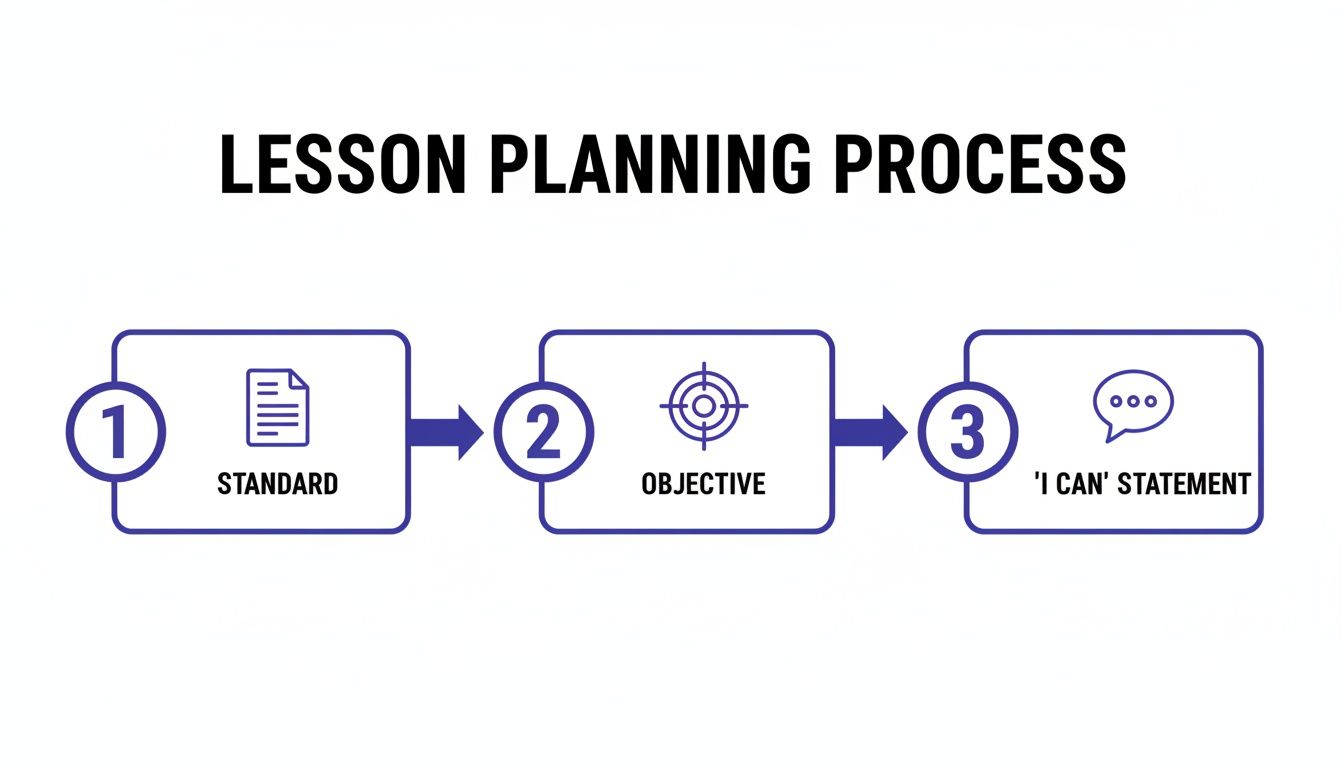
As you can see, every great activity is rooted in a standard. We translate that into a clear teacher objective and then distill it down to a simple "I can" statement that students can grab onto.
The Classic 'I Do, We Do, You Do' Model
One of the most effective and time-tested ways to structure a kindergarten lesson is the "I Do, We Do, You Do" model. It’s a simple, powerful framework that gradually releases responsibility to the students, building their confidence one step at a time.
This isn’t just a teaching strategy; it’s a way of scaffolding learning so that no one gets left behind. Here’s how it actually looks in a kindergarten classroom:
- I Do (Direct Instruction): This is your moment to shine! You model the skill or concept explicitly. If you're teaching the letter 'M' sound, you might say, "My turn. The letter M makes the /m/ sound. Watch my mouth. /m/, /m/, monkey." You're the expert, showing them exactly how it's done. Keep this stage short, punchy, and engaging—think 5-7 minutes at the most.
- We Do (Guided Practice): Now, it's a team effort. You do the activity together. "Let's make the /m/ sound together! Ready? /m/, /m/, /m/. Great job! Now, let's think of some words that start with /m/." This is your chance to check for understanding and offer immediate, gentle correction.
- You Do (Independent Exploration): Finally, it’s their turn to try it on their own or with a partner. This could be a center activity, a simple worksheet, or a hands-on task like finding objects in the room that start with the letter 'M'. This independent practice is what solidifies their learning.
This gradual release model is perfect for five- and six-year-olds because it builds a safe bridge from listening to doing.
Sequencing Your Lesson for Maximum Impact
Beyond the 'I Do, We Do, You Do' structure, the overall sequence of your lesson is critical. Think of it like telling a story. You need a hook to draw them in, a middle where the action happens, and a satisfying conclusion.
A typical lesson block might look something like this:
- The Hook (3-5 minutes): Start with something that grabs their attention immediately. This could be a catchy song, a mystery box with an object inside, or a silly puppet. For a lesson on patterns, I might wear a shirt with bold stripes and ask, "What do you notice about my shirt today?"
- Core Learning Activities (15-20 minutes): This is the heart of your lesson, where you'll use the 'I Do, We Do, You Do' model. It's where the direct teaching, guided practice, and independent work happen. Keep the pace brisk and the activities varied to hold onto those short attention spans.
- Wrap-Up and Reinforcement (3-5 minutes): Always end with a quick review to cement the main idea. Ask students to share what they learned, do a quick "thumbs up if you can..." check, or sing a song that summarizes the key concept. This brings closure to the lesson and helps you quickly assess understanding.
Mastering the Art of Transitions
In any kindergarten classroom, transitions are the make-or-break moments. The time between cleaning up centers and coming to the rug can either be a seamless shift or five minutes of pure chaos. The secret is to plan your transitions just as carefully as you plan your activities.
Teacher-tested transition strategies are worth their weight in gold. Having a go-to list of songs, chants, and brain breaks eliminates downtime and keeps the classroom energy positive and productive.
Here are a few ideas to make your transitions smoother:
- Transition Songs: Use a specific song for a specific task. A "Clean Up Song" signals it's time to put materials away, while a "Lining Up Song" gets everyone ready for the hallway.
- Counting Down: A simple countdown from 10 gives a clear, audible cue that an activity is ending. "When I get to zero, I need to see all the blocks back in the bin and your hands on your head."
- Quick Brain Breaks: Before starting a new task, especially one that requires focus, do a quick movement break. A few rounds of "Head, Shoulders, Knees, and Toes" or some simple yoga stretches can work wonders.
When transitions are predictable and fun, students know exactly what to expect. This significantly cuts down on off-task behavior and is a key part of any successful lesson plan for kindergarten.
Meeting Every Student Where They Are
Let's be real—your classroom isn't filled with 20 identical little learners. It's a vibrant, wonderfully chaotic mix of personalities and abilities. You've got kids still learning English, others who are zipping ahead and ready for more, and everyone else somewhere in between. A one-size-fits-all lesson plan for kindergarten is a recipe for frustration, leaving some kids behind and others bored.
Differentiation isn't some lofty academic theory you need a PhD to grasp. It's simply about tweaking your lesson to connect with each child. It’s about being flexible and responding to the actual kids sitting on the carpet in front of you.
Beyond the One-Size-Fits-All Approach
At its heart, differentiation is about choice. When you offer students different ways to learn, practice, or show what they know, you hand them the keys to their own education. This absolutely does not mean creating 20 separate lesson plans—that's a one-way ticket to burnout.
Instead, think in terms of small, purposeful adjustments to your activities. It usually boils down to making slight changes to the content (what they learn), the process (how they learn it), or the product (how they show you they've learned it).
- Varying the Content: For a lesson on the letter 'P', some students might just be working on recognizing the letter and its sound. A few others could be sorting picture cards by their beginning sound, while an advanced group might be ready to try writing simple CVC words like "pig" or "pen."
- Varying the Process: This is all about how they get their hands on the material. Let them choose their tools! Some kids will dive into a sensory bin filled with letter magnets, while others might prefer a quiet worksheet or a learning app on a tablet.
- Varying the Product: Ask students to show their understanding of a story in a way that plays to their strengths. Can they draw their favorite part? Act it out with a buddy? Build the setting with blocks? All of these are valid ways to demonstrate comprehension.
Practical Strategies for Your Classroom
Putting differentiation into action can feel like a huge task, but it doesn't have to be. Start with small, manageable tweaks you can build right into your existing lesson plan for kindergarten.
Here are a few teacher-tested strategies that just plain work:
- Visual Aids Are Everything: For English language learners and kids who are visual thinkers, things like anchor charts, picture cards, and real objects are non-negotiable. When you introduce a new word, don't just say it—show a picture, act it out, and connect it to something they already know.
- Use Flexible Small Groups: Small group time is your differentiation command center. You can pull a group that needs extra help with letter sounds while another group works independently on a more complex puzzle. The key is that these groups are flexible and change based on the skill you're teaching that day.
- Tiered Activities: This is a brilliant way to have everyone working on the same core activity but with different levels of support or challenge. During a counting activity, for instance, one group might be counting objects up to 5, another up to 10, and a third could be working on simple addition with manipulatives.
The goal isn't to dumb down the work for some kids. It's about providing the right level of challenge and support so that every single student can hit the learning objective. It's all about access and growth.
How Modern Tools Make Differentiation Easier
Let’s be honest, planning for all these variations takes a ton of time, and time is a teacher’s most precious resource. This is where modern planning tools can be a genuine game-changer, removing the guesswork from building an inclusive classroom.
Trying to invent three versions of an activity on the spot is stressful. An AI-powered tool like Kuraplan can automatically suggest differentiated activities right inside your lesson plan. You can tell it you need a hands-on activity for your kinesthetic learners or a simple visual worksheet for your English learners, and it will generate ideas that fit. It helps you build a more powerful lesson plan for kindergarten without sacrificing your entire Sunday. That saves you precious mental energy and makes sure you're ready to meet every student right where they are.
Meaningful Assessment in Kindergarten
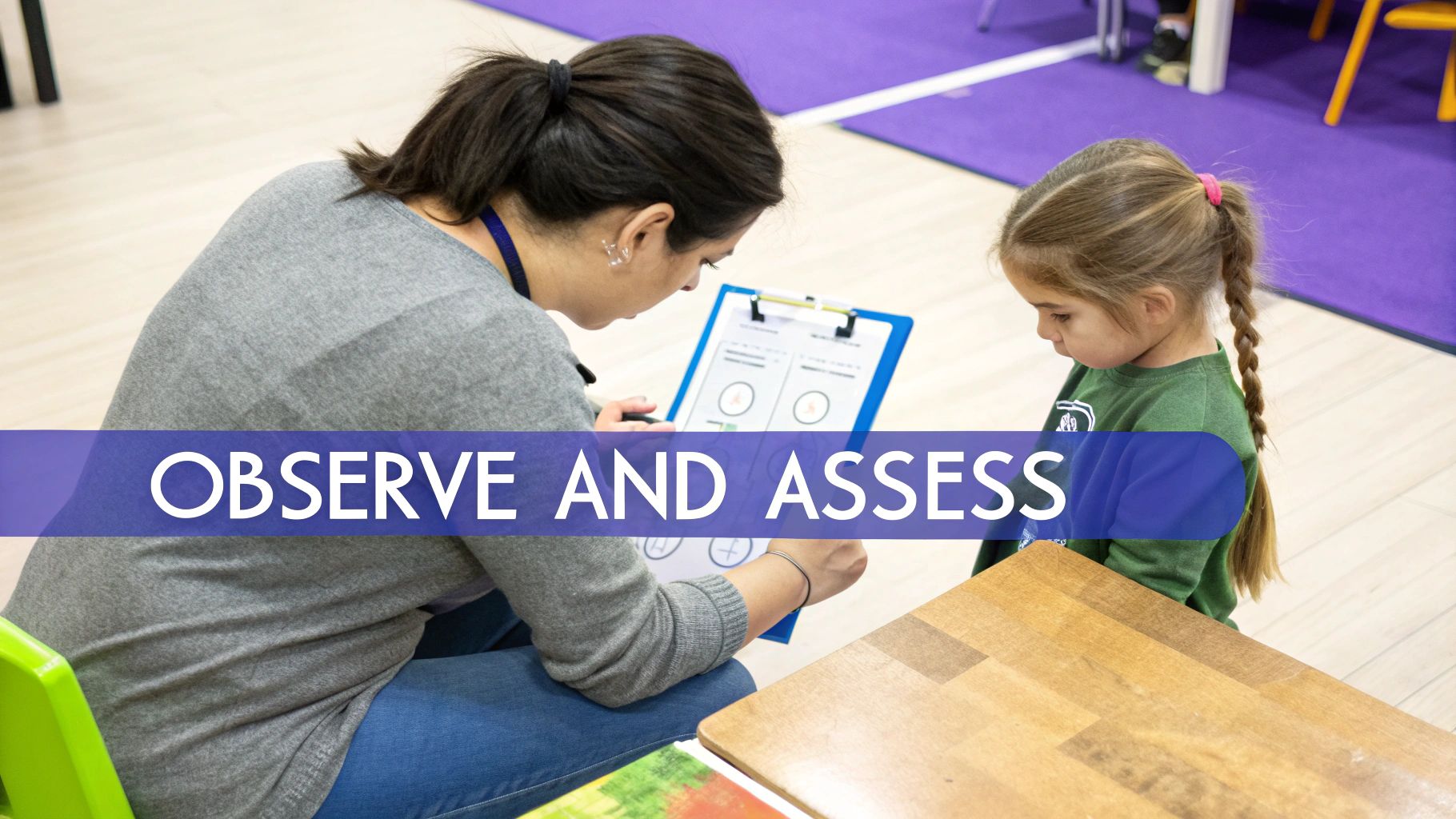
So, you’ve put together a fantastic lesson. How do you actually know if your students are getting it? Assessment in kindergarten isn’t about bubble sheets or high-stakes tests. It’s about becoming a keen observer and collecting those little breadcrumbs of understanding that show you what’s really sticking.
This is where your lesson plan for kindergarten transforms from a simple schedule into a powerful tool for tracking growth. The best assessments are woven right into the fabric of your day, not just tacked on at the end. They're quick, authentic, and often happen when the kids have no idea they're even being "assessed."
Beyond Formal Tests
Forget the idea of formal testing for a minute. Instead, think of yourself as a learning detective.
You’re looking for clues during center time, listening in on partner chats, and watching how a student approaches a new task. This kind of ongoing, informal check-in gives you far more valuable insight than any single test score ever could. It’s what helps you guide your instruction in real-time.
Research really backs this up. A 2024 meta-analysis found that standards-aligned lesson plans can boost kindergarten readiness scores by as much as 32%. Yet, a surprising 59% of teachers still rely on manual planning, making it much harder to integrate these crucial, in-the-moment assessment checks.
These quick observations give you immediate data, allowing you to pivot on a dime. You might realize a small group needs a quick reteach, or that half the class is ready to be challenged with something new.
Quick and Simple Formative Checks
Formative assessment should be fast, easy, and give you instant feedback. The best methods feel like a natural part of the lesson instead of an interruption. You're just taking the temperature of the room to see who’s got it, who’s almost there, and who needs a little more support. You can explore plenty of different formative assessment examples to build up your own toolkit.
A quick table can help organize some of the easiest, go-to options for the kindergarten classroom.
| Assessment Technique | How It Works | Best For Measuring |
|---|---|---|
| Thumbs Up/Down | Ask a clear yes/no or true/false question. Students respond with a simple thumb gesture. | Quick recall, basic concept checks, and gauging confidence levels across the whole class. |
| Picture Exit Tickets | At the end of a lesson, students circle a picture that answers a question (e.g., "Circle the picture that starts with /b/"). | Specific skill mastery (like phonics or number recognition) in a low-pressure way. |
| Observational Checklist | Keep a clipboard with student names and key skills. Jot down notes as you circulate during activities. | Social skills, fine motor development, and applied knowledge during hands-on tasks. |
These simple checks are all about gathering information to help you help your students—it’s not about grades.
Creating Simple, Effective Rubrics
Even kindergarten projects can benefit from a rubric, as long as it’s simple, visual, and focused on the learning process, not just the final product. A good rubric for a "Letter 'P' collage," for example, wouldn’t just grade how neatly things are glued. It would have clear criteria for the actual learning goal, like identifying pictures that start with the /p/ sound.
This is another area where planning tools can be a huge help. Instead of starting from scratch, platforms like Kuraplan can build a simple, standards-aligned rubric directly into your lesson plan. This makes it incredibly easy to track progress toward your objectives without adding one more thing to your to-do list.
When your assessment tools are built right into your lesson plan for kindergarten, you're setting yourself—and your students—up for success from day one.
Your Top Lesson Planning Questions Answered
We’ve covered a lot of ground, from anchoring activities in standards to assessing learning in meaningful ways. But let’s be real—theory is one thing, but making it all work on a rainy Tuesday when half the class has the wiggles is another.
When it comes to creating a lesson plan for kindergarten, questions always pop up. This is where we get into the nitty-gritty. Think of this as a friendly chat over coffee, sharing the practical advice that’s been tested in the trenches of a real kindergarten classroom.
How Can I Make Lesson Planning Less Time-Consuming?
This is the million-dollar question, isn't it? The Sunday night planning marathon is a rite of passage for many teachers, but it doesn't have to be your reality. Reclaiming your evenings is all about planning smarter, not harder.
First, stop creating everything from scratch. You don’t need to reinvent the wheel every single week. Start building a digital library of your go-to activities, songs, and read-alouds. When a game is a huge hit, save it. That way, you’re pulling from a trusted toolkit rather than staring at a blank page.
Second, embrace tech that actually helps. This is where tools designed specifically for educators, like Kuraplan, can be a lifesaver. Instead of manually aligning every single activity to standards, the platform can do that heavy lifting for you. It can also generate differentiated materials and assessments, cutting down hours of prep time. You still get to infuse your creativity, but you’re not starting from zero.
Remember, a lesson plan is a guide, not a rigid, minute-by-minute script. Give yourself permission to use templates and tools for the repetitive parts so you can focus on the creative, human side of teaching.
Where Do You Find New Ideas for Activities?
It's so easy to fall into a rut and use the same five activities on repeat. Keeping your lesson plan for kindergarten fresh is just as important for your own sanity as it is for your students' engagement! Luckily, inspiration is everywhere if you know where to look.
Here are a few of my favorite places to find new ideas:
- Teacher Blogs and Social Media: Platforms like Pinterest and Instagram are absolute goldmines. Following other kindergarten teachers gives you a daily stream of real-world, classroom-tested ideas for centers, art projects, and read-alouds. Just search for hashtags like #kindergartenactivities or #teachertips.
- Children's Literature: A great book is the perfect launchpad for an entire week of activities. A story like The Very Hungry Caterpillar isn't just a read-aloud; it's a science lesson on life cycles, a math lesson on counting, and an art project all in one.
- Your Students: Pay attention to what your kids are obsessed with right now. If they’re all talking about dinosaurs, lean into it! Plan a dinosaur-themed week where you count dinosaur eggs (math), dig for fossils in the sensory bin (science), and write dino stories (literacy). Their natural curiosity is your best planning asset.
How Detailed Should My Lesson Plan Be?
Finding the right level of detail is a balancing act. You need enough structure to stay on track, but enough flexibility to pivot when things inevitably go off-script.
A good rule of thumb is to focus your detail on the "what" and "why," not so much the "how."
- Be specific about your objective: Clearly write out your "I can" statement. This is your non-negotiable for the lesson.
- List your key materials: You don’t want to be scrambling for glue sticks mid-lesson. A quick list is all you need.
- Outline the sequence: A simple bulleted list (e.g., Hook, 'I Do', 'We Do', 'You Do', Wrap-Up) is plenty.
You don't need to write out a full script of what you’re going to say. A well-structured outline is your roadmap, giving you the freedom to respond to your students' needs in the moment. If they’re grasping a concept faster than you expected, you can move on. If they’re struggling, you have the flexibility to slow down and reteach. That's the art of teaching.
Ready to spend less time planning and more time teaching? Kuraplan is an AI-powered platform that helps you create amazing, standards-aligned lesson plans, activities, and visuals in minutes. Join over 30,000 educators who are reclaiming their weekends and bringing their best ideas to life.