A truly effective classroom management plan goes way beyond a list of rules and consequences. It all starts with your teaching philosophy—the core beliefs that define the kind of classroom culture you want to build. Think of it as a proactive blueprint for creating a safe, respectful, and productive space where students actually feel supported and ready to learn.
When you start with that foundation, every other piece of your plan just works better.
Building Your Classroom Management Foundation
Before you even think about writing a single rule, you need to nail down the "why" behind your plan. This is where your personal teaching philosophy comes into play, connecting what you believe to how you lead.
A strong foundation isn't about control; it’s about creating a predictable and positive community where learning can flourish. This initial step will guide every decision you make, from how you greet students at the door to how you handle disruptions. Your philosophy is your north star, keeping your approach consistent and authentic.
Defining Your Core Beliefs
So, where do you begin? Start by reflecting on what you fundamentally believe about teaching, learning, and student behavior. A little self-reflection goes a long way.
Ask yourself a few key questions to get to the heart of your philosophy:
- What does a safe and respectful classroom look and sound like to me?
- How do I believe students learn best? (Through collaboration, independent work, hands-on projects?)
- Beyond academics, what is my main goal for my students? (To become kind, responsible, curious citizens?)
- What role do student-teacher relationships play in my classroom?
Answering these helps you articulate a vision that is uniquely yours. For instance, if you believe students thrive on collaboration, your procedures will naturally prioritize group work and shared spaces. Exploring how to build strong educational foundations can give you more ideas for crafting these core principles.
Your classroom management philosophy is the constitution for your classroom. It’s a living document that declares your values and sets the stage for a community built on mutual respect and a shared purpose.
Connecting Philosophy to Practice
Once your philosophy feels clear, the next step is to translate those big ideas into concrete, everyday actions. This is the bridge that makes a management plan truly work, preventing it from becoming just another poster on the wall.
For example, a belief in student autonomy might lead you to create a "choice board" for assignments. A focus on community could translate into daily morning meetings to build relationships.
This proactive approach is more critical than ever. A 2024 survey revealed that 72% of U.S. educators feel student misbehavior has worsened since the pandemic. This isn't just a feeling; it actively disrupts teaching for nearly a third of public school teachers.
Strategies rooted in a clear, positive philosophy are proven to reduce these disruptions significantly. You can see the full analysis of modern classroom management trends on edweek.org.
Core Components of a Strong Classroom Management Plan
Here is a quick overview of the essential pillars every teacher should consider for a well-rounded and effective strategy.
| Component | Key Objective | Example Action |
|---|---|---|
| Teaching Philosophy | Establish the "why" behind your rules and routines. | Write a short statement about creating a respectful, collaborative learning environment. |
| Classroom Procedures | Create clear, efficient routines for daily tasks. | Model and practice how to enter the room, turn in work, and transition between activities. |
| Positive Relationships | Build trust and rapport with every student. | Use morning greetings, check in with students individually, and show interest in their lives. |
| Clear Expectations | Define and communicate expected behaviors. | Co-create 3-5 simple, positively-phrased classroom rules with your students (e.g., "Respect each other"). |
| Consequence System | Outline a logical, fair, and consistent response to misbehavior. | Use a hierarchy of consequences, starting with a non-verbal cue or private reminder. |
| Family Communication | Keep parents and guardians informed and involved. | Send a weekly newsletter or use a communication app to share updates and positive news. |
By weaving these components together, you create a comprehensive plan that doesn't just manage behavior—it fosters a thriving classroom community.
Crafting Clear Classroom Rules And Procedures
This is where your teaching philosophy hits the classroom floor. You can have the most beautiful vision for a warm, welcoming community, but it can all fall apart without clear, practical guidelines that kids can actually understand and follow.
Let's be honest, vague rules like "Be Respectful" are a nice thought, but they're often too broad for students to interpret correctly. What does respect look like to a six-year-old? To a teenager? We have to show them. The goal is to build a predictable, safe space where students know exactly what’s expected, freeing up their brainpower to focus on learning.
From Vague Rules to Specific Expectations
First thing's first: reframe your rules as positive expectations. Instead of a list of "don'ts," tell them what they should do. This simple language shift has a massive impact on the tone of your room.
For instance, "No running" becomes "Walk safely in our classroom." And "Don't interrupt" becomes "Raise your hand to share your ideas."
This approach helps students picture the right behavior in their heads. It’s a subtle but powerful part of any solid classroom management plan because it sets a cooperative, not a punitive, tone right from day one.
Classroom research is clear on this: students respond way better to positive instructions. When you tell a child what to do instead of what not to do, you're giving them a clear action to follow. This cuts down on confusion and misbehavior right away.
Co-Creating Rules for Genuine Buy-In
Want students to actually follow the rules? Give them a say in creating them. When kids have a voice, they take ownership. They're way more invested in upholding standards they helped set.
Kick off the year with a class discussion using simple prompts:
- What do we need to do to make sure everyone feels safe and can learn in here?
- How should we treat each other and our classroom stuff?
- What does a great classroom look and sound like to you?
Your job is to guide this conversation and distill their big ideas into 3-5 simple, memorable rules. Keeping the list short is key—anything longer is just going to be forgotten. This process is also a fantastic, organic way to talk about the balance between individual rights and responsibilities within the classroom.
Establishing Airtight Classroom Procedures
While rules are your general guideposts, procedures are the nuts-and-bolts, step-by-step instructions for getting things done every day. A classroom with smooth procedures runs like a well-oiled machine, which means less chaos and more time for teaching. Never assume students know how to do something. Explicitly teach and model every single routine.
Think about all the little things that happen during the day that need a clear procedure. Here are a few must-haves to get you started:
- Entering the Classroom: What’s the first thing they do? (e.g., Unpack their bag, turn in homework, start the morning warm-up.)
- Getting Your Attention: How can they get help without yelling your name? (e.g., Raise a hand, use a colored cup system on their desk.)
- Turning in Work: Where does finished work go? Is there a special spot for late assignments?
- Using the Restroom: What's the signal or sign-out sheet process?
- Switching Activities: How do they clean up one thing and get ready for the next?
- Packing Up and Dismissal: What are the steps for a calm, orderly end to the day?
For every procedure, walk through it in your mind from a student's perspective. What seems obvious to you might be totally confusing to them. Model it, have them practice it, and give positive feedback until it’s automatic. I promise, the time you invest in this upfront will pay you back all year long.
Using Positive Reinforcement and Logical Consequences
A truly effective classroom management plan does two things really, really well. First, it celebrates the behaviors you want to see more of. Second, it addresses missteps in a way that teaches, not just punishes.
This blend of positive reinforcement and logical consequences is what moves a classroom from simple compliance to a community of self-regulated learners. When students understand the why behind your expectations, they start building intrinsic motivation. You’re not just trying to control them; you’re giving them clear, respectful guardrails to help them stay on track.
Recognizing Good Conduct Beyond the Candy Jar
Let's be clear: positive reinforcement is so much more than stickers and candy. While a small treat has its place, the most powerful strategies are often the ones that cost nothing and focus on relationships. Meaningful recognition builds genuine self-esteem and makes students feel truly seen.
Here are a few low-cost, high-impact ways to acknowledge great choices:
- Specific, Sincere Praise: Ditch the generic "Good job." Instead, try, "Leo, I noticed how you invited the new student to join your group. That was a really kind and inclusive thing to do." This pinpoints the exact behavior you want everyone to emulate.
- Earned Privileges: Give students a little autonomy and responsibility. This could be anything from choosing the class read-aloud book, being the line leader for the day, or earning five minutes of free drawing time after finishing their work.
- Positive Notes Home: A quick email or a short, handwritten note celebrating a win can be incredibly powerful. It reinforces the behavior for the student and builds a fantastic bridge with parents and guardians.
My best advice? Try to "catch" students being good, especially those who often struggle. Acknowledging their positive choices, whether publicly or in private, can completely shift how they see themselves and their place in your classroom.
Creating a Hierarchy of Logical Consequences
When a rule gets broken, the response needs to feel fair, predictable, and directly connected to what happened. That's the heart of logical consequences. Unlike a punishment that feels random, a logical consequence helps a student connect their action to an outcome. It’s a chance to learn how to make a better choice next time.
Having a tiered system gives you a clear, consistent roadmap for responding to misbehavior. It lets you start with a gentle nudge before things escalate.
Here’s a sample hierarchy you can adapt:
- The Non-Verbal Cue: Often, just making eye contact, using a quiet hand signal, or even just walking closer to a student is enough to redirect them without saying a word.
- The Private Verbal Reminder: Lean down and whisper a quick reminder at the student's desk. Something simple like, "Remember, we raise our hands to share," keeps their dignity intact and the lesson moving.
- Restorative Action or Redirection: If the behavior continues, it’s time for a brief reset. This could be a "take a break" chair where they can reflect for a few minutes or a moment to practice the correct procedure, like walking down the hall again.
- The Problem-Solving Chat: Pull the student aside for a private conversation to figure out what’s going on. You might ask, "I noticed you were having trouble staying focused during math. What can we do to help you succeed?"
- Parent Contact and Documentation: For persistent behaviors that disrupt learning, it’s time to bring parents into the loop and document the interventions. This ensures everyone is working together as a team.
The Power of Respectful Phrasing
How you say something is just as important as what you say. Your goal is always to correct the behavior while protecting your relationship with the student. Whenever you can, address misbehavior privately to avoid public shaming.
Focus on the behavior, not the child. Use "I" statements to explain the impact of their actions. For instance, instead of, "You are being so disruptive," try, "I am having trouble teaching when there is talking during the lesson."
This simple switch depersonalizes the correction and frames it as a community issue. It shows students your rules are there to protect everyone's ability to learn and reinforces that you’re on their side, even when you have to correct them. This kind of respectful communication is a cornerstone of any successful sample classroom management plan.
Adapting Your Plan for Different Grade Levels
Let's be honest: the classroom management plan that works wonders with first graders will get you laughed out of a room full of high schoolers. While the core principles—respect, clear expectations, and consistency—are universal, how you apply them has to change as your students grow.
It’s not just a nice idea; it's a necessity. What motivates a seven-year-old is worlds apart from what drives a sixteen-year-old. Younger kids need concrete, visual systems and lots of positive feedback. Older students crave autonomy and respond to systems that treat them like the young adults they're becoming. A one-size-fits-all approach is a fast track to frustration for everyone.
The Elementary School Framework: Focus on Visuals and Routines
In an elementary classroom, routine is everything. Young children thrive on predictability, so your management plan should be built around clear, simple routines they can master. Think visual, think whole-class, think community.
Your plan should feel like a game with simple rules that everyone learns and plays together. The goal is to make positive choices feel automatic and even a little bit fun.
Here’s what works best for an elementary sample classroom management plan:
- Visual Rule Charts: Don't just write the rules; show them. Use pictures next to simple, positive phrases like "Raise a quiet hand." This is a huge help for early readers and English language learners.
- Whole-Class Reward Systems: The classic marble jar is a classic for a reason. It builds teamwork and gives the class a shared goal. When the jar is full, the whole class celebrates with something fun, like extra recess or a pajama day.
- Simple, Direct Consequences: Consequences need to be immediate and logical. If a student is misusing the art supplies, the natural consequence is losing the privilege to use them for a few minutes while they help clean up.
The most powerful tool in an elementary classroom is positive narration. Constantly point out what students are doing right. "I love how quietly Sarah's table is lining up!" This reinforces the behavior you want to see and gives other students a real-time reminder.
The Middle School Method: Bridging Structure and Independence
Middle school is a whirlwind of change. Students are navigating new social circles and figuring out who they are, but they absolutely still need structure and firm boundaries. Your plan has to walk a fine line, holding them accountable while giving them a bit more freedom and responsibility.
The focus naturally shifts from whole-class systems to individual accountability. This is where students really start to learn that their choices have direct results—a lesson that will serve them well in the years to come.
A solid middle school plan should include:
- Student Responsibility: Get them involved in solving problems. If a group is constantly off-task during labs, pull them aside for a quick chat and ask them for ideas on how to fix it. This builds ownership.
- Logical Consequences: The link between an action and its consequence must be rock-solid. If a student doesn't turn in their homework, the consequence isn't just a zero; it's a required lunch session in your room to get the work done. The focus is on learning and responsibility, not just punishment.
- Consistent Procedures for Multiple Classes: Middle schoolers move around all day. Having consistent procedures for entering the classroom, starting the warm-up, and packing up can make a huge difference in keeping the day running smoothly.
This is the age where we move from mostly positive reinforcement toward more restorative consequences, which help students learn from their mistakes.
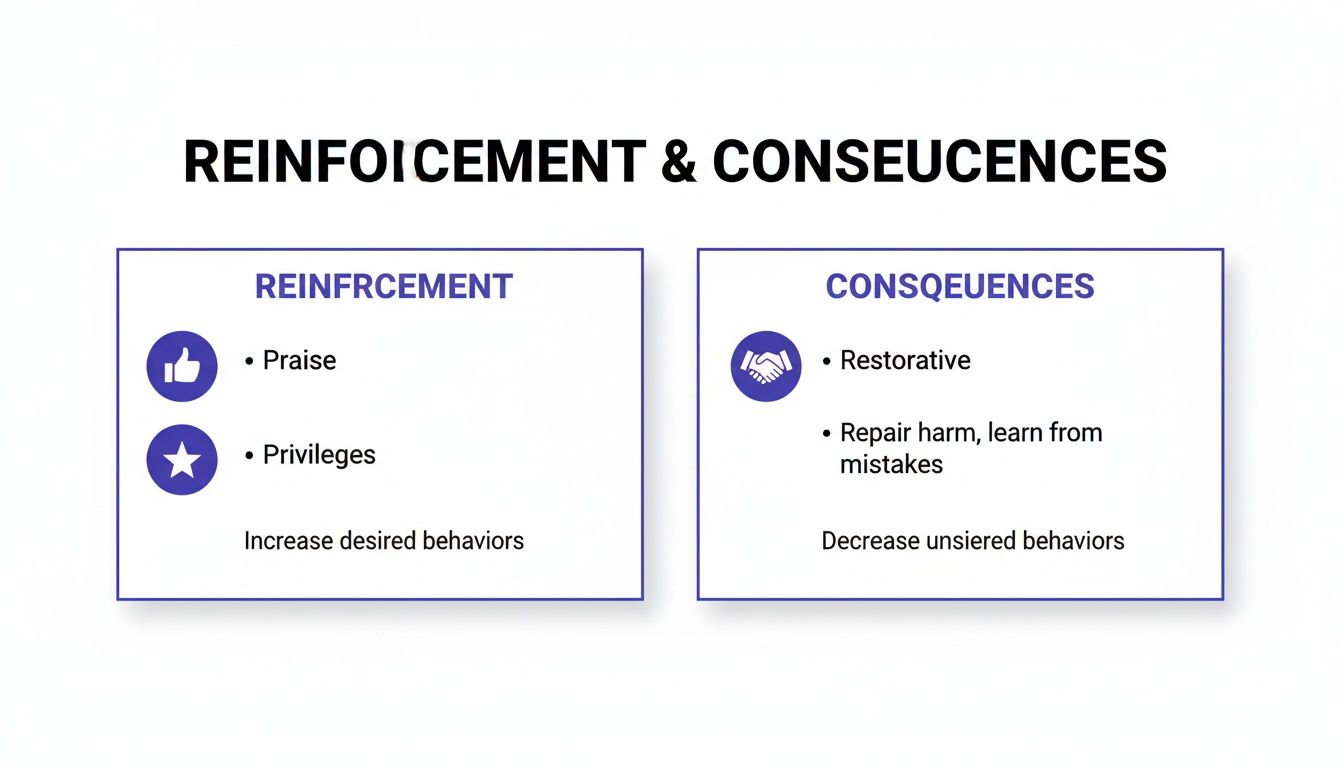
As the diagram shows, while praise and rewards are still important, helping students repair relationships and understand the impact of their actions becomes a critical part of management for older kids.
The High School Approach: Cultivating Autonomy and Accountability
By the time students reach high school, they're preparing for the real world. Your management plan needs to reflect that. The goal is to foster autonomy and academic accountability, not to micromanage. Your role shifts from director to facilitator.
Think of your plan less as a set of rules and more like a course syllabus. The tone should be one of mutual respect, focused on the shared goal of learning and preparing for what comes next.
Here are the key elements for a high school plan:
- Academic Accountability Policies: Your plan must clearly detail policies on deadlines, late work, and academic honesty. Frame them as standards that prepare students for college and the workplace. For example, giving each student one "late pass" per semester teaches them to manage their time and use resources wisely.
- Emphasis on Self-Advocacy: You want students to take charge of their own learning. Your procedures should clearly explain how to ask for help, schedule a meeting to discuss a grade, or request an extension when they have a legitimate reason. These are essential life skills.
- Clear Technology Policies: Phones and laptops are part of their world, so ignoring them isn't an option. Create a simple, firm policy. A "stoplight" system on the board (red for no devices, yellow for approved tasks, green for open use) gives a clear visual cue that's easy to enforce.
Comparing Management Strategies Across Grade Levels
To make it even clearer, let's break down how the core components of a management plan shift as students get older. What works for a 6-year-old needs a serious update for a 16-year-old.
| Strategy Component | Elementary School Approach | Middle School Approach | High School Approach |
|---|---|---|---|
| Rules & Expectations | Simple, positive, and visual. Displayed prominently in the classroom. Whole-class focus. | Co-created with students. Focus on responsibility and respect. Procedures for transitions are key. | Presented as a syllabus. Focus on academic policies, deadlines, and self-advocacy. |
| Rewards & Recognition | Frequent, tangible, and often whole-class (e.g., marble jar, class points). Verbal praise is constant. | More individualized. Praise for effort and growth. Privileges like preferred seating or choice in projects. | Intrinsic motivation is the goal. Recognition is more formal (e.g., academic awards, positive notes home). |
| Consequences | Immediate, logical, and short-term (e.g., brief time-out, loss of a privilege for that activity). | Restorative focus. Logical consequences tied directly to the action (e.g., redoing an assignment, study hall). | Based on academic policies. May involve parent contact, academic probation, or loss of academic privileges. |
Ultimately, the best sample classroom management plan for any grade is one that feels authentic to you, is enforced with consistency, and truly meets your students where they are developmentally.
Launching Your Classroom Management Plan

You’ve done the hard work of building a thoughtful, comprehensive plan on paper. But a brilliant plan is only as good as its launch—now comes the most critical part: turning that document into a living, breathing part of your classroom culture.
Those first few weeks of school are everything. This is your prime time to set the stage, actively teaching, modeling, and practicing every single expectation until it becomes second nature for your students. The energy and consistency you bring to this rollout phase will truly determine how smoothly your classroom runs for the rest of the year.
Teach and Model Every Single Procedure
Never, ever assume your students just know what to do. You have to explicitly teach every single procedure—from how to enter the room to how to ask for help—just like you would teach a new math concept.
The best way to do this? Model it and role-play. Don't just tell them; show them. Walk through the steps of turning in homework, then have the whole class practice it. Make it interactive and even a little bit fun.
Here’s a quick-start list of procedures to model right away:
- Entering the classroom: What should students do with their coats and backpacks? Where do they go first?
- Transitioning between activities: How do they clean up one task and prepare for the next with minimal chaos?
- Getting your attention: What’s the non-verbal signal or specific hand-raise you expect?
- Lining up for dismissal: Show them the exact steps for packing up and getting ready to leave calmly.
My go-to strategy is to turn this into a game. I’ll say something like, "Okay, let's see if we can transition to our reading groups in under 30 seconds!" This positive, game-like approach makes practicing procedures feel engaging, not tedious.
Build a Strong Home-School Partnership
Your classroom management efforts get a massive boost when parents are on board. A simple welcome letter or email at the beginning of the year can work wonders. It’s your chance to introduce yourself, share your positive approach, and open that line of communication from day one.
This first message shouldn't be a long list of rules. Frame it as a partnership. Explain your core philosophy—that you’re building a safe, respectful community—and invite them to be a part of it. This simple act builds goodwill and makes future conversations, especially the tough ones, so much easier.
A strong home-school connection is a foundational piece of any sample classroom management plan. It ensures everyone is working together to support the student.
Be Consistent, but Ready to Adjust
Consistency is your superpower, especially in the beginning. Students need to see that your expectations are firm and that you’ll follow through every single time. If you let a small behavior slide one day, you’re accidentally sending the message that the rules are optional.
At the same time, no plan is perfect right out of the gate. Be prepared to watch and adjust. If a particular procedure isn't working, don't be afraid to revisit it with your class. Maybe you notice the pencil sharpening routine is causing a major traffic jam every morning.
Address it head-on with your students. "Hey team, I've noticed our pencil sharpening system is a little chaotic. What are your ideas for making it smoother?" Involving them in the solution builds their problem-solving skills and reinforces that you are all in this together. This kind of flexibility turns your plan from a static document into a responsive tool that truly supports learning all year long.
Integrating Technology into Modern Classroom Management
Let's be real—technology is already in your classroom. The question isn't if students will have devices, but how you'll manage them. Instead of seeing phones and tablets as distractions, a modern classroom management plan turns them into powerful tools for learning and organization. The trick is to get ahead of it.
The first step is creating dead-simple, explicit policies for device use. This cuts down on confusion and makes it clear that technology has a specific purpose in your room. Something as simple as a "stoplight" visual on the board (red, yellow, green) can signal your expectations without you having to say a word.
Leveraging Classroom Management Software
Beyond setting basic rules, dedicated classroom management software can completely change your day-to-day. These tools aren't just for tracking behavior; they streamline communication with parents, help you spot patterns in student conduct, and can even gamify positive reinforcement. Think of it as a digital co-teacher handling the routine stuff.
The demand for these platforms is exploding. The global market is jumping from $8.55 billion in 2024 to an estimated $10.57 billion in 2025, and experts see it hitting $23.49 billion by 2029. The proof is in the results: schools using these systems report 20-30% improvements in student focus. You can dig into more of this data on the growth of classroom management systems on giiresearch.com.
Here’s what these platforms do best:
- Instant Parent Communication: Send a quick note about a great moment or a behavior concern, keeping parents in the loop.
- Data-Driven Insights: Easily see which students might need extra support before a small issue becomes a big one.
- Engagement Boosters: Use digital badges or a points system to get students excited about positive behavior and academic effort.
A good platform should make your life easier, not add another complicated task to your to-do list. Find one with a clean interface where you can log behaviors, send messages, and check student data in seconds.
Using Technology Proactively
The best way to use these tools is to weave them directly into the plan you already have. For instance, if your students earn points for participation, an app can automate the tracking and let them see their progress in real-time. It makes the whole system feel more transparent and official.
This kind of integration is also a massive time-saver. That reclaimed time can be poured back into teaching, and many educators are now exploring how to use AI to help with lesson planning for teachers to free up even more time. By embracing the right tools, you build a classroom that’s more organized, communicative, and engaging for everyone.
Kuraplan helps you build a more organized and effective classroom. Our AI-powered platform assists with creating standards-aligned lesson plans, worksheets, and visuals in minutes, giving you more time to focus on what matters most—your students. Discover a smarter way to plan at https://kuraplan.com.