In today's classrooms, the shift from traditional, teacher-led instruction to student-centered learning is a critical evolution. This change is not just about adopting a new educational buzzword; it's about fundamentally re-shaping the learning environment to foster essential skills like critical thinking, problem-solving, and deep collaboration. But how do educators translate this powerful philosophy into daily practice? The key lies in having a robust toolkit of proven strategies and activities.
This guide moves beyond abstract theory to provide a comprehensive collection of actionable student centered learning activities examples. We will deconstruct ten powerful models, from Project-Based Learning and Socratic Seminars to Gamification and Personalized Learning Paths. For each example, you will find a detailed breakdown designed for immediate application, including:
- Step-by-step implementation guides.
- Concrete examples across various grade levels and subjects.
- Actionable differentiation and classroom management tips.
- Practical assessment strategies and rubric suggestions.
Our goal is to provide a clear blueprint for implementation, helping you build a classroom where students are not just passive recipients of information but active drivers of their own educational journey. Whether you are looking to introduce a new activity or refine your existing student-centered approach, the tactical insights within this listicle will equip you to create a more dynamic, engaging, and empowering learning environment. Let’s explore the activities that put students at the heart of learning.
1. Project-Based & Problem-Based Learning (PBL)
Project-Based Learning (PBL) and Problem-Based Learning are dynamic student-centered learning activities where students gain knowledge and skills by working for an extended period to investigate and respond to an authentic, engaging, and complex question, problem, or challenge. These approaches shift the classroom dynamic from teacher-led instruction to student-driven inquiry. Students take ownership of their learning, collaborating to create public products or present solutions to real-world issues.
In Project-Based Learning, the focus is on creating a tangible product or performance, guided by a compelling driving question. In Problem-Based Learning, the process starts with an ill-structured problem, requiring students to define the learning objectives themselves to find a solution. Both methodologies foster critical thinking, collaboration, creativity, and self-management skills.
Why It Works and How to Implement
This approach excels because it connects learning to students' interests and the world outside the classroom, making education relevant and meaningful. The extended timeline allows for deep exploration and skill development.
Implementation Strategies:
- Start with an Authentic Problem: Frame the unit around a compelling driving question or a genuine local issue. For example, instead of just studying ecosystems, have students design a plan to improve biodiversity in a local park.
- Structure for Success: Use structured checkpoints, peer feedback sessions, and clear rubrics to guide students. This scaffolding prevents overwhelm and ensures accountability. The Buck Institute for Education (now PBLWorks) provides excellent frameworks for this.
- Integrate Community: Invite local experts to provide feedback or serve as an authentic audience for final presentations. This raises the stakes and provides valuable real-world context for students.
- Assess Process and Product: Your rubric should evaluate not just the final outcome but also essential skills like collaboration, critical thinking, and iterative refinement. Document learning through portfolios and reflective journals.
2. Cooperative Learning & Peer Teaching
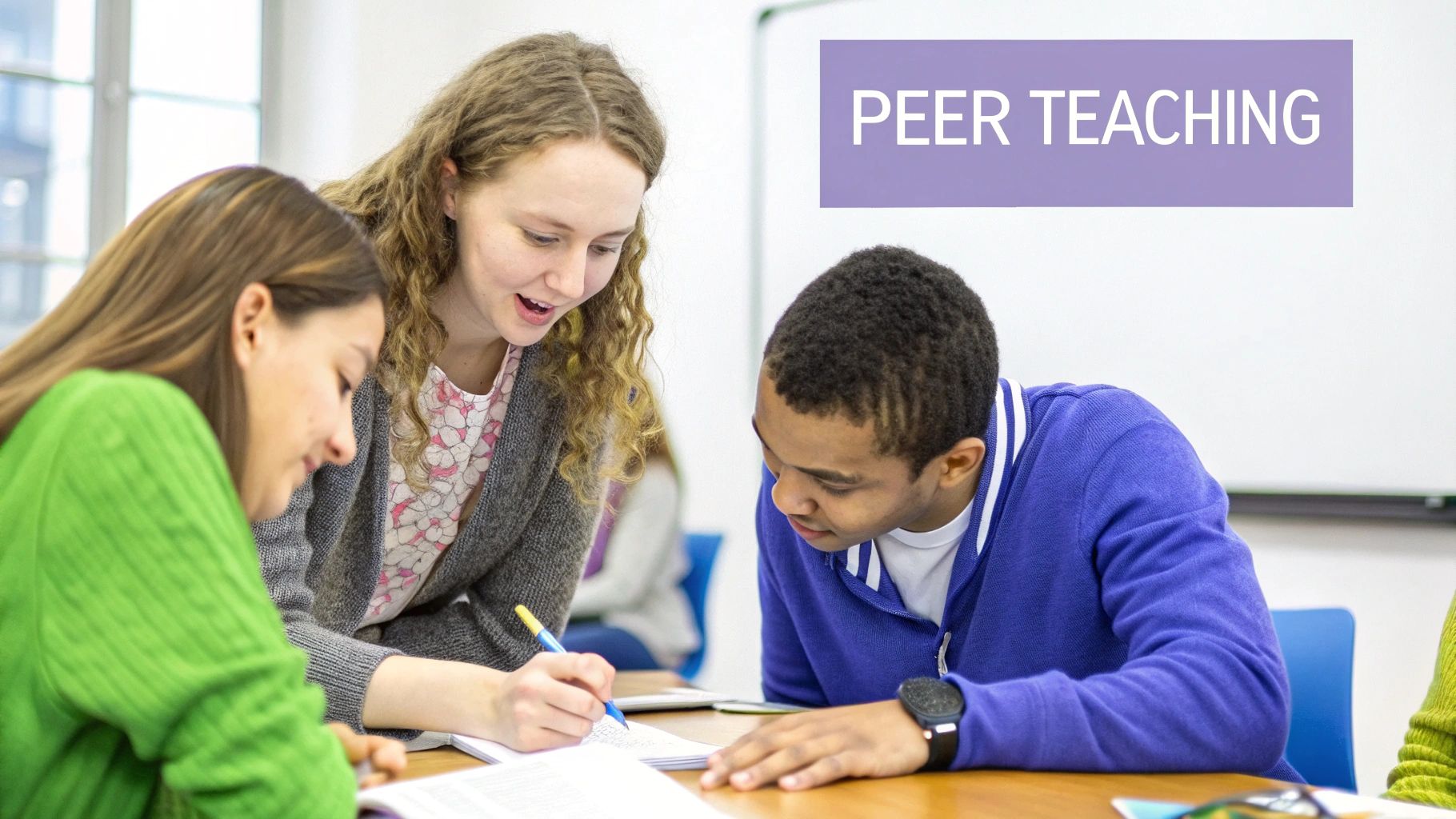
Cooperative Learning and Peer Teaching are powerful student-centered learning activities that restructure the classroom to leverage social interaction for academic and social growth. In Cooperative Learning, students work together in small, often heterogeneous, groups to achieve a shared goal, with structures that ensure positive interdependence and individual accountability. Peer teaching involves students taking on the role of the instructor, explaining concepts to their classmates, which solidifies their own understanding while providing support to their peers.
Both approaches are built on the principle that students learn through discussion, clarification, and teaching others. These methods move the focus away from the teacher as the sole source of knowledge and empower students to construct their understanding collaboratively. This dynamic not only deepens content knowledge but also explicitly builds essential communication, leadership, and teamwork skills necessary for success beyond the classroom.
Why It Works and How to Implement
This strategy works because it makes learning an active, social process. When students teach a concept, they must organize their thinking, identify key points, and articulate them clearly, leading to a deeper level of mastery. It also creates a supportive, low-stakes environment where students feel more comfortable asking questions of their peers.
Implementation Strategies:
- Use Structured Protocols: Implement established cooperative learning structures like Jigsaw, where each group member becomes an "expert" on one piece of the content and then teaches it to their home group. Another simple yet effective tool is Think-Pair-Share, which provides a moment for individual processing before peer discussion.
- Assign and Rotate Roles: To ensure equitable participation and prevent one student from dominating, assign specific roles within each group (e.g., Facilitator, Recorder, Timekeeper, Encourager). Rotate these roles regularly so every student develops different collaborative skills.
- Teach Collaboration Skills Explicitly: Do not assume students know how to work together effectively. Dedicate time to teaching and modeling skills like active listening, respectful disagreement, and consensus-building. Create anchor charts with sentence frames to support productive academic conversations.
- Combine Group Goals with Individual Accountability: The final product should be a group effort, but each student must be accountable for their learning. Follow up a group activity with an individual exit ticket or a short quiz on the material to ensure every member understood the concepts.
3. Inquiry-Based Learning
Inquiry-Based Learning is a powerful student-centered approach that casts students in the role of investigators. Instead of receiving information directly, students generate their own driving questions, make predictions, conduct research or experiments, analyze their findings, and draw evidence-based conclusions. This method transforms learning from a passive act of memorization into an active process of discovery.
This model operates on a spectrum, from structured inquiry, where the teacher provides the question and method, to open inquiry, where students formulate their own questions and design their investigations from scratch. Regardless of the level, the core principle is that students learn by doing and thinking critically about the process. This fosters deep curiosity, scientific reasoning, and the metacognitive skill of understanding how one learns.
Why It Works and How to Implement
This approach is highly effective because it leverages natural curiosity, making learning an authentic and personally motivated quest for answers. By wrestling with evidence and uncertainty, students develop resilience and a more sophisticated understanding of how knowledge is constructed, which is one of the key benefits of these student centered learning activities examples.
Implementation Strategies:
- Start with a Phenomenon: Introduce a puzzling observation, a compelling video, or an interesting dataset to spark curiosity. For example, show students a video of a non-Newtonian fluid and ask, "What is going on here? How could we investigate its properties?"
- Scaffold the Process: Begin with structured or guided inquiry before moving to more open-ended investigations. Provide tools like data collection templates or question formulation charts to support students as they build their inquiry skills.
- Teach the Skills Explicitly: Dedicate time to teaching the specific skills involved in inquiry, such as how to ask a testable question, design a fair test, or analyze data for patterns.
- Emphasize Reflection: The inquiry cycle should always conclude with reflection. Prompt students to consider: "What did we learn? How does our evidence support our conclusion? What new questions do we have now?" You can explore more strategies to design scaffolded investigations and build your students’ inquiry skills by checking out these Foundations of Inquiry lesson plans from Kuraplan.
4. Flipped Classroom Model
The Flipped Classroom Model is a student-centered learning activity that inverts traditional teaching methods. Instead of delivering lectures in class, teachers provide instructional content for students to review at home, typically through videos, readings, or interactive modules. This shift frees up valuable class time for more dynamic, collaborative, and hands-on activities where students apply what they've learned, with the teacher acting as a facilitator and guide.
This model transforms the classroom from a space for passive information absorption into an active learning hub. For example, a high school physics class might watch a 10-minute video explaining Newton's Laws of Motion at home. Then, during class, they work in small groups to design and conduct experiments that test these laws. This allows the teacher to provide personalized support, address misconceptions as they arise, and challenge students with higher-order thinking tasks.
Why It Works and How to Implement
This approach works because it maximizes face-to-face time for the most complex cognitive tasks: application, analysis, and creation. It gives students control over the pace of their initial learning, allowing them to pause and re-watch content as needed, which is a powerful tool for differentiation.
Implementation Strategies:
- Keep Home Content Concise and Engaging: Create or curate short videos (ideally 5-15 minutes) or readings. Embed low-stakes comprehension questions using tools like Edpuzzle to ensure students engage with the material and to gather formative data.
- Establish Accountability: Start the class with a brief entry ticket, a quick quiz, or a short discussion based on the home content. This ensures students come prepared for the in-class application activities.
- Design Meaningful In-Class Tasks: The success of a flipped classroom hinges on the quality of the in-class activity. Focus on collaborative problem-solving, project-based work, Socratic seminars, or lab experiments that require active participation.
- Provide Scaffolding: Offer guided notes, graphic organizers, or key vocabulary lists to support students as they engage with the material at home. This is especially crucial for students who may struggle with independent learning.
5. Socratic Seminars & Structured Discussions
Socratic Seminars are formal, student-led discussions designed to foster a deeper understanding of a text, idea, or complex question. In this powerful student-centered learning activity, participants engage in a thoughtful dialogue, using evidence to support their claims and building upon each other's ideas. The teacher acts as a facilitator, guiding the conversation with probing questions rather than providing answers, which shifts the cognitive load and intellectual responsibility to the students.
This method transforms the classroom into a community of inquiry where learners practice active listening, respectful debate, and collaborative thinking. By defending their interpretations and considering alternative viewpoints, students develop critical thinking, sophisticated communication, and analytical reasoning skills. The core goal is not to "win" an argument but to collectively explore meaning and achieve a more profound, shared understanding.
Why It Works and How to Implement
This approach works because it honors student voices and builds intellectual confidence. It teaches students how to think, not just what to think, by making their reasoning visible and holding them accountable to textual evidence. The collaborative nature makes learning a social, engaging, and memorable experience.
Implementation Strategies:
- Start with a Rich Text: Choose a text (which can be an article, image, data set, or video) that is complex, open to interpretation, and raises genuine questions. Prepare students by having them annotate the text or complete a guided reading assignment beforehand.
- Establish Clear Protocols: Explicitly teach and model discussion etiquette. Use a "fishbowl" format (an inner circle for discussion, an outer circle for observation) to help students learn the process. Provide sentence stems like "I agree with... but I'd like to add..." to support all learners.
- Facilitate, Don't Dominate: Your role is to guide, not to lead. Ask open-ended, clarifying questions ("Can you show us where you found that in the text?") and use generous wait time. Redirect the conversation back to the students when they look to you for validation.
- Assess the Process: Evaluate students on their preparation, use of evidence, active listening, and contributions to the collective understanding. Use post-seminar written reflections to have students assess their own performance and synthesize their new insights.
6. Station Rotation & Learning Centers
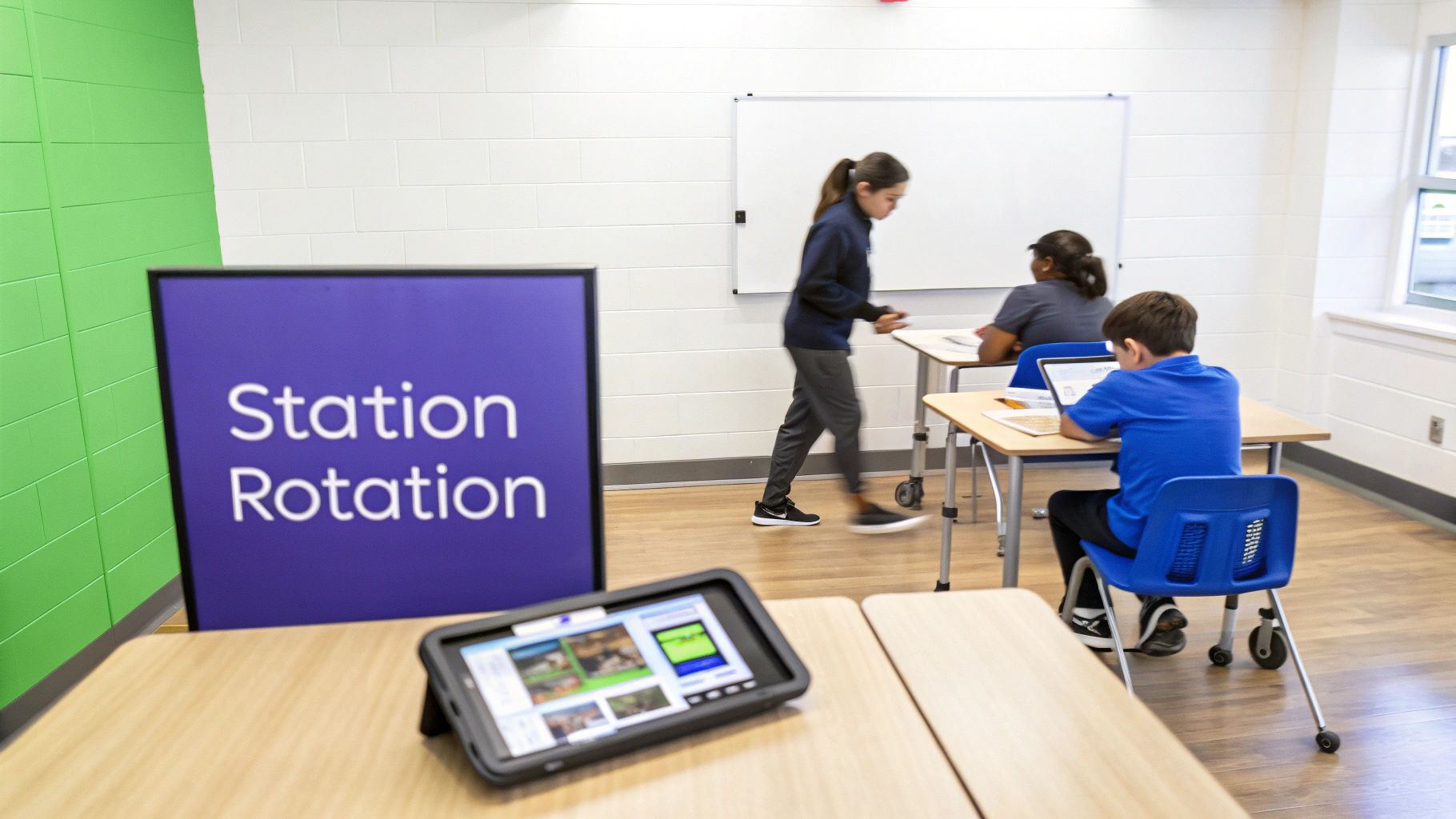
Station Rotation is a powerful classroom management and instructional model where students move through different learning stations or centers, engaging with varied activities and content. This framework allows for a dynamic learning environment where students can work independently, collaboratively, or in small, teacher-led groups. It is one of the most effective student-centered learning activities examples for differentiation and targeted skill practice.
This approach breaks down a larger lesson into manageable, focused tasks. For example, a math block could include stations for hands-on manipulatives, digital practice on tablets, collaborative problem-solving, and a teacher-led group for targeted remediation or enrichment. This structure ensures that every student receives instruction tailored to their specific needs while also developing independence and time management skills.
Why It Works and How to Implement
Station rotation excels because it maximizes instructional time and facilitates differentiation. While the teacher works with a small group on a specific skill, other students are actively engaged in meaningful, independent, and collaborative tasks, creating a highly efficient and personalized learning environment.
Implementation Strategies:
- Establish Clear Routines: Before launching, explicitly teach and practice the routines for transitioning between stations. Use a clear timer and visual schedule to help students manage their time and movement independently.
- Design Purposeful Stations: Each station must have a clear learning objective. Combine different modalities to maintain engagement, such as a hands-on "maker" station, a technology station for research or practice, a collaborative discussion station, and an independent reading or writing station.
- Leverage the Teacher-Led Station: This is your opportunity for high-impact, targeted instruction. Use formative assessment data to create flexible groups based on student needs, whether for reteaching, practice, or extension activities.
- Plan for Accountability: Ensure each station has a clear task with a simple deliverable or a way to check for understanding. This could be an exit ticket, a completed graphic organizer, or a digital submission. For more structured ideas, you can explore resources for investigation stations on kuraplan.com to help generate differentiated tasks and instructions.
7. Gamification & Game-Based Learning
Gamification and Game-Based Learning are powerful student-centered learning activities that harness the motivational power of games. Gamification applies game mechanics like points, badges, and leaderboards to classroom tasks, while Game-Based Learning uses actual games, such as Minecraft Education or Prodigy, as the primary vehicle for instruction. Both approaches leverage intrinsic motivators like competition, achievement, and storytelling to boost engagement and make learning feel less like a chore.
These methods transform the learning environment by providing students with clear goals, immediate feedback, and the freedom to fail and try again in a low-stakes context. Students are not just passive recipients of information; they are active players navigating challenges, solving problems, and developing strategic thinking skills. Whether it’s designing historical structures in a digital world or mastering math facts to level up a character, these activities put students in control of their learning journey.
Why It Works and How to Implement
This approach works because it taps into the brain's natural reward systems, making difficult tasks more palatable and encouraging persistence. The structure of games provides clear paths to mastery, helping students visualize progress and celebrate small victories along the way.
Implementation Strategies:
- Start with a Learning Goal: Select games or design gamified systems that directly align with your curriculum objectives. For instance, use a platform like Kahoot! for a fun, competitive review session or Classcraft to gamify classroom routines and behavior.
- Balance Competition and Collaboration: While leaderboards can be motivating, ensure there are also cooperative challenges. This allows students who are not motivated by direct competition to engage and builds a more inclusive classroom culture.
- Debrief After Play: The learning doesn't stop when the game ends. Facilitate a discussion connecting the game experience to the academic concepts. Ask questions like, "What strategy did you use to solve that problem?" or "How does this simulation reflect the historical event we studied?"
- Mix Digital and Analog: Not all games need to be on a screen. Board games, card games, and role-playing scenarios are excellent non-digital options that promote face-to-face collaboration and critical thinking, ensuring equity and variety in your classroom.
8. Choice Boards & Student Agency
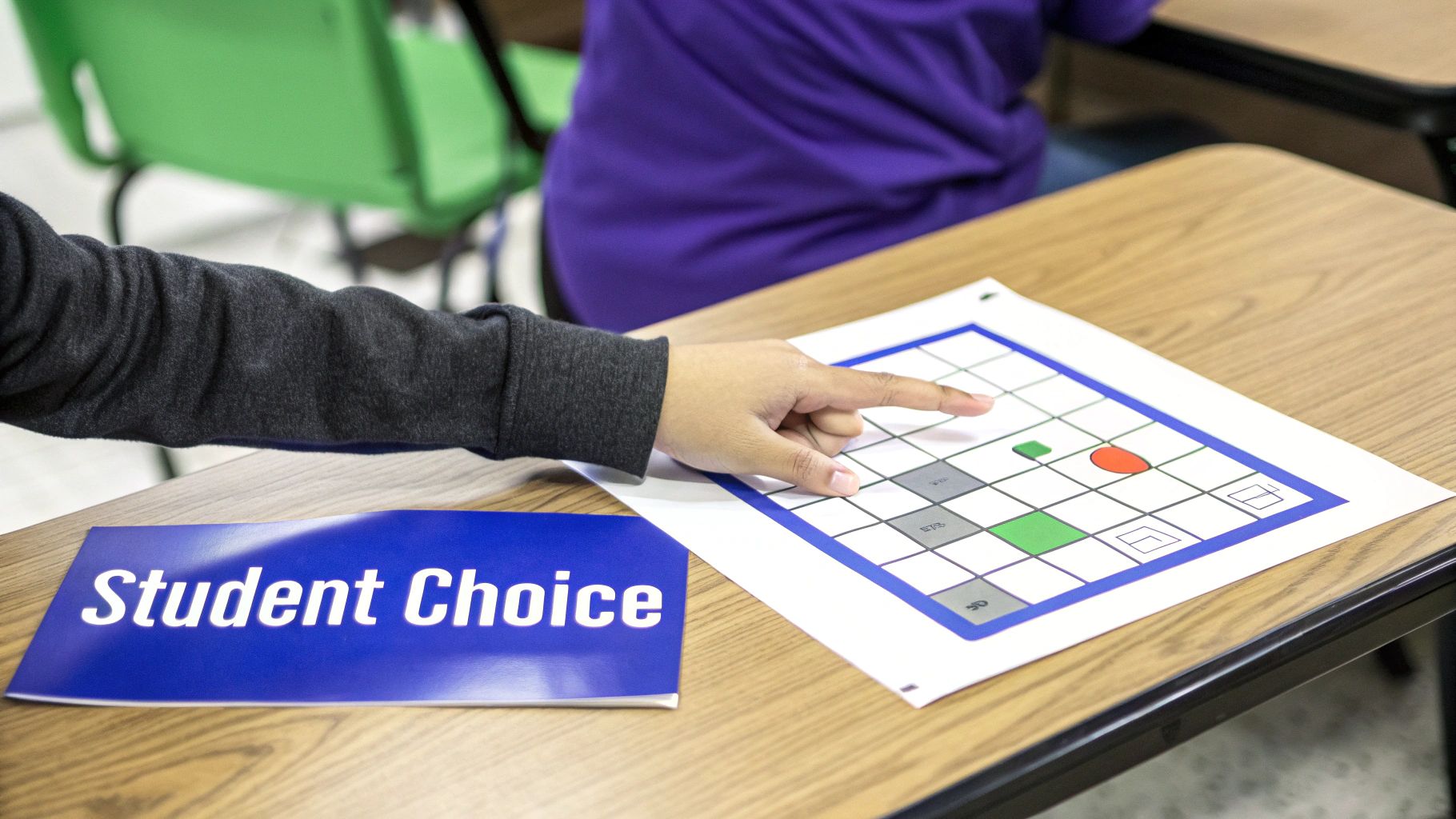
Choice Boards are graphic organizers that offer students a menu of learning activities. This student-centered approach empowers learners by allowing them to select how they will engage with content, practice a skill, or demonstrate their understanding. All options on the board are carefully designed to meet the same core learning objective, but they vary in modality, complexity, and product, catering to diverse learning preferences and increasing intrinsic motivation.
By providing structured autonomy, choice boards place students in the driver's seat of their own learning journey. For example, a reading response board might offer options like a written summary, a podcast discussion, a dramatic reading, or a visual representation of a key scene. Each path leads to the same destination: demonstrating comprehension of the text. This method effectively blends accountability with personalized learning.
Why It Works and How to Implement
This strategy is highly effective because it honors student variability and agency, which research shows directly boosts engagement and effort. When students feel they have a say in their work, they are more invested in the outcome. Choice boards are also an efficient tool for differentiation, allowing a single assignment to meet students where they are.
Implementation Strategies:
- Anchor to One Objective: Ensure every single activity on the board is tightly aligned with the non-negotiable learning standard you are targeting. The how can be flexible, but the what they are learning must be consistent.
- Offer Quality Over Quantity: Limit options to 3-6 well-designed tasks. This provides meaningful choice without causing decision fatigue. A simple 3x3 grid where students must complete a "tic-tac-toe" line is a popular and effective format.
- Vary the Activities: Include tasks that appeal to different learning styles and intelligences. Mix in activities that are creative, analytical, hands-on, or technology-based. For example, a science board on ecosystems could include building a model, writing an explanatory essay, or creating an informational video.
- Provide Clear Rubrics: Create a single, clear rubric that can be used to assess any of the choices on the board. The rubric should focus on the quality of evidence for the learning objective, not the specific format of the product. This ensures equitable assessment across different tasks.
9. Student-Led Conferences & Self-Assessment
Student-Led Conferences shift the traditional parent-teacher meeting dynamic by empowering students to take the lead. In this model, students prepare and facilitate the conference with their parents or guardians, using evidence from their work to explain their learning, progress, and future goals. This process is deeply intertwined with self-assessment, where students regularly evaluate their own work against clear criteria, fostering metacognition and a profound sense of ownership over their academic journey.
These practices transform assessment from something done to students into something done with them. Instead of passively receiving feedback, students become active agents in their learning narrative. They learn to articulate their strengths, identify areas for improvement, and set meaningful, actionable goals. This develops crucial communication skills, self-advocacy, and a growth mindset that serves them long after they leave the classroom.
Why It Works and How to Implement
This approach works because it makes learning transparent and places responsibility directly with the student, boosting accountability and engagement. It turns assessment into a powerful learning experience rather than a final judgment. When students can explain their own progress using evidence, they internalize their learning more deeply.
Implementation Strategies:
- Build a Portfolio: Guide students in curating a portfolio (physical or digital) of work samples that demonstrate growth over time. For example, a student might include a first draft and a final draft of a writing piece to show their revision process.
- Teach Self-Assessment Skills: Explicitly teach students how to use rubrics and checklists to evaluate their own work. Provide structured reflection time and sentence frames like, "I am proud of this piece because..." or "Next time, I will focus on..." to help them articulate their thoughts.
- Practice and Rehearse: Conduct mock conferences in class. Have students practice their presentations with peers, role-playing different scenarios to build confidence and refine their communication.
- Integrate Goal-Setting: Make goal-setting a core component of the conference. Guide students in creating SMART (Specific, Measurable, Achievable, Relevant, Time-bound) goals based on their self-assessments. Explore detailed strategies for presenting and reflecting on learning at kuraplan.com.
10. Personalized Learning Paths & Mastery-Based Progression
Personalized Learning Paths and Mastery-Based Progression are powerful student-centered learning activities that shift the focus from seat time to demonstrated competence. This model tailors instruction to individual student needs, interests, and learning pace. Instead of moving all students through content at the same rate, this approach allows them to advance only after they have shown proficiency on specific learning objectives, recognizing that learning timelines are unique to each child.
This method transforms the classroom into a flexible environment where students work on different skills at different times. Instruction becomes highly targeted, using data from formative assessments to guide next steps. Students might use adaptive technology like Dreambox for math, work in small guided groups based on skill level rather than grade, or follow an Individual Learning Plan (ILP). The core principle is that learning is the constant and time is the variable, ensuring no student is left behind or held back.
Why It Works and How to Implement
This approach works because it honors the individual learner, building both confidence and competence by ensuring students have a solid foundation before moving on. It fosters student agency as they track their own progress and understand what they need to do to advance.
Implementation Strategies:
- Define Clear Mastery Criteria: Start by creating clear, measurable learning objectives for a unit. Define what "mastery" looks like, for example, achieving 80% or higher on a skills assessment or successfully completing a performance task based on a detailed rubric.
- Use Frequent Formative Assessments: Implement low-stakes, frequent check-ins like exit tickets, short quizzes, or brief observations. Use this data to group students for targeted instruction, assign relevant practice activities, and determine who is ready to move on.
- Create Flexible Pathways: Offer multiple ways for students to learn and practice a skill. This can be structured as learning stations (e.g., a teacher-led station, an independent practice station, and a collaborative project station) that students rotate through based on their mastery level.
- Embrace Reassessment: Normalize the idea that learning is a process. Allow students multiple opportunities to demonstrate mastery without penalty. This shifts the focus from a single grade to genuine understanding and skill acquisition.
10 Student-Centered Learning Activities Comparison
| Strategy | Implementation Complexity 🔄 | Resource & Tech Requirements ⚡ | Expected Outcomes ⭐ / 📊 | Ideal Use Cases 💡 | Key Advantages ⭐ |
|---|---|---|---|---|---|
| Project-Based & Problem-Based Learning (PBL) | High — extensive planning, scaffolding, assessment design | Moderate–High — materials, community/experts, research tools | Deep conceptual understanding, collaboration, real-world problem solving ⭐⭐⭐ 📊 | Interdisciplinary units, capstones, community-focused projects | Authentic relevance; transferable 21st‑century skills |
| Cooperative Learning & Peer Teaching | Moderate — requires roles, training, monitoring | Low–Moderate — simple materials, role cards, rubrics | Improved achievement, social skills, peer support ⭐⭐ 📊 | Small-group tasks, review sessions, heterogeneous classes | Peer explanation; individual accountability; inclusive support |
| Inquiry-Based Learning | High — teacher shifts, strong scaffolding needed | Moderate–High — lab materials, datasets, digital tools | Scientific thinking, curiosity, research skills ⭐⭐⭐ 📊 | STEM investigations, data analysis projects, primary-source work | Promotes metacognition and deeper conceptual grasp |
| Flipped Classroom Model | Moderate–High — redesign of instruction and class flow | High — quality off‑class content, LMS, reliable home access | More in-class application, personalized support, increased feedback ⭐⭐ 📊 | Concept-heavy subjects, blended learning, flipped labs | Maximizes class practice time; supports differentiation |
| Socratic Seminars & Structured Discussions | Moderate — prep texts and protocols; teach discussion skills | Low — texts, seating arrangement, minimal tech | Higher-order thinking, argumentation, perspective-taking ⭐⭐ 📊 | Literature, ethics, history, debate-oriented lessons | Builds communication and critical thinking with minimal materials |
| Station Rotation & Learning Centers | Moderate–High — station design and transition management | Moderate — varied materials, some tech for stations | Differentiation, increased small-group instruction, engagement ⭐⭐ 📊 | K–8 classrooms, skill practice, blended stations | Targets instruction; supports varied modalities and formative checks |
| Gamification & Game-Based Learning | Moderate–High — align mechanics to learning goals thoughtfully | High — quality games/platforms, devices, infrastructure | Strong engagement, persistence, immediate feedback ⭐⭐ 📊 | Skill practice, motivation drives, formative assessment | Sustains motivation; offers frequent feedback and safe failure |
| Choice Boards & Student Agency | Low–Moderate — design equivalent options and rubrics | Low — activity materials, exemplars, rubrics | Greater autonomy, motivation, differentiated demonstration ⭐⭐ 📊 | Independent work, homework, differentiated assignments | Easy to implement; honors diverse preferences and choice |
| Student-Led Conferences & Self-Assessment | Moderate — portfolio prep, rehearsal, scheduling | Low–Moderate — portfolios (digital/physical), rubrics | Increased metacognition, ownership, parent engagement ⭐⭐ 📊 | Reporting periods, goal-setting routines, SEL emphasis | Authentic audience for learning; builds reflection and accountability |
| Personalized Learning Paths & Mastery-Based Progression | High — data systems, scheduling, teacher PD required | High — adaptive platforms, assessments, staff time | Tailored pace, higher mastery, reduced gaps ⭐⭐⭐ 📊 | Diverse classrooms, remediation/acceleration programs, ILPs | Meets individual needs; mastery focus and flexible pacing |
Key Takeaways for Your Student-Centered Classroom
Transitioning to a student-centered classroom is a pedagogical evolution, not an overnight revolution. The comprehensive list of student centered learning activities examples we've explored, from the long-term engagement of Project-Based Learning to the dynamic interaction of Socratic Seminars, are not merely isolated tactics. They represent a fundamental shift in instructional philosophy, moving the teacher from the "sage on the stage" to the "guide on the side."
The core principle weaving through every strategy is the intentional transfer of ownership to the learner. This is where the magic happens. When students are empowered with choice, voice, and responsibility for their own learning journey, engagement skyrockets, and knowledge retention deepens. They cease to be passive recipients of information and become active constructors of meaning.
Synthesizing the Strategies: From Theory to Practice
Reflecting on the diverse activities covered, several key themes emerge as critical for successful implementation. Mastering these concepts will transform how you approach lesson design and classroom management.
1. The Power of Scaffolding: Student-centered learning is not about abandoning students to figure everything out on their own. Each example, from Inquiry-Based Learning to Flipped Classrooms, relies on carefully constructed supports. This means providing clear rubrics for self-assessment, offering sentence starters for peer teaching, and designing structured protocols for group discussions. Effective scaffolding is the bridge that allows students to access complex tasks and develop independence gradually and successfully.
2. Choice is a Catalyst, Not Chaos: A common fear is that offering choice will lead to a chaotic classroom. However, as demonstrated with Choice Boards and Personalized Learning Paths, choice is most effective when it is structured. You control the learning objectives and the quality standards, while students control the process, product, or topic. This managed approach builds executive functioning skills and intrinsic motivation, leading to more focused and productive work, not less.
Key Insight: Student agency thrives within a well-defined framework. Your role is to design the "sandbox" where students can play, explore, and learn, knowing the boundaries are secure and the goals are clear.
3. Assessment as a Learning Tool: The shift to a student-centered model requires a parallel shift in assessment practices. The focus moves from purely summative (what did they learn?) to a blend of formative and metacognitive assessment (how are they learning, and how do they know?). Strategies like student-led conferences and the use of detailed rubrics empower students to become active participants in their own evaluation. This makes assessment a continuous, reflective dialogue rather than a final, one-time judgment.
Your Actionable Next Steps
Embarking on this journey can feel overwhelming, but progress is made through small, intentional steps. You don't need to overhaul your entire curriculum at once.
- Start Small: Choose one activity from this list that resonates with you and your students. Perhaps it's introducing a simple station rotation for a single unit or trying a "think-pair-share" cooperative learning structure.
- Gather Feedback: After trying a new activity, ask your students what worked and what didn't. Their insights are invaluable for refining your approach and building a classroom culture of mutual respect and collaboration.
- Embrace Iteration: Not every activity will be a perfect fit the first time. View each attempt as a learning experience. The goal is continuous improvement, not immediate perfection.
By consistently incorporating these student centered learning activities examples into your practice, you are doing more than just teaching content. You are cultivating a community of curious, resilient, and self-directed learners who are prepared for the challenges and opportunities of the future. You are building a classroom where every student feels seen, heard, and empowered to achieve their full potential.
Planning and differentiating these rich, multi-faceted activities can be time-consuming. Kuraplan is an AI-powered lesson planning assistant designed to streamline this exact process, generating standards-aligned, differentiated materials and assessments in minutes. Spend less time on administrative tasks and more time facilitating the incredible student-centered learning happening in your classroom by visiting Kuraplan to see how it works.