One of the most common moments in early reading goes like this. A child looks at stop, says /s/, then freezes. You can almost see the effort on their face. They know some sounds, but they don't yet know how to hold the whole word together.
I've been there more times than I can count.
What usually helps isn't another long explanation. It's showing the child that words have parts they can grab onto. Instead of tackling every sound all at once, they can work with a beginning chunk and a rhyming chunk. That small shift is often the moment reading starts to feel possible.
The Secret Code to Unlocking Early Reading
A few years ago, I had a student who could recognise plenty of letters but still stumbled over simple one-syllable words. If I asked her to read cat, she'd often give me the first sound and then guess. If I asked her to read mat right after, she'd start all over again as if the two words had nothing in common.
What changed things was teaching her to notice the pattern.
When she saw that c-at, m-at, and h-at all shared the same ending, reading stopped feeling random. She didn't need to solve a brand-new puzzle every time. She had a known chunk she could reuse.
The breakthrough for many children is realising that words aren't just strings of separate sounds. They're patterns.
That's why onset and rime matter so much in the classroom. They give children a practical way into decoding and spelling. Instead of hearing a word as one blur, or trying to chop it into tiny phonemes before they're ready, students can work with manageable parts.
For teachers, this is one of those concepts that sounds technical at first but becomes very simple once you start using it. You don't need a linguistics degree. You need a few clear examples, some oral practice, and activities that make the pattern visible.
If you're trying to define onset and rime for your class, think of it as teaching children the secret code inside word families. Once they spot it, they start reading with more confidence and writing with more control.
And if you've got students who are still guessing from pictures or only reading the first letter, this is often one of the most useful places to slow down and teach directly.
What Are Onset and Rime Anyway
Let's make the language plain.
In a one-syllable word, the onset is the sound at the beginning, before the vowel. The rime is the vowel and everything after it.
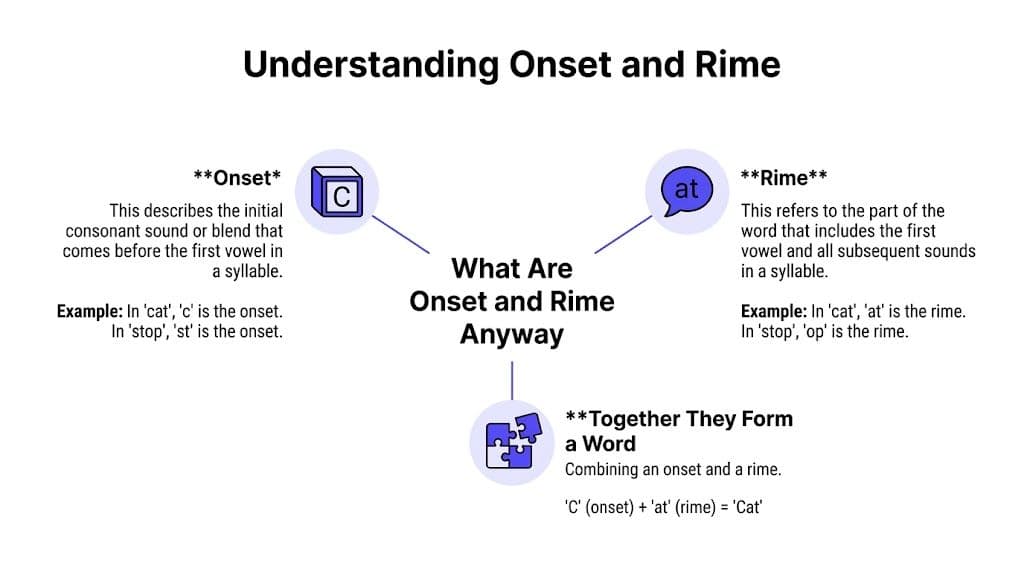
Onset means the initial consonant or consonant blend in a syllable. Rime means the vowel plus the sounds that follow.
The easiest way to explain it to children
I usually call the onset the starting sound and the rime the rhyming part.
That wording helps because children can hear rhymes before they can explain them formally. If they know that cat, hat, and mat sound alike at the end, they're already close to understanding rime.
Try these examples out loud:
- c-at
- p-an
- m-op
- t-ub
Then move to blends:
- fl-ip
- tr-uck
- st-op
- cl-ap
In cat, the onset is c and the rime is at.
In stop, the onset is st and the rime is op.
In climb, the onset is cl and the rime is imb.
Where children often get confused
The biggest mix-up is with blends.
A child might hear stop and say the onset is just s. That's understandable, because they're noticing the first sound. But in onset-rime work, the onset can be more than one consonant sound if those sounds come before the vowel. So in stop, st is the onset.
Another common confusion is vowel-initial words. Some words don't have an onset at all.
Here's a quick classroom reference:
| Word | Onset | Rime |
|---|---|---|
| cat | c | at |
| pan | p | an |
| flip | fl | ip |
| truck | tr | uck |
| apple | none | apple |
That last one matters. In a word like apple, there isn't a consonant before the vowel sound in the first syllable, so there may be no onset in that syllable.
Why this level of sound work matters
Onset and rime are foundational phonological units in syllables, and teaching children to segment and blend them supports reading and spelling development. A Twinkl overview of onset and rime also notes that a 2012 study on preschoolers found a strong rime priming effect, which points to the cognitive importance of rime from an early age.
If you're helping colleagues connect this to the bigger phonological awareness picture, this guide on how to teach phonemic awareness is a useful companion.
Why This Skill Is a Game Changer for Young Readers
Children don't move from hearing whole words straight to manipulating individual phonemes with ease. Most need a stepping stone. Onset and rime often serve that role beautifully.
Instead of asking a child to pull apart every sound in mat, we can first help them hear m + at. That's a more manageable lift. Once that pattern clicks, they start recognising word families and applying them to unfamiliar words.

It helps children decode by analogy
This is the classroom magic. A student who can read hat has a pathway into bat, sat, and flat. They're no longer treating every word as unrelated.
That pattern knowledge matters for both reading and spelling. When children know the rime -op, they can work with hop, top, and shop more efficiently because the ending stays stable.
It sits in the right place developmentally
Onset-rime awareness is often easier than full phoneme segmentation. Children can usually hear larger chunks sooner than they can isolate every sound in sequence.
That's why this skill fits so well in Pre-K, Kindergarten, and Year 1 classrooms. It gives students a way to succeed with sound work before they are fully ready for more detailed phonemic manipulation.
When a child keeps guessing at simple CVC words, I don't assume they need harder phonics. I usually check whether they can hear and blend the word in chunks first.
The evidence lines up with what teachers see
Explicit onset-rime instruction causes significant gains in decoding accuracy. Students struggling with phonological retention can see 20 to 30% improvement in word reading fluency after 10 to 15 minutes of daily practice over 8 weeks, and this skill is embedded in standards such as Common Core RF.K.2c and Australian F-2 phonics benchmarks, according to Five from Five's onset-rime segmentation guidance.
That lines up with everyday practice. Short, focused repetition works. Children don't need hour-long sessions. They need frequent opportunities to hear, sort, blend, and say patterns.
Where it shows up in planning
If you're mapping curriculum, onset and rime belong in your phonological awareness sequence before children are expected to do sustained phoneme-level work independently.
A simple way to think about progression is:
- First: hear whole words and rhymes
- Then: split words into onset and rime
- Next: move toward finer phoneme segmentation and blending
That sequence helps children build confidence instead of feeling like they're constantly behind.
Fun and Effective Ways to Teach Onset and Rime
You don't need fancy materials to teach this well. Some of my best lessons have involved mini whiteboards, picture cards, a pocket chart, and a bit of dramatic teacher voice.
The key is keeping the practice oral, visible, and quick.
Word family sliders
This one is a classic because it works.
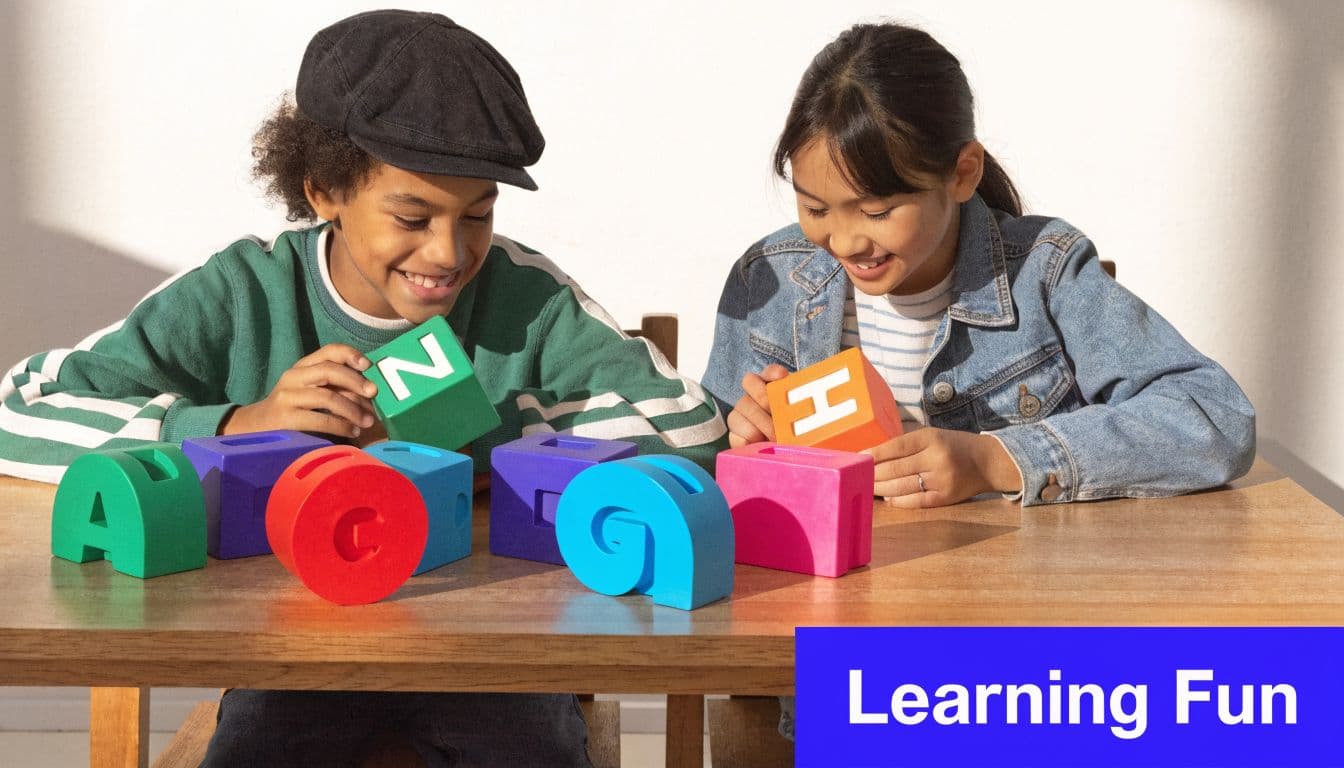
Write a rime such as -at on a card or sentence strip window. Then slide different onsets across the front: c, h, m, s, fl. Students read each word as the onset changes.
Why it works: children get repeated exposure to a stable pattern. Their attention stays on what changes and what stays the same.
A quick routine looks like this:
- Say the rime together: at.
- Add an onset: m.
- Blend it orally: m-at, mat.
- Swap the onset and repeat.
If you're short on prep time, a printable phonics sorting task like this phonics sound sorting activity can save you from making every card by hand.
Onset-rime puzzles
Cut simple pictures and words into two pieces. One piece shows the onset. The other shows the rime. Students match the pieces and then read the completed word.
Examples:
- sn + ake
- st + ar
- r + ake
This kind of hands-on matching works especially well because children physically assemble the word while saying it aloud. If you're interested in the broader idea behind that, this short piece on Experiential Learning explains why active, concrete tasks often stick better than purely verbal explanations.
Whiteboard blending
For whole-group teaching, I love mini whiteboards.
Write a rime on the board, such as -ig. Call out onsets and have students build and read:
- b-ig
- d-ig
- p-ig
Then reverse it. Give the word and ask students to circle the rime or write only the onset.
This activity tells you a lot very quickly. You can spot who is still relying on guessing, who can hear the chunk, and who is ready for blends.
Practical rule: Keep early onset-rime practice brisk. A few accurate, successful rounds beat a long lesson where children drift.
Oral games that don't need paper
Some of the best practice happens in transitions.
Try these:
- Mystery word: “I'm thinking of a word with /h/ and /op/.”
- Stand up if it rhymes: say cake, then rake, sun, lake.
- Pass the sound: one child says the onset, the next says the rime, the class says the whole word.
A short modelling clip can help if you're coaching a teaching assistant or setting up parent support at home:
Keep the teacher talk simple
I don't say, “Today we will segment monosyllabic words into sub-syllabic units.” I say, “We're going to listen for the first part and the rhyming part.”
Children don't need the complex language first. They need the pattern first. Once they can do it, you can layer in the correct terms.
How to Know If Your Students Are Getting It
Assessment for onset and rime doesn't need to look like a formal test. In fact, some of the best information comes from listening closely during regular instruction.
You're watching for whether a child can hear the two parts, blend them smoothly, and use the pattern again in a new word.
What to listen for during lessons
When students work orally, notice these behaviours:
- Accurate blending: Can they hear m + at and say mat without guessing?
- Stable rime recognition: If they read cat, can they use -at again in hat?
- Transfer to spelling: When writing, do they keep the word family pattern intact?
These signs matter because onset-rime work supports spelling pattern generalisation. Mrs Wordsmith's overview of onset and rime notes that onset-rime segmentation can enhance spelling accuracy by 25 to 40% in early writers, and picture-card matching activities have shown 0.6 to 0.8 SD effect sizes in phonological awareness meta-analyses.
Low-prep checks that fit into the school day
I keep these in rotation because they take almost no setup:
- Thumbs up check: Say a word like shop and ask, “Is the rhyming part op?”
- Quick sort: Hand students two rime cards, such as -an and -it, and have them place picture cards underneath.
- One-word exit slip: Show a picture of sun and ask students to write the onset or circle the rime.
- Guided reading prompt: Pause at a decodable word and ask, “What part do you already know?”
If you want a more structured checkpoint, something like this Year 1 phonics check worksheet can help you gather evidence without building an assessment from scratch.
A useful benchmark
If a student is still below 80% accuracy in blending trials, I don't rush ahead to harder tasks. I keep practising with oral blending, pictures, and a narrow set of word families until responses become more secure.
A child who can't consistently blend onset and rime will often struggle later with finer phoneme work. Slow down early and you save time later.
What misunderstanding looks like
Usually it shows up in one of three ways:
| What you hear | What it may mean | Next move |
|---|---|---|
| Child says only first sound | onset is secure, rime isn't | practise with rhyming endings |
| Child guesses from picture | pattern isn't internalised yet | remove picture clues sometimes |
| Child mixes up blends | onset treated as one letter only | teach blend onsets explicitly |
Those little observations will tell you far more than a long test ever could.
Differentiating Onset and Rime for All Learners
No class learns this at the same pace. Some children hear patterns quickly. Others need many more repetitions, more movement, and less language at once.
That's normal. It isn't a sign that the approach has failed. It usually means the delivery needs adjusting.
For children who need extra support
Make the sound work more concrete.
Use magnetic letters, counters, felt squares, or blocks. Say the onset as you move one object. Say the rime as you move the second. Then slide them together and say the whole word.
A few reliable supports:
- Slow the tempo: Give students more processing time between the onset and the rime.
- Reduce the choice load: Work with one rime family at a time, such as -at for several days.
- Add movement: Clap the onset, then tap or stomp the rime.
- Repeat predictably: Keep the routine the same so attention goes to the sounds, not the instructions.
For inclusion settings, oral rehearsal before print is especially helpful. Some students can hear and blend successfully long before they can show the same skill on paper.
For children who are ready to stretch
These students don't need to sit in the same practice loop forever.
You can extend onset-rime work by asking them to:
- build larger word family charts
- sort words by shared rimes but different spellings
- write short rhyming poems
- explore onset-rime chunks within longer words when appropriate
One of my favourite extension tasks is a word family book. Each page features one rime, and students add as many matching words as they can read, write, or illustrate.
Some children need more support to hear the pattern. Others need a reason to do something interesting with it.
For small groups and intervention
Here, teacher judgement matters most.
If a child has weak phonological retention, don't pile on too many examples at once. Keep your set tight. Practise m-at, s-at, h-at before moving to a new family.
If a child is accurate orally but falls apart in print, separate those goals. Teach the hearing and blending first, then bridge to letters. If a child can do isolated examples but not transfer, mix known and new words in the same session.
Differentiation isn't an extra layer you add later. It's the difference between a lesson some children survive and a lesson all children can join.
Putting It All Together for Reading Success
When teachers define onset and rime clearly and teach it on purpose, a lot of early reading problems become easier to solve. Children start hearing the internal structure of words. They stop treating every new word as completely unfamiliar. Spelling begins to look less random too.
The most useful thing about onset-rime instruction is that it bridges theory and practice so neatly. It's grounded in phonological awareness, but it turns into classroom action fast. You can teach it in a short whole-group lesson, reinforce it in small groups, check it during guided reading, and adapt it for the children who need more or less support.
If I were handing this guide to a new colleague, I'd keep the message simple:
- Teach the parts out loud first
- Use clear word family patterns
- Watch closely for transfer into reading and spelling
- Adjust pace and support before moving on
That's the work.
And if you're supporting children beyond the classroom, systems used by tutoring teams can also help with consistency across staff. Tools designed for scheduling, records, and lesson coordination, such as Tutorbase for tutoring centers, can make that follow-through easier when multiple adults are involved in literacy support.
The good news is that onset and rime doesn't need to be complicated to be powerful. A few smart routines, taught well and repeated often, can give young readers a strong foothold.
If you want to turn these ideas into a full sequence of lessons, printable practice, and standards-aligned assessments without losing your planning time, Kuraplan is worth a look. It helps teachers build phonics lessons, worksheets, and differentiated supports quickly, so you can spend more time teaching and less time formatting.