MathematicsFreePrintable

Candle Geometry Activities

A free mathematics worksheet ready for your classroom. Open in Kuraplan to grab the print-ready PDF, customize it for your students, or generate a fresh version in seconds.
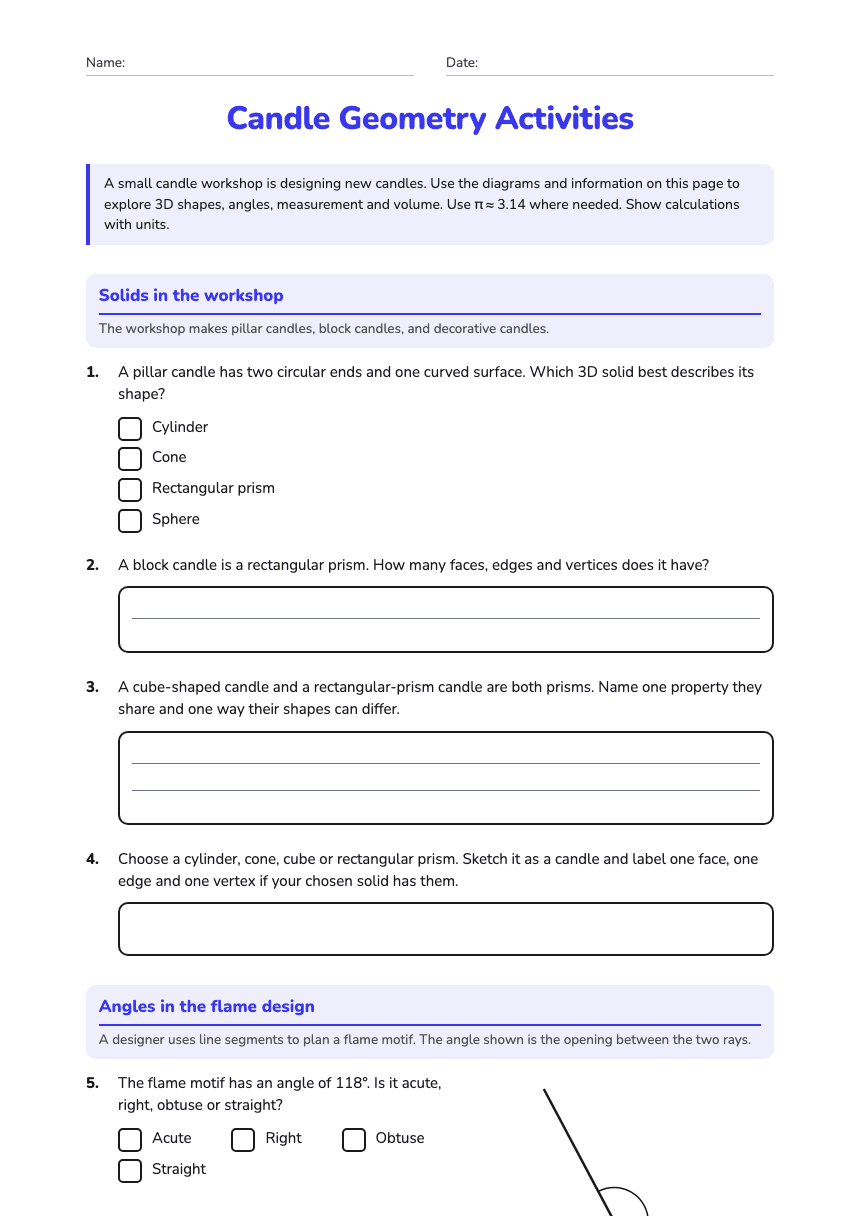
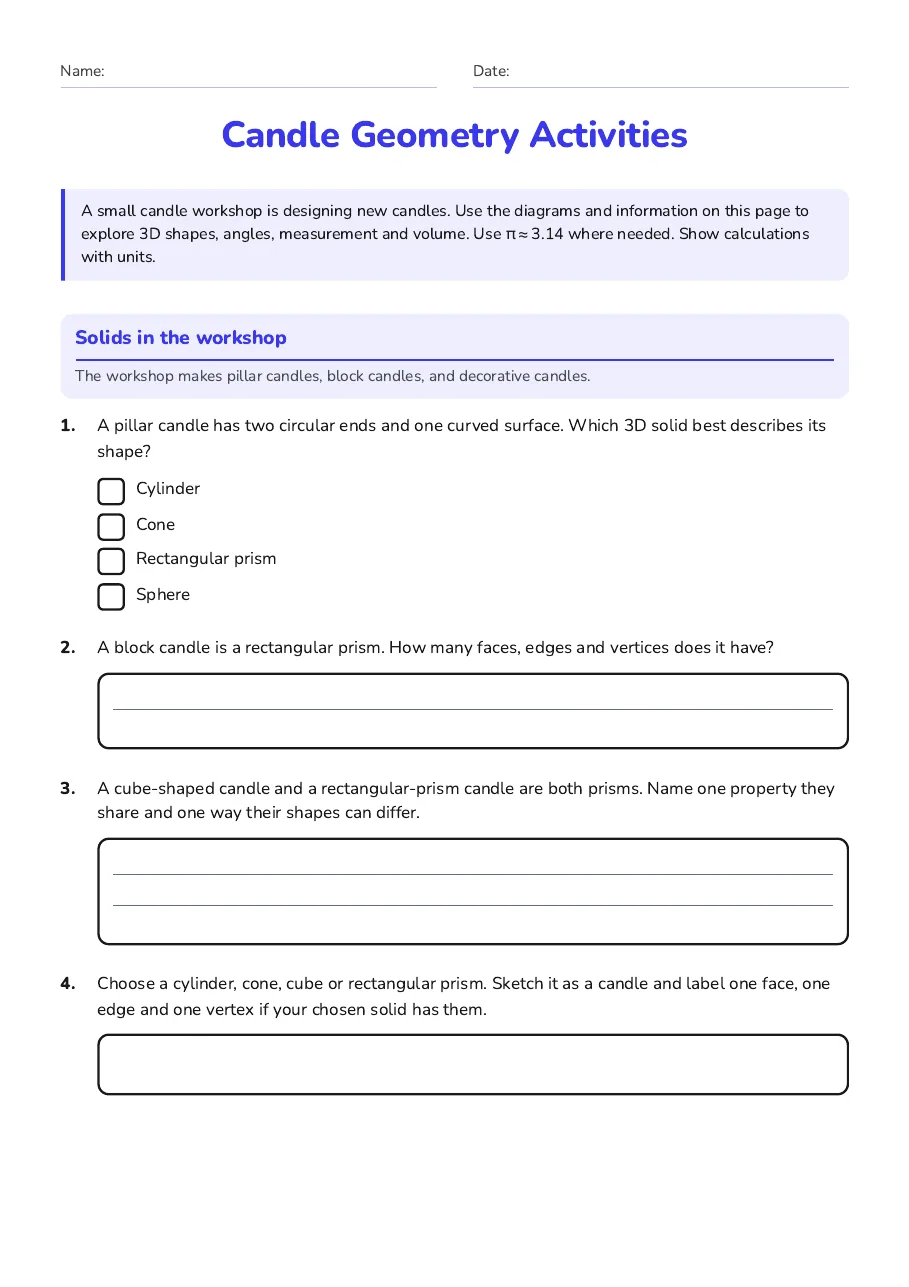
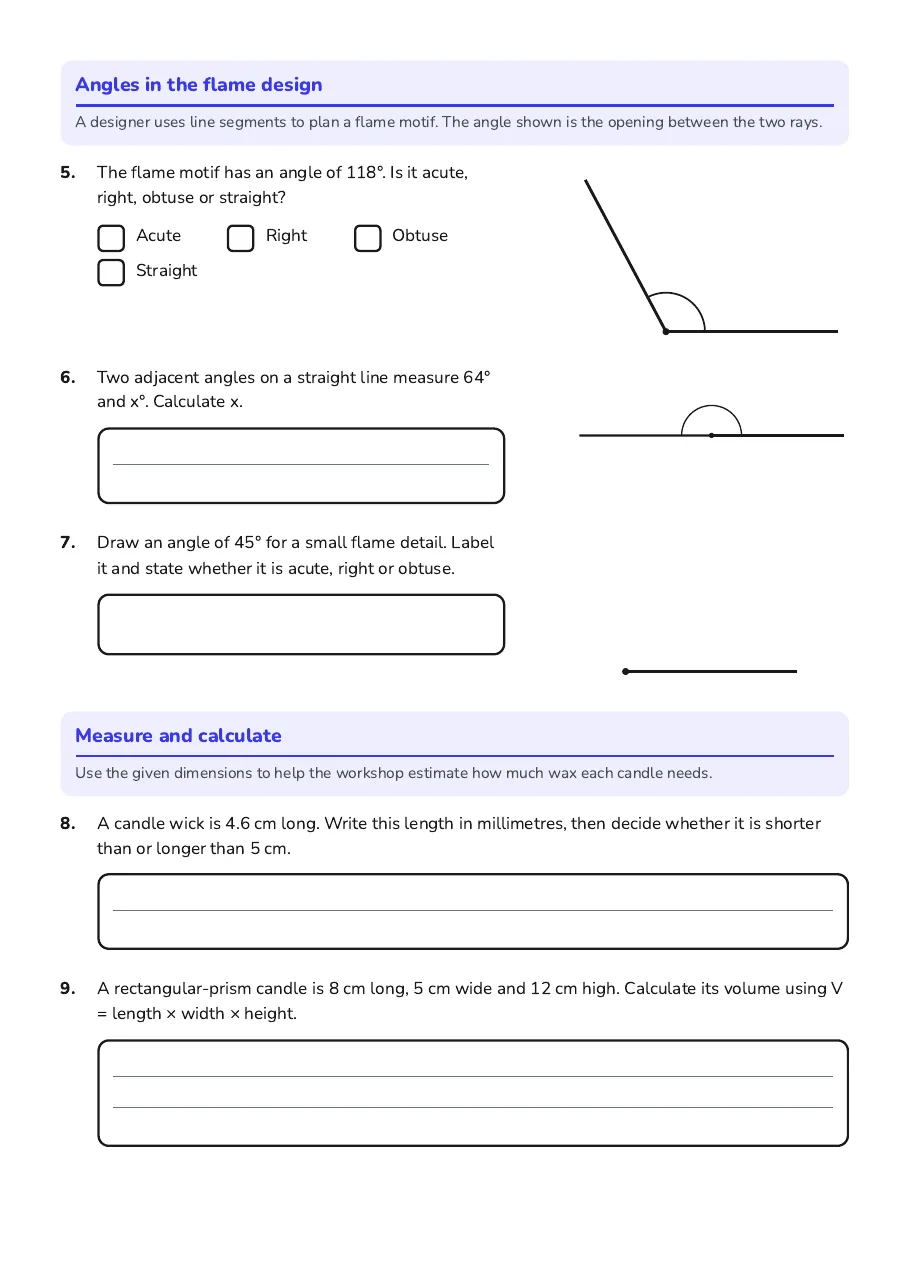
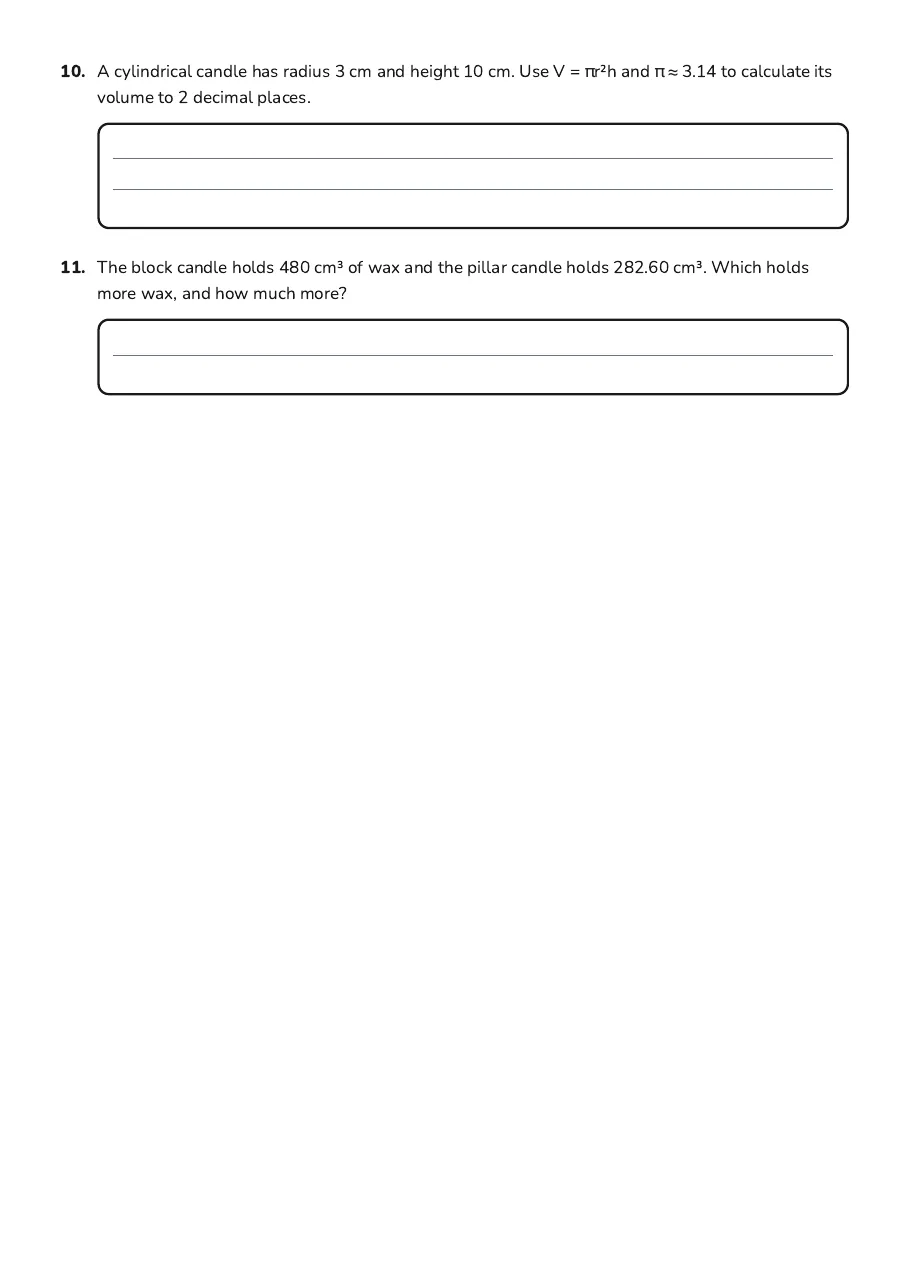
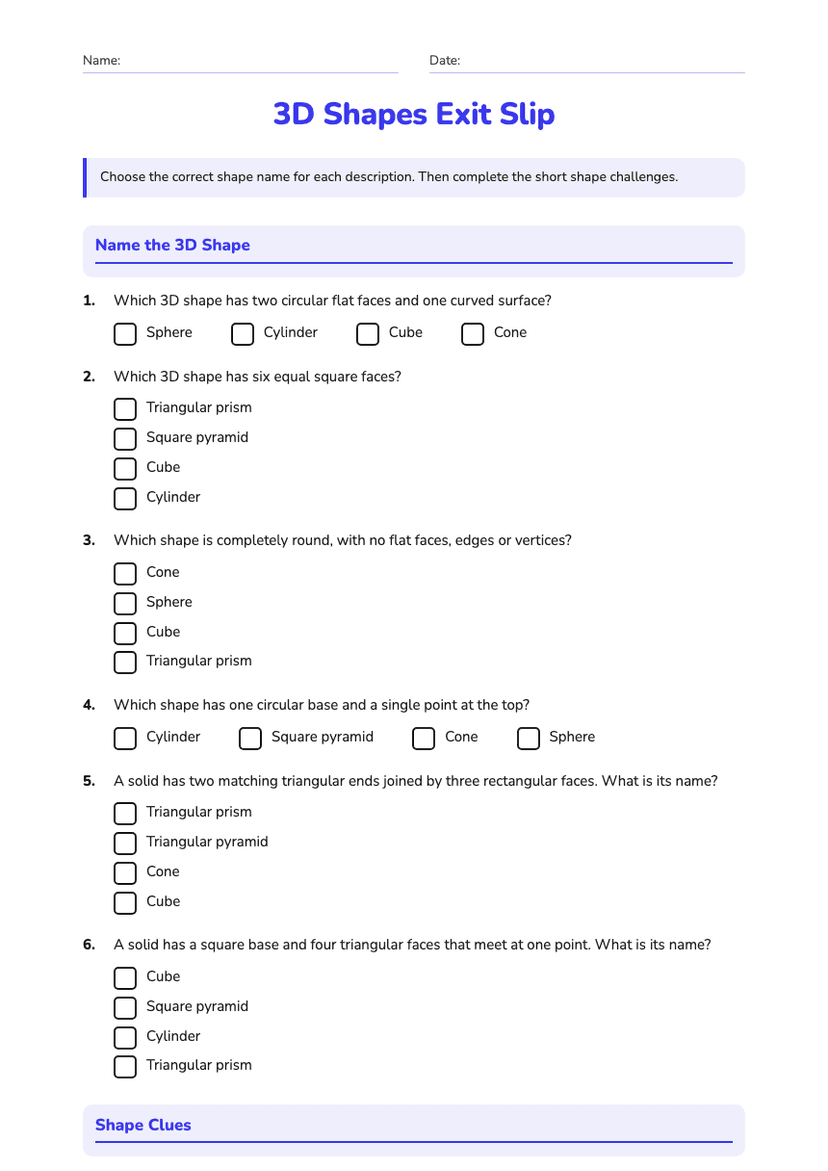
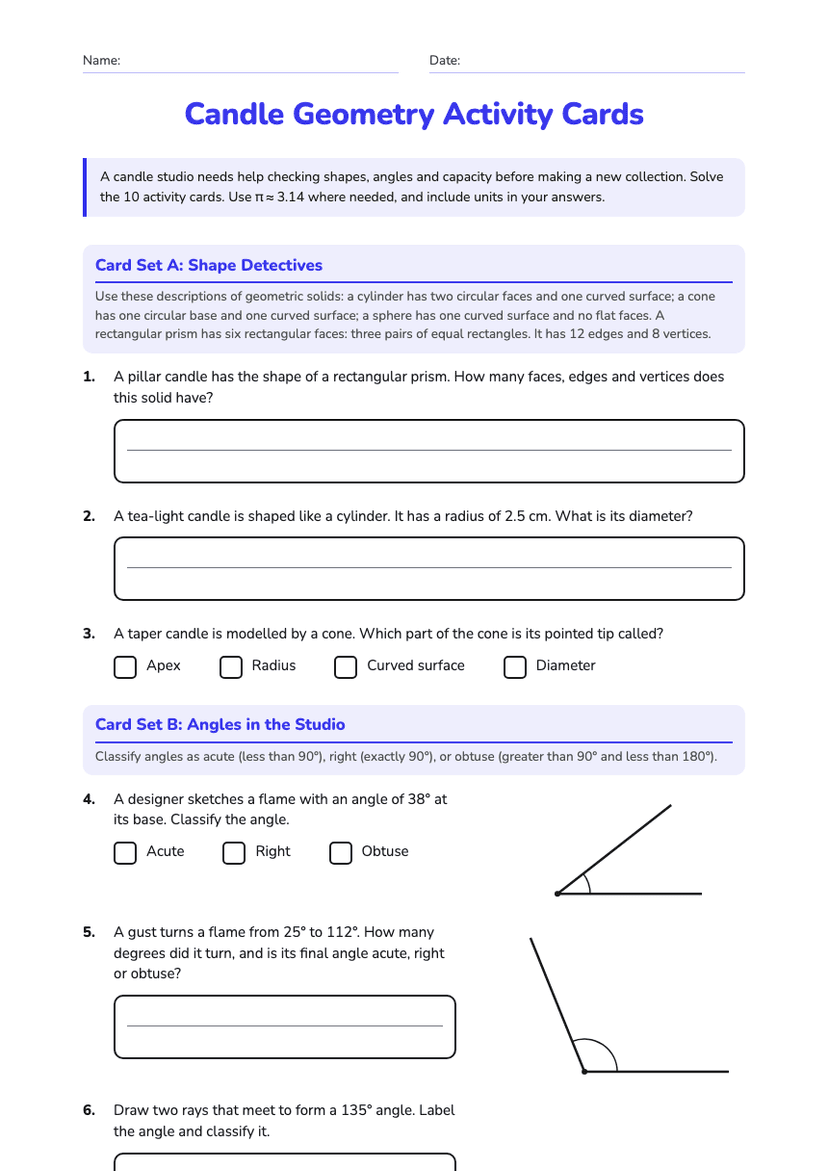
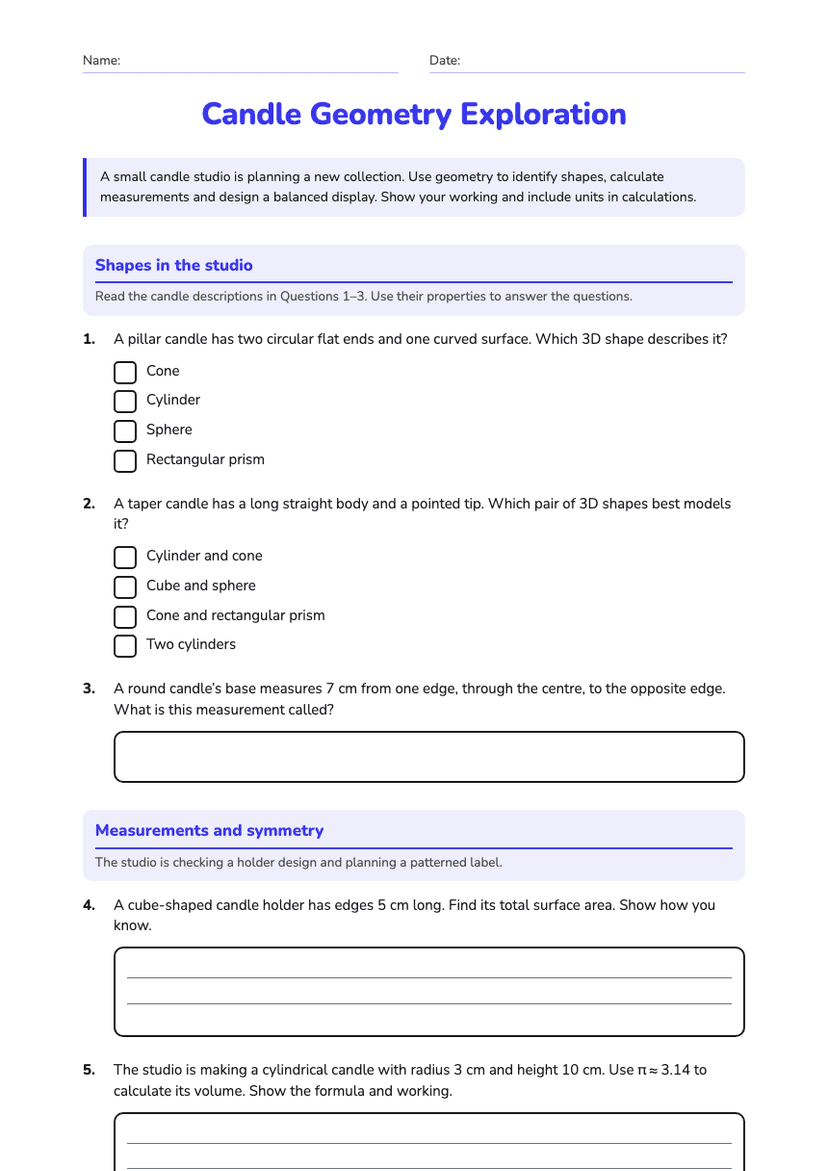
Candle Geometry Activities worksheet preview

🕯️ Candle Geometry Activities

Montessori Mathematics — Geometry Work Cycle

Candle geometry illustration

🕯️ Material 1 — Measuring Candle Wicks

About this material: Each card shows a candle with a wick drawn to scale. Students measure the wick using a ruler and record the length in centimetres and millimetres.

📋 Direction Card — Measuring Candle Wicks

You will need: Wick Measurement Cards 1–8, a ruler, and your recording sheet.

Steps:

1. Choose a Wick Card. Place your ruler so the 0 cm mark lines up with the base of the wick.

2. Read the measurement at the tip of the wick. Record the length in centimetres and millimetres.

3. Write whether the wick is shorter than, equal to, or longer than 3 cm.

4. Work through all 8 cards, then check your answers with the Control of Error Card.

Extension: Order all 8 wicks from shortest to longest. Calculate the difference between the longest and shortest wick.

Differentiation: Beginners may measure to the nearest centimetre only. Advanced learners record in millimetres and convert to metres.

✅ Control of Error Card — Measuring Candle Wicks

After completing all 8 cards, check your measurements below.

Wick Card Answers (cm / mm):

Card 1: 2.3 cm / 23 mm  |  Card 2: 4.5 cm / 45 mm  |  Card 3: 1.8 cm / 18 mm  |  Card 4: 3.0 cm / 30 mm

Card 5: 5.2 cm / 52 mm  |  Card 6: 0.7 cm / 7 mm  |  Card 7: 3.6 cm / 36 mm  |  Card 8: 2.9 cm / 29 mm

Shortest wick: Card 6 (7 mm)  |  Longest wick: Card 5 (52 mm)  |  Difference: 45 mm

📝 Student Recording Sheet — Measuring Candle Wicks

1. Measure each wick and record your findings in the table below.

Card 1: Length = _______ cm = _______ mm   Shorter / Equal / Longer than 3 cm (circle one)

Card 2: Length = _______ cm = _______ mm   Shorter / Equal / Longer than 3 cm

Card 3: Length = _______ cm = _______ mm   Shorter / Equal / Longer than 3 cm

Card 4: Length = _______ cm = _______ mm   Shorter / Equal / Longer than 3 cm

Card 5: Length = _______ cm = _______ mm   Shorter / Equal / Longer than 3 cm

Card 6: Length = _______ cm = _______ mm   Shorter / Equal / Longer than 3 cm

Card 7: Length = _______ cm = _______ mm   Shorter / Equal / Longer than 3 cm

Card 8: Length = _______ cm = _______ mm   Shorter / Equal / Longer than 3 cm

2. Order the 8 wick lengths from shortest to longest.

_______ , _______ , _______ , _______ , _______ , _______ , _______ , _______

3. (Extension) What is the difference in millimetres between the longest and shortest wick?

📐 Material 2 — DIY Geometric Figures: Candle Shapes

About this material: Each card shows the net (flat pattern) of a 3D candle shape. Students identify the shape, name its faces, and sketch or build the 3D figure.

📋 Direction Card — DIY Geometric Figures

You will need: Shape Cards 1–8, pencil, ruler, scissors (optional), and your recording sheet.

Steps:

1. Look at the net on each card. Name the 3D shape it will make (e.g., cylinder, rectangular prism, cone).

2. Count and record the number of faces, edges, and vertices.

3. In the drawing box, sketch the 3D shape as it would look assembled.

4. Label which candle type each shape represents (pillar, taper, votive, tealight, etc.).

5. Check your answers with the Control of Error Card.

Extension: Fold and tape the net to build a physical model. Calculate the surface area of one face.

Differentiation: Beginners focus only on naming the shape and counting faces. Advanced learners complete all columns including edges and vertices.

✅ Control of Error Card — DIY Geometric Figures

Card 1 — Cylinder (pillar candle): Faces 3, Edges 2, Vertices 0
Card 2 — Cone (taper candle tip): Faces 2, Edges 1, Vertices 1
Card 3 — Rectangular Prism (block candle): Faces 6, Edges 12, Vertices 8
Card 4 — Cube (votive candle): Faces 6, Edges 12, Vertices 8
Card 5 — Triangular Prism (decorative candle): Faces 5, Edges 9, Vertices 6
Card 6 — Sphere (ball candle): Faces 1 curved, Edges 0, Vertices 0
Card 7 — Hexagonal Prism (honeycomb candle): Faces 8, Edges 18, Vertices 12
Card 8 — Square Pyramid (pyramid candle): Faces 5, Edges 8, Vertices 5

📝 Student Recording Sheet — DIY Geometric Figures

4. For each Shape Card, record the 3D shape name and its properties.

Card 1: Shape = _________________   Faces = _____   Edges = _____   Vertices = _____   Candle type = _________________

Card 2: Shape = _________________   Faces = _____   Edges = _____   Vertices = _____   Candle type = _________________

Card 3: Shape = _________________   Faces = _____   Edges = _____   Vertices = _____   Candle type = _________________

Card 4: Shape = _________________   Faces = _____   Edges = _____   Vertices = _____   Candle type = _________________

Card 5: Shape = _________________   Faces = _____   Edges = _____   Vertices = _____   Candle type = _________________

Card 6: Shape = _________________   Faces = _____   Edges = _____   Vertices = _____   Candle type = _________________

Card 7: Shape = _________________   Faces = _____   Edges = _____   Vertices = _____   Candle type = _________________

Card 8: Shape = _________________   Faces = _____   Edges = _____   Vertices = _____   Candle type = _________________

5. Sketch one 3D candle shape of your choice in the box below. Label all faces.

🔥 Material 3 — Identifying Flame Angles

About this material: Each card shows a stylised candle flame with two lines forming an angle. Students classify the angle and estimate or measure its degree.

📋 Direction Card — Identifying Flame Angles

You will need: Flame Angle Cards 1–8, a protractor, pencil, and your recording sheet.

Steps:

1. Look at the angle formed by the two lines on the flame card.

2. Classify the angle as: Acute (less than 90°), Right (exactly 90°), or Obtuse (greater than 90°).

3. Use your protractor to measure the angle to the nearest degree.

4. Record your classification and measurement on the recording sheet.

5. Check your work with the Control of Error Card.

Extension: Draw your own flame angle card. Write a word problem using the angle (e.g., "The flame tilts at ___ ° in the wind…").

Differentiation: Beginners classify only (no measurement). Advanced learners calculate the supplementary angle for each flame angle.

✅ Control of Error Card — Identifying Flame Angles

Card 1: 35° — Acute  |  Card 2: 90° — Right  |  Card 3: 120° — Obtuse  |  Card 4: 47° — Acute
Card 5: 155° — Obtuse  |  Card 6: 72° — Acute  |  Card 7: 90° — Right  |  Card 8: 108° — Obtuse

Supplementary angles (Extension): Card 1 = 145°, Card 2 = 90°, Card 3 = 60°, Card 4 = 133°, Card 5 = 25°, Card 6 = 108°, Card 7 = 90°, Card 8 = 72°

📝 Student Recording Sheet — Identifying Flame Angles

6. Measure each flame angle and classify it. Circle your classification.

Card 1: Measurement = _______ °   Classification:   Acute  /  Right  /  Obtuse

Card 2: Measurement = _______ °   Classification:   Acute  /  Right  /  Obtuse

Card 3: Measurement = _______ °   Classification:   Acute  /  Right  /  Obtuse

Card 4: Measurement = _______ °   Classification:   Acute  /  Right  /  Obtuse

Card 5: Measurement = _______ °   Classification:   Acute  /  Right  /  Obtuse

Card 6: Measurement = _______ °   Classification:   Acute  /  Right  /  Obtuse

Card 7: Measurement = _______ °   Classification:   Acute  /  Right  /  Obtuse

Card 8: Measurement = _______ °   Classification:   Acute  /  Right  /  Obtuse

7. How many of the 8 flame angles were acute? _______   Right? _______   Obtuse? _______
8. (Extension) Choose one flame angle and calculate its supplementary angle. Show your work.

📦 Material 4 — Volume Calculation Cards

About this material: Each card gives the dimensions of a candle shape. Students use the correct volume formula to calculate how much wax the candle holds.

Key Formulas:

🔷 Cylinder: V = π × r² × h  |  🔶 Rectangular Prism: V = l × w × h  |  🔺 Cone: V = ⅓ × π × r² × h  |  🔹 Square Pyramid: V = ⅓ × l × w × h

Use π ≈ 3.14. Give all answers in cm³, rounded to 2 decimal places.

📋 Direction Card — Volume Calculation Cards

You will need: Volume Cards 1–8, pencil, calculator (optional), and your recording sheet.

Steps:

1. Read the candle shape and dimensions on each card.

2. Choose the correct volume formula from the Formula Reference Card.

3. Substitute the values into the formula and solve step by step in your work box.

4. Write your final answer in cm³.

5. Check your answer with the Control of Error Card.

Extension: Convert your answer from cm³ to mL (1 cm³ = 1 mL). If wax costs $0.03 per mL, calculate the cost of wax for each candle.

Differentiation: Beginners use only rectangular prism cards (Cards 1–3). Advanced learners complete all 8 cards and the cost extension.

✅ Control of Error Card — Volume Calculation Cards

Card 1 — Rectangular Prism (l=8, w=8, h=10 cm): V = 640.00 cm³
Card 2 — Rectangular Prism (l=5, w=5, h=12 cm): V = 300.00 cm³
Card 3 — Rectangular Prism (l=6, w=4, h=9 cm): V = 216.00 cm³
Card 4 — Cylinder (r=3, h=15 cm): V = 423.90 cm³
Card 5 — Cylinder (r=4, h=10 cm): V = 502.40 cm³
Card 6 — Cylinder (r=2, h=7 cm): V = 87.92 cm³
Card 7 — Cone (r=3, h=12 cm): V = 113.04 cm³
Card 8 — Square Pyramid (l=6, w=6, h=9 cm): V = 108.00 cm³

Extension (cost at $0.03/mL): Card 1 = $19.20 | Card 4 = $12.72 | Card 7 = $3.39 | Card 8 = $3.24

📝 Student Recording Sheet — Volume Calculation Cards

9. Complete each volume calculation. Show your work clearly.

Card 1 — Rectangular Prism (l = 8 cm, w = 8 cm, h = 10 cm)

Formula used: _______________________

Volume = _____________ cm³

Card 2 — Rectangular Prism (l = 5 cm, w = 5 cm, h = 12 cm)

Formula used: _______________________

Volume = _____________ cm³

Card 3 — Rectangular Prism (l = 6 cm, w = 4 cm, h = 9 cm)

Formula used: _______________________

Volume = _____________ cm³

Card 4 — Cylinder (r = 3 cm, h = 15 cm)

Formula used: _______________________

Volume = _____________ cm³

Card 5 — Cylinder (r = 4 cm, h = 10 cm)

Formula used: _______________________

Volume = _____________ cm³

Card 6 — Cylinder (r = 2 cm, h = 7 cm)

Formula used: _______________________

Volume = _____________ cm³

Card 7 — Cone (r = 3 cm, h = 12 cm)

Formula used: _______________________

Volume = _____________ cm³

Card 8 — Square Pyramid (l = 6 cm, w = 6 cm, h = 9 cm)

Formula used: _______________________

Volume = _____________ cm³

10. Which candle holds the most wax? _________________   How much more wax does it hold than the smallest candle? Show your work.
11. (Extension) If wax costs $0.03 per mL, and 1 cm³ = 1 mL, calculate the cost of wax for the cylinder candle on Card 4.

💭 Reflection

12. Which material did you find most challenging and why?
13. What is one geometry fact you learned from these candle activities?

About This Worksheet

Free in Kuraplan

Sign up free, grab the PDF, and customize it for your class.

Print-Ready

Formatted for standard paper. Clean layout, easy to read.

AI-Generated

Created with Kuraplan's AI, designed for real classroom use.

For Teachers & Parents

Use in classrooms, for homework, tutoring, or homeschool.

Need a custom version of this worksheet?

Kuraplan's AI generates custom worksheets in seconds — differentiated for every learner, aligned to your curriculum.

Generate Custom Worksheets — Free
No credit card Curriculum-aligned Under 60 seconds