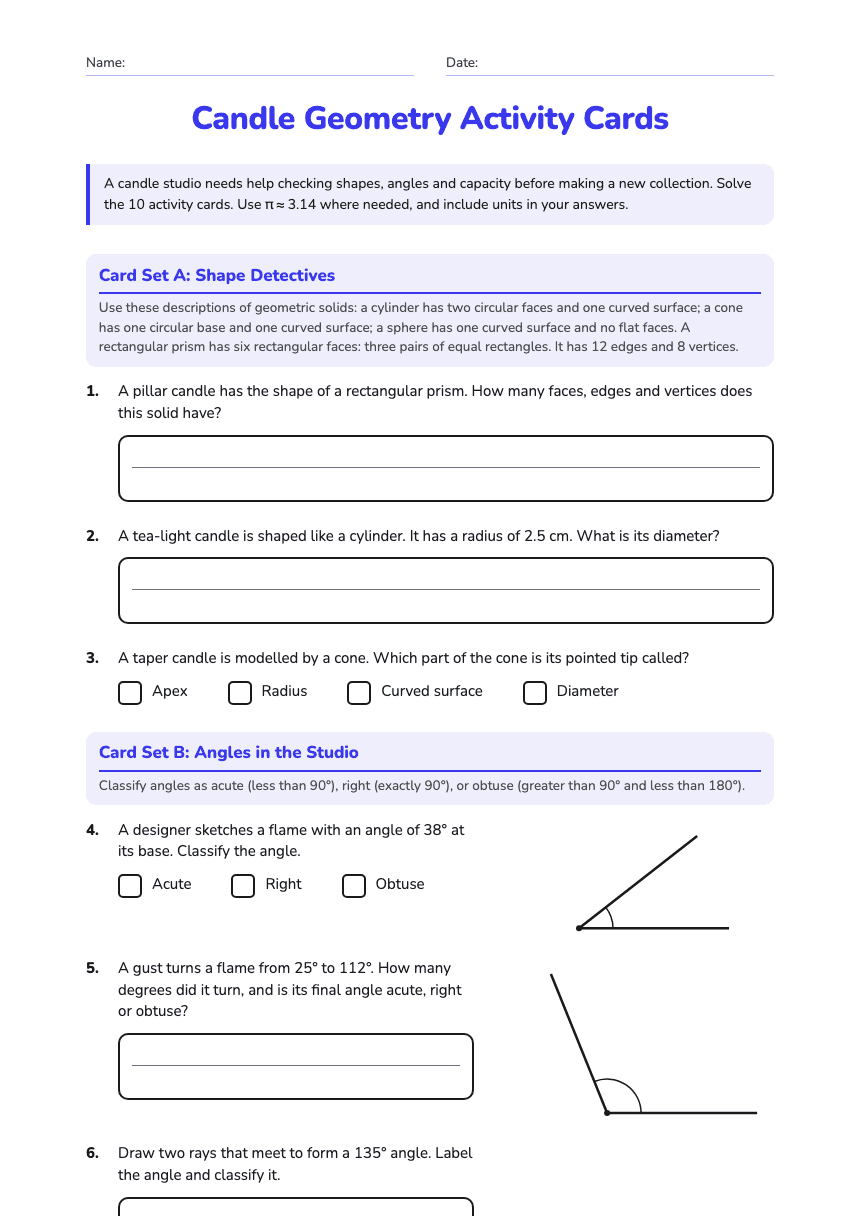
Candle Geometry Activity Cards
A free mathematics worksheet ready for your classroom. Open in Kuraplan to grab the print-ready PDF, customize it for your students, or generate a fresh version in seconds.
Candle Geometry Activity Cards
Montessori Mathematics Material Set
🕯️ MATERIAL SET OVERVIEW — Teacher & Student Guide
This Montessori material set contains four card series, each with 8 activity cards, 1 direction card, and 1 control of error card. Work through one series at a time on a mat or tray.
📋 Direction Card — How to Use This Material
1. Choose one card series (Series A, B, C, or D).
2. Lay the cards face-up on your mat in order from Card 1 to Card 8.
3. Complete the task shown on each card using the materials on your tray.
4. Record your answers in your Geometry Journal.
5. When finished, flip the Control of Error Card to check your work.
6. Return all cards neatly to their envelope.
🎯 Differentiation Strategies
For learners who need support: Work with a partner; use a number line or formula reference card; complete only Cards 1–4 in each series first.
For advanced learners: Complete the Extension Challenge printed on the back of each card. Compare two candle shapes and explain which holds more wax and why.
For English Language Learners: A visual vocabulary card with diagrams of all geometry terms is available as a companion card.
📏 SERIES A — Measuring Candle Wicks with a Ruler
Materials needed: ruler (cm), pencil, Geometry Journal
🗂️ Direction Card — Series A
Use your ruler to measure the wick shown on each card. Record the measurement in centimetres. Round to the nearest half centimetre. Compare your measurement to the control of error card when done.
Measure the wick line below. Write the length: _________ cm
Wick line printed here — 3.5 cm (teacher prints actual line at correct length)
Length: _________ cm Is this wick longer or shorter than Card A1? _________
Wick 1: _________ cm Wick 2: _________ cm Difference: _________ cm
Length in cm: _________ cm Length in mm: _________ mm
Wick A: _________ cm Wick B: _________ cm Wick C: _________ cm
Order (shortest → longest): _______ , _______ , _______
Measured length: _________ cm Needs trimming? Yes / No
Show your subtraction: 1.4 − 0.6 = _________ cm
Equation: _________ ÷ _________ = _________ cm per wick
✅ Control of Error Card — Series A
(Print answers on the back of this card or in a sealed envelope)
A1: 3.5 cm | A2: 5.0 cm, longer | A3: varies by print — difference is key | A4: multiply cm × 10 | A5: order by measured value | A6: if > 0.6 cm → Yes | A7: 0.8 cm | A8: 24 ÷ 12 = 2 cm
⭐ Extension Activity — Series A
Measure 5 real objects in your classroom. Which is closest in length to a candle wick (0.6 cm)? Record in your journal with a sketch.
📐 SERIES B — DIY Geometric Figures: Candle Shapes
Materials needed: pencil, ruler, compass (optional), Geometry Journal
🗂️ Direction Card — Series B
Each card shows a candle shape made from a geometric figure. Identify the shape, label its parts, and answer the question. Use your ruler to measure when needed. Check your answers with the Control of Error Card.
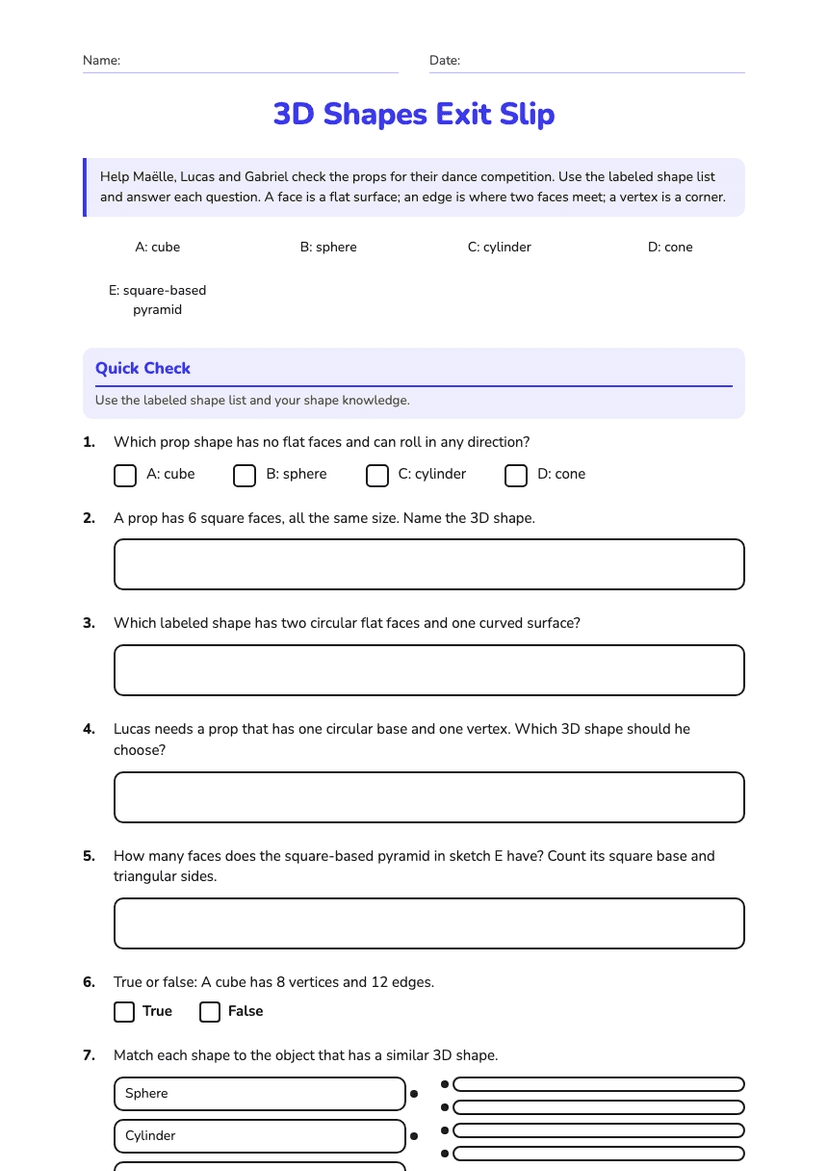
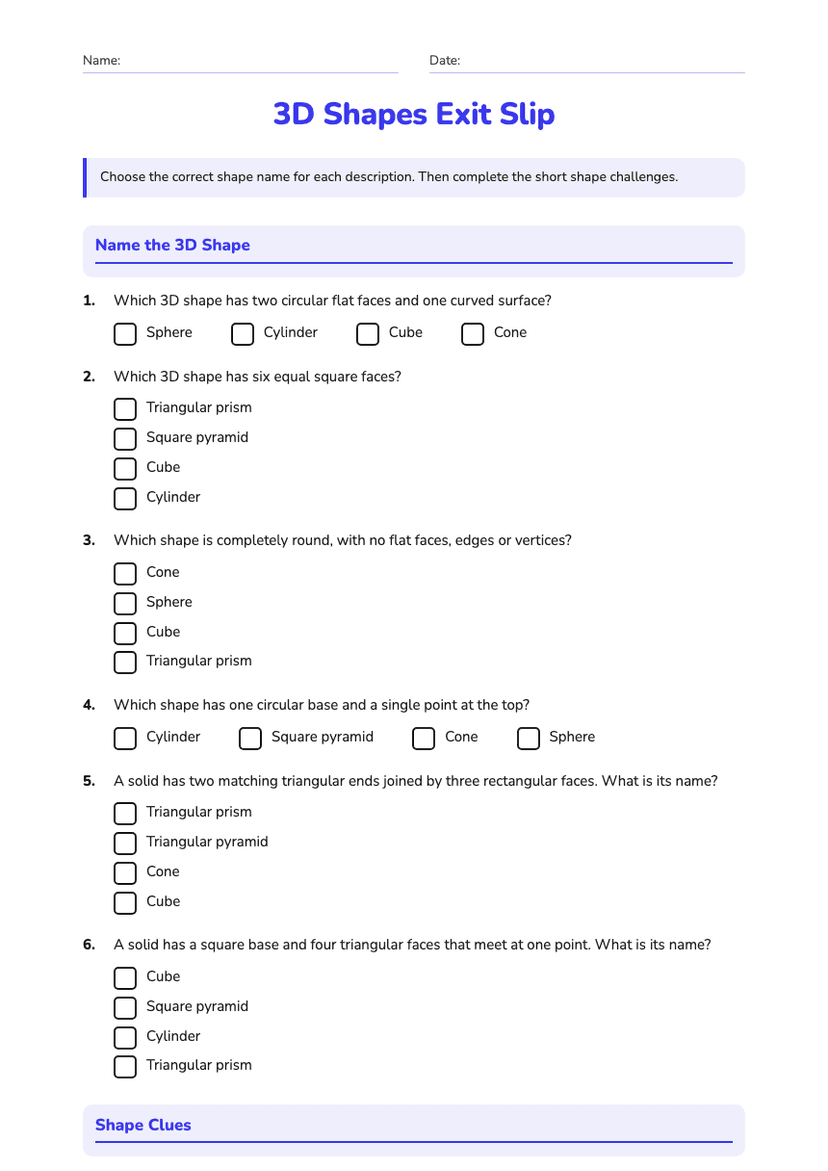
Number of faces: _________ Number of edges: _________ Number of vertices: _________
d = _________ cm
r = _________ cm
Perimeter = _________ × _________ = _________ cm
Number of rectangular faces: _________
Sides: _________ Angles: _________ Lines of symmetry: _________
Name of my candle shape: _________________________
✅ Control of Error Card — Series B
B1: 6 faces, 12 edges, 8 vertices | B2: apex at top, base at bottom, slant connects both | B3: d = 4 cm | B4: r = 4 cm | B5: 4 × 5 = 20 cm | B6: 3 rectangular faces | B7: 6 sides, 6 angles, 6 lines of symmetry | B8: teacher reviews for accuracy of labels
⭐ Extension Activity — Series B
Find a candle at home or in a picture. Identify its geometric shape. Write 3 properties of that shape in your Geometry Journal. Can you find the same shape in another everyday object?
🔥 SERIES C — Flame Angle Identification Cards
Materials needed: protractor, pencil, Geometry Journal
🗂️ Direction Card — Series C
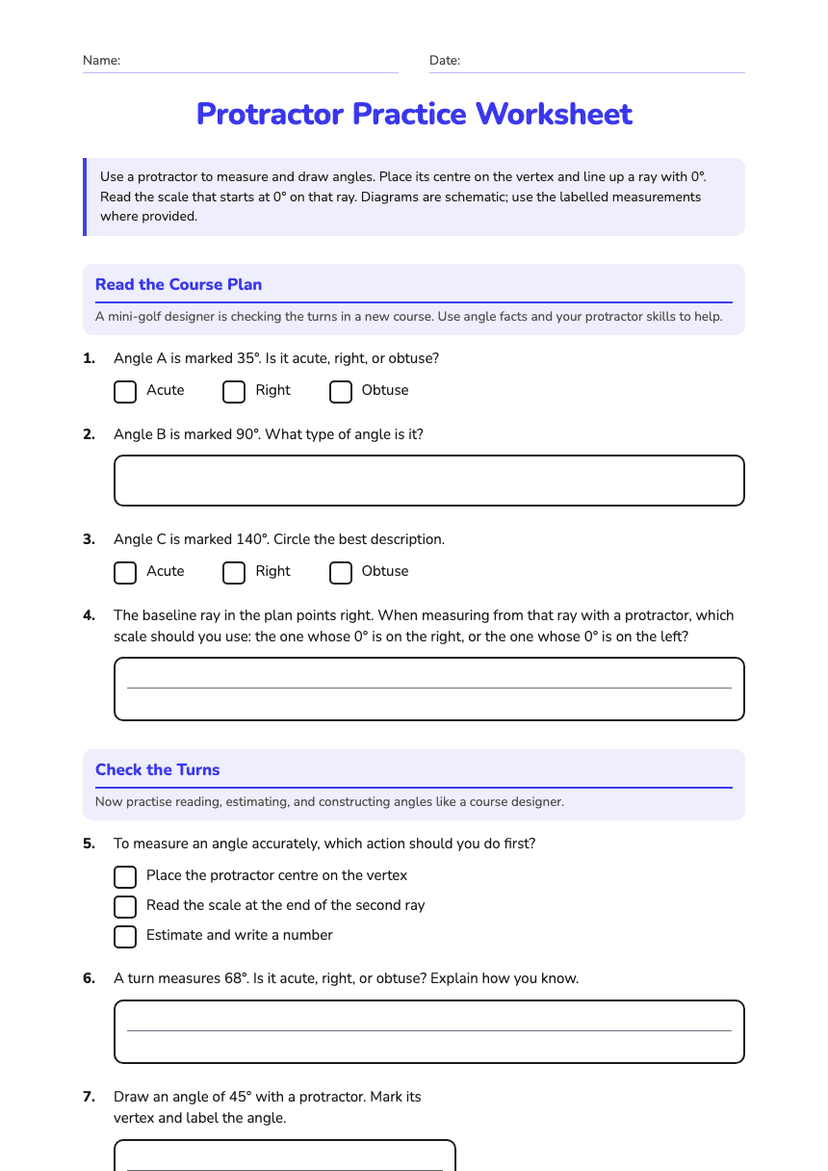
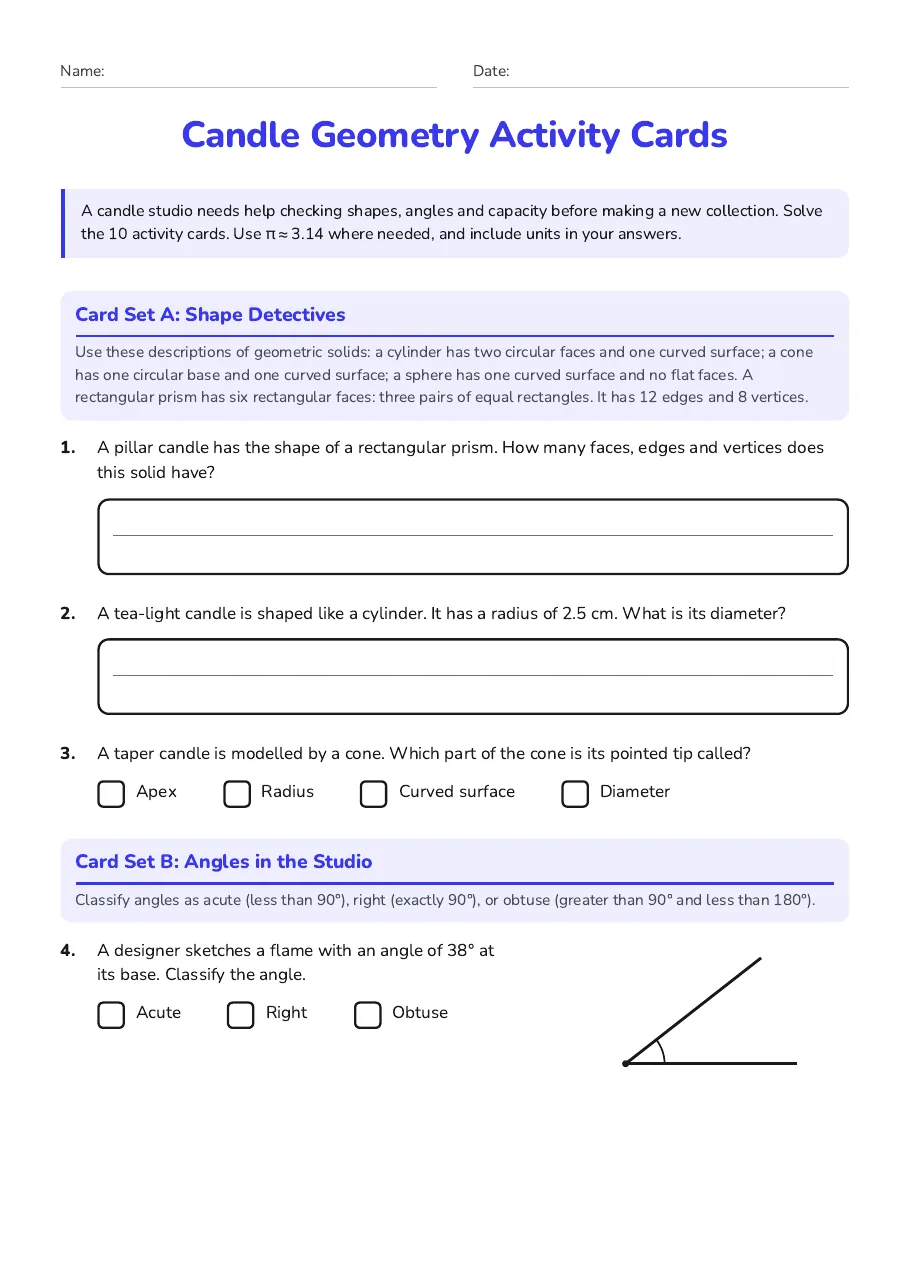
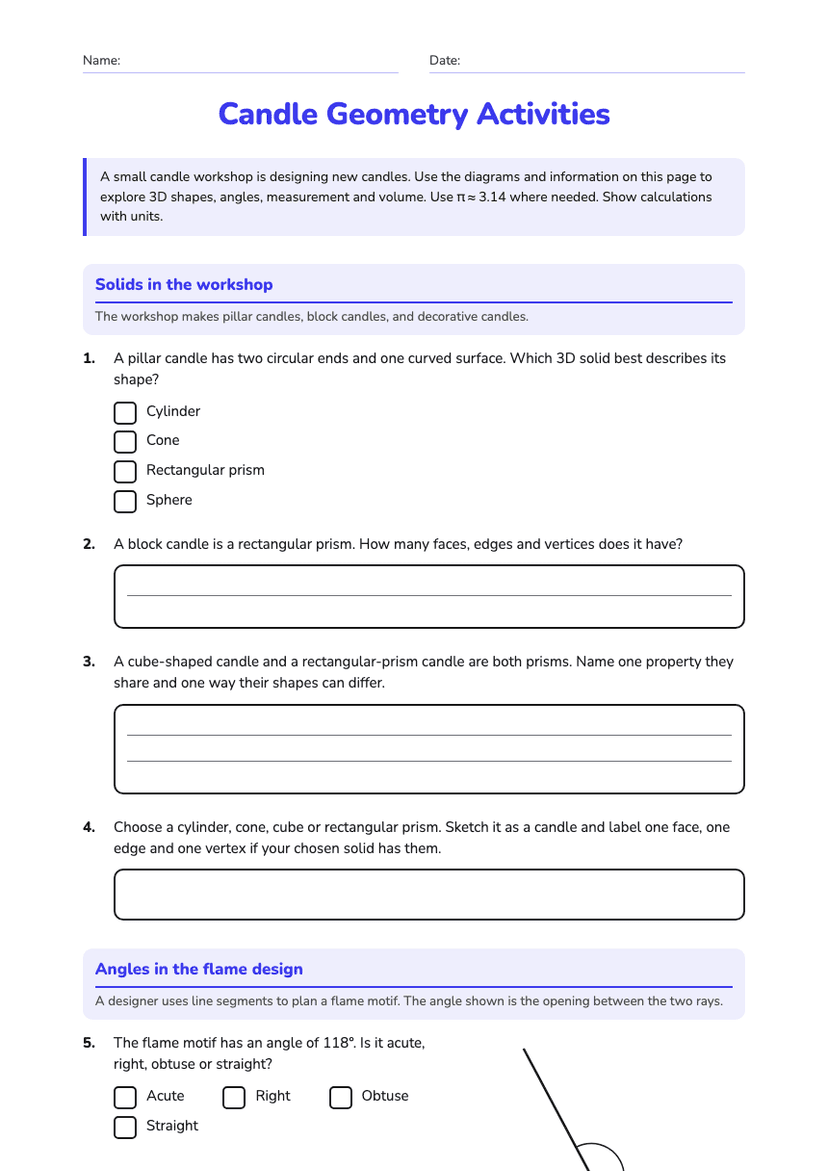
Each card shows a candle flame drawn at an angle. Use a protractor to measure the angle at the base of the flame. Classify the angle as acute (less than 90°), right (exactly 90°), or obtuse (greater than 90°). Record your answers and check with the Control of Error Card.
Measured angle: _________ ° Type: Acute / Right / Obtuse
Angle: _________ ° Type: Acute / Right / Obtuse
Flame A: _________ Flame B: _________
Which flame is leaning more? _________________________
Classification: _________________________
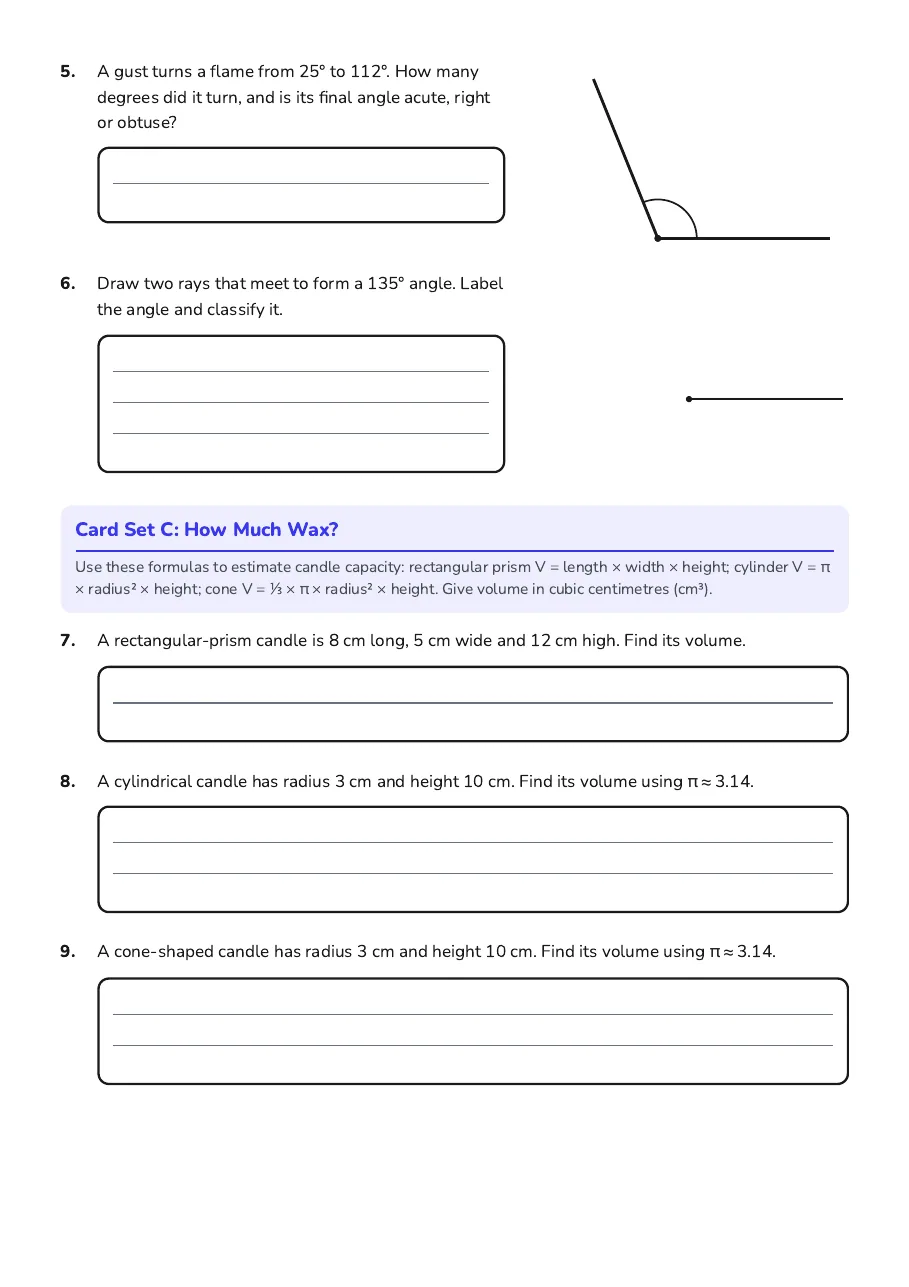
Degrees moved: 110 − 25 = _________ °
Final angle type: _________________________
✅ Control of Error Card — Series C
C1: teacher sets printed angle (suggested 35° — acute) | C2: 90° — right | C3: teacher sets printed angle (suggested 115° — obtuse) | C4: Flame A = acute, Flame B = obtuse, Flame B leans more | C5: 30° = acute | C6: 90° = right | C7: 135° = obtuse | C8: 85° moved, final = obtuse
⭐ Extension Activity — Series C
Look at 5 photos of candle flames online or in a book. Estimate the angle each flame makes. Classify each one. Record in your journal with a sketch. Which type of angle appears most often?
🧮 SERIES D — Volume Calculation Cards for Candle Shapes
Materials needed: pencil, calculator (optional), Geometry Journal
Key Formulas: Cylinder: V = π × r² × h | Rectangular Prism: V = l × w × h | Cone: V = ⅓ × π × r² × h | Sphere: V = 4/3 × π × r³ | Use π ≈ 3.14
🗂️ Direction Card — Series D
Each card gives the dimensions of a candle. Choose the correct formula, substitute the values, and calculate the volume in cubic centimetres (cm³). Show all your work. Check answers with the Control of Error Card.
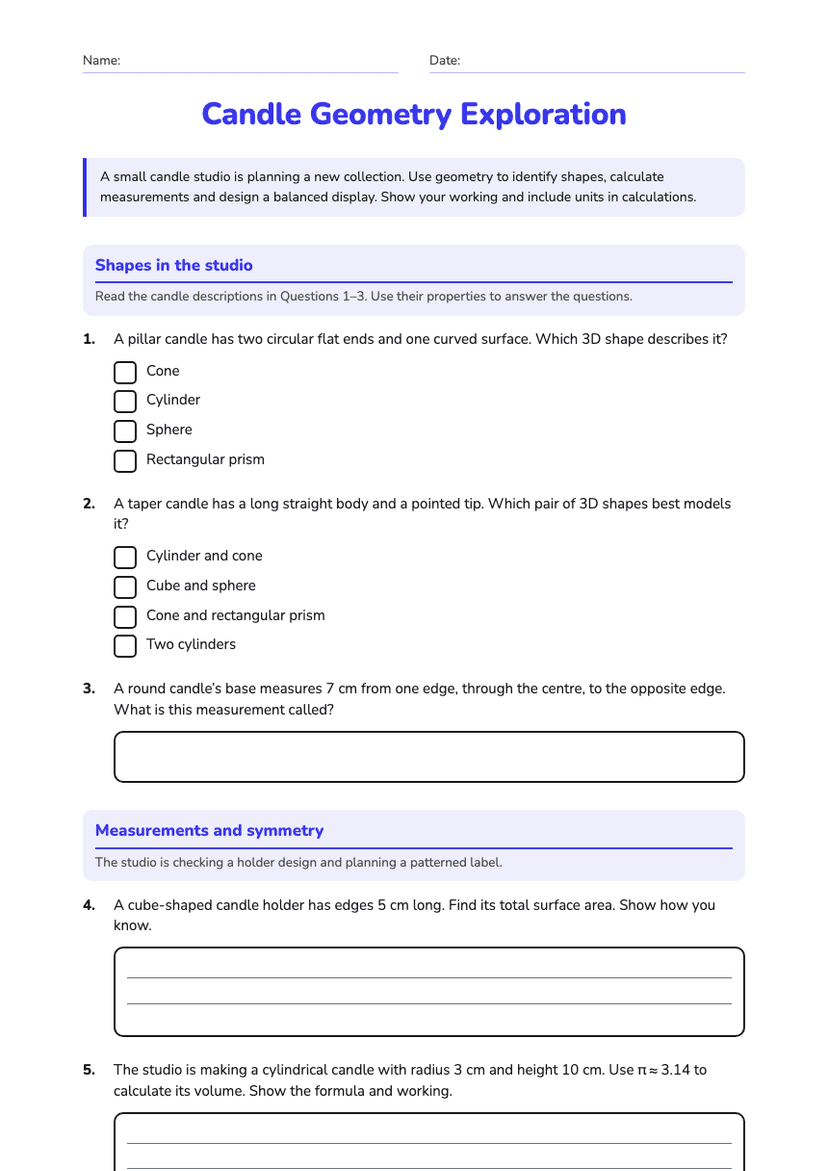
Formula: V = π × r² × h
V = 3.14 × ______² × ______ = _________ cm³
Formula: V = l × w × h
V = ______ × ______ × ______ = _________ cm³
Formula: V = ⅓ × π × r² × h
V = ⅓ × 3.14 × ______² × ______ = _________ cm³
Formula: V = 4/3 × π × r³
V = 4/3 × 3.14 × ______³ = _________ cm³
Formula: V = l × w × h (since l = w = 5)
V = ______ × ______ × ______ = _________ cm³
V = 3.14 × ______² × ______ = _________ cm³
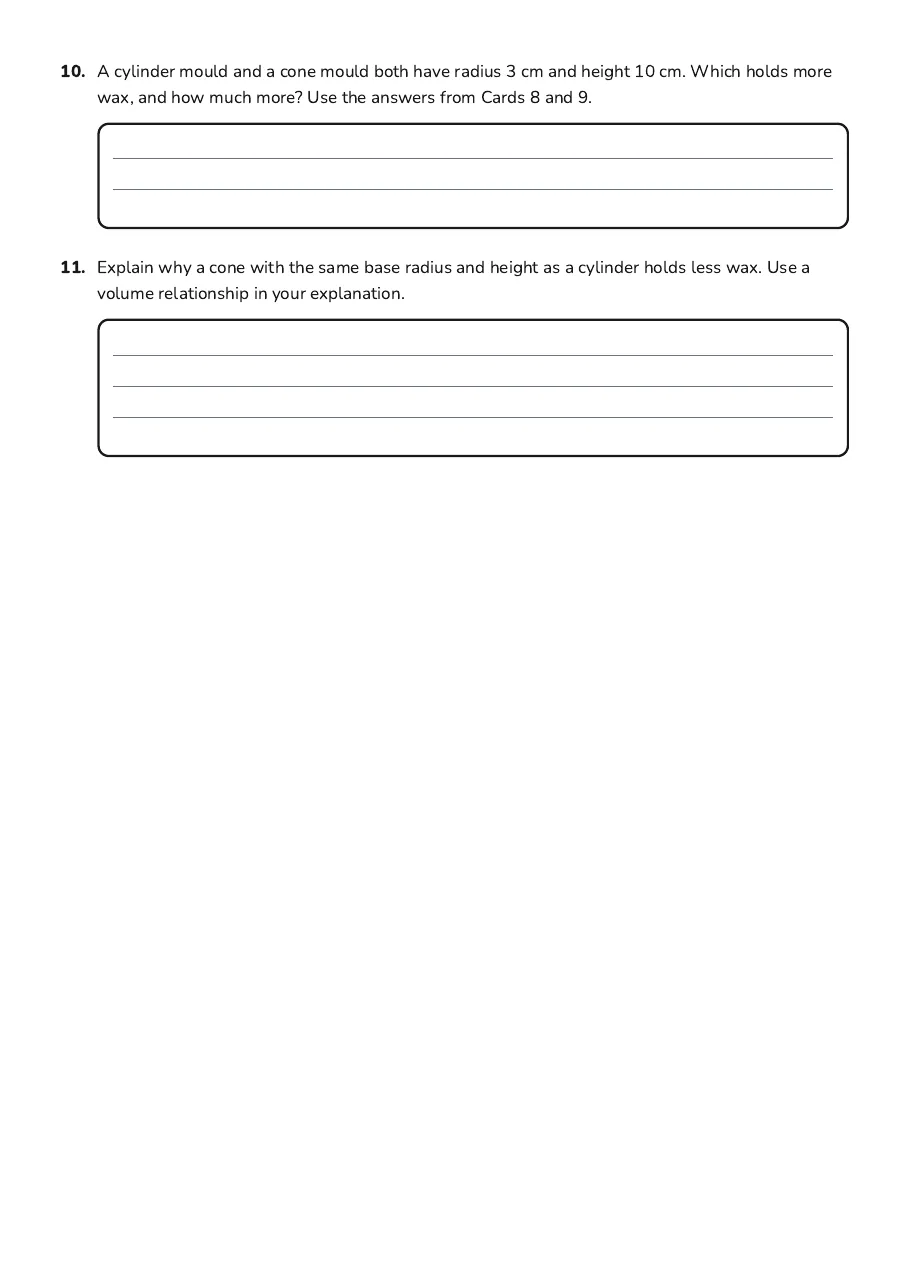
Cylinder V = _________ cm³ Cone V = _________ cm³
Difference = _________ cm³ _________________ holds more wax.
h = 500 ÷ (3.14 × ______²) = 500 ÷ _______ = _________ cm
✅ Control of Error Card — Series D
D1: 3.14 × 9 × 10 = 282.6 cm³ | D2: 6 × 4 × 12 = 288 cm³ | D3: ⅓ × 3.14 × 16 × 9 = 150.72 cm³ | D4: 4/3 × 3.14 × 125 = 523.33 cm³ | D5: 5 × 5 × 15 = 375 cm³ | D6: 3.14 × 2.25 × 1 = 7.065 cm³ | D7: Cylinder = 226.08 cm³, Cone = 75.36 cm³, Cylinder holds 150.72 cm³ more | D8: 500 ÷ (3.14 × 16) = 500 ÷ 50.24 ≈ 9.95 cm
⭐ Extension Activity — Series D
Visit a candle shop website (with a parent or teacher). Find 3 candles with different shapes. Estimate their dimensions in centimetres and calculate the approximate volume of wax in each. Which candle likely burns the longest? Write your reasoning in your Geometry Journal.
📓 Geometry Journal Reflection
After completing all four series, answer these questions in your journal or below.
Measuring with a ruler:
I need more practice I understand it I can teach it!Identifying geometric shapes:
I need more practice I understand it I can teach it!Classifying angles:
I need more practice I understand it I can teach it!Calculating volume:
I need more practice I understand it I can teach it!About This Worksheet
Free in Kuraplan
Sign up free, grab the PDF, and customize it for your class.
Print-Ready
Formatted for standard paper. Clean layout, easy to read.
AI-Generated
Created with Kuraplan's AI, designed for real classroom use.
For Teachers & Parents
Use in classrooms, for homework, tutoring, or homeschool.
Need a custom version of this worksheet?
Kuraplan's AI generates custom worksheets in seconds — differentiated for every learner, aligned to your curriculum.
Generate Custom Worksheets — Free