MathematicsFreePrintable

Candle Geometry Exploration

A free mathematics worksheet ready for your classroom. Open in Kuraplan to grab the print-ready PDF, customize it for your students, or generate a fresh version in seconds.
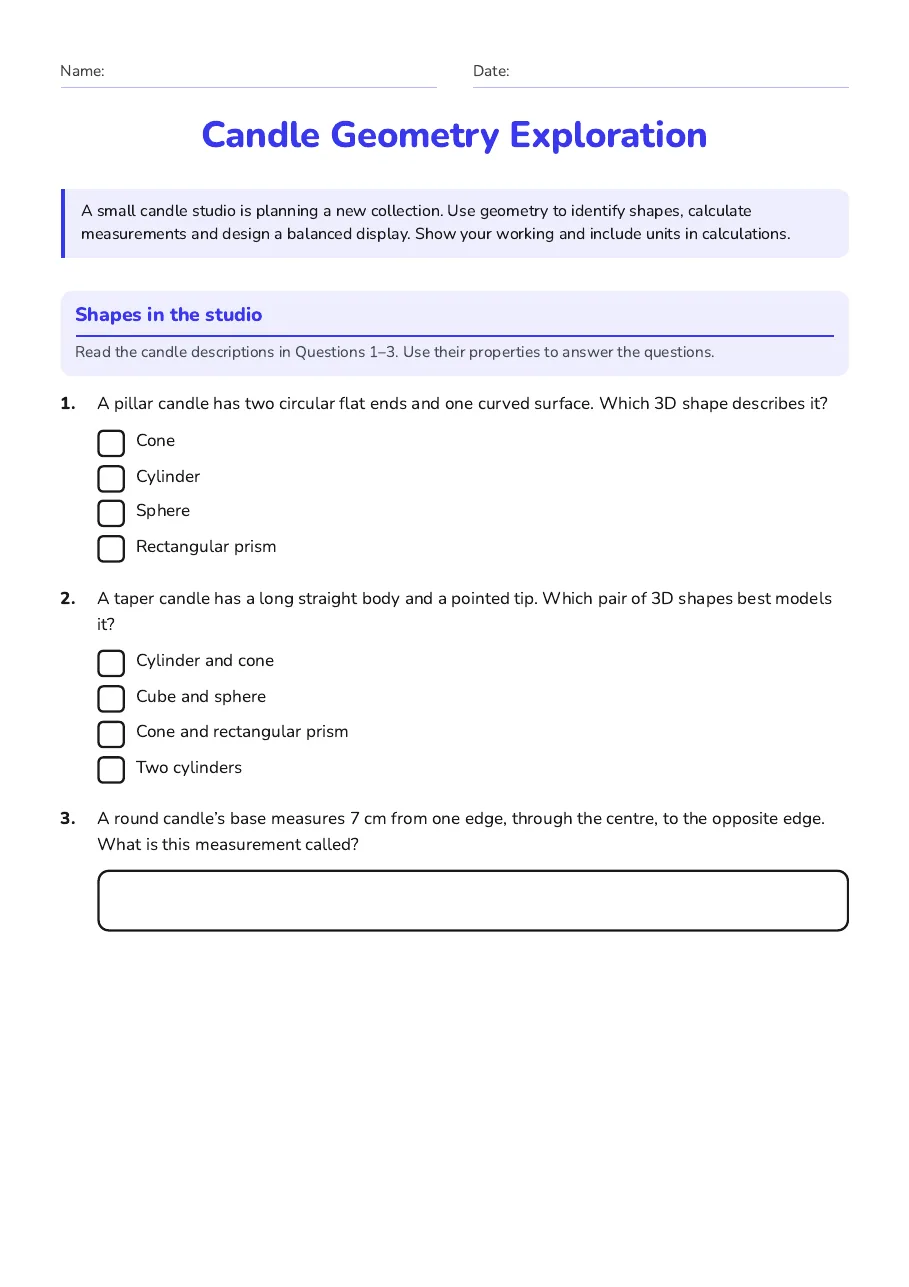
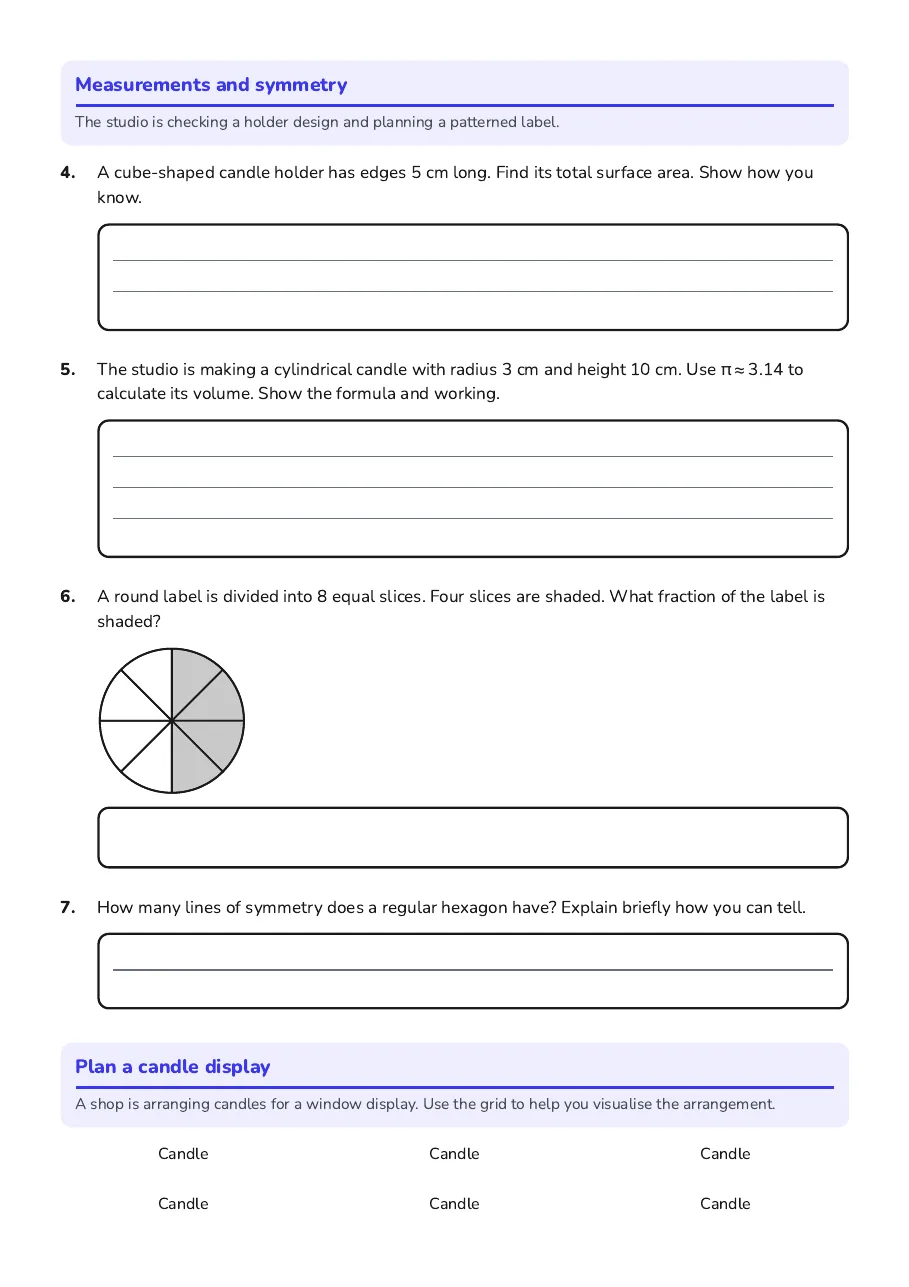
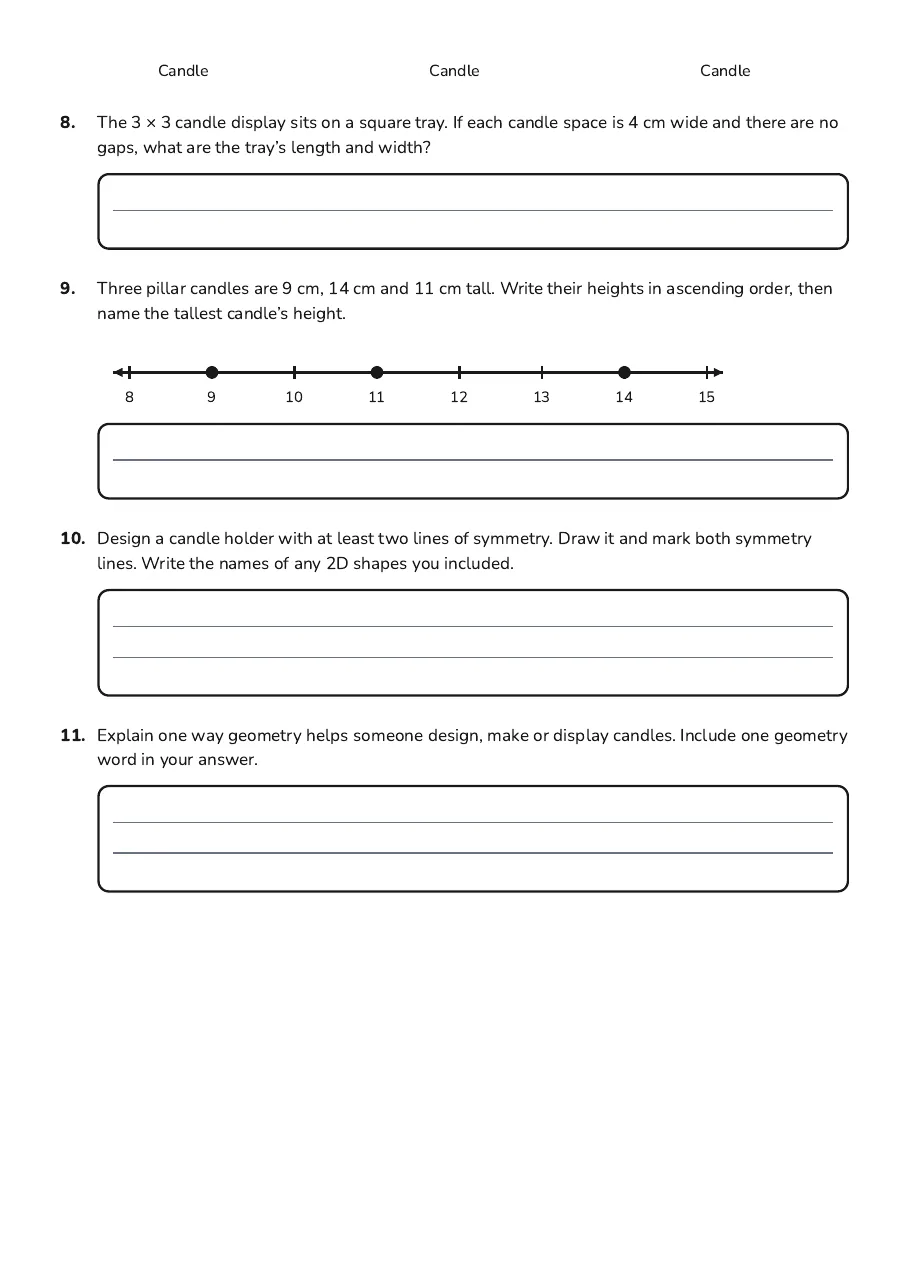
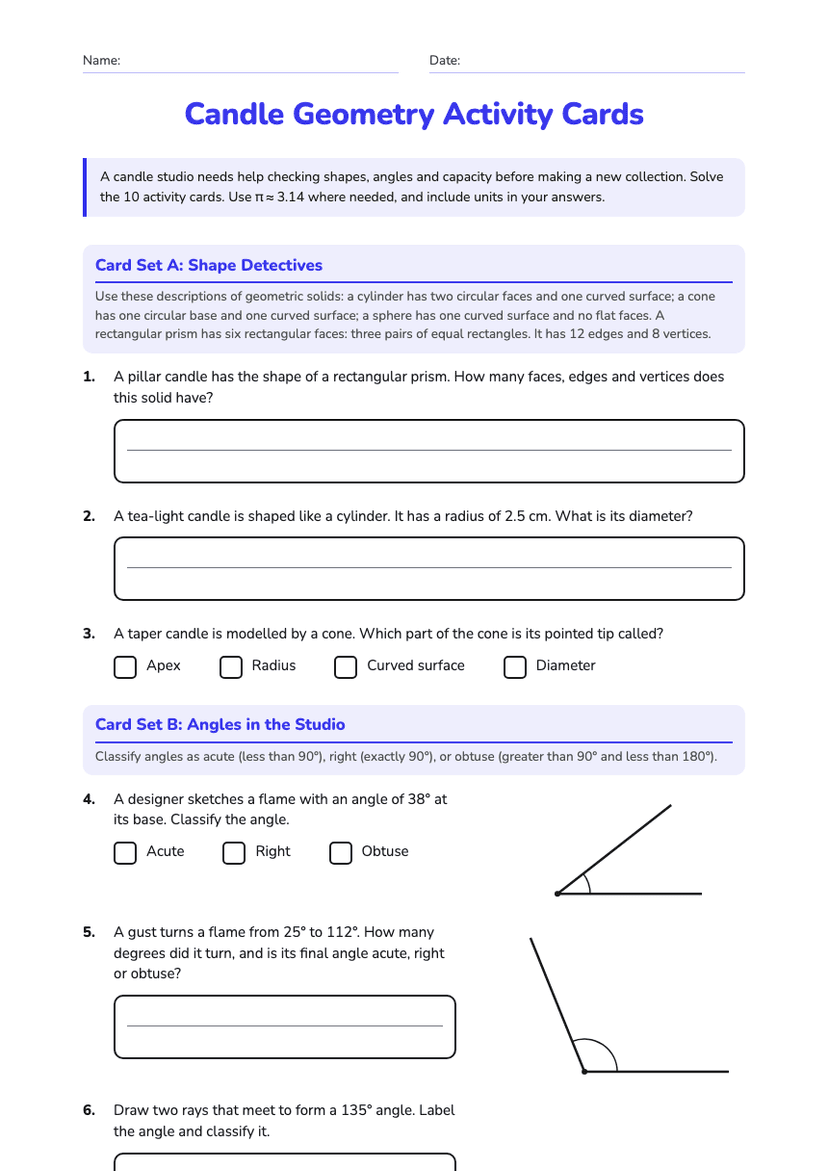
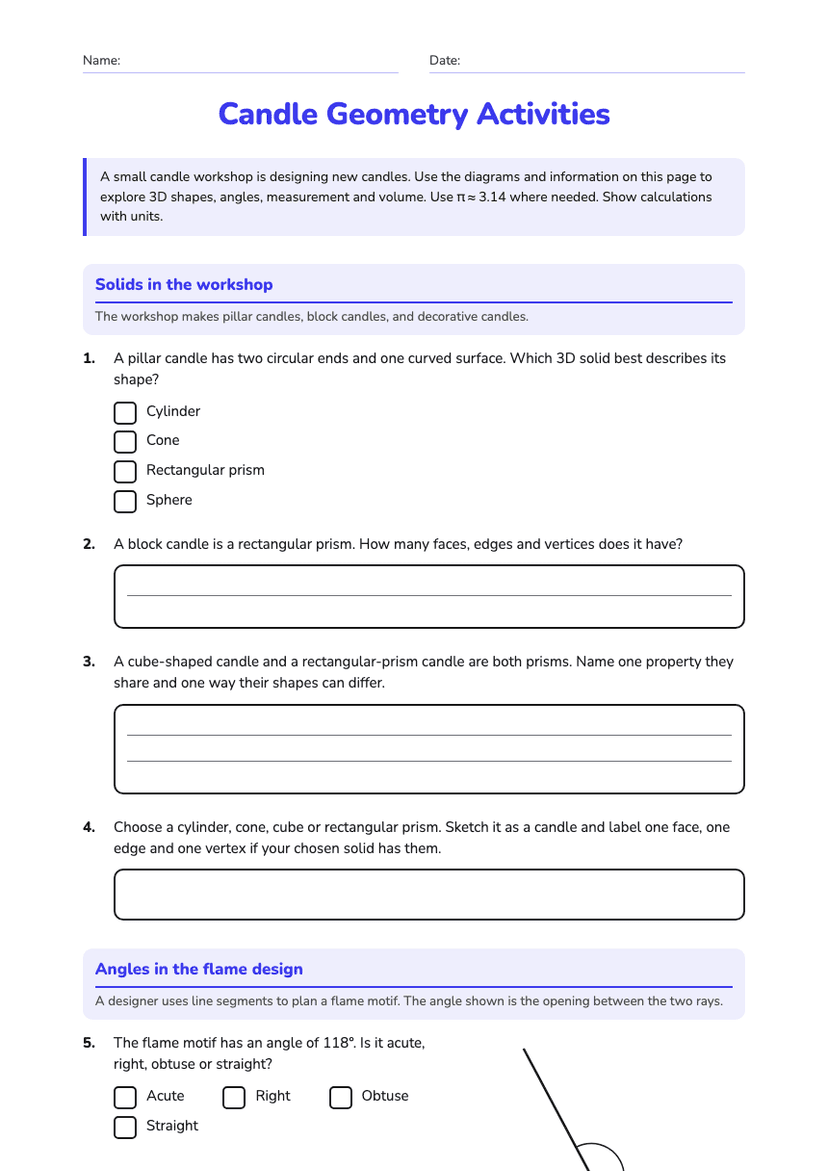
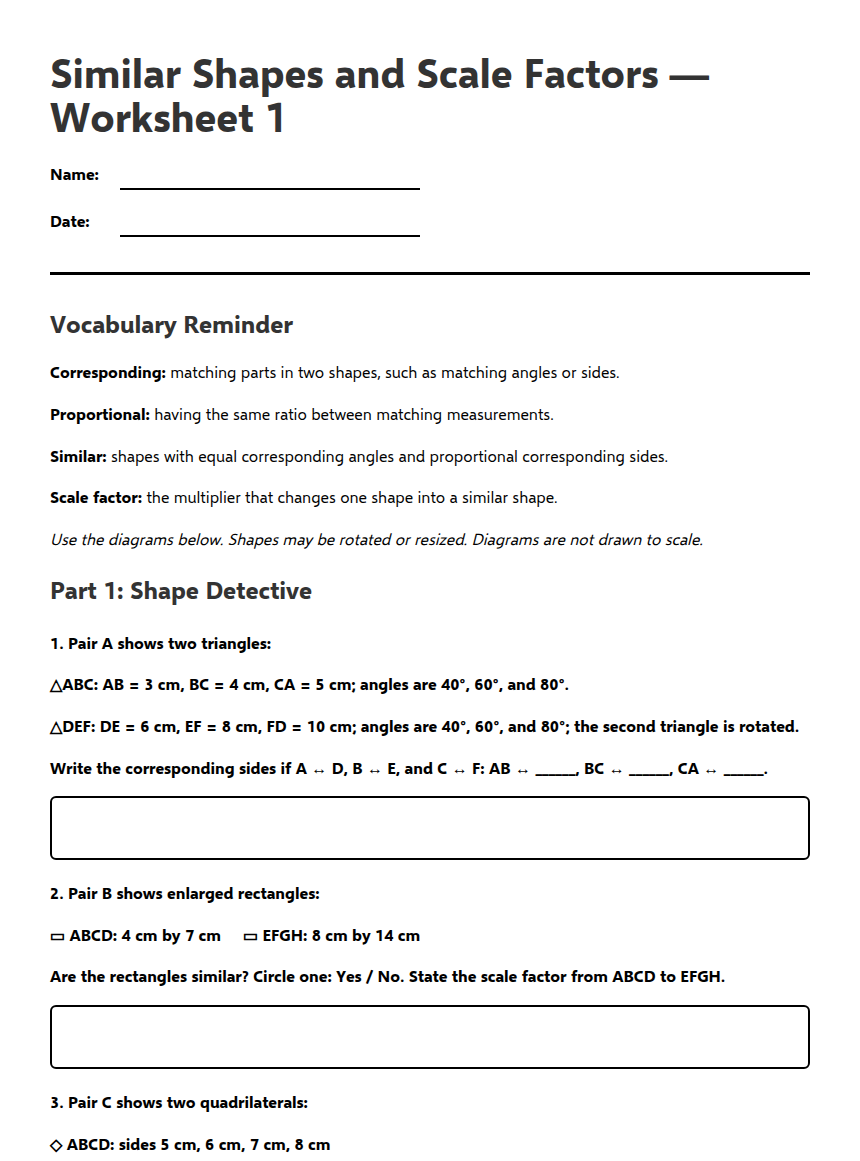
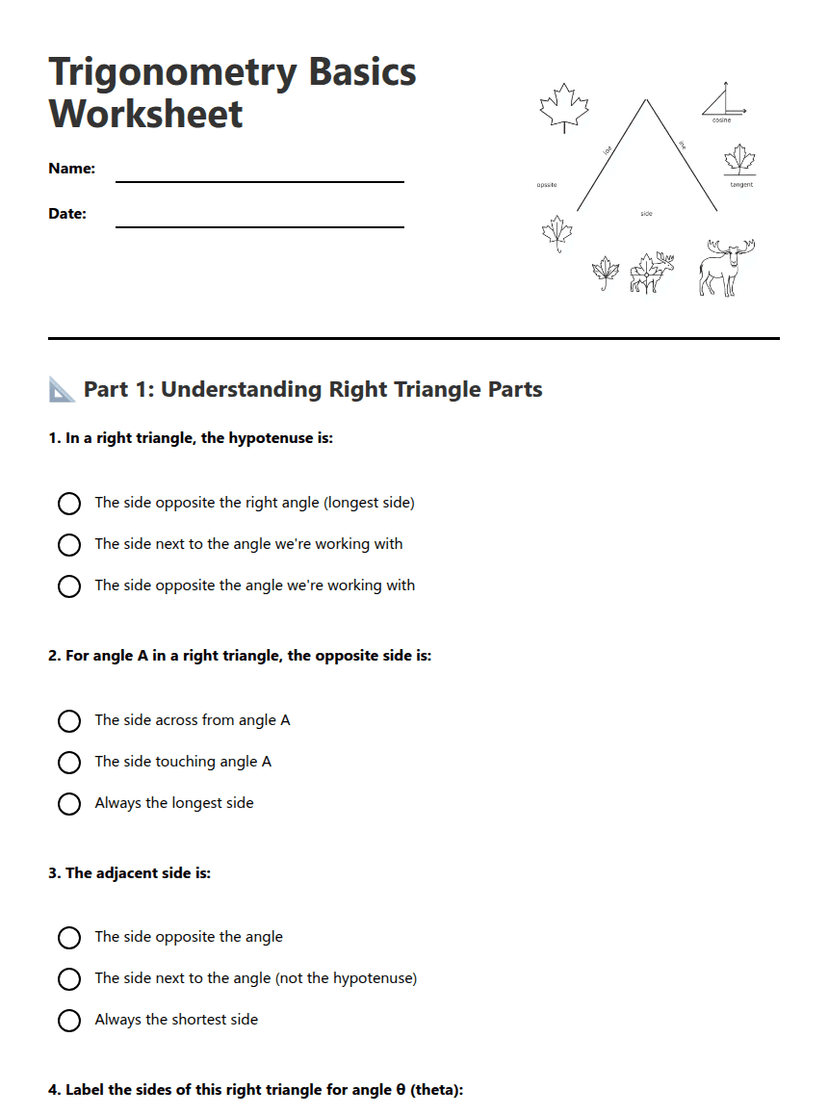
Candle Geometry Exploration worksheet preview

Candle Geometry Exploration

A Montessori Mathematics Investigation

Candle geometry illustration

🕯️ Direction Card — Read Before You Begin

Materials needed: This worksheet, a pencil, a ruler, and a mirror (for symmetry work).

How to use this material:

1. Read each question carefully before writing your answer.
2. Use your ruler when drawing lines or measuring.
3. For symmetry tasks, place your mirror along the line of symmetry to check your work.
4. Work quietly and at your own pace.
5. When finished, use the Control of Error Card (provided by your teacher) to check your answers independently.

🌟 Extension learners: Look for the star (⭐) tasks throughout the worksheet for an extra challenge!

💡 Support tip: If you find a question tricky, try using a real candle shape cut-out from your geometry cabinet to help you visualise.

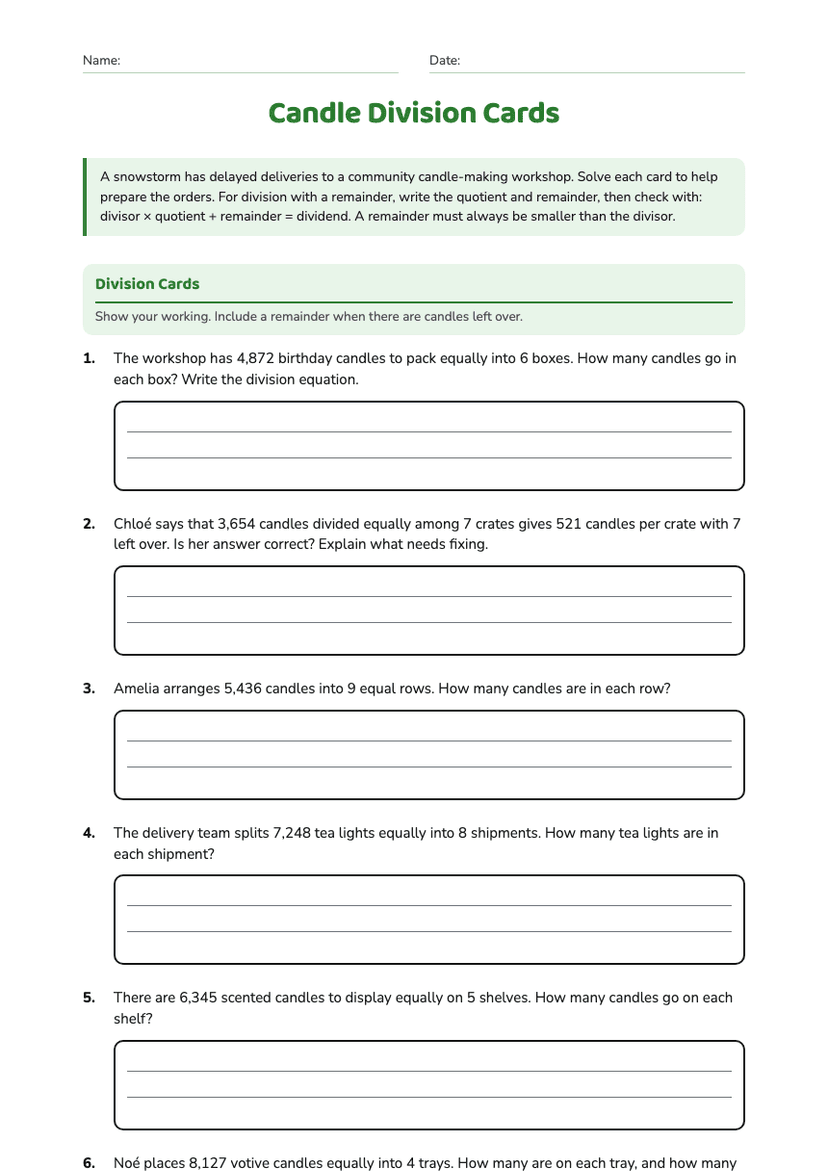
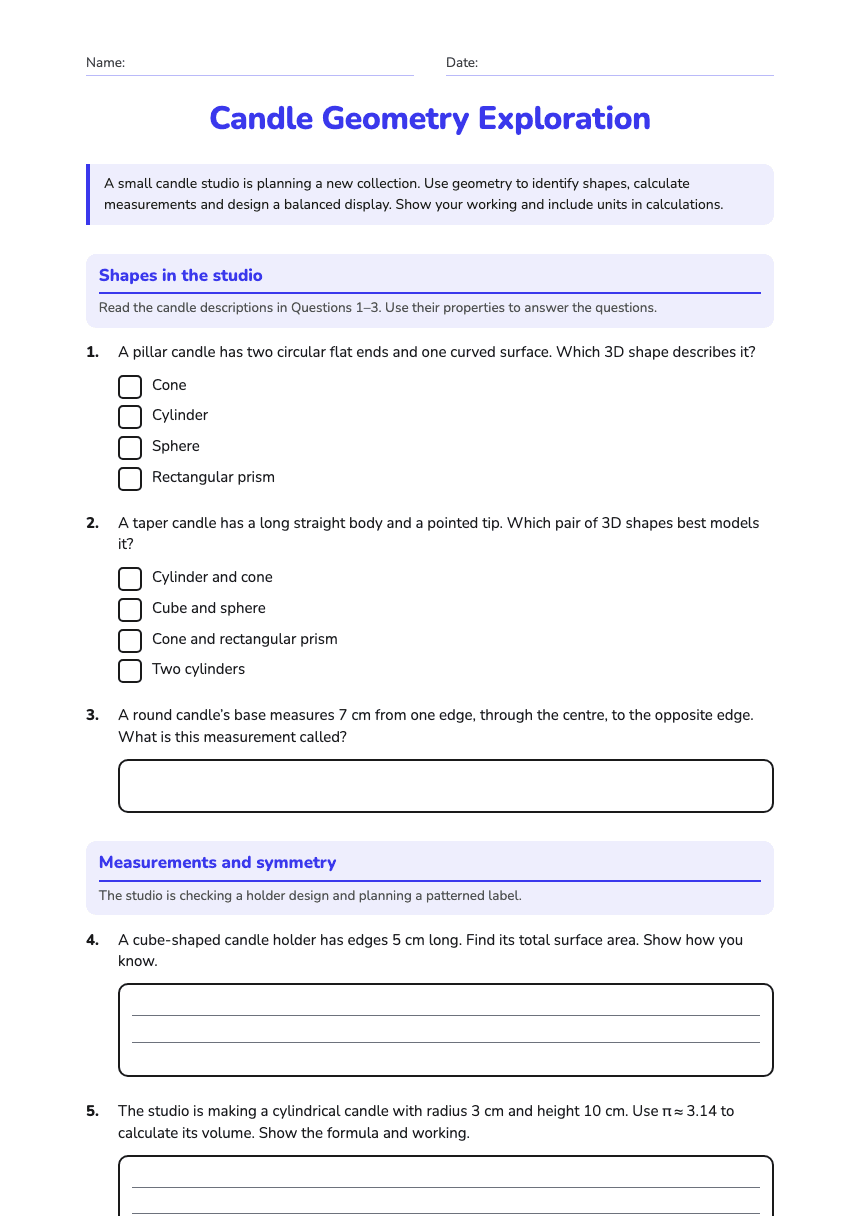
🔷 Part 1: Identifying Shapes in Candle Designs

Candles come in many shapes! Look carefully at the descriptions below and answer the questions.

1. A pillar candle has a tall, round body. What 3D shape is a pillar candle?

Rectangular prism

Cylinder

Cone

Sphere

2. A taper candle is wide at the bottom and comes to a point at the top. Which two 3D shapes best describe a taper candle together?

Cylinder

Cone

Cube

Pyramid

3. The flat bottom of a pillar candle is a circle. What is the name of the measurement across the centre of that circle?

Perimeter

Diameter

Area

Circumference

4. A candle holder is shaped like a cube. Each side measures 6 cm. What is the total surface area of the candle holder?

Surface area = _________ cm²

⭐ Extension: A cylindrical candle has a diameter of 8 cm and a height of 15 cm. Calculate the volume of the candle. Use π = 3.14. Show your full working below.

Volume = _________ cm³

🪞 Part 2: Symmetry with Candles

A shape has a line of symmetry when one half is a mirror image of the other. Use your ruler and pencil to complete the tasks below.

5. Draw a simple candle shape in the box below. Then draw its line of symmetry using a ruler. Label the line "Line of Symmetry."

💡 Support tip: Fold a piece of paper in half to help you understand what symmetry looks like before drawing.

6. How many lines of symmetry does each shape have? Fill in the blanks.

A circle has _________ line(s) of symmetry.

A rectangle has _________ line(s) of symmetry.

A regular hexagon has _________ line(s) of symmetry.

7. A candle flame is roughly oval (ellipse) shaped. Is an oval perfectly symmetrical? Explain your thinking.
⭐ Extension: Design a symmetrical candle holder pattern in the box below. Your design must have at least two lines of symmetry. Label each line.

🧩 Part 3: Spatial Awareness & Reflection

Think about how candles and their shapes relate to the space around them.

8. Three cylindrical candles are placed in a row. The first is 10 cm tall, the second is 15 cm tall, and the third is 12 cm tall. If you look at them from the side, describe the arrangement using geometry vocabulary (e.g., tallest, shortest, ascending, descending).
9. A square tray holds 9 candles arranged in a 3 × 3 grid. Each candle takes up a square space of 4 cm × 4 cm. What are the dimensions of the tray? Show your working.

Tray dimensions: _________ cm × _________ cm

10. In your own words, explain one way that geometry is used in real life when making or displaying candles.

💡 Support tip: Think about the shape of the mould, the box it comes in, or how candles are arranged in a store.

✅ Control of Error Card — Teacher Reference

This section is to be printed separately and given to students after completing the worksheet, or kept at the checking station. Students use this independently to self-correct — a core Montessori principle.

Q1: Cylinder

Q2: Cylinder + Cone

Q3: Diameter

Q4: Surface area = 6 × (6 × 6) = 6 × 36 = 216 cm²

⭐ Q4 Extension: Volume = π × r² × h = 3.14 × 4² × 15 = 3.14 × 16 × 15 = 753.6 cm³

Q6: Circle = infinite; Rectangle = 2; Regular hexagon = 6

Q7: An oval has 2 lines of symmetry (horizontal and vertical through the centre), but is not infinitely symmetrical like a circle. Accept well-reasoned student responses.

Q9: 3 candles × 4 cm = 12 cm per side. Tray = 12 cm × 12 cm

Q8 & Q10: Open-ended — assess for use of appropriate geometry vocabulary and reasoning.

🌟 Extension answers should be assessed for correct use of formula and accurate calculation. Accept minor rounding differences when using π ≈ 3.14.

About This Worksheet

Free in Kuraplan

Sign up free, grab the PDF, and customize it for your class.

Print-Ready

Formatted for standard paper. Clean layout, easy to read.

AI-Generated

Created with Kuraplan's AI, designed for real classroom use.

For Teachers & Parents

Use in classrooms, for homework, tutoring, or homeschool.

Need a custom version of this worksheet?

Kuraplan's AI generates custom worksheets in seconds — differentiated for every learner, aligned to your curriculum.

Generate Custom Worksheets — Free
No credit card Curriculum-aligned Under 60 seconds