ScienceFreePrintable

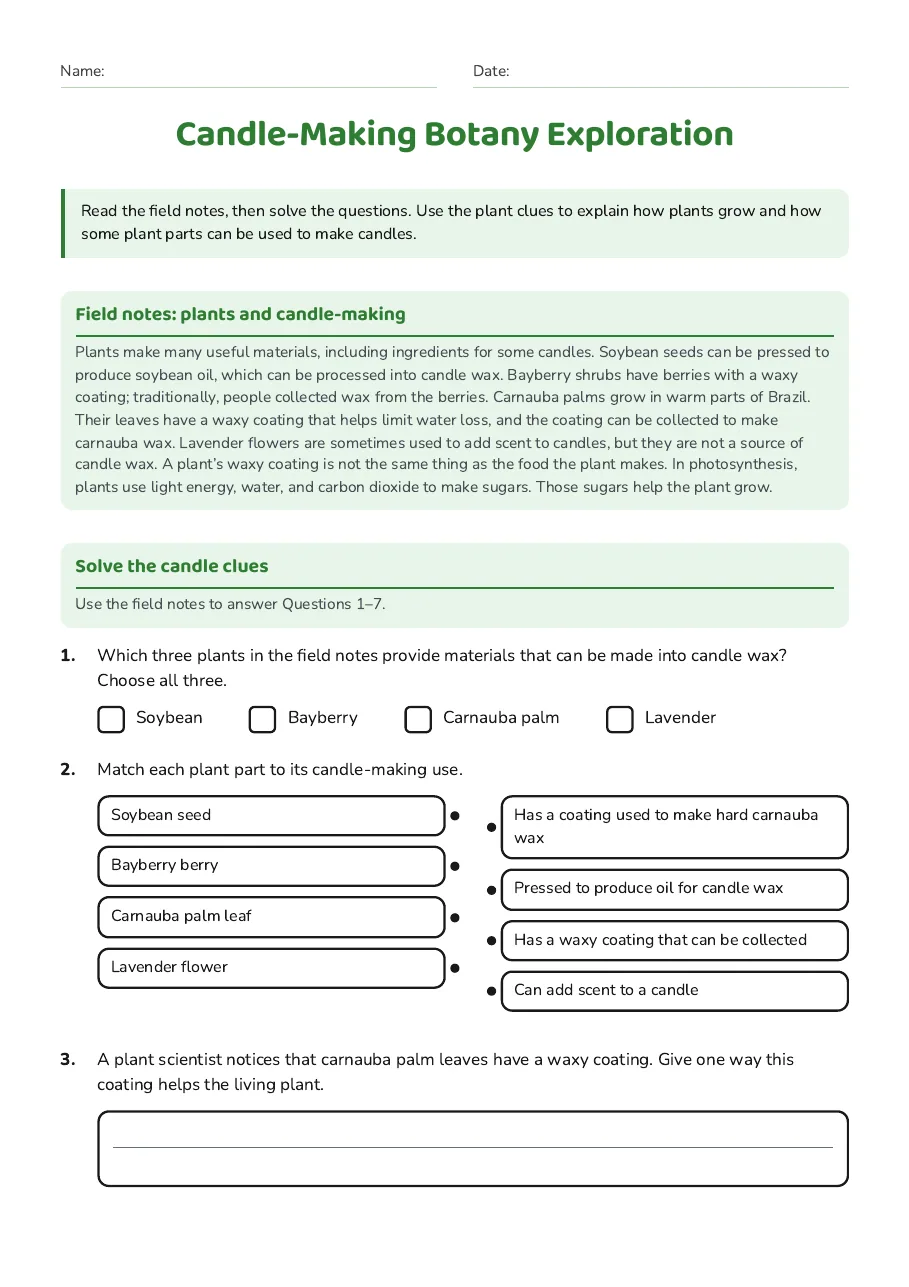
Candle-Making Botany Exploration

A free science worksheet ready for your classroom. Open in Kuraplan to grab the print-ready PDF, customize it for your students, or generate a fresh version in seconds.
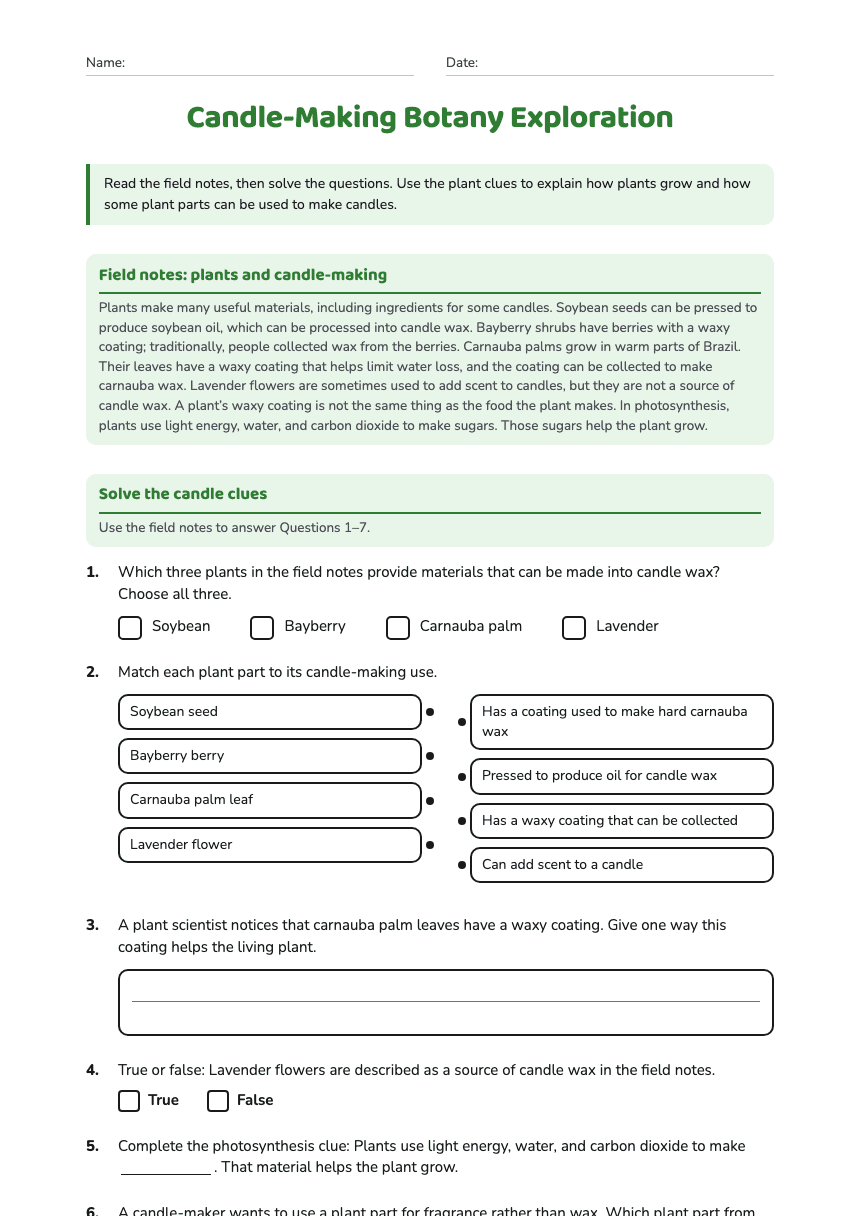
Candle-Making Botany Exploration worksheet preview

🕯️ Candle-Making Botany Exploration

Candle with botanical plants illustration

📋 Direction Card — Read Before You Begin

Purpose: Explore the plants that help us make candles! You will learn about plant parts, wax-producing plants, and how plants grow through their life cycle.

Materials you may use: This worksheet, a pencil, coloured pencils, and your botany reference cards.

Steps:

1️⃣ Read each question carefully before writing your answer.

2️⃣ Use complete sentences where asked.

3️⃣ When finished, use the Control of Error Card (found in the back of your folder) to check your work independently.

4️⃣ If you finish early, try the Extension Activities in Part 3.

🌿 Differentiation tip for learners who need support: Use your plant parts labelling card and the botanical vocabulary mat to help you answer questions.

🌿 Part 1: Plants and Candle-Making

1. Which of the following plants are used in candle-making? Check all that apply.

Bayberry (Myrica pensylvanica) — produces natural wax on its berries

Carnauba palm (Copernicia prunifera) — leaves coated in hard wax

Soy plant (Glycine max) — seeds pressed into soy wax

Dandelion (Taraxacum officinale) — used for yellow dye only

Jojoba (Simmondsia chinensis) — liquid wax in its seeds

2. Where on the bayberry plant does wax come from?

The roots

The berries (fruit)

The stem

The flowers

3. Carnauba wax comes from the leaves of the carnauba palm. Why do you think the plant produces wax on its leaves?
4. Match each plant part to its role in candle-making. Draw a line from left to right.
Soy seed
Carnauba leaf
Bayberry berry
Lavender flower
Adds natural fragrance to candles
Pressed to make soft, creamy wax
Boiled to collect floating wax
Scraped to collect hard, shiny wax

🌱 Part 2: Plant Parts and Life Cycle

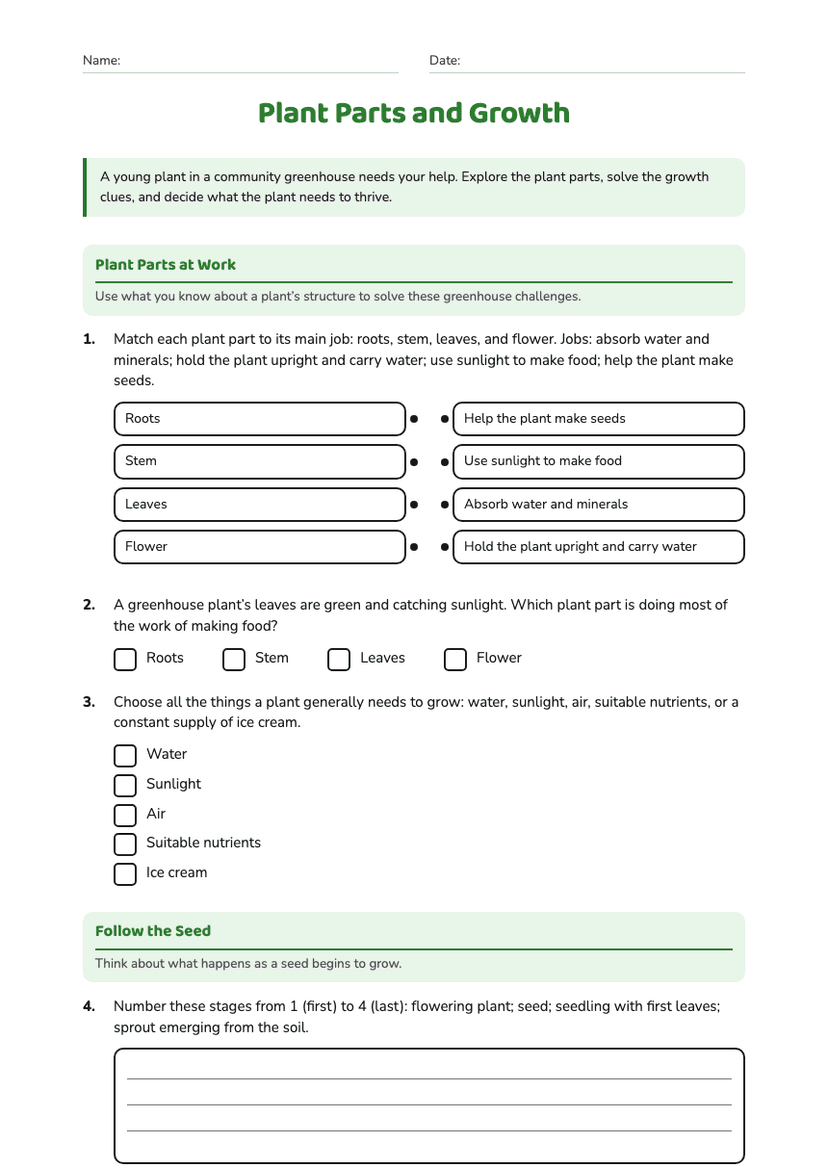
5. Label the drawing of the soy plant below. Use these words: root, stem, leaf, flower, seed pod.

🌿 Draw and label the soy plant, or draw arrows pointing to each part with the correct label written beside it.

6. Put the soy plant life cycle in the correct order. Write numbers 1–5 in the blanks.

____ The seed pod dries and releases seeds.

____ A seed is planted in warm soil.

____ Flowers bloom and are pollinated.

____ The seedling grows roots, a stem, and leaves.

____ Seeds germinate and a sprout appears.

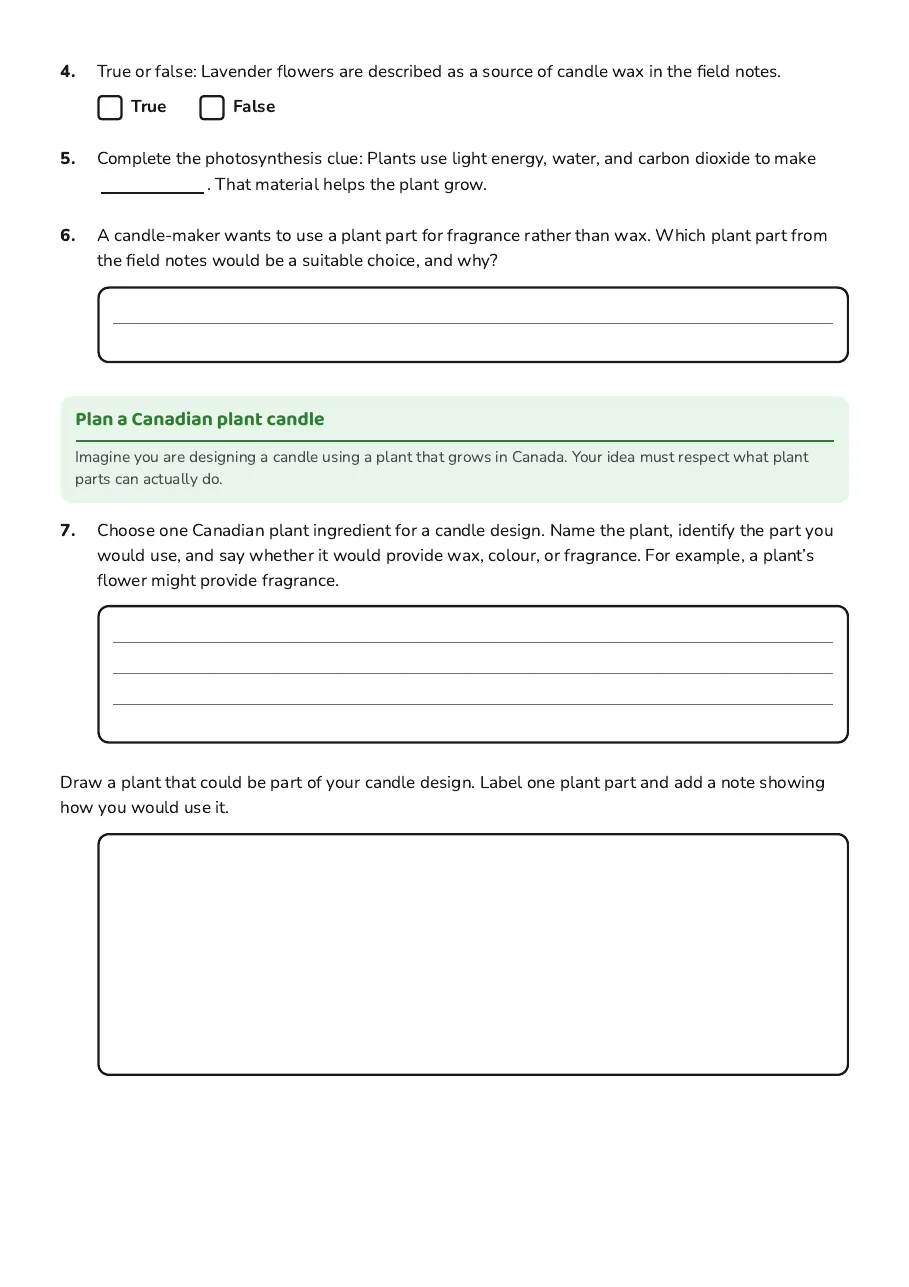
7. A soy plant needs certain conditions to grow well. Check all the things a soy plant needs:

Sunlight

Water

Darkness at all times

Nutrients from soil

Carbon dioxide (CO₂)

8. In your own words, explain what photosynthesis is and why it matters for wax-producing plants like the carnauba palm.

🌿 Differentiation — Support: If this is tricky, use the sentence starter: "Photosynthesis is when a plant uses _______ and _______ to make _______."

⭐ Part 3: Extension Activities for Advanced Learners

Try one or more of these challenges if you have finished Parts 1 and 2!

9. 🌍 Extension A — Research Challenge: Carnauba palms grow in northeastern Brazil. Canada's climate is very different. Describe TWO reasons why carnauba palms could not grow outdoors in Canada. Use what you know about plant needs and climate.
10. 🕯️ Extension B — Design Thinking: Imagine you are designing a candle made entirely from Canadian plants. Name at least ONE plant that grows in Canada that could provide wax, colour, or fragrance. Explain which plant part you would use and why.
11. 🎨 Extension C — Botanical Illustration: In the box below, draw a detailed botanical illustration of ONE candle-making plant. Label the roots, stem, leaves, and any flowers or fruit. Add colour using coloured pencils.

✅ Control of Error Card — Check Your Own Work!

Use this card AFTER completing the worksheet. Check your answers independently — this is your Montessori self-correction tool!

Question 1 — Correct answers: ✅ Bayberry ✅ Carnauba palm ✅ Soy plant ✅ Jojoba
(Dandelion is not used for candle wax — it is used for dye or food.)

Question 2 — Correct answer: The berries (fruit). Bayberry wax is collected by boiling the berries and skimming the floating wax.

Question 3 — Sample answer: The plant produces wax on its leaves to reduce water loss (prevent drying out) in the hot, dry climate where it lives. The wax acts like a protective coating.

Question 4 — Matching answers:
Soy seed → Pressed to make soft, creamy wax
Carnauba leaf → Scraped to collect hard, shiny wax
Bayberry berry → Boiled to collect floating wax
Lavender flower → Adds natural fragrance to candles

Question 6 — Life cycle order: 4 → 1 → 5 → 3 → 2
(Seed planted → Germinates → Seedling grows → Flowers bloom → Pod releases seeds)

Question 7 — Correct answers: ✅ Sunlight ✅ Water ✅ Nutrients from soil ✅ Carbon dioxide
(Plants do NOT need darkness at all times — they need light for photosynthesis!)

Question 8 — Sample answer: Photosynthesis is the process where a plant uses sunlight, water, and carbon dioxide to make its own food (sugar). For the carnauba palm, this process gives the plant energy to grow large leaves and produce the waxy coating that protects them.

🌿 Differentiation reminder: If you used the sentence starters or vocabulary mat — that is perfectly okay! Montessori learning means using your environment to support your thinking.

About This Worksheet

Free in Kuraplan

Sign up free, grab the PDF, and customize it for your class.

Print-Ready

Formatted for standard paper. Clean layout, easy to read.

AI-Generated

Created with Kuraplan's AI, designed for real classroom use.

For Teachers & Parents

Use in classrooms, for homework, tutoring, or homeschool.

Need a custom version of this worksheet?

Kuraplan's AI generates custom worksheets in seconds — differentiated for every learner, aligned to your curriculum.

Generate Custom Worksheets — Free
No credit card Curriculum-aligned Under 60 seconds