Ecosystems and Food Webs
A free science worksheet ready for your classroom. Open in Kuraplan to grab the print-ready PDF, customize it for your students, or generate a fresh version in seconds.
Ecosystems and Food Webs
Page 1 — Learn About Ecosystems
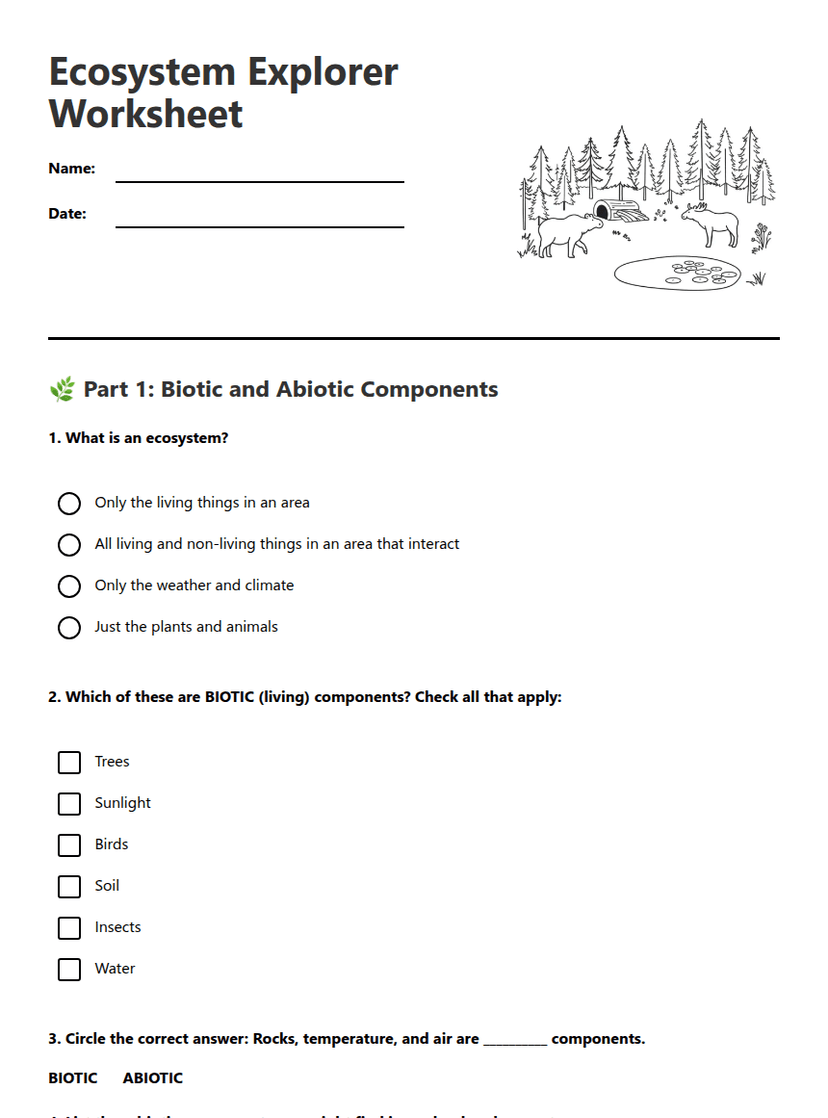
Learning goals: I can describe an ecosystem, identify living and non-living factors, explain food chains and food webs, and suggest ways to care for the environment.
Instructions: Read each question carefully. Circle the best answer or write a complete response.
A forest is an ____________ because living and non-living things interact there.
A frog’s ____________ may be a pond.
Plants and animals are ____________ factors. Rocks and air are ____________ factors.
Page 2 — Food Webs, Adaptations, and Responsibility
Instructions: Use arrows to show the direction of energy. Remember: arrows point from the food to the eater.
__________ → __________ → __________ → __________ → __________
Which organism is the producer? ____________________
Which organism is the top consumer? ____________________
Algae is eaten by the insect and the small fish. The insect is eaten by the frog. The small fish and frog are eaten by the heron.
Producers: __________________________________________
Consumers: _________________________________________
Decomposers: _______________________________________
Page 3 — Review and Teacher Answer Key
Student review: In one or two sentences, explain why removing one organism can affect an entire food web.
Teacher Answer Key
1. Living and non-living things interacting in an area.
2. Sunlight and water.
3. 1-B, 2-C, 3-D, 4-A.
4. ecosystem; habitat; biotic; abiotic.
5. Grass → grasshopper → frog → snake → hawk. Producer: grass. Top consumer: hawk.
6. Algae → insect; algae → small fish; insect → frog; small fish → heron; frog → heron.
7. Producers: maple tree, grass. Consumers: deer, fox. Decomposers: mushroom, earthworm.
8. The teeth help the beaver gather food or build a home. Webbed feet help it move through water and escape danger.
9. Accept answers such as polluted water harming plants or animals; actions may include removing litter, using less plastic, or organising a clean-up.
10. Check that the design includes all required parts and correctly shows energy moving from food to eater.
Review. Accept answers explaining that organisms depend on one another for food or that a population change can affect predators, prey, and other parts of the web.
About This Worksheet
Free in Kuraplan
Sign up free, grab the PDF, and customize it for your class.
Print-Ready
Formatted for standard paper. Clean layout, easy to read.
AI-Generated
Created with Kuraplan's AI, designed for real classroom use.
For Teachers & Parents
Use in classrooms, for homework, tutoring, or homeschool.
Need a custom version of this worksheet?
Kuraplan's AI generates custom worksheets in seconds — differentiated for every learner, aligned to your curriculum.
Generate Custom Worksheets — Free