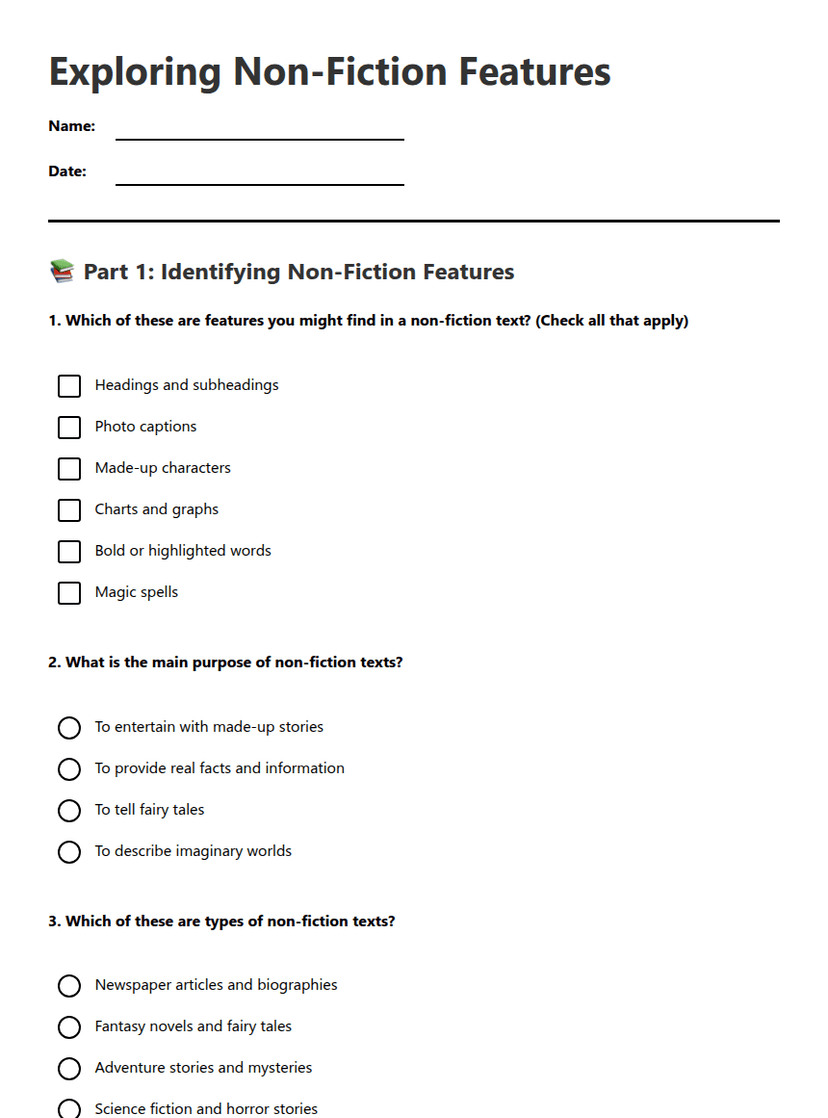
Exploring Literary Themes
A free english (ela) worksheet ready for your classroom. Open in Kuraplan to grab the print-ready PDF, customize it for your students, or generate a fresh version in seconds.

Exploring Literary Themes

📚 Part 1: Quick Check — Understanding Theme
✏️ Part 2: Short Responses & Theme Mapping
Theme: ___________________________
Connected idea / symbol 1: ___________________________
Connected idea / symbol 2: ___________________________
a) One way understanding theme helps us appreciate literature: _________
b) One question you still have about theme or the upcoming Theme Mapping assignment:
🔎 Part 3: Success Criteria, Differentiation & Extensions
• Define "theme" and explain how it differs from plot.
• Identify at least one central theme in my book and cite two supporting details.
• Begin a simple theme map that connects theme to characters, symbols or events.
• Struggling readers: use simplified handout, sentence starters ("One theme is ___ because ___"), and visuals.
• ELL or new-comers: provide bilingual glossary, pair with a strong reader, allow oral response.
• Students needing challenge: identify multiple or implied themes; connect themes across texts.
• Attention/processing support: chunk the task, allow graphic organiser templates, offer a seated gallery option.
• Write a short analytical paragraph comparing a theme from your book to a different text.
• Create a multi-themed concept map linking themes to current events or personal experience.
• Produce a creative piece (poem, visual art, or short scene) that explores an implied theme.
About This Worksheet
Free in Kuraplan
Sign up free, grab the PDF, and customize it for your class.
Print-Ready
Formatted for standard paper. Clean layout, easy to read.
AI-Generated
Created with Kuraplan's AI, designed for real classroom use.
For Teachers & Parents
Use in classrooms, for homework, tutoring, or homeschool.
Need a custom version of this worksheet?
Kuraplan's AI generates custom worksheets in seconds — differentiated for every learner, aligned to your curriculum.
Generate Custom Worksheets — Free