Leaf Wax Rubbing Activity
A free science worksheet ready for your classroom. Open in Kuraplan to grab the print-ready PDF, customize it for your students, or generate a fresh version in seconds.
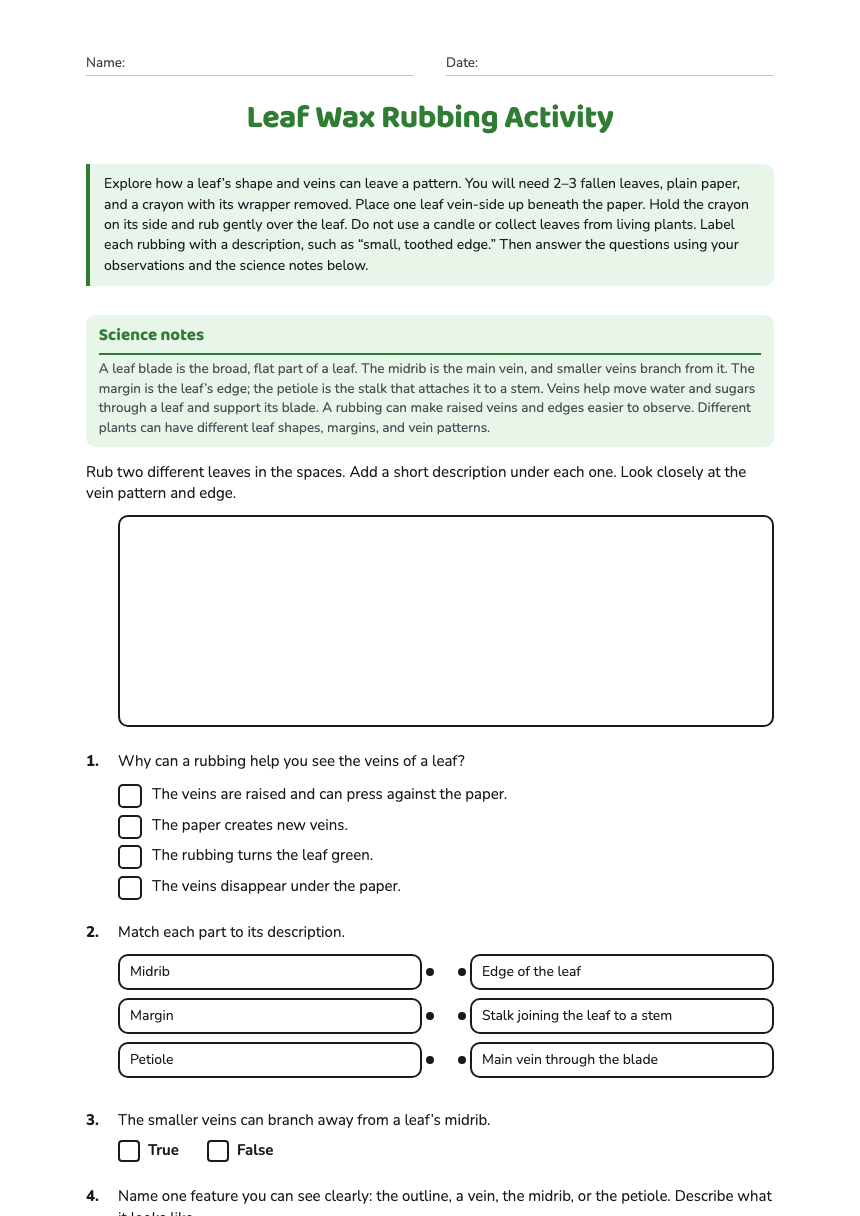
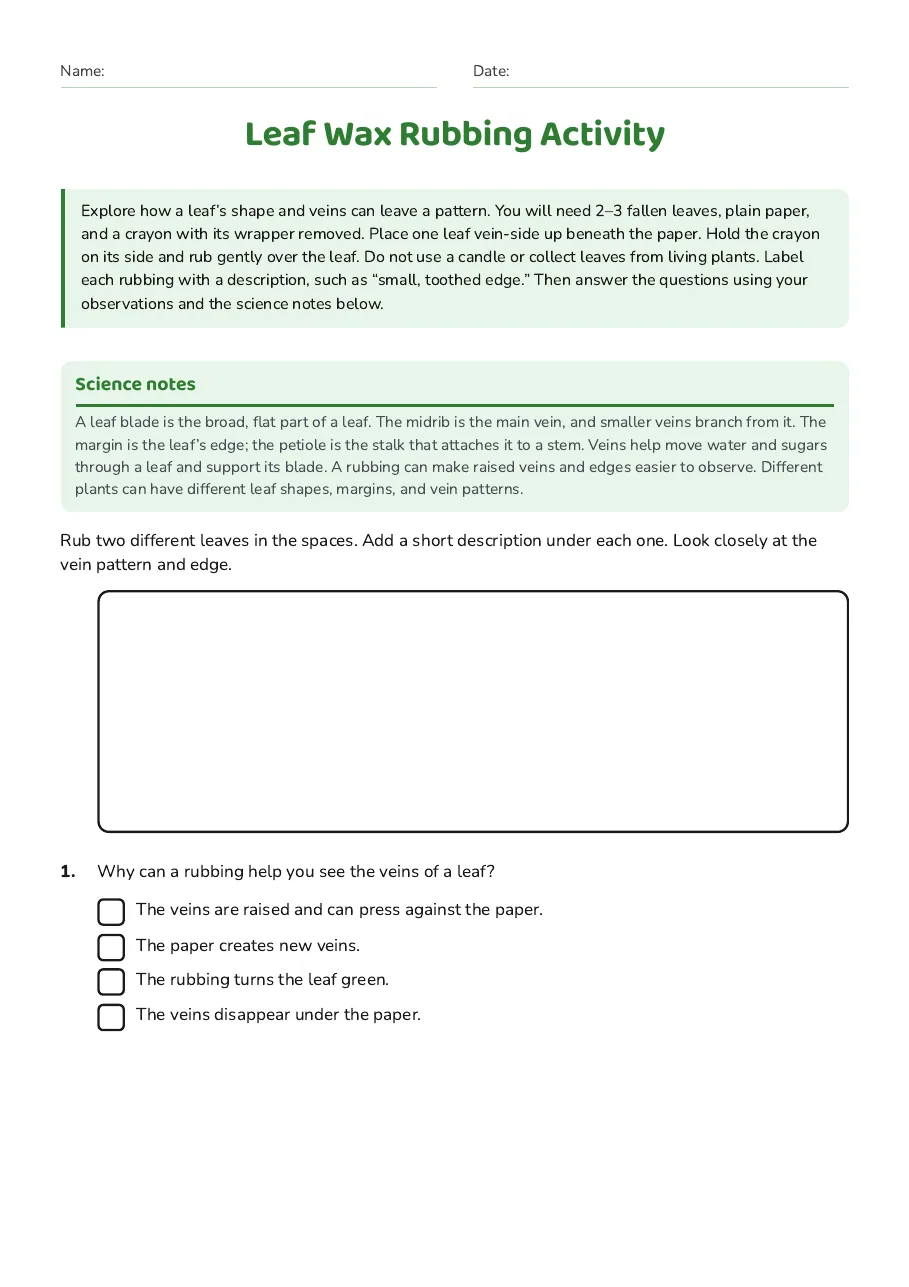
Leaf Wax Rubbing Activity
Botany — Montessori Prepared Environment
📋 Direction Card — How to Do Your Leaf Wax Rubbing
Materials you will need: collected leaves, white paper, a white or light-coloured candle (unscented), coloured pencils or crayons, this worksheet.
Step-by-step directions:
1. Choose one leaf and place it vein-side up on your work mat.
2. Lay a piece of white paper gently on top of the leaf.
3. Rub the side of a candle firmly over the paper above the leaf. Press evenly.
4. Watch the leaf's shape and veins appear through the wax!
5. Label your rubbing: write the leaf's name (if you know it) and the date.
6. Repeat with 2 more different leaves in the boxes below.
7. When finished, return all materials to their place on the shelf.
💡 Why does this work? The wax from the candle sticks more to the raised veins and edges of the leaf, showing us its structure!
🍃 My Leaf Rubbings
Complete your wax rubbing in each box, then label it below.
Rubbing 1
Leaf name or description: _______________________________
Rubbing 2
Leaf name or description: _______________________________
Rubbing 3
Leaf name or description: _______________________________
🔍 Observation Questions
✅ Control of Error Card
Use this card after you have completed your work to check yourself. Turn it over or keep it face-down until you are ready!
Check your rubbing — did you:
Answer guide for Question 1: The veins — because the veins are raised on the underside of the leaf, they press against the paper and pick up more wax.
🌟 Extension Activities for Advanced Learners
Try one or more of these challenges:
⭐ Classify your leaves: Use a botany reference book or card set to identify whether each leaf has pinnate, palmate, or parallel venation. Label your rubbings with the correct term.
⭐ Measure and record: Using a ruler, measure the length and width of each leaf in centimetres. Record your measurements in a small table.
⭐ Compare wax types: Try your rubbing with a white candle and then with a coloured crayon. Describe how the results are different and why.
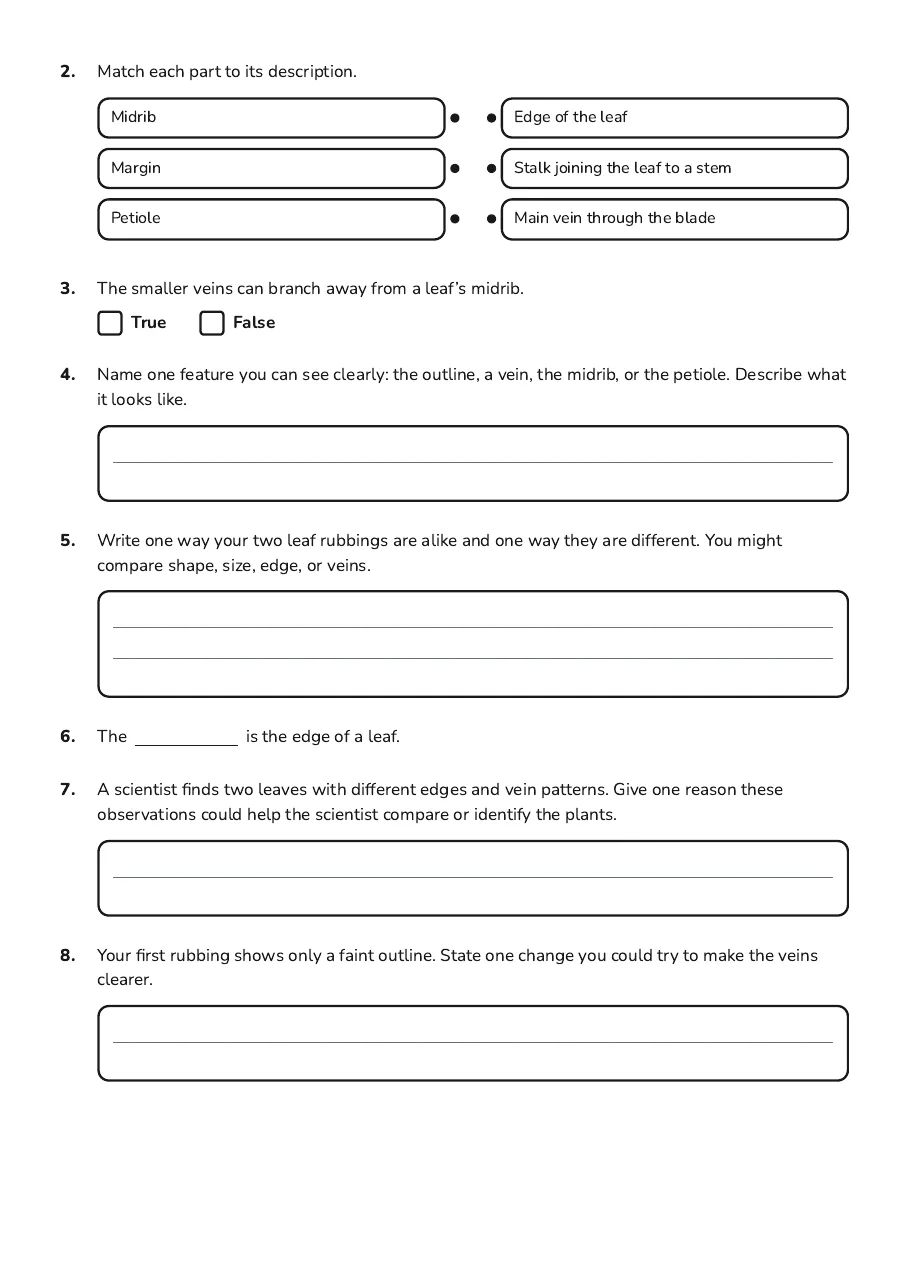
⭐ Scientific drawing: Choose your favourite rubbing and create a detailed labelled diagram beside it, naming the midrib, lateral veins, margin, apex, and petiole.
🤝 Differentiation Strategies
For learners who need extra support:
• Provide pre-selected leaves that are large and have bold, clear veins (e.g., maple or oak).
• Offer a word bank for observation questions (veins, edges, shape, smooth, rough).
• Allow verbal responses recorded by a peer or teacher.
For learners who need enrichment:
• Encourage the extension activities above.
• Invite the child to create their own "leaf identification booklet" using their rubbings as illustrations.
About This Worksheet
Free in Kuraplan
Sign up free, grab the PDF, and customize it for your class.
Print-Ready
Formatted for standard paper. Clean layout, easy to read.
AI-Generated
Created with Kuraplan's AI, designed for real classroom use.
For Teachers & Parents
Use in classrooms, for homework, tutoring, or homeschool.
Need a custom version of this worksheet?
Kuraplan's AI generates custom worksheets in seconds — differentiated for every learner, aligned to your curriculum.
Generate Custom Worksheets — FreeMore Science Worksheets
Danforth: Authority and Conscience
Free
Natural Resources Science
Free
Natural Resources Science
Free
Vitamins, Minerals, and Protein Science
Free
Exploring Science Materials
Free
Waka Buoyancy Science Worksheet
Free
Science Skills Made Simple
Free