Legumes Botany Exploration
A free science worksheet ready for your classroom. Open in Kuraplan to grab the print-ready PDF, customize it for your students, or generate a fresh version in seconds.
Legumes Botany Exploration
Montessori Botany Work — Legume Identification & Classification
🌿 Part 1: Legume Identification Cards
Direction Card: Read each description carefully. Write the name of the legume that matches each clue on the line provided. Use your identification cards to help you.
Control of Error: Flip your identification cards over — the name of each legume is printed on the back. Check your answers when you are finished.
🔍 Differentiation — Emerging Learners: Use your picture identification cards and match the image to the name before writing your answer.
🚀 Extension — Advanced Learners: On the back of this sheet, sketch one legume and label its root nodules, pod, seed, leaf, and stem.
🌱 Part 2: Classification Activity
Direction Card: Legumes belong to the plant family Fabaceae. They share special features that set them apart from other plants. Sort the characteristics below by placing a ✓ in the correct column.
Control of Error: A completed classification chart is kept in the teacher's answer envelope at the Botany shelf. Compare your work when you are done.
🔍 Differentiation — Emerging Learners: Use your legume vocabulary card to find the meaning of nitrogen fixation before answering Question 7.
🚀 Extension — Advanced Learners: Research one legume crop grown in your province. Write two facts about how it is farmed and why it is important to Canadian agriculture.
🕯️ Part 3: Legumes & Candle Making Connection
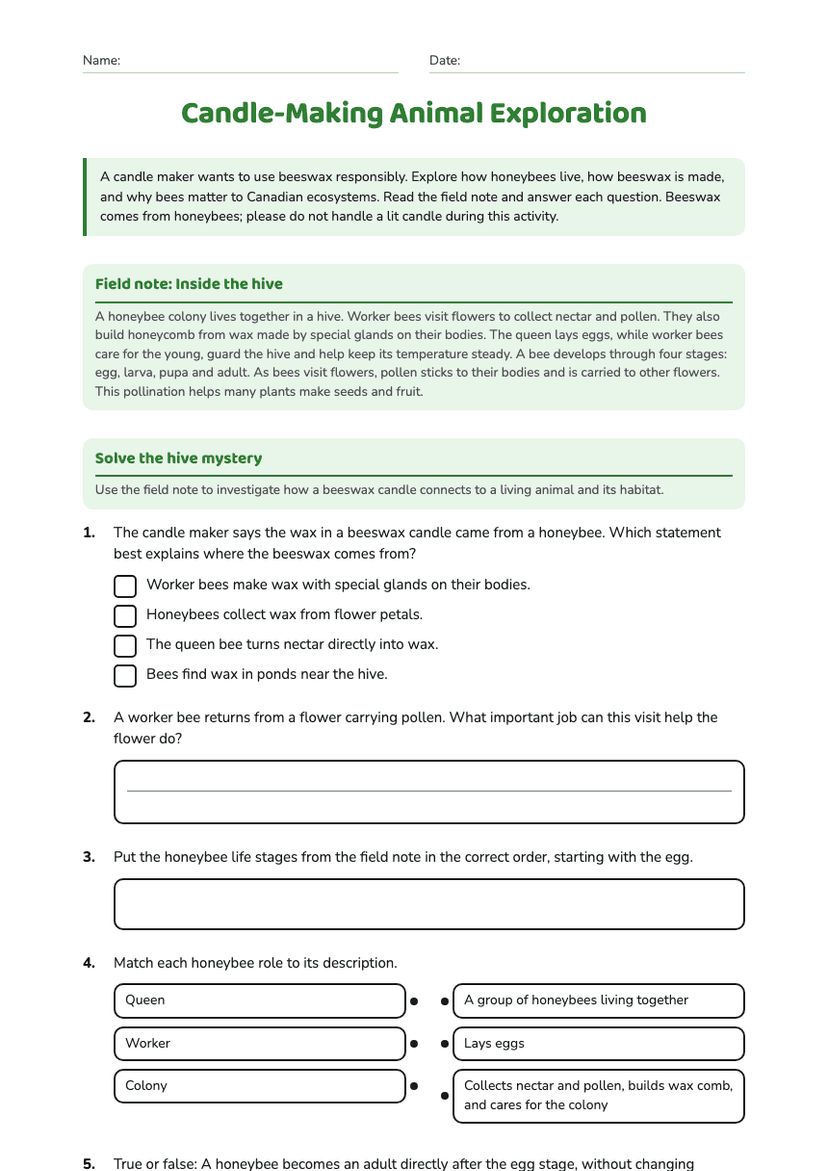
Direction Card: Some legumes produce oils and waxes used in candle making. Soy wax, made from soybeans (Glycine max), is a popular natural alternative to paraffin wax. Read the information below and answer the questions.
Control of Error: A completed answer key for this section is stored in the red answer folder on the Botany shelf. Review it after completing your work independently.
Did you know? Soybeans are legumes grown across Canada, especially in Ontario. Their oil is extracted and hydrogenated to create soy wax, which is used in eco-friendly candles. Soy wax burns more slowly and cleanly than paraffin wax, which is made from petroleum.
🔍 Differentiation — Emerging Learners: Use the soybean diagram card from the Botany shelf to help you label your drawing in Question 11.
🚀 Extension — Advanced Learners: Compare soy wax to one other plant-based wax (such as carnauba or bayberry wax). Write three sentences explaining similarities and differences. Use the research cards in the extension basket.
🌟 Reflection
About This Worksheet
Free in Kuraplan
Sign up free, grab the PDF, and customize it for your class.
Print-Ready
Formatted for standard paper. Clean layout, easy to read.
AI-Generated
Created with Kuraplan's AI, designed for real classroom use.
For Teachers & Parents
Use in classrooms, for homework, tutoring, or homeschool.
Need a custom version of this worksheet?
Kuraplan's AI generates custom worksheets in seconds — differentiated for every learner, aligned to your curriculum.
Generate Custom Worksheets — Free