MathematicsFreePrintable

Measuring Lines and Perimeter

A free mathematics worksheet ready for your classroom. Open in Kuraplan to grab the print-ready PDF, customize it for your students, or generate a fresh version in seconds.
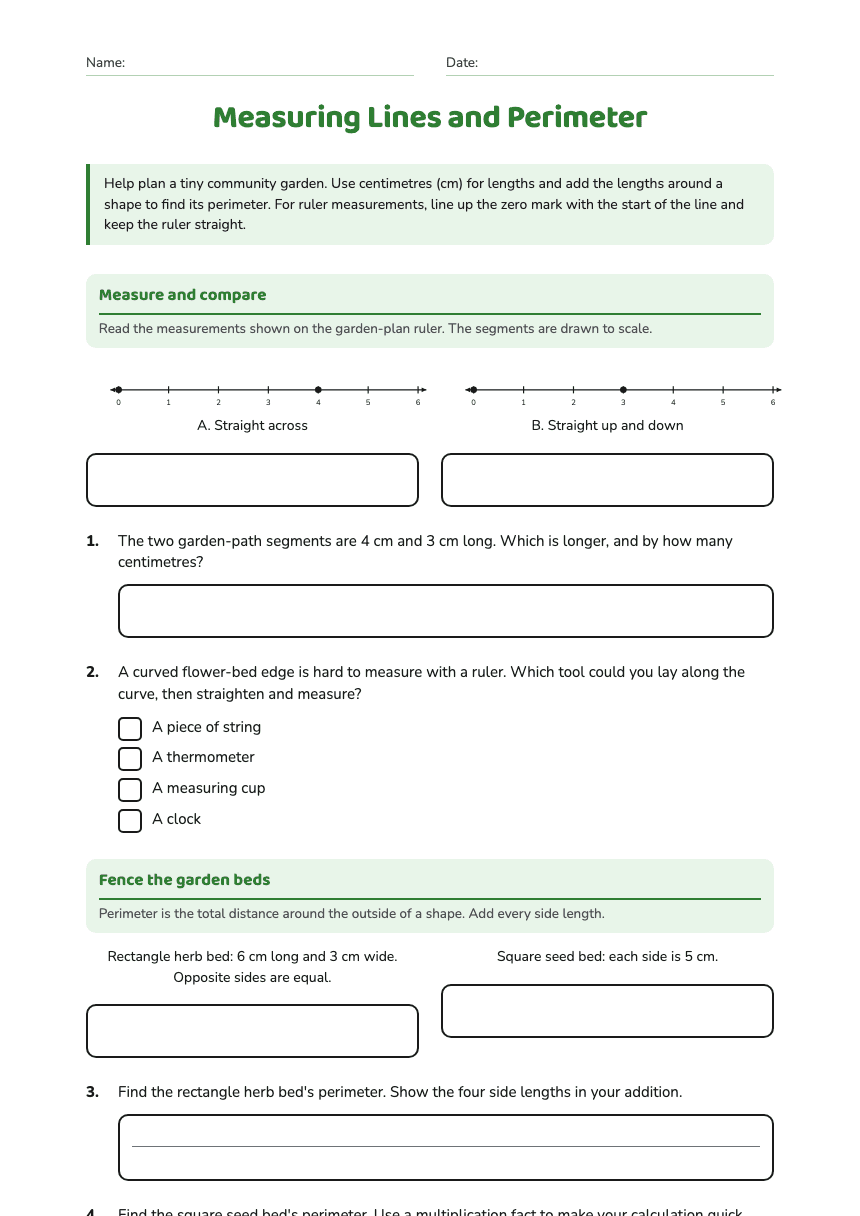
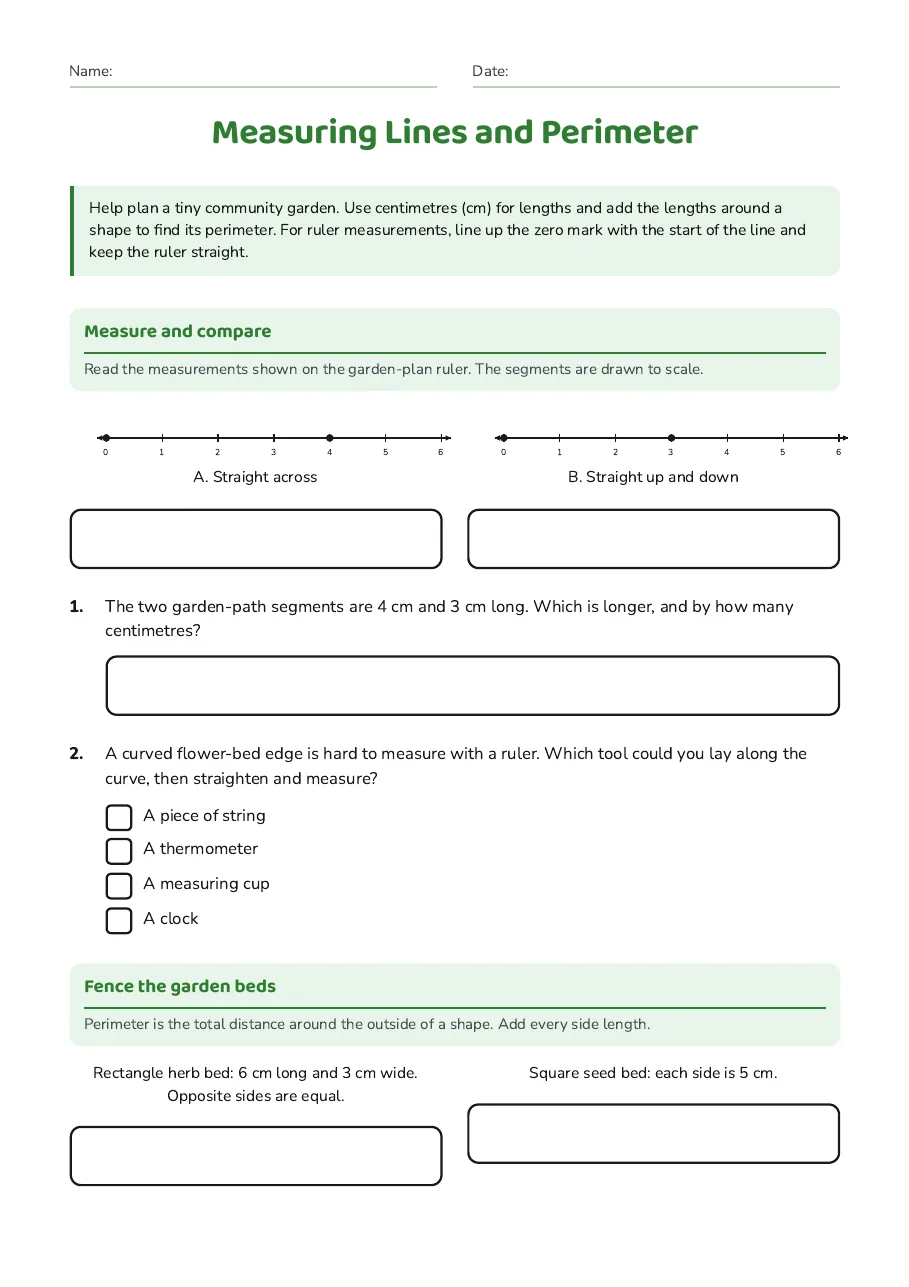
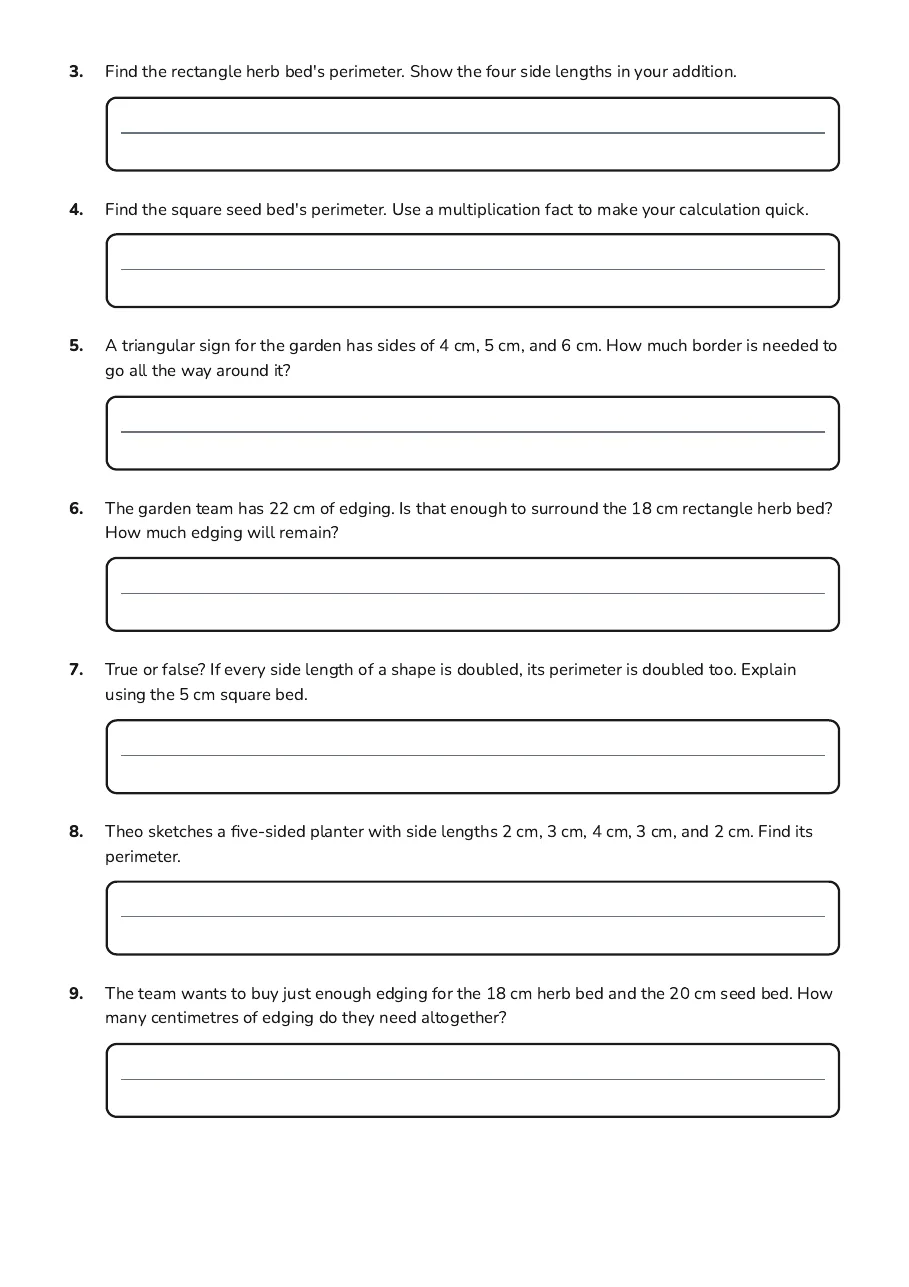
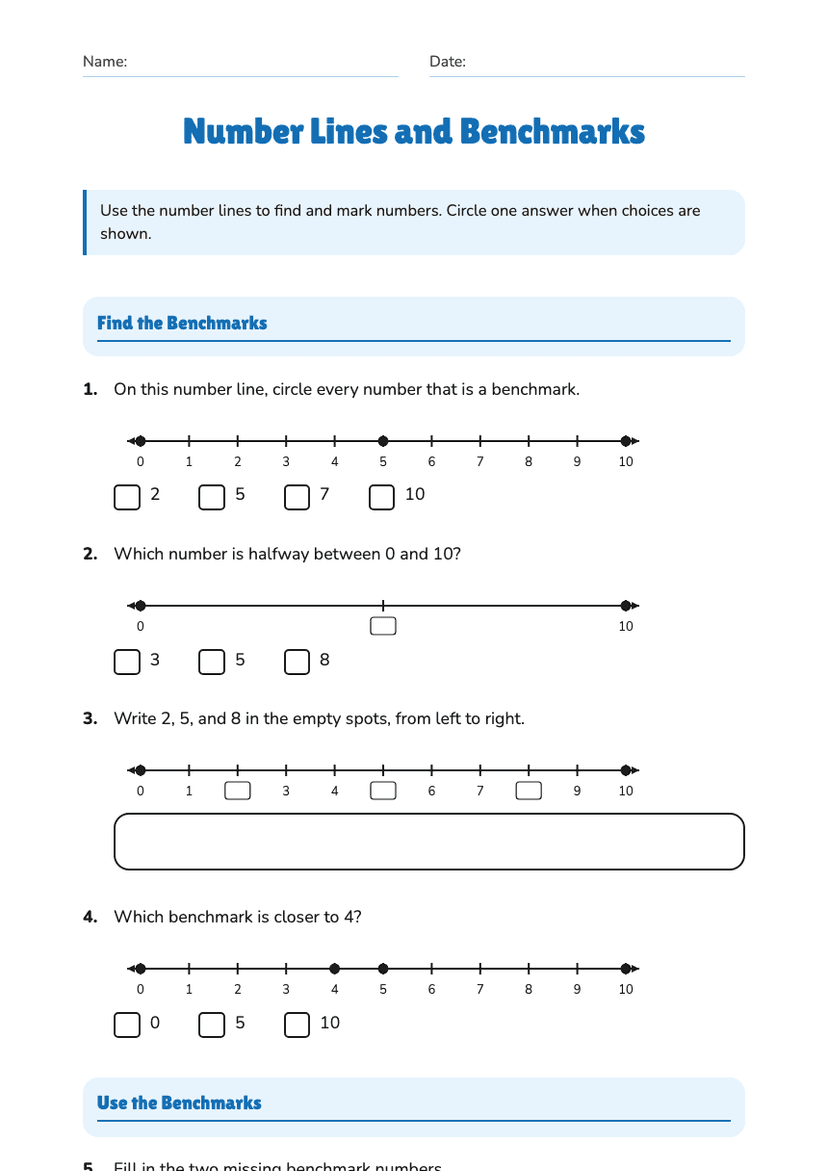
Measuring Lines and Perimeter worksheet preview

Measuring Lines and Perimeter

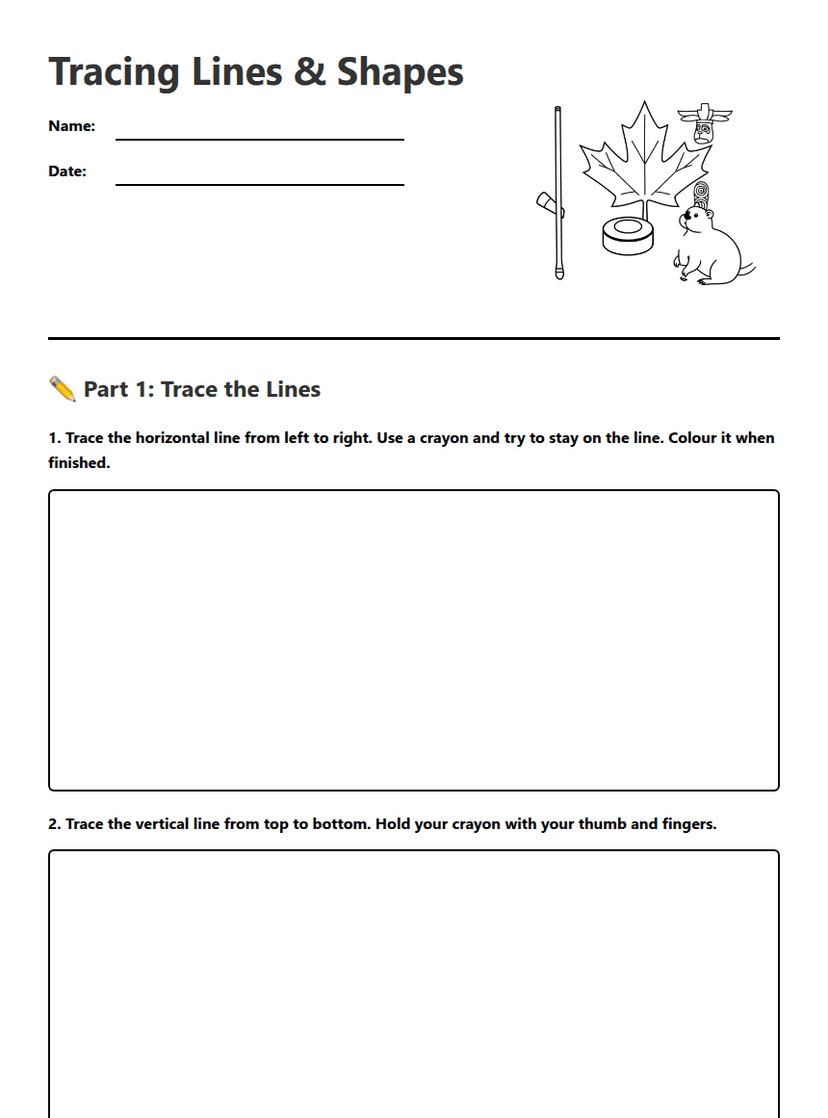
Ruler and measuring lines illustration

📋 Direction Card: How to Use Your Ruler

Follow these steps carefully before you begin measuring:

1️⃣ Place the zero end (0 cm) of your ruler exactly at the start of the line.

2️⃣ Keep the ruler straight and flat along the entire length of the line.

3️⃣ Look directly down from above — do not look at an angle.

4️⃣ Read the number where the line ends. Record in centimetres (cm).

5️⃣ If the line ends between two numbers, read to the nearest half centimetre (0.5 cm).

🔍 Control of Error Card

Use this checklist to check your own work:

  My ruler started exactly at 0 cm — not at the edge of the ruler.

  My ruler did not move or slip while I was measuring.

  I recorded the measurement to the nearest 0.5 cm.

  I wrote the correct unit (cm) after every measurement.

  I double-checked by measuring the line a second time.

💡 Tip for diverse learners: Use a coloured dot sticker to mark the start of each line before measuring!

📏 Part 1: Identify and Measure Lines

Use your ruler to measure each line segment below. Write the measurement on the blank. Then identify the type of line from the word bank.

Word Bank:   horizontal  |  vertical  |  diagonal  |  curved

1. Measure this line and identify its type.

⎯⎯⎯⎯⎯⎯⎯⎯⎯⎯⎯⎯

Measurement: _________ cm     Type of line: _________________________

2. Measure this line and identify its type.


Measurement: _________ cm     Type of line: _________________________

3. Measure this diagonal line and identify its type.


Measurement: _________ cm     Type of line: _________________________

4. Look at the curved line below. Estimate its length, then use a piece of string and your ruler to measure it.

∿∿∿∿∿∿

My estimate: _________ cm     Measured length: _________ cm

💡 Differentiation tip: Use a piece of string to trace the curved line, then measure the string with your ruler.

5. Which line in questions 1–3 is the longest? Which is the shortest?

Longest: Question _____     Shortest: Question _____

Difference in length: _________ cm − _________ cm = _________ cm

📐 Part 2: Calculate the Perimeter

Measure each side of the shapes below using your ruler. Add all the sides together to find the perimeter.

Remember: Perimeter = sum of all sides.   P = side + side + side + side

6. Measure the rectangle below and calculate its perimeter.

(Draw or trace a rectangle here if this is printed — measure each side with your ruler.)

Top: _______ cm    Bottom: _______ cm    Left: _______ cm    Right: _______ cm

Perimeter = _______ + _______ + _______ + _______ = _________ cm

7. Measure the triangle below and calculate its perimeter.

(Draw or trace a triangle here if this is printed — measure each side with your ruler.)

Side A: _______ cm    Side B: _______ cm    Side C: _______ cm

Perimeter = _______ + _______ + _______ = _________ cm

8. A square garden has one side that measures 6 cm on this diagram. What is its perimeter?

Perimeter = _________ cm

💡 Differentiation tip: Use the formula P = 4 × side for a square.

🌟 Extension Activity (Advanced Learners)

9. Draw your own irregular shape below using at least 5 straight sides. Measure each side and calculate the total perimeter. Show all your work.

Side measurements: _______ + _______ + _______ + _______ + _______ = _________ cm

10. CHALLENGE: If you doubled the size of your shape in Question 9, what would the new perimeter be? Explain how you know.

🔍 Control of Error Card: Perimeter

Use this checklist to verify your perimeter calculations:

  I measured every side of the shape — I did not skip any.

  I added all the sides together correctly. I can check with a calculator.

  My answer is written in centimetres (cm).

  For a rectangle, I checked: the two long sides are equal and the two short sides are equal.

  For a square, I checked: all four sides are equal, and P = 4 × one side.

💡 Peer check: Swap with a partner and re-measure one shape each to confirm your answers match!

💭 Part 3: Reflect and Connect

11. In your own words, explain the difference between a straight line and a curved line. Give one real-life example of each.
12. Where might you use perimeter in real life? Circle the best example.

Finding out how much fence you need around a yard

Measuring how heavy a backpack is

Checking the temperature outside

Counting the number of students in a class

💡 Differentiation note for teachers: For students needing support, provide a word bank, pre-drawn shapes with labelled sides, or allow use of a calculator for addition. For early finishers, assign the extension activity and challenge question above.

About This Worksheet

Free in Kuraplan

Sign up free, grab the PDF, and customize it for your class.

Print-Ready

Formatted for standard paper. Clean layout, easy to read.

AI-Generated

Created with Kuraplan's AI, designed for real classroom use.

For Teachers & Parents

Use in classrooms, for homework, tutoring, or homeschool.

Need a custom version of this worksheet?

Kuraplan's AI generates custom worksheets in seconds — differentiated for every learner, aligned to your curriculum.

Generate Custom Worksheets — Free
No credit card Curriculum-aligned Under 60 seconds