ScienceFreePrintable

Optics and Vision Worksheet

A free science worksheet ready for your classroom. Open in Kuraplan to grab the print-ready PDF, customize it for your students, or generate a fresh version in seconds.
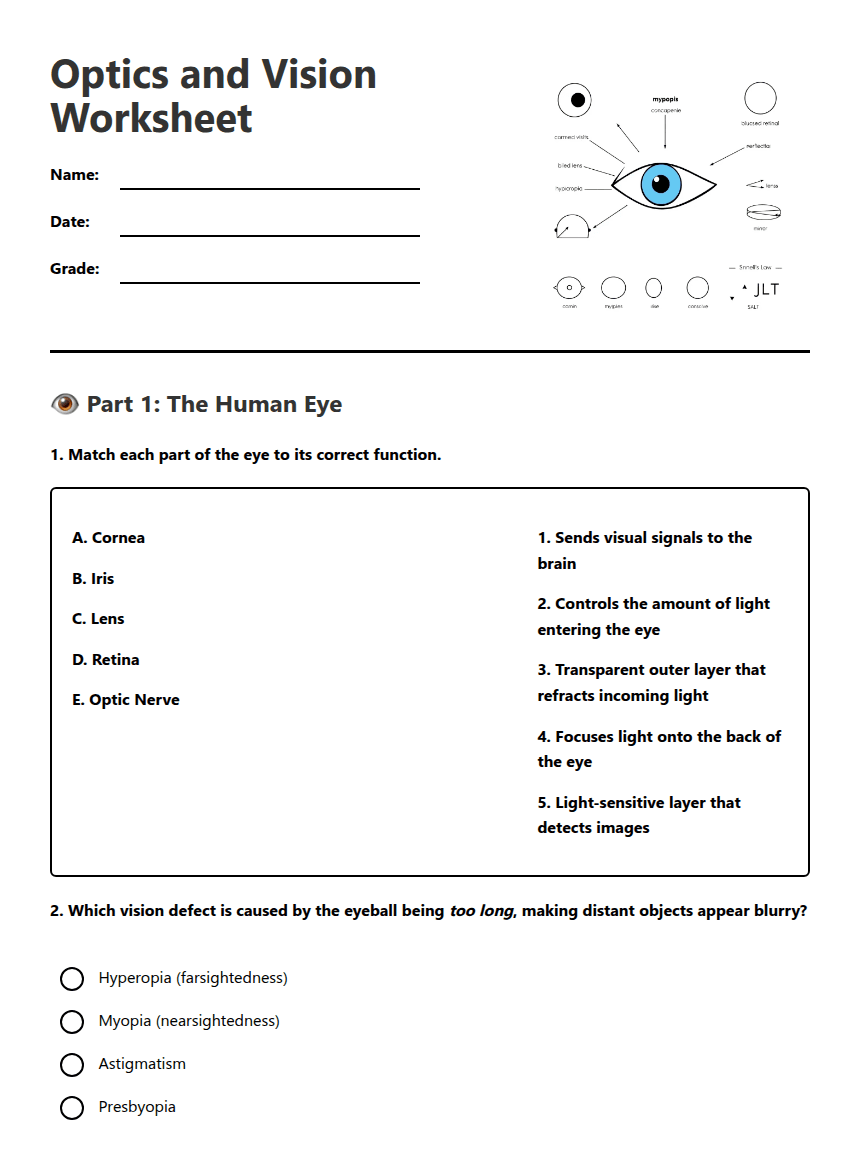
Optics and Vision Worksheet worksheet preview
Optics and Vision Worksheet

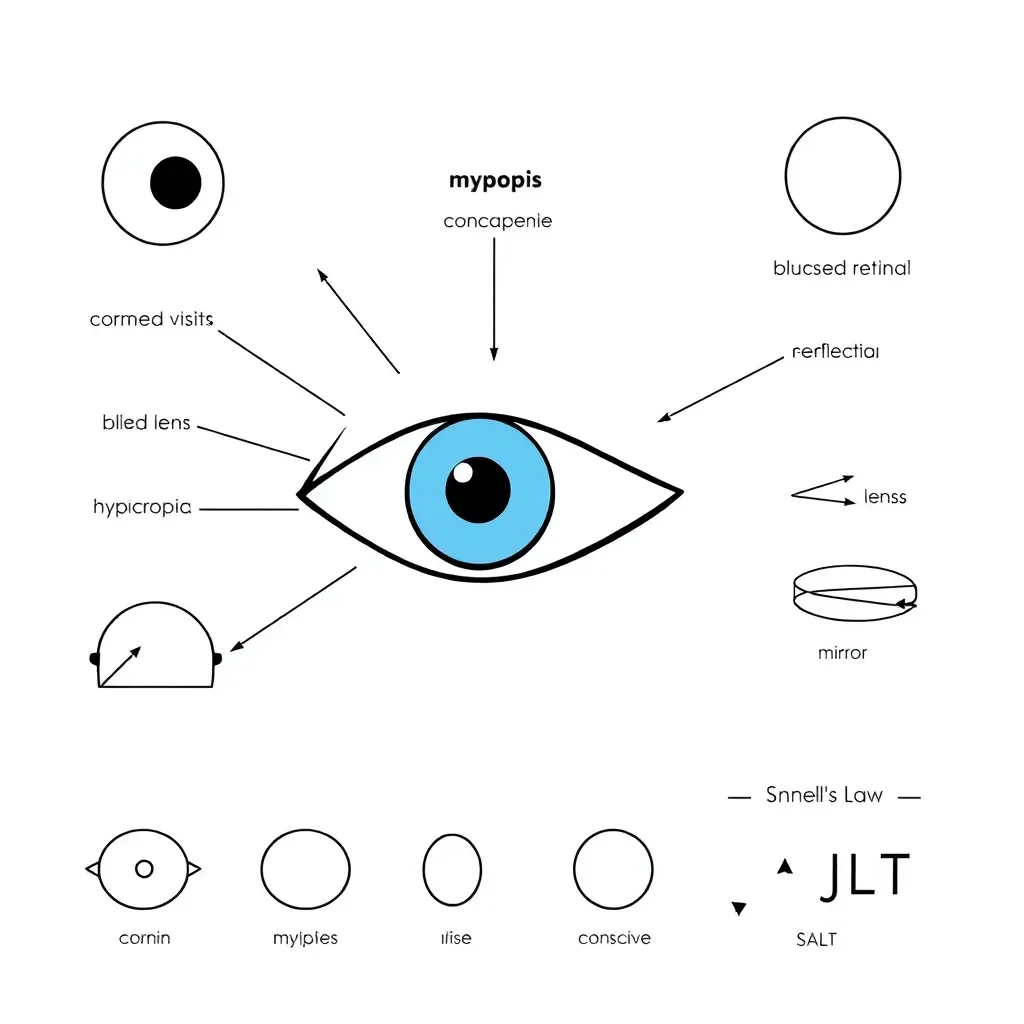
Diagram of the human eye and light refraction

👁️ Part 1: The Human Eye

1. Match each part of the eye to its correct function.
A. Cornea
B. Iris
C. Lens
D. Retina
E. Optic Nerve
1. Sends visual signals to the brain
2. Controls the amount of light entering the eye
3. Transparent outer layer that refracts incoming light
4. Focuses light onto the back of the eye
5. Light-sensitive layer that detects images
2. Which vision defect is caused by the eyeball being too long, making distant objects appear blurry?

Hyperopia (farsightedness)

Myopia (nearsightedness)

Astigmatism

Presbyopia

3. Astigmatism is caused by an irregularly shaped _______________. Instead of being perfectly round, the surface is more oval, causing light to focus at multiple points rather than one.
4. Select ALL vision defects that can be corrected using prescription lenses.

Myopia

Hyperopia

Astigmatism

Colour blindness

🔦 Part 2: Reflection and Mirrors

5. State the Law of Reflection in your own words.
6. Complete the sentence: The angle of incidence is always _____________ the angle of reflection, and both angles are measured from the _____________.
7. Match each mirror type to the correct description of the image it produces for an object placed beyond the focal point.
A. Plane Mirror
B. Convex Mirror
C. Concave Mirror
1. Virtual, upright, smaller — used in car side mirrors
2. Can produce real, inverted images — used in telescopes
3. Virtual, upright, same size as object
8. Use the SALT acronym to describe the image formed by a plane mirror.

Size: _______________________

Attitude (orientation): _______________________

Location: _______________________

Type (real or virtual): _______________________

🔬 Part 3: Refraction, Lenses, and Calculations

9. Which type of lens is used to correct myopia, and why?

Convex lens — it converges light to help focus images farther back on the retina

Concave lens — it diverges light so the focal point moves forward onto the retina

Convex lens — it makes objects appear larger

Concave lens — it increases the index of refraction

10. The index of refraction (n) of a material is defined as:

n = speed of light in a vacuum ÷ speed of light in the material

If the speed of light in glass is 2.0 × 10⁸ m/s, and the speed of light in a vacuum is 3.0 × 10⁸ m/s, calculate the index of refraction of the glass.

11. Using Snell's Law (n₁ sin θ₁ = n₂ sin θ₂), solve the following:

A ray of light travels from air (n = 1.00) into water (n = 1.33) at an angle of incidence of 30°. Calculate the angle of refraction. (sin 30° = 0.500)

12. A student places a candle 20 cm in front of a concave mirror with a focal length of 10 cm. Using the SALT acronym, predict and describe the image formed. Explain your reasoning.

About This Worksheet

Free in Kuraplan

Sign up free, grab the PDF, and customize it for your class.

Print-Ready

Formatted for standard paper. Clean layout, easy to read.

AI-Generated

Created with Kuraplan's AI, designed for real classroom use.

For Teachers & Parents

Use in classrooms, for homework, tutoring, or homeschool.

Need a custom version of this worksheet?

Kuraplan's AI generates custom worksheets in seconds — differentiated for every learner, aligned to your curriculum.

Generate Custom Worksheets — Free
No credit card Curriculum-aligned Under 60 seconds