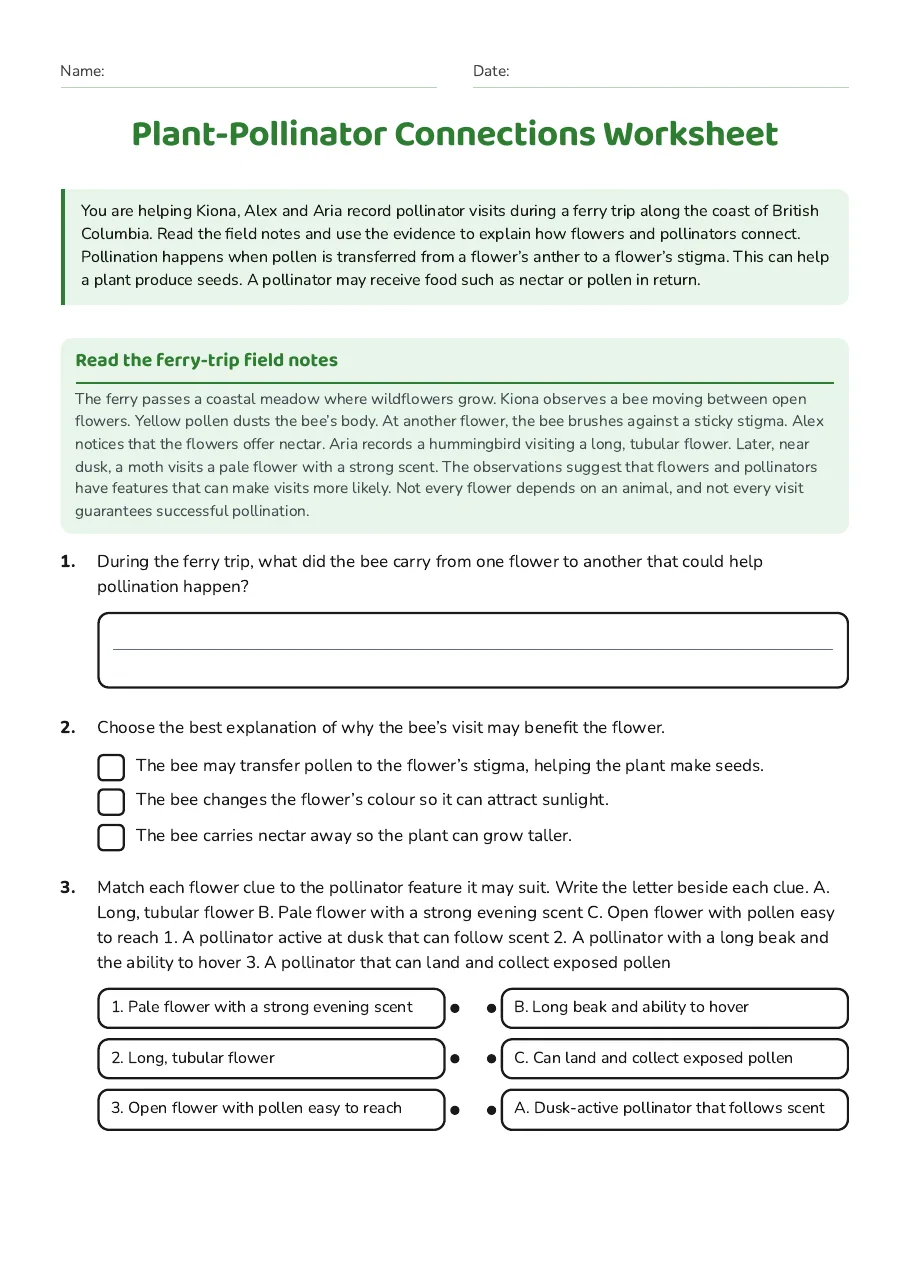
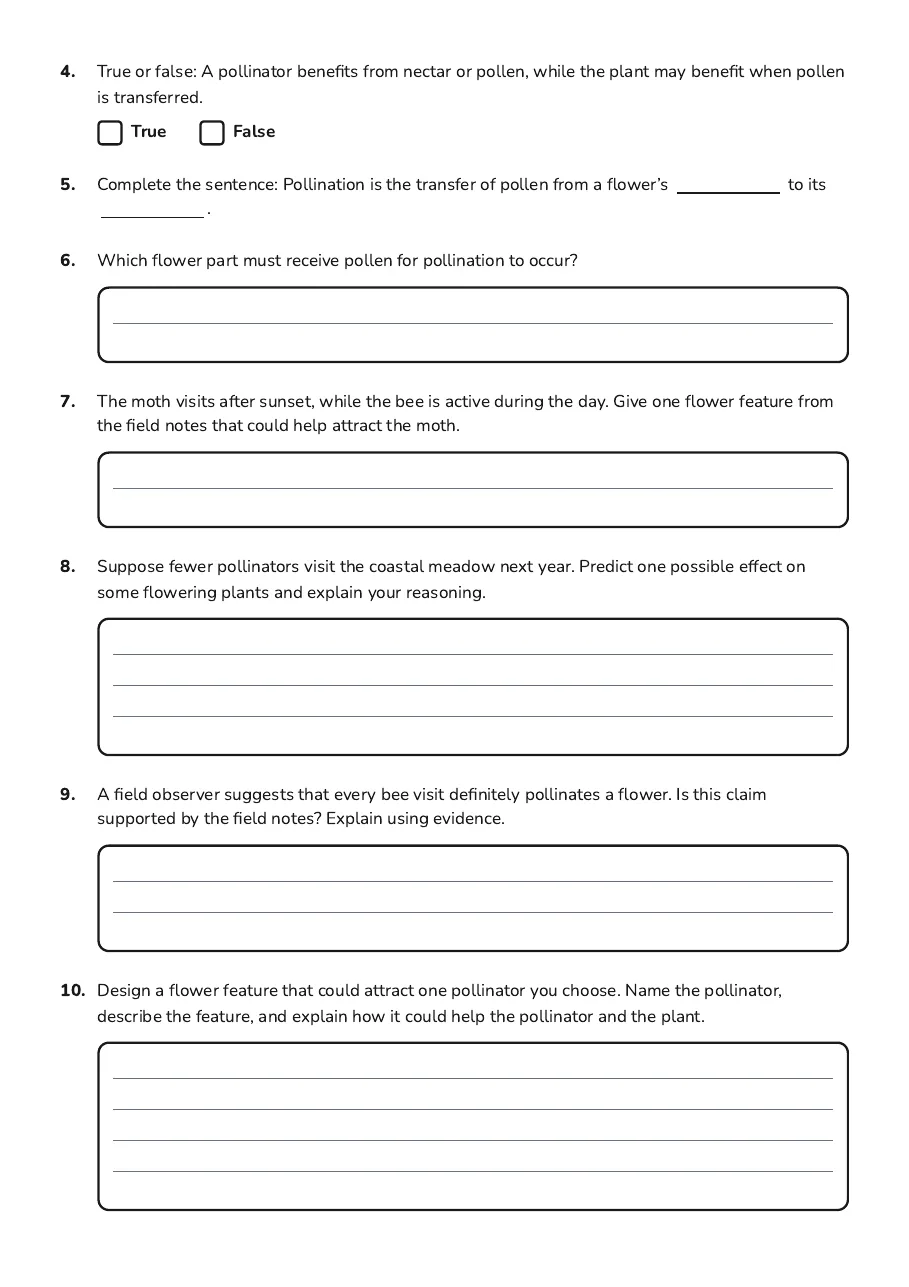
Plant-Pollinator Connections Worksheet
A free science worksheet ready for your classroom. Open in Kuraplan to grab the print-ready PDF, customize it for your students, or generate a fresh version in seconds.
Plant-Pollinator Connections
Botany — Montessori Work Cycle
🌸 Part 1: Plant-Pollinator Relationship Cards
Read each plant description card below. Then write the name of the matching pollinator on the line provided.
Pollinator: _______________________________
Pollinator Word Bank: Hummingbird | Moth | Honeybee | Fly | Bumblebee
🔗 Part 2: Matching Activity — Plant Features & Pollinator Adaptations
Draw a line from each plant feature on the left to the pollinator adaptation it matches on the right.
✏️ Part 3: Short Answer — Making Connections
Pair chosen: _______________________________
🌿 Extension Activity — For Advanced Learners
Complete this section if you have finished all other parts and want to explore further.
📋 Direction Card — How to Use This Material
Purpose: To understand the relationships between flowering plants and their pollinators, and to recognise how plant features and pollinator adaptations work together.
Materials needed: This worksheet, pencil, coloured pencils (optional for drawing activity), plant-pollinator reference cards (from your classroom shelf).
Steps:
1. Begin with Part 1. Read each plant description card carefully. Use the word bank to write the correct pollinator on the line. Take your time — look for clues in the description.
2. Move to Part 2. Use a pencil to draw lines connecting the plant feature on the left to the matching pollinator adaptation on the right. Each item has exactly one match.
3. Complete Part 3 in your own words. Write in full sentences. There is no single right answer — use what you have learned.
4. When finished, use the Control of Error Card to check your work in Parts 1 and 2.
5. If you would like a greater challenge, continue to the Extension Activity in Part 4.
Differentiation Strategies:
🟢 Emerging learners: Use the plant-pollinator picture reference cards from the shelf while completing Part 1. Focus on Parts 1 and 2 only.
🟡 On-level learners: Complete all three main parts independently. Use the reference cards only if needed.
🔵 Advanced learners: Complete all parts including the Extension Activity. Try Part 1 without the word bank first, then check your answers.
✅ Control of Error Card — Check Your Answers
Use this card ONLY after completing Parts 1 and 2. Cover the answers until you are ready to check.
Part 1 — Pollinator Answers:
1. Red tubular flower → Hummingbird
2. Night-blooming white flower → Moth
3. Ultraviolet-patterned flower → Honeybee
4. Dull purple, unpleasant odour → Fly
5. Large, sturdy, daytime flower → Bumblebee
Part 2 — Matching Answers:
Tubular red flower → Long beak and hovering flight
Sweet, strong night scent → Sensitive antennae for night navigation
Ultraviolet nectar guides → Eyes that see ultraviolet light
Rotting smell → Attracted to decaying matter
Large, open petals → Heavy body and strong grip
How did you do? If you made an error, return to your reference cards and find out why that match is correct. This is how we learn!
About This Worksheet
Free in Kuraplan
Sign up free, grab the PDF, and customize it for your class.
Print-Ready
Formatted for standard paper. Clean layout, easy to read.
AI-Generated
Created with Kuraplan's AI, designed for real classroom use.
For Teachers & Parents
Use in classrooms, for homework, tutoring, or homeschool.
Need a custom version of this worksheet?
Kuraplan's AI generates custom worksheets in seconds — differentiated for every learner, aligned to your curriculum.
Generate Custom Worksheets — FreeMore Science Worksheets
Danforth: Authority and Conscience
Free
Natural Resources Science
Free
Natural Resources Science
Free
Vitamins, Minerals, and Protein Science
Free
Exploring Science Materials
Free
Waka Buoyancy Science Worksheet
Free
Science Skills Made Simple
Free