You know the moment. You introduce an assignment you thought was clear, worthwhile, even engaging, and the room goes quiet in the wrong way. A few students ask questions that reveal they don't know where to start. A few more smile and nod, then turn in work that answers a different question than the one you asked. By grading time, you're staring at a stack of submissions and thinking, “This is not what I meant.”
Most assignment problems start long before students begin working. They start in the planning. Not because the task itself is weak, but because the blueprint is incomplete. The prompt makes sense in your head, but students can't see the map you used to build it.
That's why planning an assignment has to go beyond picking an activity and writing a rubric the night before. The strongest assignments are built backward, sequenced with care, and written so clearly that students know what the work is for, what they're supposed to do, and what success looks like before they begin. That's also where Transparent Assignment Design matters. It pushes us to plan from the student's point of view, not just the teacher's.
From Blank Stares to Breakthrough Moments
A teacher once showed me a project she was proud of. The topic was strong. The standards were there. Students had choice. On paper, it looked solid. In practice, it fell apart.
Some students wrote summaries instead of arguments. Others spent days making polished slides with almost no substance. A few capable students did decent work, but they all interpreted the task differently. The problem wasn't effort. It wasn't motivation either. The problem was that students didn't have a clear picture of the destination or the route.
That's common. Teachers often assume that if the assignment is interesting, students will figure out the rest. They usually won't. They need a purpose they can name, a process they can follow, and criteria they can use while working.
The assignment that seems obvious to the teacher is often full of invisible steps for the student.
When planning an assignment, I look for three failure points first:
- Fuzzy outcomes: Students can't tell what they're meant to learn.
- Mismatched tasks: The activity doesn't measure the skill you care about.
- Hidden expectations: Students only discover the true standard after they've been graded.
Fix those three things and the whole experience changes. Students ask better questions. Drafts come in closer to the mark. Grading gets faster because you're evaluating actual learning instead of decoding confusion.
Breakthrough moments usually don't come from a more creative prompt. They come from stronger design. Clear assignment planning gives students a way in, and it saves teachers from reteaching the task after it has already launched.
Start with the End What Do You Want Them to Know
Before writing directions, decide what students should know or be able to do when the work is finished. If that isn't precise, everything after it gets shaky.

A useful assignment starts with an explicit learning target. Not “research a topic.” Not “make a presentation.” Those are activities. The target is the learning underneath the activity. Maybe students need to compare sources, explain a scientific process, justify a solution, or develop an argument from evidence.
Guidance from Duke's statistics project instructions makes this practical. Students are told to start “as early as possible” and to think realistically about whether the design can be completed with the time and energy available, which reinforces that effective assignment planning works best as a mini project schedule with a clear topic, explicit objectives, and a timetable tied to the final output (Duke statistics project guide).
Write the objective before the task
If I'm coaching a teacher through planning an assignment, I ask for one sentence:
By the end of this assignment, students will be able to...
That sentence forces clarity. It also exposes weak design quickly. If the objective says students will analyze, but the task mostly asks them to collect facts, that mismatch shows up immediately.
A clean objective usually includes:
- The skill: analyze, explain, compare, justify, create
- The content: ecosystem changes, character motivation, linear relationships
- The evidence: using data, citing texts, showing reasoning, applying a method
For teachers who want a practical overview of how this works in day-to-day planning, this explanation of backward design in education is a helpful starting point.
Check the assignment the way a user would
One habit that improves assignments fast is testing them like a product. Not in a corporate way. In a classroom reality way. Ask: where will students get stuck, what will they misunderstand, and what assumptions am I making?
That mindset is similar to conducting effective user interviews. The core idea transfers well. If you ask real users clear questions, you learn where your design fails them. Students are the users of your assignment. Their confusion is feedback, not resistance.
After you write the objective, test it with three quick checks:
- Can a student restate the goal in plain language
- Does the task produce evidence of that goal
- Can it realistically be completed with the time and supports available
That third question matters more than teachers admit. Ambitious assignments often fail because they ask for research, collaboration, drafting, visuals, and presentation in a window that only supports half of that work.
A short explainer can help teachers think through this planning move before drafting the prompt:
When the end point is clear, later decisions get easier. You're not just assigning work. You're designing evidence of learning.
Design the Yardstick How You Will Measure Success
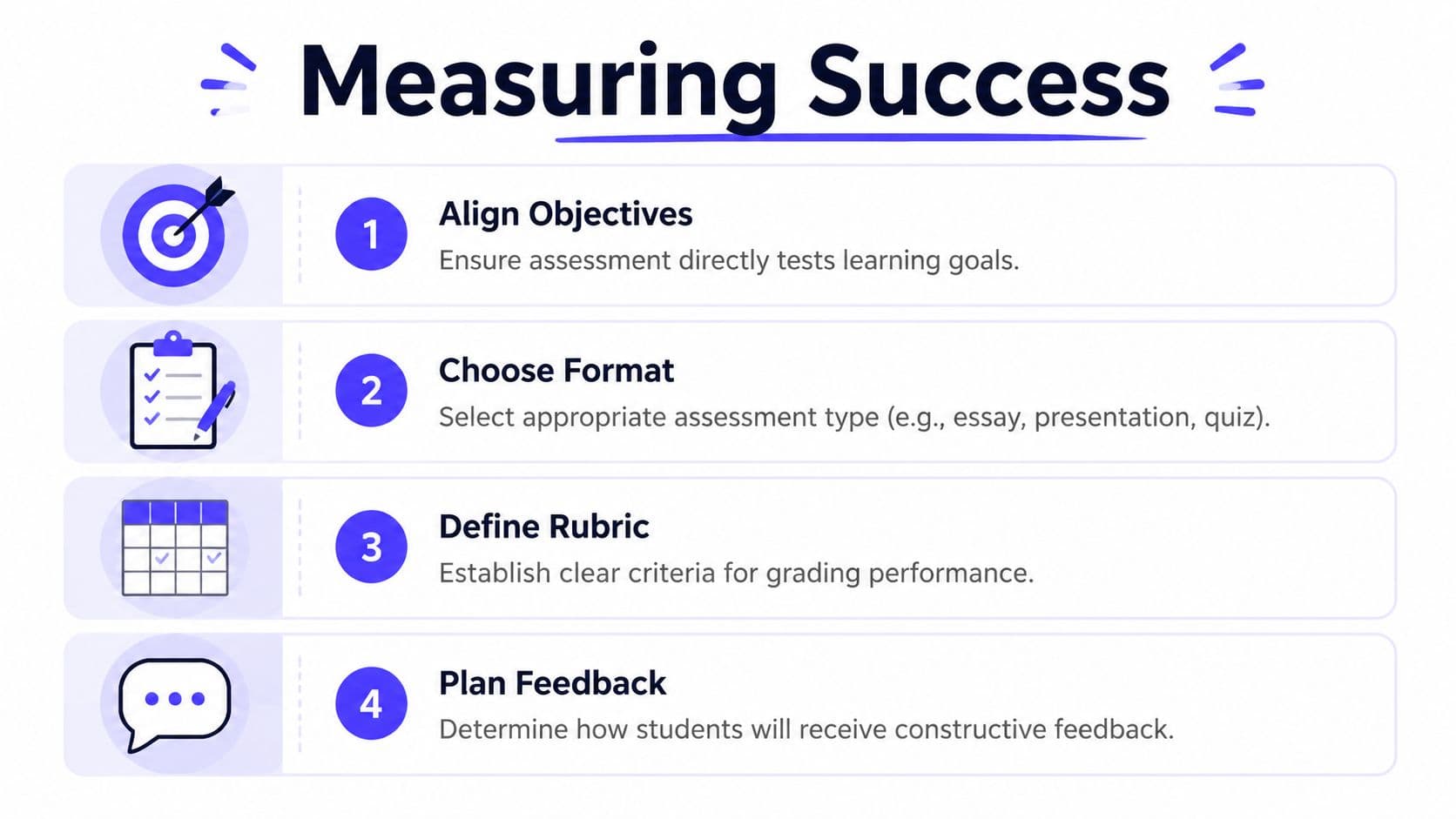
Once the objective is solid, the next question is simple. What kind of work would prove that students learned it?
That answer should shape the format. If students need to interpret evidence and build a claim, a selected-response quiz won't tell you enough. If they need fluency with a process, a polished poster may hide weak thinking. The format has to fit the learning.
In many formal education settings, instructors require students to submit a plan before the final product, which signals that planning is part of the assessed work itself. The same University of Michigan writing guidance also shows how grading can weight discussion and conclusion at 50% and clarity or visual presentation at 10%, which is a reminder that planning affects not only content but also interpretation and presentation (University of Michigan statistics writing tips).
Match the format to the thinking
A quick way to decide is to ask what students must do.
| Learning need | Better assessment match | Usually weaker match |
|---|---|---|
| Build an argument | Essay, seminar, evidence-based response | Basic worksheet |
| Explain a process | Lab write-up, annotated diagram, oral explanation | Decorative slideshow |
| Compare perspectives | Source analysis, discussion, comparative writing | Fact-recall quiz |
| Apply a method | Problem set with reasoning, demonstration | Generic reflection |
Teachers sometimes choose a format because it sounds engaging. Students then spend most of their energy on design choices, tech tools, or surface features. If the target is academic reasoning, the format should make that reasoning visible.
Build the rubric early
The rubric shouldn't be the last thing you slap on before uploading the assignment. It should be built alongside the task, because it tells students what quality looks like while they're still working.
A strong rubric does four things well:
- Names the criteria clearly: thesis, use of evidence, reasoning, organization, conventions
- Uses student-friendly language: avoid vague labels that only make sense to adults
- Separates traits: don't bury analysis, accuracy, and presentation inside one line
- Describes performance levels concretely: show what “meets” looks like in observable terms
Practical rule: If a student can't use your rubric to improve a draft, it's not finished yet.
That's why I prefer rubrics with short, plain descriptors over dense academic wording. Students don't need elegant rubric language. They need usable language.
If you want a faster starting point, a tool like Kuraplan's rubric generator can help draft criteria that teachers can then tighten to match the assignment and classroom expectations.
A useful final check is this: hand the assignment and rubric to a colleague and ask what kind of student work they think would earn a strong score. If their answer doesn't match yours, students don't have a fair shot either.
Build the Bridge Scaffolding and Sequencing Activities
Big assignments don't usually fail at the end. They fail in the middle, when students lose the thread.
A student starts with a decent idea, picks weak sources, misreads the task, or spends too much time on one piece and not enough on another. By the time the teacher sees the final product, the problem has been building for days. Good planning an assignment means creating checkpoints before that happens.
Research guidance on assignment planning points to a common pitfall: students often jump into analysis before the research question is precise. The same guidance recommends deconstructing the task into a checklist of requirements, including the deliverable, word count, and rubric criteria, because that makes the work more efficient and prevents rework (research planning guidance).
Break the work into visible stages
Most students don't need a simpler assignment. They need a clearer path through a complex one.
A workable sequence often looks like this:
- Clarify the question: Students rewrite the prompt in their own words and identify the end product.
- Gather the raw material: notes, sources, examples, data, or text evidence.
- Shape the thinking: outline, planning sheet, claim-evidence pairing, model response.
- Test a draft: peer review, conference, self-check against rubric.
- Revise toward submission: not just edit for neatness, but improve the substance.
Each stage gives you a chance to catch the wrong turn early. That matters far more than writing “see me if you need help” on the handout.
Sequence for confidence, not just coverage
Teachers sometimes build the lead-up to an assignment around content coverage alone. Students read, discuss, and take notes, but the support activities never rehearse the kind of thinking the assignment requires.
That's where sequencing matters. If the final task asks students to compare claims across sources, they should practice comparing claims across sources before the final week. If they need to present an explanation, they should rehearse verbal explanation in low-stakes settings first.
Students rarely struggle because they skipped straight from easy work to hard work. They struggle because the middle steps were invisible.
This is also one of the few places where planning tools can save real time. If a teacher already knows the summative task, an AI planning tool can help draft a sequence of mini-lessons, checkpoints, and formative tasks leading up to it. Kuraplan, for example, can generate standards-aligned lesson sequences, worksheets, and assessment supports from a unit topic, which is useful when you need the assignment pathway, not just the final prompt.
The assignment should feel like the last step in a chain, not a surprise event at the end of a unit.
Plan for Everyone Differentiation as a Default
Differentiation works best when it starts in the planning, not when it's added after students begin struggling. Retrofitting support is slower, messier, and usually less effective. Teachers end up rewriting directions, adjusting materials under pressure, and creating one-off fixes that don't hold up next time.
A better move is to assume from the start that students will need different entry points, different supports, and sometimes different ways to show the same learning. That doesn't mean building separate assignments for every learner. It means designing enough flexibility that more students can access the task without constant rescue.
Three places to build flexibility
Content can vary without changing the target. One group may work with a more accessible text set, another with more complex sources. In math or science, some students may need guided examples before independent application.
Process can flex too. Some students think best through discussion. Others need quiet drafting time, sentence stems, graphic organizers, or a checkpoint calendar. Those aren't extras. They are design choices that remove friction.
Product is where many teachers find quick wins. If the learning goal is argument or explanation, students may be able to show that through writing, a recorded oral response, a presentation, or another structured format. The standard stays fixed. The route can vary.
Planning this way often reduces workload
Teachers sometimes resist differentiation because they picture thirty separate lesson plans. That's not the job. The job is to identify where choice is possible and where consistency is necessary.
Here are the trade-offs I've seen most often:
- Same goal, varied support: Easier to manage and usually the most sustainable model.
- Same task, no flexibility: Efficient up front, but often creates confusion and reteaching later.
- Too much open choice: Looks student-centered, but can overwhelm students who need more structure.
For classrooms where audio capture, notes, and accessibility supports help students participate more fully, teachers may find useful options in this roundup of top tools for students and professors.
If you want a practical frame for designing levels of challenge without losing the common objective, this article on tiered instruction is a solid reference.
The simplest test is this: if a student struggles, can you point to a planned support already built into the assignment? If the answer is yes, your design is doing its job.
Write for Clarity The Art of Student-Facing Instructions
A well-planned assignment can still fail if the handout is vague. In such cases, strong ideas often break down. The teacher has the objective, the sequence, and the rubric. The student gets a page full of school language and guesses what matters most.
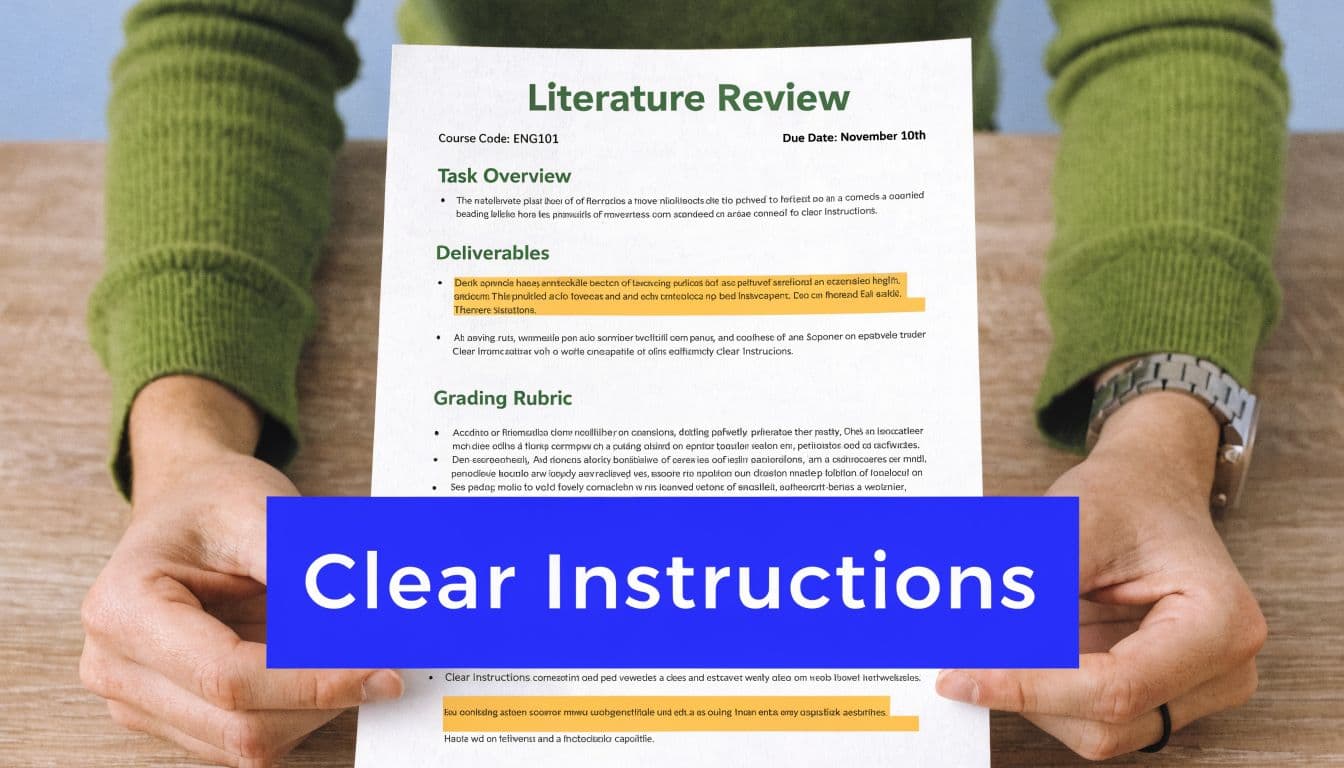
Transparent Assignment Design fixes that by making three things explicit: purpose, tasks, and criteria. Research on transparent design shows that when instructors clearly explain those elements, students, especially those from underserved backgrounds, report higher academic confidence and a stronger sense of belonging (Transparent Assignment Design workshop handout).
Write the handout students actually need
Most assignment sheets over-explain the background and under-explain the task. Students need direct language first.
A clear handout usually answers these questions in order:
- Why are we doing this
- What exactly do I need to do
- What steps should I follow
- What does strong work look like
- When is each part due
That structure matters. If students know the purpose, they're more likely to invest effort. If they know the steps, they're less likely to freeze. If they know the criteria before they begin, they can monitor themselves while working.
Use visible supports, not hidden expectations
The strongest student-facing instructions include practical supports that many teachers still leave out:
- A checklist of requirements: deliverable, format, materials, due date, submission method
- An exemplar or model: not to be copied, but to show quality and structure
- Plain-language verbs: explain, compare, defend, identify, cite
- A brief note on common mistakes: weak evidence, summary instead of analysis, unclear claim
Good instructions don't make an assignment easier. They make the target visible.
I also recommend reading your assignment sheet out loud. Anywhere you stumble, students will stumble too. Anywhere you use a word like “discuss,” “explore,” or “reflect,” ask whether that verb is precise enough to produce the work you want.
One more test helps: remove yourself from the equation. Could a student who missed the verbal explanation still complete the assignment successfully using the handout alone? If not, the handout isn't ready.
Clarity is not hand-holding. It's equitable design. Students should spend their effort on the thinking the assignment requires, not on deciphering what the teacher meant.
Frequently Asked Questions About Assignment Planning
A few questions come up every time teachers revisit planning an assignment. Most of them aren't about theory. They're about time, workload, and whether better design is worth the effort.
For teachers who want to make their support pages easier to scan and more useful to families or students, this practical guide to creating effective FAQs is worth a look.
FAQ on Assignment Planning
| Question | Answer |
|---|---|
| How far ahead should I plan a major assignment? | Earlier than feels convenient. Strong assignments need time for task design, sequencing, and revision. If the work involves research, multiple steps, or collaboration, planning late usually means students get a rushed version of the task. |
| Should I create the rubric first or the prompt first? | Draft them together. If you write the prompt first and leave the rubric until later, you'll often discover that the task and criteria don't match. |
| How many checkpoints are enough? | Use enough checkpoints to catch predictable mistakes before final submission. Most projects need at least a planning step, a thinking step, and a feedback step. |
| What if students still seem confused? | Assume the instructions need tightening before assuming the students weren't listening. Ask a student to explain the task back to you. Their version will show where the wording broke down. |
| Is it okay to reuse assignments? | Yes, if you revise them. Keep a template, but update the wording, examples, supports, and rubric notes based on what happened last time. |
| Can technology help without taking over the process? | Yes. Use tools to speed up structure, not to replace judgment. Templates, peer review forms, calendar tools, and planning platforms can all reduce prep time if the learning target is already clear. |
A practical routine helps more than inspiration does. Keep a reusable planning template. Save strong exemplars. Ask a colleague to sanity-check the prompt before launch. Build one reflective note for yourself after grading so next year's version starts better than this year's.
If you want a faster way to turn learning goals into sequenced lessons, rubrics, worksheets, and student-friendly materials, Kuraplan is worth exploring. It's built for K–12 educators who need standards-aligned planning support without spending their evenings formatting documents from scratch.