3D Shapes: Year 4 Explorer
Discovering the world of three-dimensional shapes Learning about prisms, pyramids, and other solids Understanding properties and attributes

What are 3D Shapes?
3D shapes are solid objects with length, width, and height They take up space in the real world We can hold them and walk around them Different from flat 2D shapes

Cube
6 square faces that are all the same size 12 edges (lines where faces meet) 8 vertices (corners where edges meet) All edges are the same length

Rectangular Prism (Cuboid)
6 rectangular faces 12 edges of different lengths 8 vertices Opposite faces are identical rectangles

Triangular Prism
2 triangular faces (bases) 3 rectangular faces (sides) 9 edges total 6 vertices

Cylinder
2 circular faces (top and bottom) 1 curved surface connecting the circles No edges or vertices Rolls smoothly

Cone
1 circular face (base) 1 curved surface that comes to a point 1 vertex at the top No edges

Sphere
1 curved surface all around No faces, edges, or vertices Perfectly round in all directions Rolls in any direction

Square Pyramid
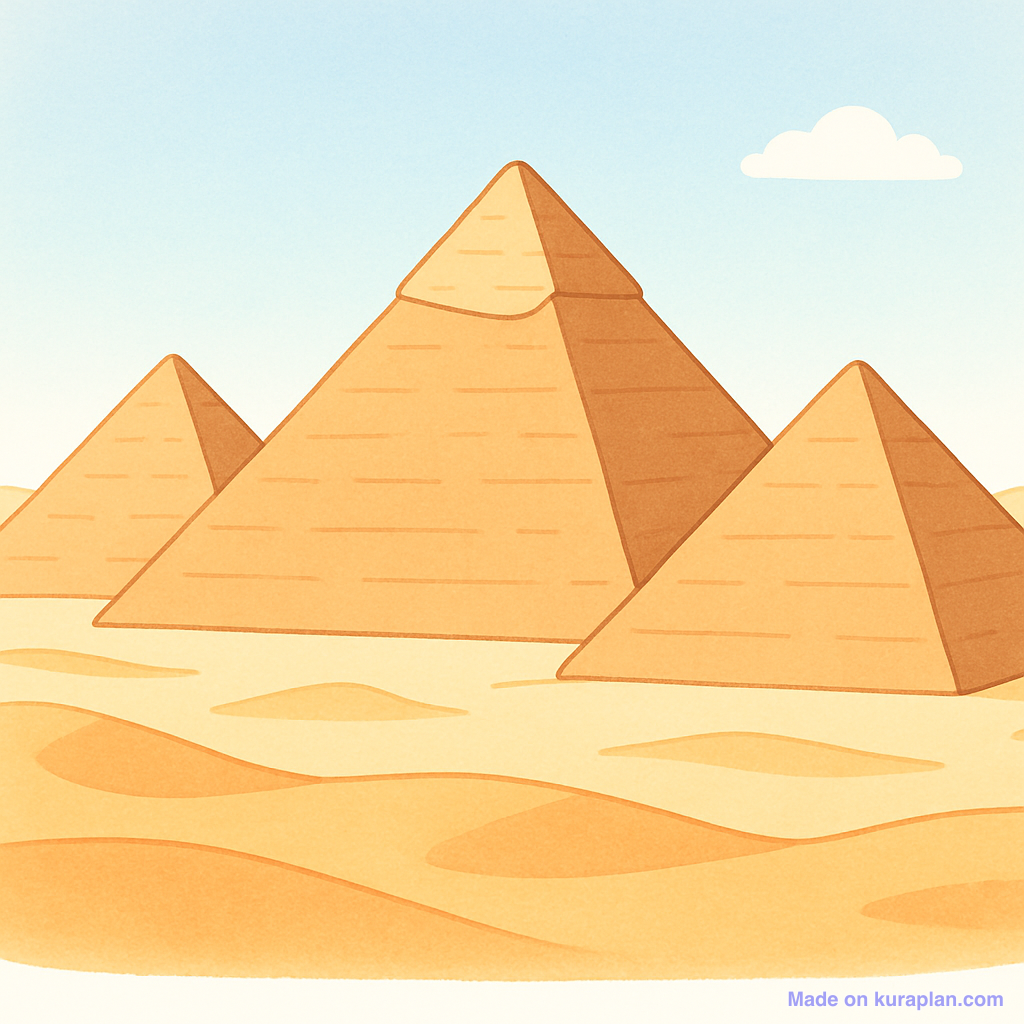
1 square base 4 triangular faces meeting at the top 5 faces total 8 edges and 5 vertices

Triangular Pyramid (Tetrahedron)
4 triangular faces 6 edges 4 vertices All faces are triangles

Shape Detective Challenge
Look around the classroom Find one example of each 3D shape Draw or write what you found Share your discoveries with a partner

Prisms vs Pyramids
{"left":"Prisms have two identical end faces\nPrisms have rectangular side faces\nExamples: cube, rectangular prism, triangular prism","right":"Pyramids have one base\nPyramids have triangular faces meeting at a point\nExamples: square pyramid, triangular pyramid"}
2 more slides available after you open the deck.
Download all 14 slidesMore Mathematics slide decks
Other ready-to-teach mathematics decks for New Zealand classrooms.


Free Pyramids images
Drop these illustrations straight into your lesson.